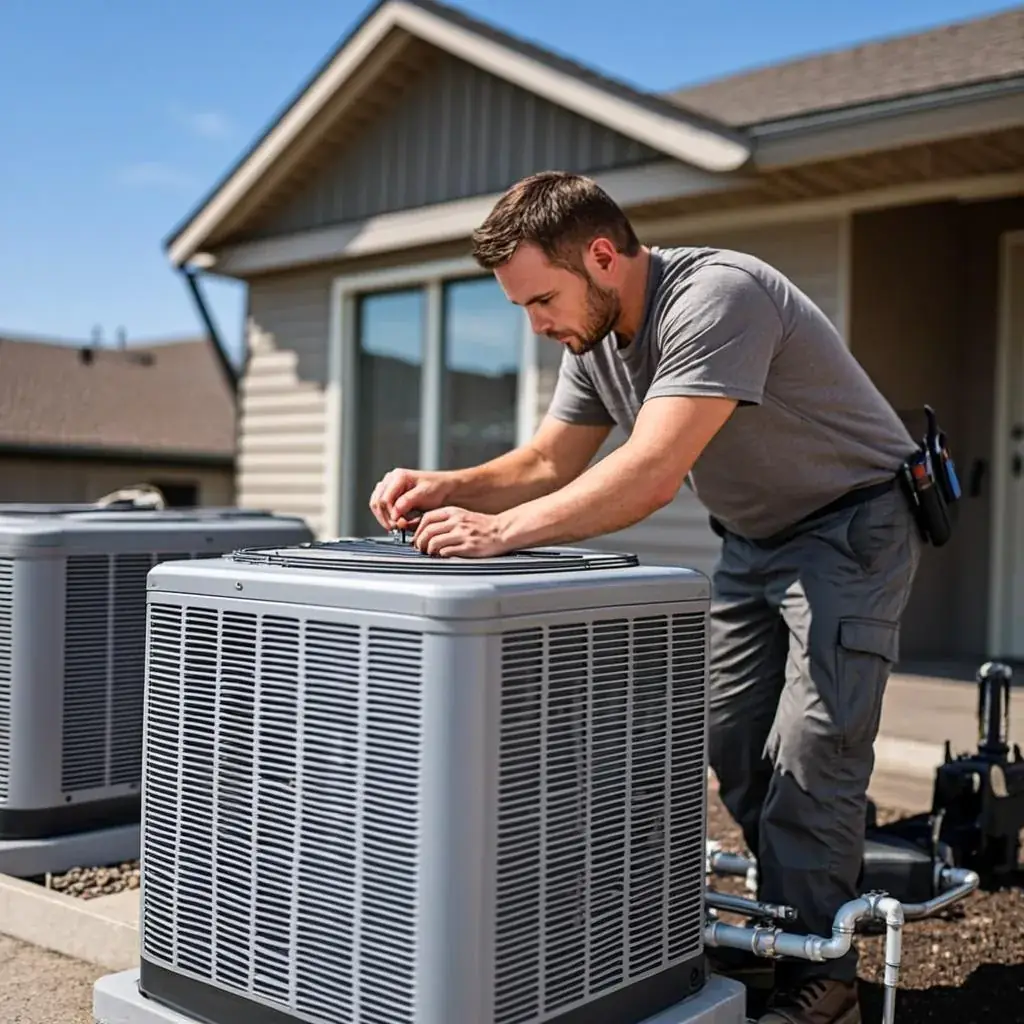
The Honest Answer Up Front
Here is the short version we give at the kitchen table after 12,000-plus jobs across Metro Vancouver since 2010: your air conditioner needs one proper look every spring, about an hour of your own attention on the homeowner half of the checklist, and a repair call the moment it behaves strangely rather than after the third retry. That is the whole discipline. There is no monthly ritual, no chemical treatment, and no subscription box that substitutes for it.
What that modest routine buys is disproportionate. BC air conditioners live a strange life compared with their cousins in Phoenix or Toronto: they sit silent from October to May while coastal dampness works on their capacitors and contacts, then get asked to run nearly continuously through a heat dome with overnight lows above 20°C. The parts that fail on the first hot weekend, capacitors, contactors, clogged condenser coils and tripped condensate floats, are exactly the parts a spring check inspects, cleans and measures. We know because those are the calls we answer in July, and the story is nearly always "it ran fine last year."
This guide walks all twelve points, split honestly between the six you can do yourself this weekend and the six that belong to a licensed technician with gauges and a meter. It ends with the cost math, the regional calendar we actually recommend to customers from Vancouver to Abbotsford, and the cheat sheet to photograph before the first heat warning. If your system is already blowing warm air, skip straight to our troubleshooting-first approach in the AC installation and service guide, then come back here to keep the problem from returning.
The most expensive words in BC cooling are "let's see if it does it again." Every hard start on a weak capacitor and every restart on a frozen coil is damage with compounding interest. Maintenance is mostly the discipline of stopping early.
0 jobs since 2010
Heating, cooling and plumbing jobs completed by our Red Seal team across Metro Vancouver and the Fraser Valley.
0 diagnostic, credited
When a spring check turns up a real fault, the flat diagnostic fee is credited in full toward the repair.
0 star rated
From 512 verified reviews, earned one flat-rate invoice and one honest recommendation at a time.
0 on workmanship
Repairs and installs carry a 2-year workmanship warranty, under BC licence BC-PL-2019-4421 with $2M liability coverage.
Why Spring Is the AC Season in BC
Timing is the whole trick of cooling maintenance in this region, and the local calendar sets it. Metro Vancouver's real cooling season is short and violent: a handful of heat warnings between late June and mid-August, each capable of pushing the South Coast into the high thirties, separated by long mild stretches that let everyone forget their system exists. The maintenance window is April to early June, before the first heat warning, when appointment slots are open and a discovered fault can be fixed at weekday pricing instead of on the hottest day of the year with the whole region's compressors failing in a wave.
The idle season is harder on equipment than the running season. From October to May the outdoor condenser sits in everything this climate drops on it: cottonwood fluff in May, maple seeds and cedar pollen through spring, Douglas fir needles year-round, and the slow green film that coastal dampness grows on anything shaded. A condenser coil fouled with organic mat cannot reject heat, which raises head pressure, which raises current draw, which is precisely how a healthy capacitor gets worked to death. All of that is washable and inspectable in April.
Indoors, the story is dampness and stillness. Electrical contacts oxidize in humid air, blower bearings dry out, and the condensate drain, which carries litres a day in July, has had seven months to grow the algae mat that trips the float switch on the first cold call for cooling. Furnace filters, meanwhile, finished their winter loaded with the season's dust, and a loaded filter in cooling mode chokes airflow across the evaporator coil, the direct cause of the frozen-coil calls we answer every July. The heat dome preparedness guide covers the household plan; this checklist is the equipment half.
One more reason spring matters: it is the honest season for decisions. A system that enters June with verified pressures, clean coils and healthy electrics is one you can trust through a heat dome. One that enters June with a slow leak and a tired capacitor is a system you want to know about while you still have weeks to weigh a repair against a replacement at your leisure, not hours, at midnight, in a 31°C bedroom. That is the real product of maintenance: information, delivered early enough to act on calmly.
The 12-Point Checklist at a Glance
Six points are homeowner territory and six belong to a licensed technician. The order matters: the homeowner six cost you an hour in April and prevent or reveal most of the common summer failures, and the professional six measure the things none of your senses can, pressures, temperatures, amperage and refrigerant charge.
| Point | Who | Why it matters in a BC summer |
|---|---|---|
| 1. Filter change before cooling season | You | A winter-loaded filter chokes the evaporator; restricted airflow is the frozen-coil factory |
| 2. Condenser clearance check | You | Two feet of clear space on all sides; shrubs, stored items and dryer vents kill heat rejection |
| 3. Condenser fin wash, inside out | You | Cottonwood fluff and fir needles come out with a garden hose, gently, in the reverse direction of airflow |
| 4. Condensate drain flow check | You | Pour a cup of water into the primary drain pan or trap and watch it leave; a float switch trip kills cooling instantly |
| 5. Thermostat cool test | You | One full cycle on the first warm day confirms the chain while failure is still a small repair |
| 6. Listen and look cycle | You | New noises, hard starts, water on the floor: the symptoms worth stopping at, not retrying |
| 7. Refrigerant pressures and temperature split | Pro | Verified against the rating plate; the only honest way to know charge level and capacity |
| 8. Contactor and capacitor inspection | Pro | Pitted contacts and weak capacitance are the two quiet pre-failures behind most first-hot-day calls |
| 9. Professional coil cleaning | Pro | Deep fin cleaning and straightening, plus the indoor coil inspection a homeowner cannot reach |
| 10. Blower and airflow verification | Pro | Measured airflow confirms the filter habit and flags blower wear while it is still cheap |
| 11. Electrical and safety checks | Pro | Amperage draw, wire connections, breaker condition: the coast's damp idle season shows up here |
| 12. The written record | Pro | Numbers year over year are how slow declines and slow leaks get caught before they cost compressors |
Points 1 through 6 are the weekend project in Chapter 4, point by point. Points 7 through 12 are what our technicians arrive with gauges and meters to do, and Chapter 5 explains each one so a tune-up report can never be a mystery document. Together they cover nearly every failure mode behind the emergency calls we answer between the first heat warning and Labour Day.
The Six You Can Do Yourself This Weekend
None of these involve refrigerant, sealed electrical cabinets or anything requiring a licence. Together they take about an hour, cost nothing but a filter, and either confirm the system is ready or hand you a specific observation to hand us when you call, which shortens every diagnosis that follows.
Start the season on a fresh filter
Whatever your filter schedule was in winter, cooling season resets it: a loaded filter in cooling mode is a frozen evaporator waiting for the first long hot run. Write the date on the new filter's frame, and during wildfire smoke weeks, treat it as done early regardless of the calendar.
Give the condenser its space back
Trim shrubs and pull stored items back to at least two feet of clearance on every side, and confirm the unit still sits level. A condenser that recirculates its own hot exhaust air loses capacity exactly when you need it most, and the corner where it lives fills in quietly over a wet winter.
Wash the coil, inside out
With the disconnect off, hose the condenser coil gently in the direction opposite to the fan's airflow, so the fluff you cannot see between the fins gets pushed back out the way it came. No pressure washer, no wire brush, no coil acid from a hardware shelf; bent fins block more airflow than the dirt did.
Prove the condensate drain flows
Find the drain at the indoor unit and pour a cup or two of water slowly into the trap or primary pan. It should leave promptly and appear at the floor drain or exterior termination. A seven-month algae mat is a fifteen-minute fix in April and a no-cooling emergency in July.
Run the first cool test deliberately
On the first 20-degree day, set cooling a couple of degrees below room temperature and watch a full cycle: smooth start, cold at the registers within a few minutes, steady run, clean shutdown. You are teaching yourself what normal sounds like before the season when abnormal shows up at midnight.
Stop at the first strange symptom
Buzzing, clicking, a compressor that restarts repeatedly, warm air, water on the floor or a tripped breaker are all stop-and-call observations. The repair difference between "it did it once and we stopped" and "we ran it all weekend" is routinely the difference between a capacitor and a compressor.
The Six That Belong to a Technician
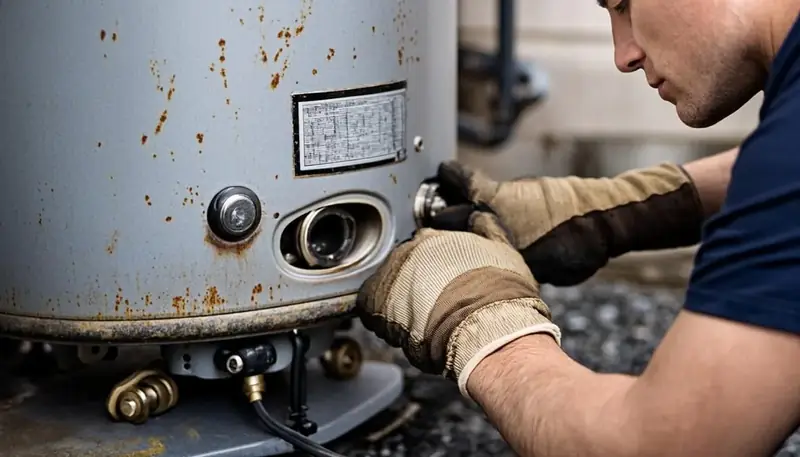
Refrigerant circuits, capacitors and sealed electrical compartments are licensed-technician territory, and for good reason: the hazards are invisible to the senses, and the measurements are the only honest evidence a system has. Our Red Seal technicians work under BC licence BC-PL-2019-4421, carry $2M liability coverage, and back completed work with a 2-year workmanship warranty. Here is what each professional point actually involves.
7. Pressures and temperature split
Gauges and thermometers verified against the rating plate tell the truth about charge level and real capacity. This is where slow leaks, wrong charges and lost capacity are caught years before your bedroom does.
8. Contactor and capacitor health
Pitted contactors and capacitors drifting out of tolerance are the two quiet pre-failures behind most first-hot-day calls in this region. Measured now, they are a small flat-rate part; discovered in July, they sometimes take the compressor with them.
9. Professional coil cleaning
Deep fin cleaning, comb-straightening of bent fins, and inspection of the indoor evaporator coil, the one your garden hose cannot reach and your frozen-coil story starts from.
10. Blower and airflow verification
Measured airflow validates your filter habit, exposes duct restrictions and flags blower motor wear while it is still a bearing, not a weekend without air moving.
11. Electrical and safety checks
Amperage draw, wire connections, breaker and disconnect condition. The coast's damp idle season oxidizes contacts and quietly loosens the connections that fail under heat-dome load.
12. The written record
Every measurement goes into a report you keep. Year-over-year numbers are how slow leaks, capacity decline and rising amperage get caught, and how replacement conversations happen with evidence instead of vibes.
One boundary note worth stating plainly: if your system is blowing warm air or tripping breakers now, what you need is not maintenance but a diagnosis, and our AC repair service in Richmond and AC repair crews in Coquitlam run the same $89-credited diagnostic across the region, with repairs at $180 to $450 through the flat-rate book. Maintenance keeps good systems good; it does not resurrect failing ones.
What a Tune-Up Covers, and What It Should Never Include
A professional spring tune-up from our team covers the six technician points end to end: gauge and temperature verification, electrical inspection, coil cleaning, airflow measurement, condensate flushing and a commissioned test cycle, all recorded in writing. Everything is quoted flat before work starts, any part that surfaces is quoted before it is touched, and the report is yours to keep as the baseline for next year.
Just as important is what a tune-up should never include, because the cooling industry has its share of theatre. A routine visit should not begin with a "free" inspection that finds catastrophe, should not quote a repair over the phone without gauges on the system, and should never, ever "top up" refrigerant as routine maintenance. Refrigerant does not burn or consume itself; a system low on charge is a system with a leak, and the honest service is to find it, quote the repair flat-rate, and recharge to the nameplate weight afterward. With the refrigerant transition underway across Canada, chasing a chronic leak with annual recharges is the most expensive non-plan in cooling, and our technicians are trained to say so out loud.
Refrigerant does not wear out. If someone has added charge to your system more than once without finding a leak, you have been paying rent on a repair nobody has made.
The same honesty applies to equipment age. A fifteen-year-old condenser with healthy numbers and a clean bill deserves to run; a ten-year-old system with a confirmed leak, a tired compressor and a repair quote worth half a replacement deserves the repair-versus-replace conversation in June, with our full cooling services and current equipment options laid out beside it. Central replacements run $3,800 to $6,500 installed and ductless alternatives $3,800 to $5,500 per zone, and heat pump routes carry combined CleanBC Better Homes, BC Hydro, FortisBC and municipal rebates that can reach $16,000 for cold-climate units in 2026, with the paperwork handled on your side. That is a menu best reviewed calmly in spring, which is the quiet argument for the whole checklist.

The Cost Math: Spring Check Versus July
The cheapest format for this argument is the one our dispatch board writes every summer. Here is the pattern of skipped maintenance, what each skip turns into during the first heat warning, and what it costs through our flat-rate book when it does.
| Skipped point | What it becomes in July | What it costs |
|---|---|---|
| Filter change (1) | Reduced airflow, frozen evaporator coil, warm air and ice on the line set | Usually an $89 diagnostic and a thaw-out; damage if the compressor slugs liquid, $180 - $450 repair range |
| Condenser clearance and wash (2, 3) | High head pressure, struggling cooling on the hottest afternoons, rising electrical draw | Hard-worked capacitors and contactors land in the $180 - $450 repair range; compressor risk compounds behind them |
| Condensate drain check (4) | Float switch trips on the first long run; system off with nothing "wrong" | Drain clearing inside the repair range, after the $89 diagnostic finds the obvious |
| Contactor and capacitor inspection (8) | The classic first-hot-day failure: system will not start, or starts and dies | Part plus labour at $180 - $450; at 11 p.m., add the $150 flat after-hours premium |
| Pressures and temperature split (7) | Slow leak discovered as lost capacity during a heat warning, not before it | Leak search plus repair and recharge inside the repair range, or the replacement conversation at $3,800 - $6,500 central |
| All of it, discovered in a heat dome | Emergency call during the region-wide failure wave | $150 flat after-hours premium, compressed availability, decisions made under pressure |
Read that table as the price of information timing. None of the July outcomes are exotic; they are the ordinary consequences of the ordinary skips, arriving in the exact weeks when every neglected system in the region competes for the same technicians. The spring alternative is an hour of your labour plus one visit, and the comparison is not close. For the furnace half of the calendar, our $129 heating tune-up covers the same discipline on the other side of the year, and most customers simply book both in one call.
The other half of the math is longevity. A system that enters each season clean, correctly charged and electrically healthy runs longer for the same reason a car with oil changes does: the compressor, the part worth replacing the whole system over, is asked to do its work at rated pressures and rated current instead of fighting fouled coils and low charge. Stretching a condenser from twelve toward fifteen-plus years pushes a $3,800 to $6,500 replacement decision back by multiple summers, and that is worth more than every filter you will ever buy.
The Metro Vancouver Cooling Calendar
Maintenance advice that ignores the coast's calendar is generic advice. This is the schedule we hand customers from Vancouver to Abbotsford, tuned to heat warning timing, smoke seasons and the June booking reality.
| When | What | Why now |
|---|---|---|
| March | Book the spring visit; glance at the condenser for winter debris and storm damage | Appointment slots are wide open and the discoveries still have months of runway |
| April | The homeowner six: filter, clearance, wash, drain check, cool test, listen | Cottonwood season starts; wash the coil before the fluff, not after |
| May | Professional tune-up and the written baseline report | Heat warnings can begin in late June; this is the last calm month |
| June | Second filter look; confirm drain during the first long runs | The first hot stretch exposes weak capacitors and clogged drains |
| July - August | Filter vigilance, stop at first strange symptom, no retries | Heat dome weeks are the stress test everything above prepared for |
| Smoke weeks | Run fan-only for filtration; swap the filter right after thick smoke clears | Smoke particulate loads filters in days; the fan-mode habit also protects the coil |
| September | Final filter change, note any quirks from the season, book furnace tune-up | Season-end notes hand next spring's visit a head start; the $129 heating check covers the other half of the year |
The two rows people skip and regret are smoke weeks and June. Smoke-week filtration is the one service your cooling system performs that no window unit matches, and the June second filter-look is the difference between catching a drain that is slowing and meeting the float switch on the first 30-degree Saturday. For the full household plan around these weeks, pair this calendar with the heat dome preparedness guide.
The Cheat Sheet
Photograph this section, or write the four lines on the filter cabinet with a marker. Everything above compresses to these rules, and they are the ones that actually keep BC systems alive through heat domes.
Fresh filter, April 1
The one task that prevents the most expensive common failure. Dated, checked monthly, swapped early after smoke weeks.
Wash the coil before cottonwood
Garden hose, disconnect off, inside out, no pressure washer. Ten minutes in April beats a $180 - $450 electrical repair in July.
Stop at the first strange noise
Buzzing, clicking, warm air, tripped breaker: call, do not retry. Hard starts turn capacitors into compressors.
Book spring, not the heat warning
Every year, the first heat warning empties the appointment book for a week. April bookers never learn this the hard way.
When the checklist hands you a fault, the next step is one call: our $89 diagnostic, credited in full toward the repair it finds, with the flat-rate price in writing before any work begins. Book the spring visit, run the homeowner six this weekend, and walk into the next heat dome with gauges-on evidence instead of hope. The line is answered 24/7 at 604-615-2212, and spring callers get the calm-weather version of us.
Frequently Asked Questions
Services From This Guide
Spring tune-ups, flat-rate AC repairs and honest cooling advice across Metro Vancouver, seventeen cities, seven days a week.
AC maintenance and tune-ups
The professional six of this checklist, with written numbers and flat-rate honesty, across seventeen Metro Vancouver cities.
AC repair Richmond
Spring check found a fault? The $89 diagnostic is credited toward the repair, flat-rate fixes from $180 - $450.
AC repair Coquitlam
The Tri-Cities and valley side of the region, same flat-rate book, same 2-year workmanship warranty.
Heat pump service and rebates
Cooling-plus-heating routes with combined rebates up to $16,000 in 2026, paperwork completed by our team.
Related Guides
Heat Dome Preparedness for BC Homes
The household heat plan this checklist plugs into: night flushing, smoke weeks, and who is most at risk.
CoolingCentral AC Installation: The Vancouver Guide
When the tune-up report says replacement, this is the install-day, permits and pricing walkthrough.
Heat pumpsHeat Pumps in Vancouver: The Full Guide
The year-round alternative when cooling replacement meets heating replacement in the same year.
Red Seal certified, licensed gas fitters (BC-PL-2019-4421), $2M insured and 15-plus years in the field, with more than 12,000 jobs completed across Metro Vancouver since 2010 and a 4.9-star rating over 39 reviews. We wrote this guide because the cheapest cooling repair is the one your own two hands and one spring visit prevent, and the company telling you that installs AC for a living.
More about our team →Book Your Spring AC Check
Book the spring tune-up or a $89 diagnostic with a Red Seal technician. You get the professional six of the checklist with written numbers, a flat-rate quote before any part is touched, and the honest read on whether your system is ready for the summer ahead. Zero obligation, same-day service on most calls.
AC down right now?
Cooling calls are answered 24/7 with live dispatch and flat after-hours pricing posted in advance, including the $150 premium explained up front. Daytime? The $89 diagnostic is usually same-day in Vancouver, Burnaby and Surrey.
Call 604-615-2212 WhatsApp Us