CleanBC Rebates 2026: Every Home Upgrade Rebate in BC (Complete List)
The full 2026 menu of BC home upgrade money in one place: CleanBC heat pump rebates that stack to $16,000, the $1,000 heat pump water heater offer, windows, insulation and air sealing, the $40,000 federal loan at 0%, FortisBC and BC Hydro programs, municipal top-ups - plus the pre-approval rules, stacking order, timelines and the mistakes that quietly void thousands of dollars.
On This Page
- How CleanBC Better Homes Works in 2026
- The Complete 2026 Rebate Table
- Heat Pump Rebates: $6,000, $11,000 and the $5,000 Top-Up
- Water Heaters, Windows, Insulation & Air Sealing
- The Federal $40,000 Greener Homes Loan at 0%
- FortisBC & BC Hydro Programs
- Municipal Top-Ups: Vancouver, Surrey & North Vancouver
- EnerGuide Assessments: The First Step You Cannot Skip
- Eligibility, Pre-Approval & Stacking Rules
- Real Net-Cost Example: $12,000 Heat Pump for $4,000
- Timeline, Paperwork & How We Handle Everything
- 8 Mistakes That Void Rebates (+ 2026 Status Notes)
British Columbia runs one of the most generous home-retrofit incentive programs in North America - and one of the easiest to lose money in. CleanBC Better Homes, stacked with federal, utility and municipal programs, can take a $12,000 heat pump down to a $4,000 invoice, put $2,000 back on a triple-pane window package, hand you $1,000 for choosing a heat pump water heater, and lend you up to $40,000 at 0% interest for ten years to bridge the gap. The catch is that every one of those programs has a sequence: assessments before upgrades, pre-approval before purchase, eligible models from a list, licensed installers, and paperwork filed in the right order within the right windows.
We file rebate paperwork on every eligible job we quote - it is a core part of what BC Home Service does across Vancouver, Surrey and Metro Vancouver, not an upsell. That front-row seat means this guide is written from the filing desk, not the brochure: what the programs actually pay in 2026, what they require, how the money moves, and the eight mistakes we watch homeowners make that void otherwise-earned rebates. Numbers shift during the year as funding windows open and close, so treat this as the map and the current program pages as the weather - and when in doubt, call our rebate desk at 604-615-2212 before you swipe a card for anything.
Maximum stacked CleanBC rebates (oil-to-heat-pump plus income top-up)
Federal Greener Homes Loan ceiling, 0% interest over 10 years
CleanBC rebate on an eligible heat pump water heater
Typical time from complete submission to rebate cheque
How CleanBC Better Homes Works in 2026
CleanBC Better Homes is the Province of BC's retrofit incentive program, delivered with BC Hydro, FortisBC and municipal partners through the Better Homes BC service. Its center of gravity in 2026 is the same as in recent years: paying homeowners to switch space heating off fossil fuels and toward high-efficiency electric heat pumps, with secondary offers for heat pump water heaters, windows, insulation and air sealing. The headline structure has three levers that stack.
The first lever is the base rebate, set by what your home currently heats with. This is the "fuel switch" logic: removing an oil tank eliminates the highest-emission, highest-cost heating in the province, so it pays the most ($11,000); replacing a gas furnace pays a strong flat amount ($6,000); homes moving off electric baseboards - which is a fuel switch in the efficiency sense, not the emissions sense - receive a lower, climate-zone-scaled amount ($4,000 to $6,000). The second lever is the income-qualified top-up of up to $5,000 for households under the program's household-income thresholds. The third is stacking: CleanBC amounts combine with municipal top-ups, FortisBC and BC Hydro offers where eligible, and can be bridged by the federal loan - which is how the "up to $16,000 combined" figure that the program and our own heat pump page advertise gets assembled ($11,000 oil-switch base plus $5,000 income top-up).
Two design features matter more than any single number. First, CleanBC is retroactive-proofed but not forgiving: the EnerGuide assessment must happen before your upgrade, the heat pump must be on the eligible-products list, and the installer must be properly licensed. Second, the program pays per upgrade, not per wish - the rebate attaches to specific equipment meeting specific performance thresholds, installed in a specific order of operations. Both features exist to keep public money out of low-quality installs; the practical effect is that your contractor choice and your paperwork discipline are worth as much as the equipment choice.
The one-sentence version: in 2026, the biggest cheques go to BC homeowners who get an EnerGuide assessment first, pick equipment from the eligible list with a licensed installer, file for pre-approval before purchasing, and treat the municipal and utility programs as stacking layers rather than alternatives.
The Complete 2026 BC Rebate Table
Here is the full menu in one view - the numbers we verify on every quote. Amounts marked with ranges scale with equipment specifics, climate zone or household income; the notes column is where most rebates are won or lost.
| Upgrade | Rebate Amount (2026) | Program | Key Requirements & Notes |
|---|---|---|---|
| Heat pump - switching from an oil heating system | $11,000 | CleanBC Better Homes | Eligible cold-climate model from the list; removal of oil system; pre-approval before purchase; stacks with income top-up toward the advertised $16,000 |
| Heat pump - switching from a natural gas furnace | $6,000 | CleanBC Better Homes | Fuel-switch base amount; same eligible-model and pre-approval rules; municipal top-ups frequently stack on top |
| Heat pump - switching from electric baseboards | $4,000 - $6,000 | CleanBC Better Homes | Amount scales with climate zone - colder zones (Interior, North) sit at the top of the range; Metro Vancouver typically mid-range |
| Heat pump - income-qualified top-up | +$5,000 | CleanBC Better Homes | Household income under program thresholds; documentation filed with the application; stacks on the base fuel-switch rebate |
| Heat pump water heater (HPWH) | $1,000 | CleanBC Better Homes | Eligible model list; typically a fuel-switch or upgrade from electric resistance tank; installed by licensed contractor |
| Windows & doors | $500 - $2,000 | CleanBC Better Homes | Minimum three panes (triple-glazed, or triple-pane-rated products on the list); model on eligible list; whole-home rather than single-window replacements in practice |
| Insulation upgrades | Partner-program amounts by area and R-value | CleanBC insulation partner network | Attic, walls, basement/crawlspace; installed by a program-registered contractor; pre-upgrade assessment required |
| Air sealing | Included with EnerGuide-following upgrades | CleanBC / assessment pathway | Blower-door verified improvements between pre- and post-assessments strengthen the file |
| Greener Homes Loan | Up to $40,000 at 0% interest, 10-year term | Federal (Canada Greener Homes) | Repayment-free bridge financing on retrofit packages; enrolment windows have shifted - verify current status before planning around it |
| High-efficiency gas furnace / boiler | Up to roughly $3,000 on boiler conversions (gas side) | FortisBC | Efficiency thresholds (95%+ AFUE / condensing); FortisBC-registered installer; gas-path alternative for homes staying with gas |
| Water heating & envelope offers | Seasonal offers on qualifying water heaters and envelope work | FortisBC | Program windows open and close through the year; our rebate desk checks current standing at quote time |
| Income-qualified electrification support | Enhanced offers / load-limiting suite support | BC Hydro | Household-income-gated; also covers service-panel and load-limiting situations in electric conversions |
| Municipal top-ups | Roughly $500 - $2,000+ depending on municipality | Vancouver, Surrey, North Vancouver and others | Local programs stack on CleanBC; each municipality sets its own deadlines, caps and application route |
Amounts reflect the CleanBC Better Homes structure as published in 2026 and our filed-claim experience. Program funding, thresholds and windows change during the year - every quote we write re-verifies the current schedule before you commit to equipment.
Read the table with one habit in mind: the "Key Requirements" column is where the money lives. A heat pump that is 5% short on the cold-climate performance threshold, installed without pre-approval, is worth $0. The identical unit, properly filed, is worth $6,000. Same equipment, same invoice, different process discipline.
Heat Pump Rebates: $6,000, $11,000 and the $5,000 Top-Up
The heat pump offer is CleanBC's flagship, and its value depends entirely on what your home is leaving behind.
Leaving an oil furnace or boiler: $11,000
Oil-heat homes - common in older pockets of North Vancouver, West Vancouver, the Gulf-facing neighborhoods and parts of the Fraser Valley - are the program's priority because oil is the most expensive and highest-carbon heating in BC. The $11,000 base rebate is sized to make the switch a clear financial win, and it stacks with the income-qualified top-up (toward the $16,000 ceiling) and with the electrical-service-upgrade support in older homes whose panels need capacity for the heat pump. Practically, an oil-to-heat-pump conversion in Metro Vancouver lands in the $14,000-to-$19,000 installed range before incentives, so the rebate stack routinely covers half or more of the project - and removes a fuel bill that has been punishing households every winter.
Leaving a gas furnace: $6,000
The gas-to-heat-pump rebate of $6,000 rewards the fuel switch most Metro Vancouver homes face, because the gas furnace is the default heating system of the region's housing stock. The economics here are subtler than the oil case: natural gas is comparatively cheap in BC, so the honest payback math is comfort (cooling plus heating), emissions, and the rebate-weighted installed cost rather than dramatic bill cuts. Where it becomes an easy call is combined systems: a cold-climate heat pump replacing furnace-plus-aging-AC pairs often nets out at a monthly cost close to the gas bill alone, while adding cooling the home did not have - the 2021 heat dome made that trade obvious to anyone who lived through 49.6 degrees in Lytton and lost air conditioning for a week.
Leaving electric baseboards: $4,000-6,000
Baseboard-heated homes - a huge share of BC's condo stock and 1970s-80s apartments and ranchers - qualify for $4,000 to $6,000 scaled by climate zone. A ductless mini-split or multi-zone heat pump cuts baseboard heating costs by 40 to 60 percent in typical BC usage, so this path pairs one of the smaller rebates with one of the best paybacks in the program. For suites and load-limited homes, BC Hydro's income-qualified and load-limiting programs layer on top.
The income-qualified top-up: +$5,000
Households under CleanBC's income thresholds (published annually, based on household size and total income) receive the $5,000 top-up on top of the base fuel-switch amount - this is the layer that turns "$11,000" into "$16,000" and that makes heat pump conversions genuinely accessible rather than merely attractive. Documentation is straightforward - prior-year income verification filed with the application - but it is also one of the most commonly skipped claims simply because homeowners do not realize they qualify. When we quote a heat pump, we check the threshold table with you in the room; it is a two-minute conversation occasionally worth five thousand dollars.
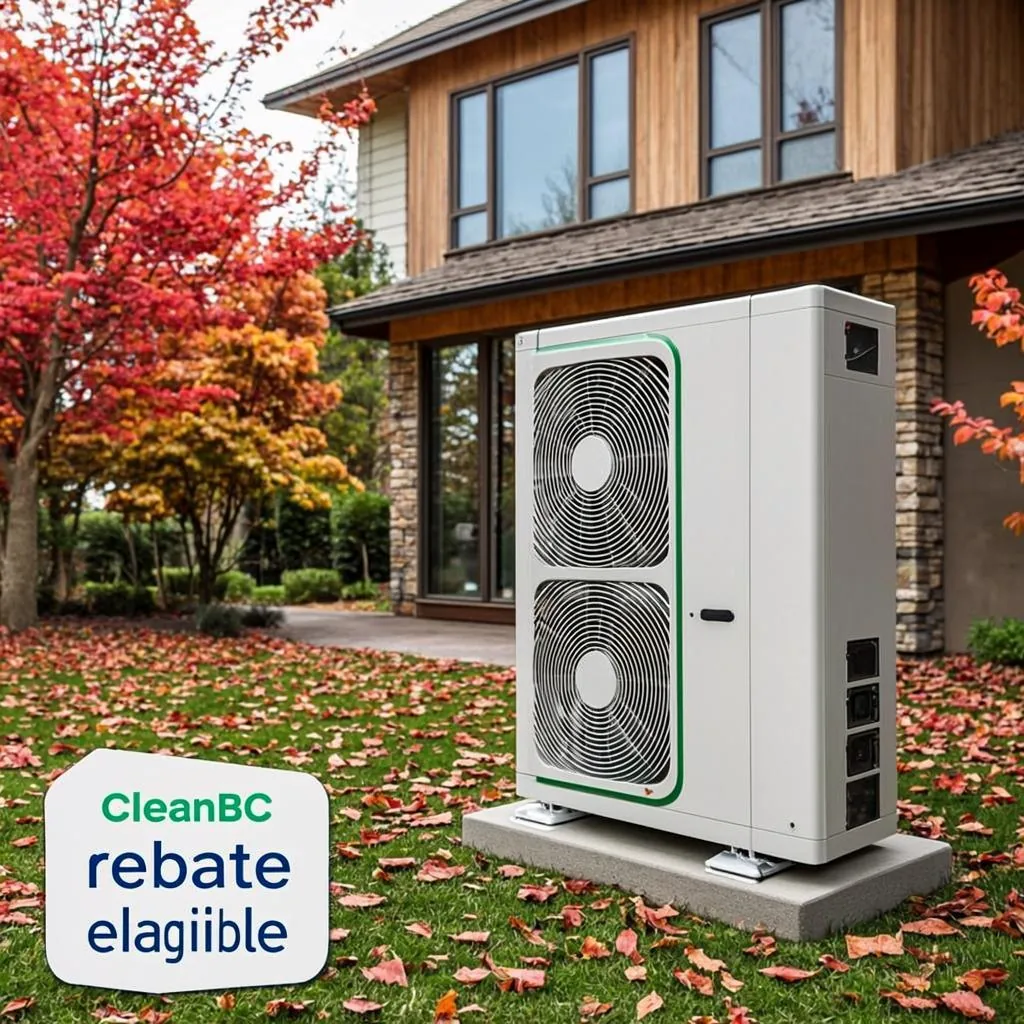
The eligible-model list is not a suggestion. Rebate-qualifying heat pumps must appear on CleanBC's qualifying-products list with the required cold-climate performance ratings, and the exact model number on the invoice must match the application. A near-identical unit one tier down is worth $0. We verify the list at quote time and put the model number in writing before you approve anything.
Heat Pump Water Heaters, Windows, Insulation & Air Sealing
Heat pump water heaters: $1,000
The water-heating side of the program pays an up-to-$1,000 rebate on eligible heat pump water heaters - the 3-to-4x-efficient electric units that cut water heating to roughly a quarter of a resistance tank's draw. The rebate most often applies on replacements of electric tanks (the like-for-like fuel path) and on new-construction or renovation electrification. Practical conditions mirror the heat pump rules: model on the eligible list, licensed installation, and for most rebate pathways a pre-upgrade EnerGuide assessment on file. Our water heater page covers the sizing and space requirements in depth; the short version is that a garage or open mechanical room, a 240-volt circuit and a condensate drain make almost any Metro Vancouver home a candidate.
Windows: $500-2,000, minimum three panes
Window rebates pay $500 to $2,000 with a hard technical floor: minimum three panes - the program funds triple-glazing (and triple-equivalent products on its list), because that is the threshold where BC-window performance genuinely changes envelope behavior. The amount scales with the number of qualifying windows and doors replaced, which makes the rebate a whole-project play: single-window repairs do not register, while a full 10-to-18-unit replacement package reliably lands in the $1,500-to-$2,000 band. Our window projects in Vancouver and Surrey typically pair this with the acoustic and condensation wins of triple glazing - Kingsway noise, failed-seam humidity - so the rebate arrives on upgrades that were already worth doing for comfort. Brands on the eligible list are BC-familiar: Vinyltek, Cascadia, Inland and Milgard all carry qualifying triple-pane lines.
Insulation and air sealing: the partner network
Insulation top-ups - attic, walls, basement and crawlspace - flow through the CleanBC partner network with amounts calculated on upgraded area and achieved R-value rather than flat cheques. The math favors the attic first (cheapest per square foot, biggest heat-loss share in pre-1990 Metro Vancouver homes), then crawlspace and walls. Air sealing is verified by the blower-door numbers on your pre- and post-upgrade EnerGuide assessments; a demonstrable improvement in air changes per hour both strengthens the retrofit file and directly cuts the drafts that make BC homes feel colder than their thermostats. Because insulation work feeds the assessment numbers that the heat pump rebates also lean on, the smart sequence for whole-home projects is insulation and sealing first, mechanical second - the envelope improvements right-size the heat pump, and the right-sized heat pump maximizes every downstream rebate.
The Federal $40,000 Greener Homes Loan at 0%
On top of the grant stack sits the Canada Greener Homes Loan: up to $40,000, interest-free, repaid over ten years, designed to finance the retrofit package your grants do not cover. A $16,000 heat pump project with $8,000 in stacked rebates and a $40,000 line available means many BC homeowners face no cash-out-of-pocket at all: the rebate cheques and the loan together bridge the full cost, and the loan payment (roughly $130 per month per $16,000 borrowed at 0%) lands below the monthly energy savings the retrofit creates. That is the arithmetic that makes deep retrofits feel painless.
The 2026 status of the loan requires honest handling: the original Greener Homes program ended new grant enrolment in 2024, and its successor programming - including the income-aimed Canada Greener Homes Affordability stream - has been phased in with different windows and eligibility. The loan facility and its 0% structure have continued to feature in the federal retrofit toolkit, but enrolment availability is exactly the kind of detail that shifts between budgets. Treat "up to $40,000 at 0% over 10 years" as the design of the instrument, and verify the current enrolment status before you build a project plan around it. Our rebate desk does that check as part of every financing conversation, and our own financing options - $0-down payment plans from 7.99% over 12 to 84 months through Financeit - cover projects in every state of federal-program flux, including stacking with rebate money that arrives later.
Sequencing tip: if you intend to use low-interest federal financing, get the EnerGuide pre-assessment and the loan enquiry moving in parallel - the assessment is required for both the grants and the loan package, and doing it once saves both weeks of calendar time and a duplicate assessor fee.
Utility Programs: FortisBC & BC Hydro
The two energy utilities run their own incentive layers, and both are stackable with CleanBC in most configurations - but each follows its own rulebook.
FortisBC (gas and electric territories)
FortisBC's offers split into the gas-side and electrification-side programs. On the gas side, rebates on high-efficiency condensing furnaces and boilers - up to roughly $3,000 on qualifying boiler work, with corresponding furnace offers - pay homes that stay with gas to at least burn it efficiently. On the electrification side, FortisBC participates in the heat-pump switch offers (the furnace-to-heat-pump path can carry $6,000+ through the combined CleanBC/FortisBC structure), runs periodic water-heating offers, and operates through registered contractors - the registration is another paperwork gate our installers already hold. FortisBC program windows open and close during the year, so a mid-October quote and a mid-January install can face different offer sheets; we re-check at both quote and filing time.
BC Hydro (electric territory)
BC Hydro's rebate energy concentrates where CleanBC's is thinnest: income-qualified households and load-limited situations. The income-qualified programs deepen the electrification math for households under the thresholds, and the load-limiting suite programs are a quiet lifeline for condo and suite electrification where panels cannot carry new resistance heating - BC Hydro's offers help fund heat pumps and heat pump water heaters precisely because they fit inside constrained electrical envelopes. For Metro Vancouver homeowners, the practical takeaway is that a "my panel can't handle it" conversation often has a program attached to it; ask before assuming.
| Utility Layer | Typical 2026 Value | Stacks With | Watch For |
|---|---|---|---|
| FortisBC condensing boiler / furnace | Up to ~$3,000 (boiler path) | Other FortisBC offers; separate track from CleanBC fuel-switch rebates | Efficiency thresholds and registered-installer requirement |
| FortisBC heat pump / water heating offers | Seasonal, changes through the year | CleanBC base + top-up on the fuel-switch path | Program windows - verify at quote and at filing |
| BC Hydro income-qualified programs | Enhanced electrification offers | CleanBC income top-up where eligible | Household income documentation |
| BC Hydro load-limiting support | Suite/panel-constrained conversions | CleanBC HPWH and heat pump paths | Panel assessment before committing to equipment size |
Municipal Top-Ups: Vancouver, Surrey & North Vancouver
Several Metro Vancouver municipalities add their own money on top of CleanBC for residents, and the top-up layer is where a lot of unclaimed dollars sit. The pattern: the municipality offers a fixed top-up or a percentage bump on the provincial rebate for heat pumps and related retrofits, filed through the same CleanBC portal or a short municipal form, with the municipality's own deadline.
- Vancouver has periodically funded electrification and heat-pump top-ups tied to its climate-emergency retrofit goals, with programs aimed at gas-to-electric conversions in detached homes and laneway properties. Availability and caps move year to year with council budget cycles.
- Surrey has run energy-retrofit incentive top-ups that pair with the CleanBC heat pump path - a meaningful layer for Surrey's large stock of gas-furnace family homes in Cloverdale, Fleetwood and Newton.
- North Vancouver (District and City) has been among the most active municipalities in the province on heat pump top-ups, frequently paying the richest local layer for oil-conversion and gas-conversion homes on the North Shore - historically in the $1,000-plus band per qualifying heat pump installation.
- Other municipalities - Burnaby, New Westminster, Delta, West Vancouver among them - have joined or exited local top-up programs in different years. The honest rule: the top-up landscape is checked at quote time, per address, because it changes annually.
Why municipal top-ups go unclaimed: homeowners learn about them after the install, or assume the contractor "handled everything" without specifying the municipal form. Our filing process checks your municipal layer by address at quote time and includes it in the submission stack when your city participates.
EnerGuide Assessments: The First Step You Cannot Skip
Almost every CleanBC path runs through an EnerGuide home energy assessment - a two-to-three-hour evaluation by a licensed energy advisor who blower-door tests your home, documents insulation levels, heating systems and envelope details, and produces the before-and-after energy models your rebate application is built on. The assessment happens twice: once before any upgrade (the "D" evaluation) and once after (the "E" evaluation), and both are on you, the homeowner, to commission - rebates attach to the pair of reports, not to receipts alone.
Cost in the Vancouver market runs $350 to $550 for the pre-assessment and a similar amount for the post, with the total pair frequently landing between $700 and $1,100. Depending on the active program terms, some or all of the assessment cost is itself rebated - historically as a partial credit within the CleanBC filing - so the net assessment cost often lands well under $500 for the pair. The assessment is not a hoop; it is also the best value-for-money energy consultation available in BC, because the report ranks your home's specific retrofit opportunities by payback. Homeowners who read theirs usually change one decision for the better - insulation-first sequencing, a smaller heat pump than assumed, or windows moved below the line.
Non-negotiable: the pre-upgrade assessment must exist before the upgrade is installed. Retrofit work done pre-assessment is invisible to the energy model, and invisible upgrades do not rebate. If your water heater dies today and you replace it tomorrow, the HPWH $1,000 is gone unless a pre-assessment was already on file. This is the single most common rebate we watch evaporate, and it is why we tell clients doing any planned mechanical work within 12 months: book the assessment now, keep every door open.
We coordinate the EnerGuide assessments for our clients - scheduling with licensed advisors in Metro Vancouver, making sure the model inputs match the equipment we are installing, and aligning the post-assessment booking with the install date so the file completes cleanly. The advisors work for you, not for us; our role is simply to make the two technical documents line up so the program processor has nothing to question.
Eligibility, Pre-Approval & Stacking Rules
The eligibility skeleton is simple. You must be the registered owner of a primary residence in British Columbia - your home, not a rental property (rentals route through different programs), and not a secondary home. The home must be your existing dwelling, not new construction. The work must be done by a licensed contractor - for our scope, that means Red Seal plumbers and gas fitters under BC-PL-2019-4421, with gas work permitted through Technical Safety BC. The equipment must be on the eligible list, and the money must be pre-approved before you purchase.
That last rule deserves its own paragraph because it voids more claims than everything else combined: buy before approval, lose the rebate. CleanBC's pre-approval is an application you file (with the assessment and the chosen equipment specification) that comes back as a confirmation before the equipment is ordered. It exists so public money backs intended upgrades, and the program enforces it literally - a same-model heat pump bought on a Friday before the Monday approval is a full-claim denial. Timeline-wise, pre-approval adds roughly two to four weeks to a project, which is why planning retrofits in September beats planning them in the second week of December when the furnace has already died.
How stacking actually works
- CleanBC base + income top-up: these combine directly - the $16,000 ceiling is exactly this stack on the oil path.
- CleanBC + municipal: municipal top-ups are designed to stack; each city caps its own layer.
- CleanBC + utility: FortisBC and BC Hydro layers stack on the fuel-switch paths per program terms; gas-efficiency rebates (boiler/furnace) are a separate track from the fuel-switch rebates by design - you cannot claim both a "stay efficient on gas" and a "leave gas" rebate on the same equipment.
- Rebates + federal loan: the 0% loan is independent financing, not an incentive - it stacks with everything, because it is your money repaid to you-interest-free.
- The double-dip rule: the same upgrade cannot be claimed twice under two programs claiming the same public purpose - our filing desk sequences claims so overlapping programs each fund a defined layer of the project.
One planning note for strata owners: duplexes, townhouses and condos can participate where the upgrade is within your strata lot (a heat pump water heater in your suite, a ductless heat pump serving your unit) - but anything touching common property, exteriors or gas risers needs strata approval in the file. We have done hundreds of these; the paperwork pattern is known.
Real Net-Cost Example: A $12,000 Heat Pump for $4,000
Here is a worked example from the 2026 filing desk - a representative Burnaby single-family home, gas furnace heating, mid-efficiency AC on its last legs, household income above the top-up thresholds, municipality without an active heat pump top-up that year. The project: a mid-size cold-climate heat pump (on the eligible list) installed and commissioned, old furnace removed, old AC scrapped, electrical minor work done, both EnerGuide assessments completed.
| Line Item | Amount | Notes |
|---|---|---|
| Heat pump supply + install (eligible cold-climate model) | $12,000 | Includes removal of furnace + old AC, commissioning, permit |
| Pre-approval (before purchase) | submitted and granted | CleanBC application with model number + EnerGuide pre-report |
| CleanBC gas-furnace-switch rebate | -$6,000 | Fuel-switch base amount |
| Municipal top-up (this municipality, that year) | $0 | No active program - in North Vancouver this line has been worth $1,000+ |
| EnerGuide pre + post assessments | +$850 | Partially recovered in filing where program terms allowed |
| Net project cost | ~$4,000-4,800 | Before financing; ~$80/month on a 60-month 0%-equivalent plan |
Now stack the variants. If the same home had heated with oil, the base rebate would be $11,000 - the net lands near zero after assessments. If the household were income-qualified, add the $5,000 top-up. If the address were in a municipality with an active $1,500 top-up, subtract that too. The equipment and labour barely changed between these scenarios - the paperwork did. That is the entire game: the same $12,000 project has cost, in our recent files, as little as a few hundred dollars net and as much as the full $12,000, purely on eligibility, sequencing and geography.
What the homeowner actually experiences: pay the installer, wait four to eight weeks, cheque arrives (or direct deposit), apply it to the financing balance. On our Financeit plans, the rebate typically lands as a lump-sum principal reduction - which, on a 7.99% plan, converts the rebate into permanently lower payments rather than just a one-time refund.
Get every rebate you qualify for - filed for you.
Free in-home quote across Metro Vancouver with the current CleanBC, utility and municipal programs checked against your address, equipment selected from the eligible list, and the entire paperwork stack handled by our rebate desk. Pre-approval submitted before you spend a dollar.
Get My Free Rebate Quote Call 604-615-2212Rebate verification is free · No obligation · 2-year workmanship warranty on installs
Timeline, Paperwork & How We Handle Everything
A rebate-filed project runs in six beats, and knowing them is the difference between a calm retrofit and a lost-winter scramble.
Energy advisor evaluates and models your home. Week 1. You receive the report ranking your best upgrades.
We specify eligible models, price the install flat-rate, and hand you the model numbers in writing.
We submit the CleanBC application (assessment + equipment + contractor details) and wait for the green light before any purchase. Typically 2-4 weeks.
Licensed install, permits filed, invoice issued with rebate-ready formatting: model numbers, itemized costs, HST lines.
EnerGuide "E" evaluation confirms the upgrades; we file the complete claim stack - provincial, utility, municipal.
Typically 4-8 weeks after a complete submission, the cheque or deposit lands. Apply it to your balance - or your next project.
Our part of that list is everything except the assessor's two site visits and the cheque itself: the eligible-model verification, the pre-approval submission, the invoice formatting the processors require, the utility and municipal layer checks, the post-assessment coordination, and the claim filing - all at no extra charge on installs we quote. The paperwork discipline is not a courtesy; it is the difference between a $12,000 project and a $4,000 one, and we would rather own it than explain it.
The most common timeline question: "how long until I see the money?" After a complete submission - complete meaning every document the program asks for, in the format it asks - payments run four to eight weeks. Incomplete files sit in query loops; that is where "I never got my rebate" stories come from. Our files are assembled against the program's own checklist before submission, which is why our claim rate on approved pre-filings runs essentially 100%.
8 Mistakes That Void Rebates (Plus 2026 Status Notes)
- Buying before pre-approval. The one-strike rule. Equipment purchased before the program's approval lands is ineligible, full stop - and it is the mistake behind most of the angry rebate stories on community forums.
- Skipping the pre-upgrade EnerGuide assessment. No "D" report, no claim. Retrofit work done pre-assessment is invisible to the model and therefore to the rebate.
- Choosing a model off-list. Nearly-identical is not identical. One tier down on cold-climate performance, or a model number that does not match the eligible list exactly, voids the claim. The $200 you saved on the unit costs $6,000.
- DIY or unlicensed installation. CleanBC requires licensed contractors; gas work requires permitted gas fitters. A DIY heat pump install is not just a warranty problem - it is an automatic rebate denial, and a Technical Safety BC problem on top.
- Receipt-only filing. Invoices must show model numbers, itemized costs and proper tax lines; credit-card statements are not documentation. This is also why paying cash "for a discount" quietly costs the rebate.
- Missing the post-assessment. The upgrade is proven by the "E" report. Skipping it to save $400 forfeits the $6,000 it proves.
- Ignoring municipal and utility layers. The stack is where the money compounds; skipping the municipal form because "the contractor handled the province part" leaves the city's layer unclaimed.
- Sequencing windows before envelope and mechanical. Done out of order, an envelope upgrade can change the load calculation that follows; done in order, insulation first right-sizes the heat pump and maximizes every downstream claim. The EnerGuide report sequences this for you - read it.
2026 status notes, honestly stated
CleanBC Better Homes continues as the backbone of provincial retrofit incentives in 2026, with the fuel-switch structure (gas $6,000 / oil $11,000 / baseboard $4,000-6,000 / income top-up $5,000) and the HPWH, window and insulation layers active at the time of writing. Federal-side, the grant landscape has cycled through successors since the original Greener Homes grant closed - the 0% loan instrument and the income-aimed affordability stream define the current federal shape, with enrolment windows that move. Municipal top-ups and FortisBC/BC Hydro offers open and close through the year with budget cycles. What does not change: the assessment-first, pre-approval-before-purchase, eligible-model, licensed-installer spine of every program. Master that sequence and any 2026 program pays you; skip it and no program will.
The phone-call that pays for itself: before you spend money on any home upgrade this year, call our rebate desk at 604-615-2212 with your address and your plan. Two minutes of checking current programs against your eligibility routinely changes a project from "someday" to "this fall" - or saves you from buying the wrong thing a week too early.
CleanBC Rebate FAQ from BC Homeowners
The CleanBC stack tops out around $16,000 for an income-qualified household switching from oil heating: the $11,000 oil fuel-switch base plus the $5,000 income top-up. From gas, the base is $6,000; from baseboards, $4,000-6,000 by climate zone. Municipal top-ups (historically $500-2,000+) and utility offers can add more on top, and the federal 0% loan up to $40,000 bridges the remaining cost as financing rather than rebate.
Yes - and it is the rule most claims die on. The EnerGuide pre-assessment must exist before your upgrade, and CleanBC pre-approval must be granted before the equipment is purchased. Buying the right model one day early voids the claim. Pre-approval typically takes two to four weeks, which is one more reason to plan retrofits in early autumn rather than mid-emergency.
Plan on $350-550 each for the pre- and post-upgrade assessments, so $700-1,100 for the pair in Metro Vancouver. Depending on active program terms, a portion of the assessment cost has been rebated within the filing - and the reports double as the best payback-ranked retrofit plan available for your specific home. They must both be booked by you, the homeowner; we coordinate scheduling so the model inputs match the installed equipment.
Four to eight weeks after a complete submission - complete meaning every document the program requests, in its requested format. Incomplete files loop in processor queries and can stretch for months. Our submissions are assembled against the program checklist before filing, which keeps our approved-claim rate essentially perfect.
Strata-titled homes can claim for upgrades inside your own strata lot - a heat pump water heater, a ductless heat pump serving your unit, suite windows depending on the strata arrangement - with the strata's approval in the file where common property or exteriors are touched. Rental and secondary properties route through different (mostly utility-side) programs; the CleanBC structure is built for primary residences. We have filed hundreds of strata claims across Metro Vancouver and know the paperwork pattern per building type.
Yes, and nothing. On installs we quote, our rebate desk verifies current program rules against your address, confirms eligible models before you approve equipment, files the pre-approval, formats the invoice the processors require, checks municipal and utility layers, coordinates the post-assessment, and submits the complete claim stack - at no charge. The alternative is evenings with PDF checklists; we prefer our version, and so do our clients' claim outcomes.
Upgrades We Install & File Rebates For
Heat Pump Installation Vancouver & CleanBC Rebate Filing
Cold-climate heat pumps from the eligible list, pre-approved before purchase, with the full provincial, utility and municipal stack filed for you. From $0 down with financing.
Triple-Pane Window Replacement Vancouver
Minimum-three-pane installations from Vinyltek, Cascadia and Inland that clear the CleanBC window threshold, plus acoustic and condensation wins Metro Van homes actually feel.
Heat Pump & Tankless Water Heater Vancouver Installs
Eligible heat pump water heaters with the $1,000 CleanBC rebate filed, plus tank and tankless replacements - assessment sequenced correctly if a bigger retrofit is planned.
Home Service Financing & Rebate Planning in BC
Payment plans from 7.99% over 12-84 months that bridge rebate timelines, with the $40,000 federal loan path and full rebate desk support built into every project.
Related Guides
The Complete Heat Pump Guide for Vancouver Homes
Cold-climate models, sizing, brands and the full rebate math - the deep dive behind the $6,000-to-$16,000 numbers in this article.
EfficiencyEnergy-Efficient Upgrades in BC: What Actually Pays Off
Every upgrade ranked by payback with CleanBC stacking applied - the answer to "where should my retrofit dollars go first?"
WindowsWindow Replacement in Vancouver: The 2026 Homeowner Guide
Triple-pane thresholds, BC brands, heritage rules and how the $500-2,000 window rebate is actually earned.
Check Your Rebate Eligibility in Vancouver & Surrey
Tell us what you are planning - heat pump, water heater, windows, envelope work - and we will verify the current CleanBC, utility and municipal programs against your address, quote the install flat-rate, and file every layer of the stack for you. Call-backs within 15 minutes during business hours, and pre-approval submitted before you spend a dollar.
Why Homeowners Choose Us
- Rebate desk checks CleanBC, FortisBC, BC Hydro and municipal layers per address
- Pre-approval filed before any equipment purchase - the rule that protects claims
- EnerGuide assessment scheduling and post-assessment coordination included
- Red Seal licensed plumbers & gas fitters, $2M insured, WorkSafeBC
- 4.9-star average from 512 verified reviews since 2010
- Flat-rate written quotes; no-charge filing on installs we quote
- Financing from 7.99% with $0 down to bridge rebate timelines