Tankless vs Tank Water Heater: Vancouver Homeowner's Decision Guide (2026)
The honest comparison Metro Vancouver homeowners ask for every week: real installed costs, lifespan, winter flow-rate math, FortisBC gas versus BC Hydro electric operating costs, CleanBC rebates, and the eight questions that settle the debate for your specific house.
On This Page
- How a Tank Water Heater Works
- How a Tankless Water Heater Works
- Cost Comparison: What You Actually Pay
- Vancouver Factors: FortisBC, Condos & Growing Families
- Lifespan & Reliability: 8-12 vs 20+ Years
- Efficiency & Standby Loss Explained
- Sizing Guide with Real Vancouver Examples
- Maintenance: The $139/yr Flush & Hard Water
- Brands We Install: Navien, Rinnai, Rheem, Bradford White
- CleanBC Rebates & Electric Options
- The Decision Flowchart
- Installation Day & Same-Day Replacement
Replacing a water heater is one of those decisions that lands on Vancouver homeowners with almost no warning: the tank starts leaking on a Tuesday, a strata notice arrives about aging equipment, or a growing family suddenly discovers that the third shower of the morning is ice cold. In that moment you are forced to choose between a classic tank and a tankless (on-demand) system, usually within 24 hours, usually with a swirling mix of online advice, a contractor's recommendation and a manufacturer's marketing claims.
This guide exists to slow that decision down and give you the real numbers we use in the field across Vancouver, Surrey, Burnaby, Richmond, Coquitlam and the rest of Metro Vancouver. We install both technologies every week - roughly 2,400 water heaters since 2010 - and the honest answer is that neither one wins universally. A $1,900 gas tank is the right call for a kits-and-basements rental in East Vancouver; a wall-hung Navien is the right call for a False Creek condo conversion or a Surrey family home with three teenagers. What decides it is your fuel source, your space, your peak hot-water demand and how long you plan to stay.
One Vancouver reality shapes this entire conversation: this is one of the few cities in North America where a gas tank is still genuinely viable. FortisBC natural gas has historically been cheaper per unit of heat than BC Hydro electricity in most usage bands, which changes the payback math that American buying guides assume. At the same time, our soft mountain water, mild winters, condo market and CleanBC electrification rebates push hard in the other direction. We will walk through all of it, with the numbers, and by the end you will know exactly which side of the line your home falls on.
Water heaters installed across Metro Vancouver since 2010
Year lifespan of a maintained condensing tankless unit
CleanBC rebate on an eligible heat pump water heater
Of our 2025 tank replacements completed the same day
How a Tank (Storage) Water Heater Works
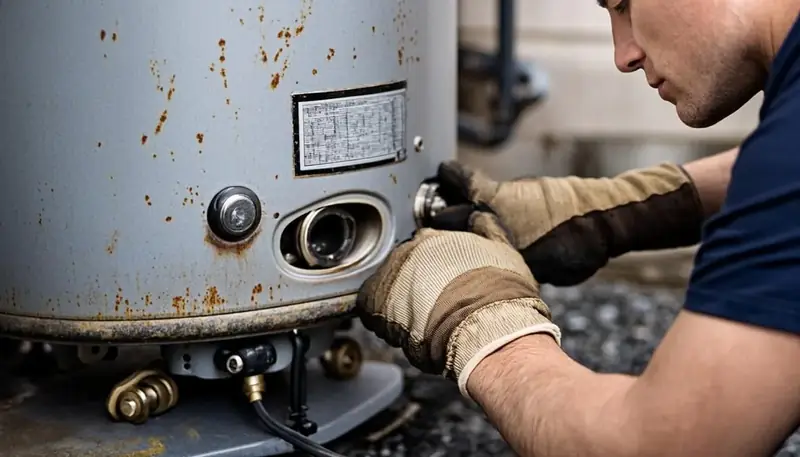
Picture a tall steel cylinder holding 40 to 75 gallons (150 to 280 litres) of water, kept hot around the clock. If it is a gas model - the most common setup in detached Vancouver houses built before 2010 - a burner sits under the tank, a chimney-like flue runs up through its core, and a thermostat switches the burner on whenever the water drops a few degrees below setpoint. Electric models replace the burner with two heating elements that poke into the tank like oversized kettle elements, one near the top and one near the bottom, taking turns under the control of the upper thermostat.
The part almost nobody thinks about is the sacrificial anode rod: a magnesium or aluminium core suspended from the top of the tank. Tank water is mildly corrosive, and without the anode the steel would rust through in a handful of years. The anode corrodes instead, sacrificing itself - hence the name - and buys the tank its 8-to-12-year service life. When the anode is consumed, the tank starts consuming itself. That is why our $139-per-year maintenance plan includes an anode inspection: a $60 part replaced on time can double the life of an $1,800 tank.
Three safety and control components complete the picture. A temperature-and-pressure relief (TPR) valve on the side dumps water if temperature or pressure ever climbs past safe limits. A dip tube inside carries cold inlet water to the bottom of the tank so hot water can be drawn from the top without mixing. And in British Columbia, every tank must be seismically strapped to the wall - two straps in most jurisdictions - a rule that dates to the code changes after earthquakes reminded coastal BC how much 400 pounds of water weighs when a building starts shaking. If your existing tank has one strap, or none, that gets corrected during any replacement we do.
Why tanks eventually fail in Vancouver: sediment from even soft water settles at the bottom, the burner or lower element repeatedly superheats that layer, and the glass lining micro-cracks. The first sign is usually a rumbling or popping sound during recovery - the tank boiling trapped sediment pockets. The second sign is a puddle.
The defining behaviour of a tank system is recovery. Draw more hot water than the tank holds - a deep soaker tub plus a back-to-back shower - and you wait 30 to 60 minutes for a gas burner (60 to 90 for electric elements) to bring the full volume back up to temperature. Sizing a tank is therefore about first-hour rating: how much usable hot water the tank can deliver starting from full, counting both stored capacity and what the burner adds while you draw.
How a Tankless (On-Demand) Water Heater Works
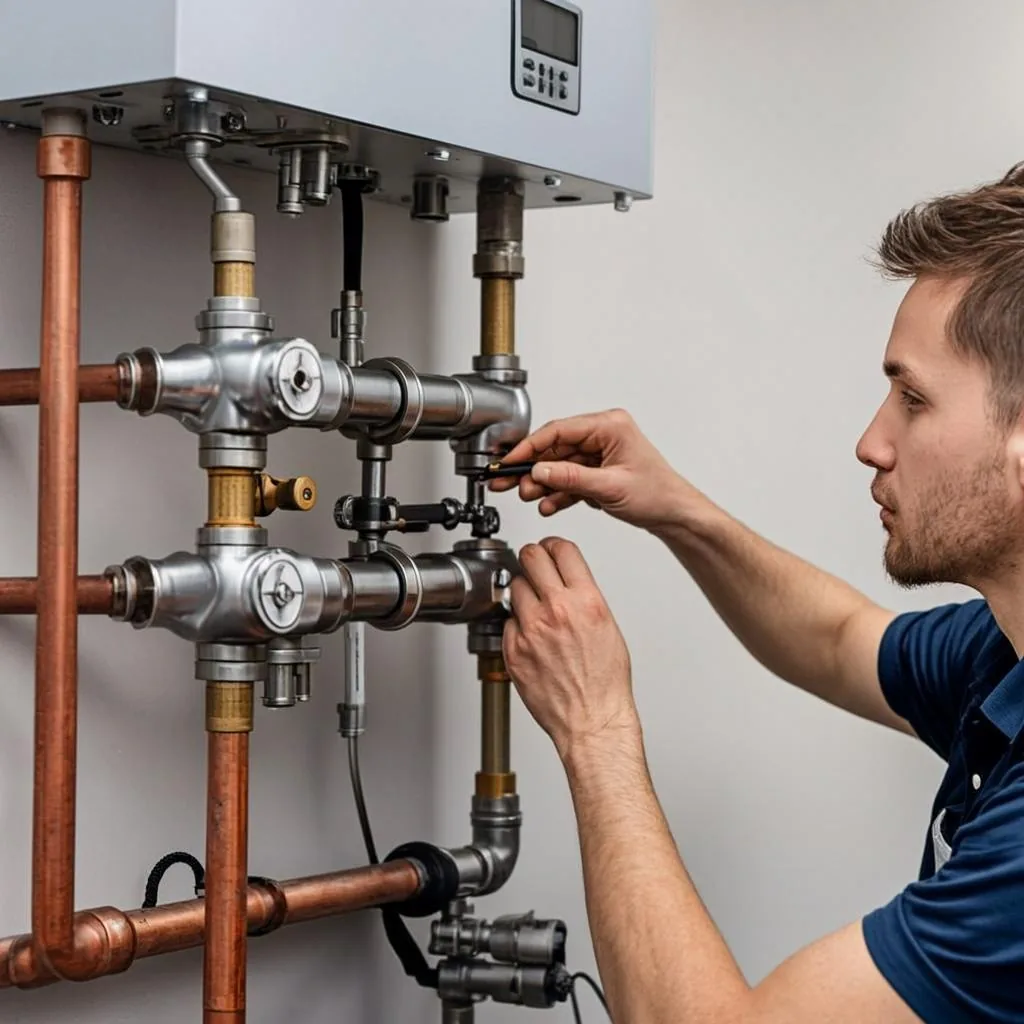
Now remove the storage entirely. A tankless unit is a flat rectangle the size of a small suitcase that mounts on a wall, with a very powerful burner aimed at a densely coiled heat exchanger - a copper or stainless passage of tubing shaped like a tightly wound radiator. Cold city water flows in one end; a flow sensor detects movement of at least roughly 0.5 to 0.7 gallons per minute and wakes the unit up; an electronic control board measures incoming water temperature and modulates the gas valve, firing only as many of the burner's stages as needed to hit your output setpoint, commonly 49 to 55 degrees Celsius (120 to 130 degrees Fahrenheit).
The moment you close the tap, the burner cuts out completely. Nothing is stored, nothing is kept warm overnight, no pilot burns in modern units (intermittent ignition replaces the standing pilot). Condensing models - which is nearly everything worth installing in 2026 - add a second heat exchanger upstream that wrings extra heat out of the exhaust gases, cooling them so much that the byproduct is a steady trickle of condensate that drains through a neutralizer. That is why condensing tankless vents through inexpensive PVC or concentric plastic pipe instead of stainless steel: exhaust leaves at a lukewarm temperature rather than several hundred degrees.
The defining behaviour of tankless is endless but rate-limited hot water. You can run showers literally all day and the water never cools - but the unit can only raise so much water per minute to shower temperature. The burner is rated in BTU per hour, commonly 120,000 to 199,000 for residential gas models in Canada, and the colder the water entering your house, the fewer gallons per minute (GPM) that BTU budget can heat. This is where Vancouver winters matter, and where online specs deceive people: a "9.8 GPM" rating on the box is measured at a 35-degree-Fahrenheit rise, not the roughly 54-degree-Fahrenheit rise (30 degrees Celsius) you need to take 10-degree-Celsius January mains water up to a 40-degree shower.
Electric tankless units exist too - typically 24 to 36 kW whole-house models - but in BC Hydro territory they are usually a dead end for whole-house use, because most Metro Vancouver service panels and many condo suites simply do not have the spare amperage (a 36 kW unit at 240 volts draws 150 amps by itself). Where electric on-demand units do work here are point-of-use applications: a single sink at a kitchen island or a garage washroom, on a dedicated 30 to 40-amp circuit.
Cost Comparison: What You Actually Pay in Vancouver
Let us start with the money, because this is where most comparisons oversimplify. The numbers below reflect real 2025-2026 installed invoices across our Metro Vancouver service area, including standard permit, disposal of the old unit, seismic strapping and code-required valves. Your actual quote moves with venting difficulty, gas-line upgrades, and access - a tank in a West Point Grey basement crawlspace costs more than the same tank in a Surrey utility room at grade.
| System Type | Typical Installed Cost (Vancouver & Surrey) | Lifespan (maintained) | Typical Annual Energy Cost* | Standby Loss |
|---|---|---|---|---|
| 40-60 gal gas tank (atmospheric vent) | $1,800 - $3,200 | 8 - 12 years | $340 - $460 | 10 - 15% of input |
| 40-60 gal electric tank | $1,400 - $2,400 | 8 - 12 years | $520 - $680 | 10 - 15% of input |
| Condensing gas tankless (wall-hung, PVC vent) | $2,800 - $5,500 | 20+ years | $250 - $340 | Essentially zero |
| Heat pump water heater (HPWH) (electric, hybrid) | $3,200 - $4,800 before up-to-$1,000 CleanBC rebate | 12 - 15 years | $140 - $230 | Small (storage, but insulated) |
| Point-of-use electric tankless (single fixture) | $450 - $900 installed (dedicated circuit) | 15+ years | Usage-based | Zero |
*Annual energy figures are illustrative ranges for a typical 3-bedroom Metro Vancouver household at current FortisBC and BC Hydro residential rates, at mid-tier consumption. Actual bills depend on household size, setpoint and rate tier.
Read that table carefully and one thing jumps out: the upfront gap between a gas tank and a condensing tankless is typically $1,000 to $2,300, while the annual operating gap is roughly $90 to $130. Straight payback on energy alone is therefore 8 to 15 years - longer than many online guides claim, because BC's relatively affordable natural gas keeps the tank's running cost lower than in Ontario or most of the US. Anyone quoting you "3-year payback" on gas tankless in Vancouver is comparing against electric tanks or ignoring our fuel market.
The cheaper way to think about it: buy the tankless for its non-energy advantages - endless hot water, 20+ year life, freed floor space, no flood risk from a burst 50-gallon tank, reduced carbon footprint, and resale appeal - and treat the $90-to-$130-per-year energy saving as a bonus that quietly covers the premium over the second decade. If those advantages matter to your household, tankless is worth it in Vancouver. If they do not, a quality gas tank remains a defensible, economical choice in a region with cheap gas.
Two cost items hide in the fine print. First, vent runs: converting from a tank to a tankless means running new Category IV (plastic) venting to the exterior, ideally within about 15 to 25 feet of an outside wall with code-required clearances to windows and property lines. Second, gas line capacity: a 199,000 BTU tankless can need a 3/4-inch gas line where the 40,000 BTU tank happily ran on 1/2-inch, which adds pipe work and occasionally a meter-upgrade conversation with FortisBC. Both are things we scope during the free in-home quote, so there are no surprises on installation day.
Vancouver Factors: FortisBC Gas, Condo Space & Growing Families
Generic buying guides fail in Vancouver because three local realities bend the decision.
1. FortisBC gas keeps tanks viable
Most detached homes in Vancouver, Burnaby, New Westminster and Surrey have FortisBC natural gas at the meter, and per unit of heat delivered it has typically undercut BC Hydro's residential electricity rates for heating water. That is the opposite of places like the Kootenays or Vancouver Island, where electric heat is the norm and gas tanks are rarer. Practically: if you have gas at your house and budget is the priority, a $1,900-to-$2,600 quality gas tank delivers perfectly good economics here, and a condensing tankless will still save energy but pay back slowly. If you have no gas service - many Richmond and North Vancouver pockets, most condos - your realistic comparison is electric tank versus heat pump water heater versus (in some houses) bringing a gas line in.
2. Condos, townhouses and laneway homes reward tankless
A 50-gallon tank occupies roughly a 24-by-24-inch footprint and, with code clearances, effectively eats a closet. In a 620-square-foot False Creek condo, a Mount Pleasant townhouse, or a laneway home where the "mechanical room" is a corner of the entry, a wall-hung tankless that measures about 18 inches wide by 27 inches tall and vents directly through an adjacent exterior wall converts dead wall space into usable storage. Strata considerations apply: exterior penetrations, vent termination locations and gas pressure in risers typically need a strata sign-off; we prepare the specification sheet your property manager will want. In load-limited suites (common in buildings that cap total electrical demand), gas tankless is often the only way to get unlimited hot water, because an electric tank's recovery is slow and whole-suite electric tankless exceeds the load cap.
Strata tip from 2,400 installs: before quoting, we photograph the existing riser, meter and vent path and provide a one-page equipment cut-sheet for the strata's records. Approvals that stall for weeks are almost always missing paperwork, not objections.
3. Growing families: the flow-rate question
The tank-versus-tankless question in family homes comes down to arithmetic. A tank delivers a big burst (its first-hour rating) then recovers slowly; a tankless delivers a smaller-but-never-ending stream. Two adults with one bathroom almost never outgrow a 50-gallon tank. Add a third bathroom, a teenager who showers at 7:05 while the dishwasher and laundry run, and a soaker tub that fills at 5 GPM - now the tank's burst runs out and the tankless keeps going. The GPM math for real Vancouver winters is in the sizing section below; the short version is that a properly sized 199,000 BTU unit runs two showers plus a fixture simultaneously in January, forever, where a 50-gallon tank delivers about 12 to 15 minutes of the same before going lukewarm.
4. Recirculation solves the "wait for hot water" problem
The classic tankless critique - "it takes longer to get hot water to the tap" - is really a pipe-volume problem that tanks also have. Twenty metres of 1/2-inch pipe holds about a gallon and a half of cold water that must be purged before hot arrives, tank or no tank. The modern fix is a recirculation system: a small pump, a smart valve or dedicated return line that pre-pushes warm water through the loop so the fixture goes hot in seconds. Navien's ComfortFlow and Rinnai's internal-circulation models build this in; on-demand buttons and smart-schedule modes keep the energy penalty near zero compared to a continuously circulating loop. We recommend recirculation for almost every laneway home, long-rancher layouts in Cloverdale, and any house where the water heater sits more than 40 pipe-feet from the main bathroom. It also eliminates the "cold water sandwich" - the slug of cool water a basic tankless delivers if you shut the tap off for 30 seconds and reopen it mid-shower.
Lifespan & Reliability: 8-12 Years vs 20+ Years
Industry-wide, glass-lined storage tanks in Canadian service average 8 to 12 years, and Vancouver sits near the middle of that band. Our soft, low-mineral source water from the Capilano and Seymour watersheds is kind to tanks - little scale, slow sediment accumulation - but it is also mildly acidic and gentle on anodes, which ironically lets tanks coast along until a failure mode that maintenance would have caught. When a tank dies, it is usually the anode that went first, unnoticed, years earlier.
Condensing tankless units invert the equation: the heat exchanger contains no stored water, so there is nothing to rust through and no anode to consume. Real-world service life is 20 years and frequently beyond - we service Navien and Rinnai units in Metro Vancouver that passed their 18th birthday on original heat exchangers. What actually retires a tankless early is almost always scale in the coil (see the maintenance section) or neglected condensate drainage. Component-level repairs - flow sensors, fan motors, control boards - are modular and typically $250 to $600, versus the tank reality where any internal failure means replacement of the whole unit.
- Tank warranties run 6, 9 or 12 years and are priced accordingly; the 12-year Bradford White and Rheem models carry heavier anodes and thicker insulation, and 12-year tank installed at 8+ expected-life economics often beats buying 6-year tanks twice.
- Tankless warranties are commonly 12 to 15 years on the heat exchanger, 5 on parts, and can extend to 12 on parts when registered and professionally maintained - another reason the $139/year flush plan matters.
- Heat pump water heaters typically carry 6 to 10-year warranties and last 12 to 15 years, with the compressor being the component that decides longevity.
- Workmanship from us is warranted 2 years on every install, on top of manufacturer coverage.
A fair reliability comparison also has to include failure consequence. When a tank fails, up to 50 gallons of water releases into your home - which is why tanks belong in a drain pan plumbed to a drain, and why we recommend leak-detection shutoff valves for tanks installed above finished spaces. When a tankless faults, it is almost always a controlled shutdown with an error code on the front panel: you lose hot water, not your ceiling. For suites over garages, mechanical rooms above living space, and laneway homes, that asymmetry alone justifies the tankless premium for many owners.
Efficiency & Standby Loss, Explained Honestly
A storage tank loses heat two ways: through the insulated walls (conduction) and up the flue (convection - the tank's internal chimney keeps siphoning warm air out of your house even when the burner is off, while drawing cold air in elsewhere). Combined, that is the famous standby loss: 10 to 15% of the energy a tank consumes is spent keeping water hot that nobody is using. Standby loss is why an electric tank with "100% efficient" elements still costs more to run than its rating suggests - the elements lose nothing to combustion, but the tank still bleeds heat every hour of the day, and it is why older tanks with degraded insulation are worse than their nameplate.
Tankless units eliminate standby loss because they store nothing. Combustion efficiency of a condensing model sits at roughly 93 to 96% - it recovers heat from exhaust that a tank dumps outside. On the federal Uniform Energy Factor (UEF) scale you will see roughly 0.60 to 0.67 for typical gas tanks, 0.93 to 0.96 for condensing gas tankless, and 3.0 to 4.0 for heat pump water heaters, which move heat rather than generate it (a UEF above 1.0 means more hot-water energy delivered than electricity consumed).
Do not confuse efficiency with savings. A tankless that is 45% more efficient saves 45% of your water-heating energy, which in a FortisBC gas home is a $90-to-$130-per-year difference, not a life-changing number. The efficiency case for tankless becomes overwhelming only against electric resistance tanks, and the strongest efficiency play of all in 2026 is the heat pump water heater with CleanBC's up-to-$1,000 rebate - though it needs roughly 7 cubic metres (about 250 cubic feet) of surrounding air or ducted air to feed on, plus a condensate drain and a 240-volt connection.
Vancouver's mild climate is quietly ideal for heat pump water heaters: they draw heat from surrounding air that only rarely falls below 10 degrees Celsius in an interior mechanical room, and their cooling side-effect (they exhaust slightly chilled air) is a feature in July, not a liability. In the 2021 heat dome's aftermath, homeowners with HPWHs in garages noticed nothing at all about their hot water; the same week, we replaced two failed power-vented tanks whose electronics did not enjoy 40-degree mechanical rooms.
Sizing Guide with Real Vancouver Examples
Sizing a tank is about first-hour rating; sizing a tankless is about GPM at your coldest inlet water. Metro Vancouver mains water runs roughly 13 to 15 degrees Celsius in late summer and 7 to 10 degrees Celsius in January. To deliver a 40-degree shower, that is a 25-to-30 degree Celsius rise, or about 45 to 54 degrees on the Fahrenheit scale most spec sheets use.
| Fixture (typical 2026 BC fixtures) | Flow at 40-49°C delivery | Notes for Metro Van homes |
|---|---|---|
| Low-flow showerhead | 1.75 - 2.1 GPM | BC plumbing code caps showerheads at 1.9 GPM in new construction |
| Two simultaneous showers | 3.5 - 4.2 GPM | The classic family-of-four morning peak |
| Kitchen faucet (aerated) | 1.5 - 2.2 GPM | Often run intermittently; dishwashers self-heat |
| Clothes washer (hot/warm) | 2.0 - 3.0 GPM | Modern HE washers use far less than 2000s models |
| Deep soaker tub fill | 4 - 6 GPM | Tub fills are the demand that breaks marginal systems |
| Whole-house steady demand, busy family morning | 5 - 7 GPM | Two showers + one fixture, or one tub + one shower |
Now the burner math. A 199,000 BTU/h condensing tankless at roughly 93% efficiency, heating water through a 30-degree Celsius (54-degree Fahrenheit) rise, delivers about 6.8 GPM continuously. A 160,000 BTU model under the same conditions delivers about 5.5 GPM. Compare that to the demand table: the 199k unit comfortably runs two showers plus a kitchen faucet in January; the 160k unit runs the two showers but gets thin if the laundry kicks in.
Worked example: family of four, Surrey panhandle duplex
Two adults, two kids, 2.5 bathrooms, two teenagers who will not schedule their showers. Peak demand is two 2.0 GPM showers plus an occasional dishwasher cycle, call it 5 GPM at a 30-degree rise. Their existing 50-gallon gas tank has a first-hour rating around 70 gallons: the first 20-minute double shower draws down stored hot water, and by the time the second bathroom joins, temperature is sagging. Replacement options we would quote: a 50-gallon 12-year tank (first-hour ~ 75 gallons, still eventually finite), or a 199,000 BTU Navien NPE-240A2 with built-in recirculation (6.5+ GPM winter continuous, endless, plus instant hot water at the far bathroom through the existing return line stub). For a family that plans to stay 10+ years in the home, the tankless premium is roughly the cost of one avoided tank replacement cycle plus a decade of better mornings.
Worked example: retired couple, Kitsilano character house
Two people, one bathroom, gas at the meter, staying in the home long-term. Peak demand is a single 2.0 GPM shower plus a kitchen sink: about 3.5 GPM. A 140,000-to-160,000 BTU tankless covers it with headroom, but so does a 50-gallon tank at half the price, and a tank swap is a 3-hour same-day job with zero venting changes. Energy savings of about $100/year against a $1,400-to-$1,900 premium is a 14-year payback. The rational call here is usually the quality tank - unless the basement renovation plans want the tank's floor space, or the owners want to eliminate the 50-gallon flood risk above the media room. This is exactly the conversation to have with a real quote in front of you.
Worked example: East Vancouver laneway rental
One bathroom, kitchenette, no gas service extended to the lane, BC Hydro meter with a modest panel. A 40-gallon electric tank works but takes 60+ minutes to recover between tenant showers and eats a corner of the laundry closet. The best-fit answer is frequently a small electric heat pump water heater (the 66-gallon compact units) with the CleanBC rebate applied, or a gas tankless if the lane home was roughed with gas - which newer ones under Vancouver's laneway program often are. Sizing a rental is also a tenant-experience decision: tankless "never runs out" is a feature listings can advertise.
Never buy a tankless off the nominal GPM on the box. That number is measured at a 35°F rise, which Vancouver mains never require. Ask instead: "How many GPM at a 55°F rise?" - the honest winter number - and size the unit so that number meets or beats your family's realistic simultaneous demand.
Maintenance: The $139/yr Flush & Hard Water Notes
Tankless maintenance is simple, cheap and non-negotiable: once a year, isolate the unit, circulate a food-grade descaler through the heat exchanger for 45 to 60 minutes, rinse, and reset. Our maintenance plan runs $139 per year and includes the flush, error-code scan, combustion check, condensate neutralizer inspection, inlet-filter cleaning and burner sight-glass inspection. On Vancouver's municipal water - genuinely soft, single-digit grain hardness - scale accumulation is slow, and an annual flush keeps the coil effectively factory-clean indefinitely.
Hard water changes the equation, and Metro Vancouver has a soft-water core with a hard-water rim. Private wells in Langley, Abbotsford, Mission, parts of Maple Ridge and Chilliwack draw groundwater that can run moderately to very hard - enough to scale a coil visibly within a year. If your home is on well water, we flush on a six-month interval and often install a sediment filter upstream; in the hardest wells, a small-scale treatment system is what keeps the 20-year lifespan promise honest. Telling your installer "we're on municipal water" versus "we're on a well" is one of the highest-value sentences in the whole process.
Tank maintenance differs in kind: annual checks focus on the anode rod (a 5-minute pull once the fitting is free), TPR valve test-lift, sediment drain (a few gallons from the bottom drain valve until it runs clear - do this into a bucket, and note that on older units the drain valve itself may be fragile), and burner inspection for gas tanks. The same $139 plan covers tanks. One caution for the DIY-minded: anode replacement on a 10-year-old tank that has never been touched can seize or, on a badly corroded fitting, crack the tank - our techs bring the extraction tools and experience for exactly that scenario.
- Tankless, soft municipal water (Vancouver core): annual flush; expect 20+ years.
- Tankless, well water (Fraser Valley rim): flush every 6 months, sediment filter, realistic 15-20 years.
- Tank, any water: annual anode/TPR/sediment check; anode replacement at first check showing 50%+ consumption.
- HPWH: annual air-filter rinse (it is a heat pump - the filter clogs like a furnace's) plus air-purge check; same $139 plan.
Brands We Install: Navien, Rinnai, Rheem & Bradford White
Brand selection in 2026 is less about dramatic quality differences - all four below are genuinely good - and more about matching the model line to your house, your water and your warranty preferences. This is our honest field assessment from installing and servicing all of them across Metro Vancouver.
| Brand | Standout strengths | Watch-outs | Best fit in Metro Vancouver |
|---|---|---|---|
| Navien (NPE-2 / NPN series) | Built-in recirculation pump + buffer tank (ComfortFlow) ends cold-sandwich complaints; dual stainless heat exchangers; strong condensing lineup; Asian-built quality control | Dense feature set means slightly more sensors to fault over 15+ years; needs proper combustion air setup | Family homes with far bathrooms; laneway homes; anyone wanting true instant hot water without add-on pumps |
| Rinnai (RU199i / RE199) | Arguably the deepest track record in condensing tankless in North America; internal circulation option; excellent parts availability; legendary heat-exchanger longevity | Recirculation implementation is a little less turnkey than Navien's on retrofit jobs | Set-and-forget reliability buyers; long-hold houses; condo riser replacements where strata wants a familiar name |
| Rheem (tankless + ProTerra HPWH) | Strong value condensing tankless; the ProTerra line is the best-known heat pump water heater in BC, with leak-detection built in and high UEF | ProTerra wants 240V and air volume; budget tankless line is non-condensing - confirm the model | HPWH buyers chasing the CleanBC $1,000 rebate; electric-tank replacements; value-focused gas conversions |
| Bradford White (Defender tanks) | The contractor-grade tank standard; thick insulation, heavy anodes, Hydrojet sediment system; sold through licensed installers rather than big-box shelves | Basic aesthetics and no "smart" features; availability windows can stretch in peak season | Tank replacements where longevity-per-dollar is the goal; rentals; homes staying with gas long-term |
Which do we install most? For tankless conversions in Vancouver proper it runs roughly 40% Navien, 35% Rinnai and 25% Rheem, driven almost entirely by recirculation needs and vent path. For tanks, Bradford White and Rheem dominate, with the 12-year-warranty versions selected about two-thirds of the time because the price step is small relative to one avoided replacement cycle. The right answer for your home may differ - which is the point of a free in-home quote rather than a web cart.
CleanBC Rebates & the Electric Option
If your decision includes the question "what will the government pay for?", the 2026 landscape tilts strongly toward electric. CleanBC Better Homes offers an up-to-$1,000 rebate on eligible heat pump water heaters as part of its fuel-switching and efficiency menu, and when combined with the typically 3x efficiency of the technology and BC Hydro's step-2-avoiding operating profile, the HPWH becomes the lowest-lifetime-cost option for many electric homes - especially those already replacing an electric resistance tank.
For gas tankless, the CleanBC menu does not treat on-demand equipment as a fuel switch, but FortisBC has periodically offered efficiency programs on high-efficiency gas water heating, and requirements can change mid-year; our rebate desk tracks the current rules and handles pre-approval before you commit to equipment, because one of the most common rebate-voiding mistakes is buying hardware that is not on the eligible list. We file the paperwork for every job we quote - EnerGuide assessments where required, model-number verification, invoicing format, the works - at no extra charge.
Rebate reality check: the big CleanBC money (up to $6,000 to switch from a gas furnace to a heat pump, up to $11,000 from oil, plus a $5,000 income-qualified top-up, stacking toward the advertised $16,000) lives in the space-heating world, not the water-heater world. If a water heater decision is on your desk at the same time as an aging furnace, sequencing the two together - heat pump first, water heater strategy second - can fund a meaningful share of both. Read our full CleanBC rebates 2026 guide for the complete program table.
HPWH installation has three practical requirements we verify on-site: the unit needs roughly 7 cubic metres of air around it (a standard garage or open mechanical room qualifies; a tight under-stairs closet does not unless ducted), a condensate drain or pump, and a 240-volt circuit. Noise is the other consideration - modern units run around 50 to 55 decibels in heat-pump mode, quieter than a fridge's ice maker, but worth knowing if it will sit against a bedroom wall. In hybrid mode the electric elements back the heat pump up during heavy demand, so the "endless" question never arises - you have a real tank, sized normally, that simply costs a quarter as much to run.
The Decision Flowchart (In Words)
Run your household through these questions in order. Where you first answer "yes" is almost always your answer.
- Do you have natural gas at the property? If no - skip to question 6. The gas-versus-gas comparison is over; you are choosing among electric options.
- Is the upfront budget the deciding factor? If yes - quality 12-year gas tank (roughly $1,900-2,600 installed) and spend the difference elsewhere. This is a rational, defensible choice in cheap-gas BC.
- Is floor space genuinely valuable - condo, townhouse, laneway, or a planned basement renovation? If yes - wall-hung condensing tankless; the freed 8-10 square feet and eliminated flood risk are worth the premium.
- Do two or more hot-water fixtures run simultaneously most mornings (two showers, shower + laundry, tub fills)? If yes - 199,000 BTU tankless with recirculation; a tank's first-hour ceiling will eventually annoy you.
- Are you staying in the home 10+ years, or is "endless hot water" a listing feature you want? If yes - tankless economics close the gap across a second decade and at resale. If you might sell within 5 years - the tank keeps more of its cost in your pocket; buyers do not reliably pay tankless premiums.
- (Electric path) Can you give a HPWH 7 cubic metres of air and a 240V circuit? If yes - heat pump water heater, claim the up-to-$1,000 CleanBC rebate, enjoy the lowest operating cost of any option.
- Is your electrical panel or suite load-limited? If yes - a standard electric tank (or, with gas available, gas tankless) - not whole-house electric tankless, which draws more amperage than many suites are allocated.
- Is this a rental property with one bathroom and modest demand? If yes - the cheapest reliable answer (often a 40-gallon electric tank, or the existing-tank-like-for-like swap) maximizes your return; spend the savings on an annual maintenance plan instead.
Three-quarters of the real-world decisions we quote land cleanly on one side of this flowchart within ten minutes of seeing the mechanical space. The interesting quarter - the "both could work" cases - come down to personal weighting of the tank's virtues (price, simplicity, fast recovery burst) versus the tankless's (endlessness, lifespan, space, no flood risk). Nobody has ever regretted either choice when it was made with the real numbers in front of them; they regret the choice that was rushed into on a flooded Tuesday.
Still weighing tankless vs tank? Get both numbers in one visit.
Our free in-home quote prices the tank swap and the tankless conversion side by side - including venting, gas line, permits, rebates and disposal - so you can decide with real figures, not web averages. Same-day replacements available across Metro Vancouver.
Get My Free Water Heater Quote Call 604-615-2212No-pressure, written quotes · $89 diagnostic credited to any repair · 2-year workmanship warranty
Installation Day & Same-Day Replacement
Planning beats panic. A pre-booked tankless conversion is a one-visit, roughly 6-to-8-hour job: protect floors, shut water and gas, drain and remove the old tank, mount the unit, run venting and condensate, upgrade the gas branch if scoped, install new isolation valves and pressure-relief arrangement, commission, burn off manufacturing oils (the new-unit smell of the first hour is normal and clears with windows cracked), walk you through the controller, and file the gas permit through Technical Safety BC. You have hot water for dinner.
An emergency tank replacement is even faster - our vans stock the common Metro Vancouver sizes (40, 50, 60 and 75-gallon, gas and electric) plus pans, straps, valves and flex connectors - so a tank that fails at 8am is typically replaced by mid-afternoon, old unit recycled, permit filed, house broom-clean. Roughly 92% of our 2025 replacements were same-day. The main variable is access: a tank swap in a tight Kitsilano basement crawl takes longer than a Surrey utility room, and pre-2015 code situations occasionally need a small corrective item - a missing sediment trap on the gas line, an unstrapped water meter - which we flag before touching anything, with the price in writing before work starts.
What we deliberately do not do is the "replace it and ask questions later" routine. Before any swap on a home with an aging furnace, boiler or heat-pump question in play, we will point out the sequencing opportunity - because CleanBC's biggest cheques go to homes that plan the electrification order correctly, and because a water heater decision made in isolation can lock in venting and gas infrastructure that a smarter two-year plan would have retired. That conversation costs nothing.
Tankless vs Tank: FAQ from Vancouver Homeowners
Yes when any of these apply: you have gas service and value endless hot water, you want to free floor space in a condo, townhouse or laneway home, you plan to stay 10+ years, or your family routinely runs two showers at once. No when the upfront premium strains the budget on a home you may sell within five years - FortisBC's relatively cheap gas keeps a quality tank economically honest here. Payback on energy alone runs 8-15 years; the rest of the value is capacity, lifespan and space.
Installed in Metro Vancouver, a condensing gas tankless runs $2,800-5,500 versus $1,800-3,200 for a quality gas tank - a $1,000-2,300 premium driven mostly by venting and gas-line work. Electric tanks run $1,400-2,400; heat pump water heaters $3,200-4,800 before the up-to-$1,000 CleanBC rebate. Every quote we write itemizes the venting, gas, permit and disposal lines so you can see exactly where the difference lives.
A 199,000 BTU condensing model. Vancouver January inlet water around 7-10°C needs roughly a 30°C rise to shower temperature, at which that burner size delivers about 6.5-7 GPM - comfortably two low-flow showers plus a kitchen fixture simultaneously, indefinitely. A 160,000 BTU unit (~5.5 GPM) works for one-shower-at-a-time households. Ignore nominal "9.8 GPM" box ratings; they assume warm inlet water we never have.
Usually yes, with gas on the riser: wall-hung units vent through an adjacent exterior wall in PVC, and we supply the cut-sheet and photos your strata or property manager needs for approval. Two constraints to check first: gas pressure in the building's riser (we test it) and electrical capacity for the condensate pump and controls (minimal). Whole-suite electric tankless is generally not viable in condos because of load limits - the units draw more amperage than many suites are allocated.
Yes - condensing models are designed for it, and freeze protection (electric heaters on the exchanger and lines) is built in as long as power stays on. The honest caveat is capacity: output GPM drops as inlet water gets colder, which is why sizing must use January water temperatures, not summer. The classic complaint about a momentary cool slug - the "cold water sandwich" - is solved by recirculation models like Navien's ComfortFlow or Rinnai's internal-circulation units, which we recommend for any bathroom more than 40 pipe-feet away.
The CleanBC heat pump water heater rebate (up to $1,000) is the standing water-heating offer, favouring the electric HPWH path. Gas tankless has no standing CleanBC rebate, though FortisBC has run periodic high-efficiency gas programs - rules shift during the year. The critical rule for every program: get pre-approval and confirm the exact model is on the eligible list before buying anything. Our rebate desk checks current offers and files all paperwork at no charge on installs we quote.
What We Can Quote For Your Home
Tankless Water Heater Vancouver Installation & Tank Replacement
Both sides of this decision, quoted in one visit: tank swaps from stock on our vans, Navien and Rinnai conversions with recirculation, and heat pump water heaters with the CleanBC rebate filed for you.
Plumbing Repairs, Leak Detection & PEX Repiping
Water heater work is plumbing work: shutoff valves, sediment drains, leak repairs and full PEX-A repipes for poly-B era homes across Vancouver, Surrey and the Tri-Cities.
CleanBC Rebates & Financing From $0 Down
Pre-approval, EnerGuide assessments and full paperwork filing on rebate-eligible upgrades, plus monthly payment plans that make the tankless premium a non-event.
24/7 Emergency Plumber Vancouver
Failed tank flooding the floor? No hot water before a holiday weekend? Live dispatch around the clock, average 45-minute response in Vancouver, Burnaby and Richmond.
Related Guides
Water Heater Failure Signs: Catch It Before It Floods
The 10 symptoms that precede a tank failure, from rusty water and rumbling to the pilot-light pattern that predicts the thermocouple's next move.
EfficiencyEnergy-Efficient Upgrades in BC: What Actually Pays Off
Heat pump water heaters, windows and heat pumps ranked by payback period with current CleanBC stacking - the sequel to this decision.
PlumbingHow To Detect Hidden Water Leaks Before They Cost Thousands
Meter tricks, acoustic detection and the silent-failure spots in Metro Vancouver homes - including the ones that end tankless warranties.
Get Your Free Water Heater Quote in Vancouver & Surrey
Tell us about your home and hot water habits and we will price the tank swap and the tankless conversion side by side - written, flat-rate, including permits, disposal and rebate filing. Call-backs within 15 minutes during business hours, and same-day replacement is usually available if your tank has already failed.
Why Homeowners Choose Us
- Serving Metro Vancouver since 2010 - 2,400+ water heaters installed
- Red Seal licensed plumbers & gas fitters, $2M insured, WorkSafeBC
- 4.9-star average from 512 verified reviews
- Same-day replacement - common tank sizes stocked on vans
- Upfront flat-rate written quotes; $89 diagnostic credited to repairs
- CleanBC rebate paperwork handled for you, at no charge
- 2-year workmanship warranty on every installation