
The Honest Answer Up Front
Most AC repairs in Surrey cost $180 to $450. That band covers the parts that actually fail in this climate, capacitors, contactors, fan motors, control boards, clogged condensate lines and failed sensors, and it is the number you should expect on a normal summer service call. The diagnostic that finds the fault is $89, and it is credited in full toward any repair completed on the same visit, so on a standard repair the diagnosis costs you nothing.
Two repairs sit outside that band, and knowing them before the van arrives is half the battle. Tracing and repairing a refrigerant leak runs $280 to $650, because finding a leak hiding in a coil, a fitting or a buried line-set is real diagnostic time plus recovery and recharge work. And a compressor replacement runs $1,800 to $3,200, which is a different conversation entirely, because that money lands next to the price of a whole new system.
A real Surrey example from a recent season: a 1998 condenser in Fleetwood died on the first hot Saturday, and the fix, capacitor, contactor and coil clean, came to $340 flat with the $89 diagnostic credited off the bill. That is what the common case actually looks like: a two-decade-old unit revived for a fraction of replacement money, honestly quoted before the wrench turned.
The other honest number is what failure costs to avoid: the $129 tune-up, booked in April or May, cleans the coils, verifies the refrigerant charge, tests electrical draw under load, clears the condensate drain and checks the capacitor before the hottest week of the year kills it. If your AC has already stopped cooling, run the not-cooling checklist first; a surprising share of no-cooling calls are tripped breakers, dead thermostats or clogged drains.
The flat-rate number on the written quote is the entire number. No hourly meters, no parts markup surprises at the counter, and if a $340 fix restores your condenser, that is the job we do.
0 diagnostic, credited
Complete fault isolation on the first visit, fee waived with any repair you approve on the spot.
0 top of the common band
Most Surrey AC repairs land between $180 and $450, capacitors, contactors, motors, boards and sensors.
0 star rated
From 512 verified reviews, earned on flat-rate quotes and first-visit fixes across twelve cities.
0 jobs since 2010
Cooling, heating and plumbing jobs across Metro Vancouver behind every price in this guide.
The Full AC Repair Cost Table for Surrey
This is the complete cooling price list we invoice from, matching the published rates on our cooling service page and the Surrey city sheet. The install lines at the bottom are the replacement market you trade against when a repair quote lands, and the tune-up line is what keeps you out of this table in the first place.
| Line item | Price | What moves it |
|---|---|---|
| Standard AC repair | $180 - $450 | The failed component, brand and parts sourcing |
| Refrigerant leak trace + repair | $280 - $650 | Coil, fitting or buried line-set location; recovery and recharge time |
| Compressor replacement | $1,800 - $3,200 | Equipment tier and the age of the surrounding system |
| Diagnostic visit | $89, credited | Complete fault isolation, fee waived with any approved repair |
| Annual tune-up | $129 flat | Coils, charge, electrical draw, condensate drain, capacitor, per system |
| After-hours premium | $150 flat | Weekday nights, weekends and holidays, disclosed before dispatch |
| Ductless mini-split install (single zone) | $3,800 - $5,500 | Head placement, line-set run, electrical |
| Central AC installation | $3,800 - $6,500 | System size, ductwork condition, electrical upgrades |
Read the table top to bottom as the escalation path a cooling season can take. The first two lines are the common summer. The compressor line is the decision point, because $1,800 to $3,200 buys a lot of repair but sits next to new-system money. The install lines are what that comparison looks like, and financing turns a $3,800 single-zone ductless install or a $5,000 central system into a predictable monthly cost, with cash and financed totals shown side by side on our financing page.
What the $89 Diagnostic Actually Buys
The diagnostic is not a door charge, it is the inspection that turns a symptom into a priced fault, and it is credited toward any repair completed on the visit. Surrey is big, over 620,000 people across the largest land area of any city in the province, and average arrival runs 45 to 60 minutes from Fleetwood to South Surrey, with the vans carrying capacitors, contactors, fan motors, boards and sensors for the major brands so the common faults are fixed on the first visit.
The sequence matters because cooling faults stack: a frozen coil can be a refrigerant problem, an airflow problem or a thermostat problem, and the wrong first guess turns a $180 fix into a $650 one. Our techs work the chain in order, electrical supply and controls first, airflow and coils second, refrigerant circuit last, because the cheapest possible cause has to be ruled out before the expensive one is quoted. That discipline is why the diagnostic exists as a separate, credited line instead of an hourly guess.
Controls and power
Thermostat calls, contactor pull-in, breaker and disconnect checks, control board signals. A surprising share of dead-AC calls are electrical supply or control faults, and they sit at the low end of the repair band.
Airflow and coils
Filter, blower wheel, evaporator and condenser coil condition, condensate drain flow. Airflow faults mimic refrigerant faults, and diagnosing them in the wrong order wastes money.
The refrigerant circuit
Pressures, temperatures and, if the charge is low, a leak trace. Low charge always means a leak somewhere, and finding it is the difference between a repair and a recharge that fails again next July.
The flat-rate quote
Diagnosis done, you get one written number for the fix, approved before work starts. Approve it and the $89 comes off the bill on the spot.
Inside the $180 to $450 Band
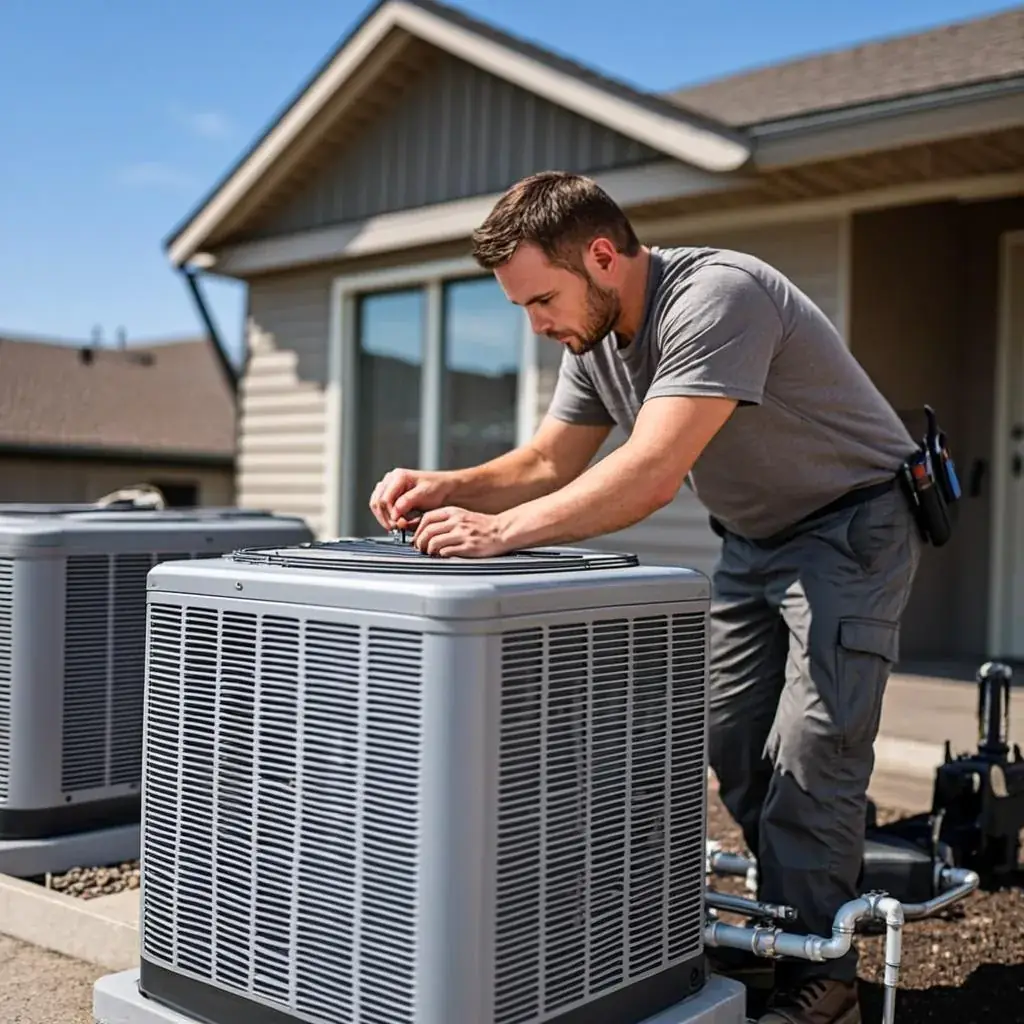
The common repair band is not a mystery, it is a parts list, and the parts fail in a predictable order of age and duty. This is what actually breaks on Surrey AC systems, and roughly what each fix involves.
The capacitor is the regional champion. It is the small part that stores the kick to start the compressor and fan, it lives in the outdoor unit through every winter, and when it weakens the system hums without starting or shuts down on hard afternoons. The contactor is its frequent partner, the heavy relay that switches the compressor on and off, pitting and sticking over thousands of cycles. Together they are the classic $340-style Fleetwood fix, capacitor, contactor and a coil clean, and testing the capacitor is a standing item on the $129 tune-up for exactly this reason.
Fan motors, control boards and sensors fill the top of the band. A failing condenser fan motor shows up as high head pressure and weak cooling on hot days, a cracked sensor or a drifted board fools the system into short cycling, and a clogged condensate line announces itself as water where water should not be, which in a Cloverdale rancher basement is its own kind of emergency. None of these repairs need a second visit when the van is stocked, and none of them should be quoted above the band they sit in.
| Part | How it fails | The fix |
|---|---|---|
| Capacitor | Humming unit, no start, hard-start afternoons, weakest on the hottest day | Test and replace, a minutes-level job with the part on the van, at the low end of the band |
| Contactor | Pitted contacts, stuck or chattering relay, compressor not pulling in | Replace the relay, inspect the board wiring while the panel is open |
| Condenser fan motor | Weak cooling on hot days, hot outdoor unit, squealing bearings | Motor replacement, coil clean in the same visit |
| Control board / sensors | Short cycling, fault codes, fan running with no cooling | Diagnose the fault code, replace the failed control or sensor |
| Condensate line | Water at the furnace or the float switch killing the system | Clear the line, clean the pan, test the switch |
One habit keeps this whole chapter cheap: the capacitor that dies in July was weak in May. The $129 tune-up tests electrical draw under load before the season, which is the one measurement that catches a weakening capacitor before it takes a service call hostage. Surrey's street trees and garden spaces also mean outdoor condensers collect debris faster than the regional average, so the annual coil clean earns its keep here more than in most cities.
Refrigerant Leaks: The $280 to $650 Truth
A refrigerant leak is the repair where honesty matters most, because the tempting fix, topping the system up, is not a fix at all. Refrigerant does not get consumed. If the charge is low, it went somewhere, and recharging without finding the leak means paying again next summer, and the summer after, until the compressor runs itself out on low charge. The proper repair is the trace, and the trace is why this band is wider than a parts swap: the leak can be a pinhole in an evaporator coil, a weeping flare fitting, or a line-set buried in a wall or under a deck, and each of those is a different amount of finding and fixing.
The $280 to $650 range covers trace and repair with the common outcomes: coil leaks located and, where the coil is sound enough, repaired or the coil replaced as a quoted separate decision; fittings re-flared and re-sealed; accessible line-set sections repaired. Recovery and recharge time is inside the number, because handling refrigerant properly means recovering it, fixing the leak, pressure-testing the repair, evacuating the system and recharging to the exact nameplate weight. A shop that skips the evacuation and vacuum step is handing you back a system with moisture and air in the circuit, which becomes the next failure.
There is also an equipment-era wrinkle worth knowing before you spend repair money: the industry is mid-transition away from older refrigerants to lower-GWP replacements, and the refrigerant your aging system uses is part of the repair-or-replace math, because component availability and refrigerant pricing only move one direction on a phased-out system. We tell you which side of that line your unit sits on at the diagnostic, before you approve anything. The heat pump replacement path is often where the math lands for units past the transition line.
The Compressor Question: $1,800 to $3,200
The compressor is the heart of the system, and its replacement is the largest repair we invoice, $1,800 to $3,200. When a compressor quote lands, the honest conversation is the comparison, not the repair: a new central AC system installs for $3,800 to $6,500 and a single-zone ductless system for $3,800 to $5,500, so compressor money is half-to-most of new-system money before you count the years the rest of your old system has left.
The rules we apply: a compressor failure on a system under a decade old with a clean diagnostic history is a reasonable repair, especially if the failure is a straightforward electrical fault like a shorted winding rather than a burnout that sends debris through the circuit. A compressor failure on a 15-year-plus system, or one that follows years of low-charge operation, is replacement math, because the repair buys the newest part in the oldest machine and the next failure is statistically the evaporator coil, the same coil that usually caused the compressor stress in the first place.
What the compressor job includes when it is the right call: recovery of the old charge, replacement of the compressor and the filter-drier, a full evacuation, recharge to nameplate weight, and a commissioning pass on pressures and amperage. Done properly it is a full-day-style repair, not an afternoon, and the $89 diagnostic is credited like any other. Done improperly, on a contaminated circuit without the drier and the vacuum, it fails within seasons, which is why this is the one repair we quote with the replacement numbers sitting next to it on the same page.
After-Hours Pricing and the Calendar
After-hours cooling calls carry one flat $150 premium on weekday nights, weekends and holidays, quoted before the van rolls, and the flat-rate repair price itself does not change after dark. There is no hourly meter and no mileage math, because a heat-dome Saturday at 9 p.m. is stressful enough without open-ended pricing. What the premium buys is the same stocked van and the same first-visit fix rate as a Tuesday morning.
The calendar is a pricing instrument, and this is the cheapest advice in the guide. Book the $129 tune-up in April or May, coils cleaned, charge verified, capacitor tested, while every company in the region still has open schedule. Book replacements and ductless installs in late spring, not the middle of a heat warning, when repair triage has every van. Homeowners who pre-season their cooling rarely meet us as an emergency; the ones who skip it meet us in July, which we handle, but the same work is quieter and better scheduled in May.
The regional pattern behind the urgency: Surrey sits in the Fraser Valley heat pocket, where heat-dome afternoons run hotter than coastal Vancouver and every AC in the city starts at once. Street trees and garden debris load the outdoor coils, long duct runs in the 1960s and 1970s ranchers of Cloverdale and Newton strain aging blowers, and the 2005-and-newer builds in Clayton Heights run higher-efficiency equipment that still dies on the same weak capacitors. When the whole city calls at once, the calendar decides who waits.
Repair or Replace: The Honest Math
The same 50 percent logic that governs furnaces governs cooling. When a quoted repair exceeds half the cost of a replacement system, and the system is deep into its second decade, the repair is usually buying time at replacement prices. The compressor chapter is the extreme case; a $650 leak repair on a 20-year-old condenser is the quieter one, because the next leak on a system that has already leaked is not a surprise, it is a schedule.
What replacement money buys that repair money cannot: SEER2-rated efficiency the old unit never had, a fresh parts warranty registered for you, a system sized from a real load calculation for the house rather than inherited from whoever installed the last one, and, on the heat pump path, winter heating in the same machine with CleanBC, BC Hydro and FortisBC rebates that can reach $16,000 on eligible cold-climate installs, paperwork handled by us. The ductless versus central AC comparison for Surrey homes lays out the equipment side of that decision.
And what repair money still buys honestly: seasons. The Fleetwood example is the standing proof, a $340 fix that carried a 1998 condenser through another full summer, diagnostic credited, no upsell. The difference between the two calls is the condition of the rest of the system, and the only way to know which side you are on is the diagnostic. Our rule is simple: we show you the repair price and the replacement math side by side, with the SEER2 and rebate numbers, and the choice stays yours.
| Situation | The honest call |
|---|---|
| Capacitor or contactor, system otherwise sound | Repair, low band, and book the tune-up so it is tested before next season |
| Refrigerant leak, first one, system under 10 years | Trace and repair, $280 to $650, with the coil condition assessed at the same visit |
| Refrigerant leak, second one in three seasons | Replacement math, the circuit is telling you something |
| Compressor, system 15 years plus or low-charge history | Replacement math, $1,800 to $3,200 against $3,800 to $6,500 new |
| Anything past the 50 percent line on an aging unit | Replacement, with financing from 7.99 percent and rebate paperwork handled |
What Your Surrey Neighbourhood Says About Your AC
Surrey's cooling stock is an era map, and the era your house was built in predicts both what breaks and what a repair should cost. This is the local half of a flat-rate quote, the reason the same capacitor replacement is routine in Clayton and diagnostic-heavy in a Newton rancher with a buried line-set.
The tune-up note that travels with it: annual service is $129 per system, and for properties with ductless heads the price scales with the number of heads on the site. Every visit cleans coils, verifies charge, tests electrical draw under load, clears the condensate drain and checks the capacitor, and it is the single cheapest line item in this entire guide relative to what it prevents.
| Neighbourhood | Housing era | What we usually find and fix |
|---|---|---|
| Fleetwood, Guildford, Fraser Heights | 1980s-90s family homes and towers | Aging original condensers, capacitor and contactor era, plus strata documentation on the towers |
| Cloverdale, Newton | 1960s-70s ranchers on big lots | Long duct runs, blower strain, buried line-sets that raise leak-trace time |
| Clayton Heights | 2005 and newer builds | Higher-efficiency equipment still failing on capacitors and drains, warranty paperwork matters |
| South Surrey, Ocean Park | 1970s-90s homes near the water | Corrosion checks on outdoor units, venting and drain assessments, annual service |
| Panorama Ridge, Morgan Creek | Larger rebuilds and luxury homes | Multi-zone ductless and zoned central systems, head-count tune-up pricing |
| Bear Creek, Green Timbers | Mixed 1970s-2000s stock | Mixed-era repairs, maintenance plans, the neighbourhood where the $129 visit pays for itself fastest |
The One-Page AC Repair Cheat Sheet
Save this for the first hot Saturday. Every line traces back to a chapter above, and every line is the difference between a flat-rate fix and an open-ended afternoon.
| Question | The answer |
|---|---|
| What does a normal AC repair cost? | $180 to $450, capacitors, contactors, fan motors, boards, drains and sensors |
| What does the diagnostic cost? | $89, credited in full toward any repair completed on the visit |
| What does a refrigerant leak cost? | $280 to $650 traced and repaired, recovery and recharge included |
| What does a compressor cost? | $1,800 to $3,200, quoted next to new-system money, $3,800 to $6,500 central |
| What is the after-hours premium? | One flat $150, disclosed before the van rolls, repair price unchanged |
| When should I book the tune-up? | April or May, $129 flat per system, before the region goes into triage |
| When is replacement the honest call? | Past the 50 percent line, second leak in three seasons, or compressor on an aging system |
| Who fixes it fastest? | 604-615-2212, 45 to 60 minutes average arrival across Surrey, 24/7 |
Get Your AC Priced Flat, Before It Gets Hotter
A $89 diagnostic credited to the repair, or a free replacement estimate with the SEER2 and rebate numbers side by side. Or call 604-615-2212, answered 24/7 with a flat $150 after-hours premium posted in advance.
Frequently Asked Questions
Services From This Guide
Flat-rate cooling repair, credited diagnostics and pre-season tune-ups across twelve Metro Vancouver cities.
AC repair and cooling service
$180 to $450 common repairs, $89 diagnostic credited, first-visit fixes with stocked vans.
AC repair Surrey
Same-day cooling repair across every Surrey neighbourhood, 45 to 60 minute average arrival, 24/7.
AC repair Langley
Flat-rate cooling repair for Langley and the Fraser Valley heat pocket, tune-ups from $129.
Heat pump replacement path
When repair math points to replacement: ductless and cold-climate installs with rebates up to $16,000.
Related Guides
AC Not Cooling: 10 Causes and the Ones You Can Fix
The checklist to run before any repair call, from breakers and thermostats to ice on the coil.
CoolingAC Capacitors: Signs of Failure, Costs and Lifespan
The part behind most of the $180 to $450 band, how it fails, and what replacement really involves.
BuyingDuctless vs Central AC for Surrey Homes
The equipment decision waiting at the end of repair math, compared honestly for Surrey housing stock.
Red Seal certified, licensed gas fitters (BC-PL-2019-4421), $2M insured and 15-plus years in the field, with more than 12,000 jobs completed across Metro Vancouver since 2010 and a 4.9-star rating over 500-plus reviews. We wrote this guide because cooling repair is the trade where vague pricing costs homeowners the most, and flat numbers posted before the wrench turns is the fix.
More about our team →Get a Flat AC Repair Price Today
Book the $89 diagnostic, credited to any repair you approve, or a free replacement estimate with the SEER2 and rebate math side by side. Financing from 7.99 percent on installs. Zero obligation, same-day service on most calls.
AC dead on the hottest day?
Cooling emergencies are answered 24/7 with live dispatch, a flat $150 after-hours premium posted in advance, and average arrival 45 to 60 minutes across Surrey.
Call 604-615-2212 WhatsApp Us