
The Honest Answer Up Front
An air conditioner that runs but does not cool has one of two kinds of problems: it cannot move enough air, or it cannot move enough heat. That sounds simplistic, but it is the divide every diagnosis starts from, and it is why the first things worth checking are the ones you can check. A clogged filter, a tripped breaker, a thermostat set to fan-only, a condenser buried in hedge trimmings and a slab of ice on the indoor coil are behind a remarkable share of the "AC not cooling" calls we run in a Metro Vancouver July, and every one of them is findable in fifteen minutes with a flashlight and your hand.
When it is not those, it is usually one part: the capacitor, the small silver cylinder that starts the outdoor fan and compressor, is the single most common genuine component failure in residential cooling, followed by contactors and fan motors. Genuine refrigerant problems do happen, but a system does not consume refrigerant, so a low charge always means a leak, and anyone who tops it off year after year without hunting the leak is selling you a subscription, not a repair. For the numbers people actually want up front: the common AC repairs in our flat-rate book run $180 to $450, the $89 diagnostic is credited toward any repair you approve, and a replacement, when the math finally says so, installs at $3,800 to $6,500 for central or $3,800 to $5,500 for ductless.
Do the fifteen-minute checks before you book, because we would rather tell you it was the filter for free over the phone than invoice you eighty-nine dollars to discover it with a flashlight. And when the checks come up clean, stop: capacitors hold lethal charge, refrigerant is regulated, and the diagnostic exists precisely so you do not have to guess deeper.
0 jobs since 2010
Cooling, heating and plumbing work across Metro Vancouver, half of it in houses that got AC after the 2021 heat dome.
0 star rated
From 512 verified reviews, many earned by talking customers out of repairs they did not need.
0 average response
On 24/7 summer emergency calls, with flat after-hours pricing posted before we roll.
0 of checks worth doing first
Filter, thermostat, breaker, ice and condenser clearance: the five-minute causes nobody should pay to discover.
How an Air Conditioner Cools, in Plain Language
You do not need thermodynamics to diagnose your AC, just the loop. Indoors, a fan blows house air across the evaporator coil, a cold radiator the refrigerant flows through; heat leaves your air, enters the refrigerant, and the now-chilled air rides the ducts back to your rooms. The warmed refrigerant travels outside to the condenser, where the compressor squeezes it hot, the outdoor fan blows air across the condenser coil to dump that heat into the street, and the refrigerant comes back inside cold to repeat the cycle. Cooling is heat moving, on a conveyor belt of refrigerant, from your living room to your patio.
Every failure in Chapter 3 is one link in that chain going weak. If the indoor fan cannot push air across the coil, you get weak airflow, a frozen coil, or both. If the outdoor fan or compressor will not run, the loop stalls and the indoor coil stops getting cold refrigerant, so air blows room-temperature. If the refrigerant has leaked out, there is not enough conveyor belt to carry the heat, and the coil runs too cold, freezes, and cools nothing. If the filter is clogged, the coil starves for air and ices over even with a full refrigerant charge. Once you can name the links, the ten causes stop being mysterious.
One term worth knowing because it appears on quotes: the two copper pipes at the outdoor unit. The fat one, the suction line, should be cold and sweating on a healthy system. The thin one, the liquid line, should be warm-to-hot. A warm fat pipe means the loop is not carrying heat; a frozen fat pipe means the charge or the airflow is off. Both readings are on the honest diagnostic checklist.
The Ten Causes, Ranked by Likelihood
Ranked by how often we actually see them in Metro Vancouver, from the ones that cost you a flashlight battery to the ones that cost you a decision. The Fix It Yourself column is honest: four of the ten are yours, six belong to a licensed tech, and the boundary between them is safety, not skill.
| Symptom | Cause | Who fixes it | Cost band |
|---|---|---|---|
| 1. Weak airflow from the vents, air is cold | Clogged filter starving the blower and coil | You | $0, five minutes |
| 2. Nothing runs at all | Thermostat on fan-only, dead batteries, or a tripped breaker | You | $0 |
| 3. Outdoor unit silent, indoor fan runs | Tripped outdoor disconnect or breaker | You | $0 |
| 4. Poor cooling, high bills, dust everywhere | Condenser coil buried in debris, pollen or hedge growth | You, gently | $0, hose and trimming |
| 5. Airflow died, then cooling died, ice on the indoor coil or pipes | Frozen evaporator coil from airflow loss or low charge | You thaw it, tech finds why | $0 to thaw, $89 diagnostic |
| 6. Outdoor unit hums, fan will not start, no cooling | Failed start capacitor | Pro | AC repair band, $180 - $450 |
| 7. Nothing starts, chattering from the outdoor unit | Failed contactor, the relay that sends power to compressor and fan | Pro | $180 - $450 |
| 8. Runs but cools worse every week, ice on the fat pipe | Refrigerant leak, low charge | Pro, leak search first | Diagnostic, then quoted repair |
| 9. Outdoor fan spins slowly or squeals, then quits | Condenser fan motor failing | Pro | $180 - $450, or worse on old units |
| 10. System is 12 to 20 years old, cools, but barely and loudly | End-of-life efficiency decline, not a single fault | Pro, replace | $3,800 - $6,500 central, $3,800 - $5,500 ductless |
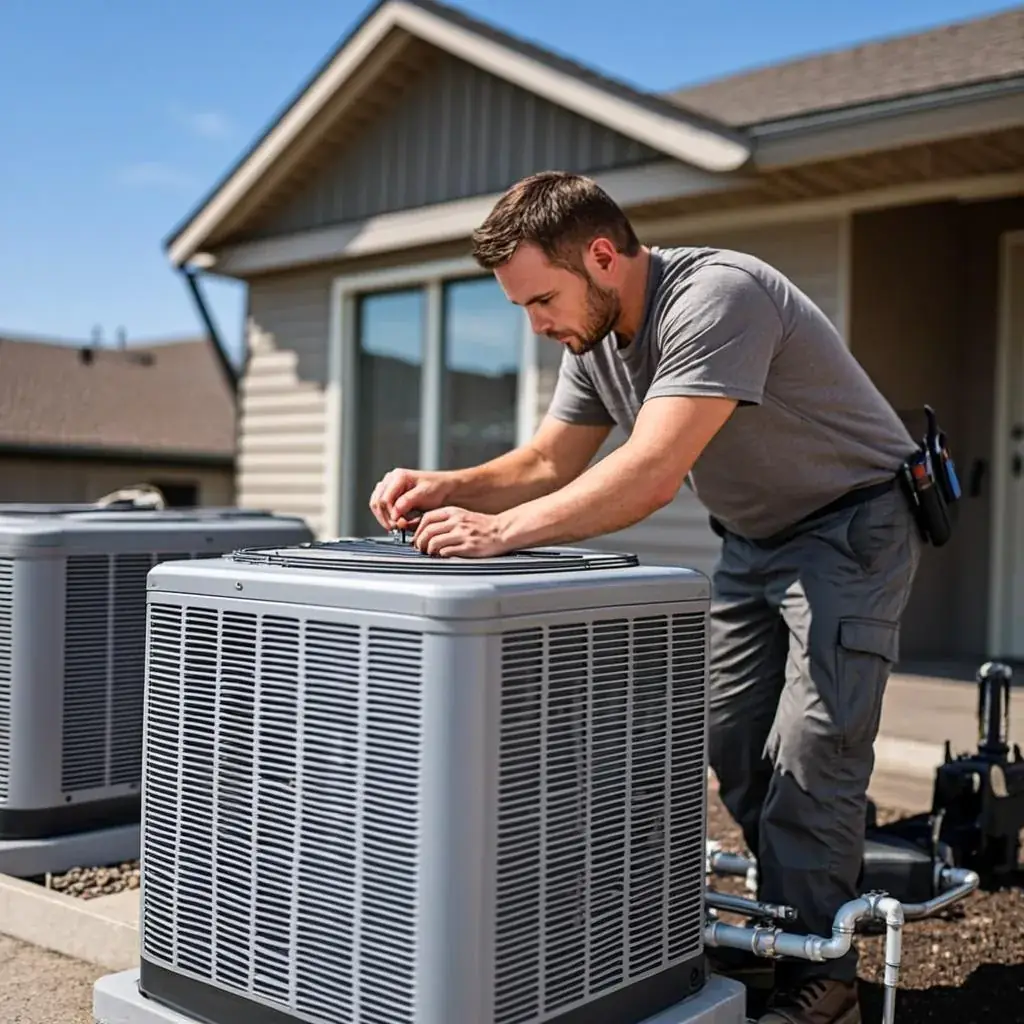
The Fifteen-Minute DIY Ladder
Run these in order, on a day the system has been trying to cool for at least half an hour. Stop the moment something is obviously wrong, fix it, and give the system an hour before judging the result. None of these steps involves opening anything electrical.
Confirm the thermostat is actually asking
Set it to Cool, three degrees below room temperature, fan on Auto. A switch left on Fan circulates room-temperature air forever and gets diagnosed as a broken AC twice a week all summer. Change batteries on any thermostat old enough to have them.
Check the filter and the airflow
Pull the filter and hold it to the light, then run the system without it for ten minutes as a test. If airflow at the far vents jumps, the filter was the whole problem, and the fix is a fresh one, today and every one to three months in cooling season, because wildfire-smoke summers load them fast.
Check both breakers and the disconnect
The AC lives on two circuits, indoor and outdoor, and the outdoor one is often a breaker plus a shutoff box on the wall beside the unit. Check both, and if the outdoor breaker is tripped, reset it once, watch the unit start, and if it trips again, stop and book a diagnostic, because repeat trips are a real electrical fault, not bad luck.
Listen to the outdoor unit
With the thermostat calling, stand at the condenser. Healthy is a steady hum with the fan spinning. A loud hum with the fan sitting still is the classic failed-capacitor signature. Rapid click-chatter is a failed contactor. Silence with the indoor unit running points back to the disconnect or the thermostat signal.
Feel the two copper pipes
At the outdoor unit, the fat pipe should be cold enough to sweat on and the thin pipe clearly warm. A warm fat pipe with the system running means the refrigerant loop is not moving heat and a tech is needed. A frozen fat pipe, or ice anywhere on the pipes or the indoor coil, means shut it off and continue to step six.
Thaw a frozen coil properly
Switch cooling off and run the indoor fan only, and give it one to three hours, because the ice has to melt off the coil, through the drain pan and out the condensate line. Do not chip, poke or heat anything. When it is thawed, try cooling again with a fresh filter: if it ices again, the cause is a low charge or a blower fault, and that is a diagnostic, not a Saturday project.
Clear the condenser's breathing room
Cut back grass, weeds and hedge growth to give the unit at least thirty centimetres of clearance on the sides and clear space above, and sweep leaves and fir needles out of the fins by hand. A condenser that cannot exhaust heat runs high pressures, cools weakly and eats compressors, and Metro Vancouver's cedar hedges plant themselves against condensers with suspicious regularity.
The Frozen Coil: the Symptom That Hides Its Cause
A block of ice on the indoor coil looks catastrophic and is usually a two-cause problem: either too little air crossed the coil, or too little refrigerant circulated through it. Both make the coil temperature drop below freezing, and the condensation on the fins freezes instead of draining, until the ice bridges the coil, blocks airflow entirely, and the AC blows room-temperature air while working harder than ever. Running a frozen system does real damage, because liquid refrigerant can slug back to the compressor, and the compressor is the part worth protecting.
The homeowner move is thaw-and-retest, from Chapter 4: cooling off, fan on, wait, fresh filter, one honest retest. If the freeze comes back, the cause is under the charge or inside the blower, and the $89 diagnostic earns its fee, credited to the repair. The technician will read the pressures, check the charge against the nameplate, measure airflow, and tell you which side of the divide you are on. What the tech will not do, on our crews, is simply melt the ice and leave: a freeze-up without an explanation is a symptom, and we write down which cause we found.
The Capacitor: the Part That Fails Most
The capacitor is the small oval or round cylinder in the outdoor unit's electrical panel, and its job is brutal: it stores and dumps a heavy jolt of current to start the compressor and fan motors, thousands of times a season, in a metal box that sits in the sun all July. Capacitors weaken with heat and age, and a weakened capacitor produces the single most recognizable not-cooling signature in residential cooling: the outdoor unit hums, because power is arriving, but the fan will not start, because the start torque is gone.
The visible signs are a fan that starts when you nudge it with a stick, a unit that starts and runs for minutes then dies, or a bulged or domed capacitor top, visible through the panel grille on some units. Here is the boundary that matters, plainly: this is not a DIY part, ever. A capacitor holds a serious stored charge with the breaker off, and it can put an untrained hand in the hospital on a system that is completely unplugged. The part itself is modest; the skill is discharging it safely, matching its rating exactly, and confirming the motor and contactor were not collateral damage. In our flat-rate book, capacitor work lands with the common AC repairs, $180 to $450, and the $89 diagnostic that identified it is credited to that invoice.
One more honesty note on capacitors: they are also the industry's favourite upsell. A tech who condemns a capacitor without testing it with a meter, or who replaces one on every visit, is guessing. Ask for the microfarad reading, written on the invoice, and compare it to the rating printed on the part. Ours always appear, because that is how you keep a 4.9-star rating over 39 reviews.
AC Blowing Warm? Diagnose It for $89
The diagnostic is credited toward any repair, common cooling repairs run $180 to $450, and the after-hours premium is a flat $150 posted in advance. Call 604-615-2212 or book the visit online.
Refrigerant: the Honesty Test for Any AC Company
Refrigerant is the conveyor belt, and an air conditioner does not burn it, consume it or use it up. A sealed system holds the same charge for decades. So the sentence "your AC is low on refrigerant" only ever means one thing: it leaked, and it leaks somewhere specific, at a fitting, a coil, or a corrosion pinhole in a line. The honest response to a low charge is a leak search, electronic detection, UV dye or pressure isolation, then a quoted repair, then a weighed-in recharge to the nameplate charge.
The dishonest response is the annual top-up: add some refrigerant, cool the house for a season, repeat next July. It costs you a subscription, vents regulated refrigerant to the atmosphere year after year, and postpones the small repair until it becomes a compressor. If a company proposes ongoing top-ups without a leak search, or quotes a recharge with no pressure readings and no hunt for the source, that is the honesty test failing in real time, and the second opinion is cheaper than the third season of top-ups. Our AC repair crews in Vancouver and the teams covering Surrey and the Fraser Valley run leak searches as standard practice on every low-charge diagnosis, and the findings go on the invoice.
One forward-looking note for owners of older systems: the industry is mid-transition away from R-410A toward lower-GWP refrigerants, which matters at replacement time and barely matters mid-life. A leak on an older system is usually repairable; it is simply worth knowing, before you spend on a large refrigerant repair, that the replacement path, $3,800 to $6,500 for central or $3,800 to $5,500 for ductless, is the moment the new refrigerants and the rebate-eligible heat pump equipment enter the math.
When the Answer Is Replacement, Honestly
Three facts retire an air conditioner. Age, first: in Metro Vancouver's short but intense cooling season, 12 to 15 years is the honest horizon, and units that limped through the heat-dome years are aging faster than their birth certificates say. The compressor, second: a failed compressor on an out-of-warranty unit is a replacement conversation, because putting the most expensive part in a decade-old system is financing a decline. The refrigerant economics, third: a major leak repair on legacy equipment, weighed against equipment whose efficiency has moved on, tips the same way.
The replacement math, from the same flat-rate book as the repairs: a new central air conditioner installs at $3,800 to $6,500, sized to the house with a load calculation, not to the old unit's nameplate; a ductless system, one outdoor unit and one wall head, installs at $3,800 to $5,500 and solves the one-room problem with cold airflow; and multi-zone ductless covers a whole floor plan. And because every ductless head is also a heat pump, the heat pump question belongs in the same conversation: combined CleanBC Better Homes, BC Hydro, FortisBC and municipal top-ups can reach $16,000 for cold-climate heat pumps in 2026, we complete the paperwork, and the heat pump pages lay out the equipment and eligibility side of that decision.
The decision rules, compressed: under 10 years old, repair almost anything in the $180 to $450 band; 10 to 12, repair the cheap faults and start planning; past 12 to 15, or a compressor, or a major leak, replacement wins on total cost of ownership. Financing runs from 7.99 percent with approved credit for the day the answer is replacement, and the same cooling service teams across Metro Vancouver quote repairs and replacements from one book, so the numbers land side by side instead of in competing pitches. If the diagnostic discipline in this guide sounds familiar, it is the same framework we published for heating season in the furnace not working guide, and for the weeks when the whole region is testing its cooling, the heat dome preparedness guide covers the house-side playbook.
Prevention: the May Visit That Skips the July Queue
Metro Vancouver's cooling season is short, which makes its failure calendar brutally concentrated: the first sustained 28-degree week, when every AC in the region starts at once after ten idle months, is when capacitors fail, filters reveal themselves and condensers meet the hedge trimmer. A May maintenance visit before that week is the air-conditioning version of the October furnace tune-up, and it covers the same ground a diagnostic covers: coil condition, capacitor microfarads, contactor contacts, refrigerant pressures against the nameplate, condensate drain flow and temperature split across the coil.
Between visits, the homeowner list is short and free: fresh filters on a wildfire-smoke-aware schedule, thirty centimetres of condenser breathing room with the hedge cut back, nothing stored or dumped on or beside the outdoor unit, the two-pipe hand test once or twice a season, and a note of anything odd, humming, slow starts, weak airflow, because the note is what turns a July emergency into a May line item. If the system is already acting up, do not wait for the calendar: the $89 diagnostic is available year-round and is credited toward any repair, and the 24/7 line, 604-615-2212, answers heat-wave nights with a flat $150 after-hours premium posted in advance.
The Not-Cooling Cheat Sheet
Find your symptom, do the row, re-test after an hour of run time. When a DIY row and a pro row both apply, the DIY row is free, so it goes first.
| Your symptom right now | The move |
|---|---|
| Nothing runs at all | Thermostat mode, batteries, both breakers, $0 |
| Airflow weak, air cold when it comes | Filter, today, $0 |
| Outdoor unit hums, fan still | Failed capacitor, book the diagnostic, do not open the panel |
| Ice on the indoor coil or pipes | Thaw with fan-only, fresh filter, retest once, then $89 diagnostic if it refreezes |
| Runs all day, house never cools | Condenser clearance and debris, then pressures and charge, diagnostic |
| Outdoor breaker trips repeatedly | Stop resetting it, book the diagnostic, real electrical fault |
| Warm fat pipe, no ice, airflow fine | Refrigerant or compressor side, diagnostic, expect a leak search |
| Anyone proposes annual refrigerant top-ups | Get the second opinion, 604-615-2212 |
| Unit is 12-plus years and this is its second fault this summer | Replacement quote, $3,800 - $6,500 central or $3,800 - $5,500 ductless, heat pump math included |
Frequently Asked Questions
Services From This Guide
Cooling diagnostics, repairs and installs across Metro Vancouver, 17 cities, seven days a week.
AC repair Metro Vancouver
The $89 diagnostic credited to repairs, capacitor and contactor work from the $180 to $450 flat-rate book.
AC repair Vancouver
Same-day cooling diagnostics across the city, leak searches as standard, no top-up subscriptions.
AC repair Surrey
Heat-wave triage for Surrey and the Fraser Valley, with honest repair-versus-replace math.
Heat pump replacement path
Ductless from $3,800 to $5,500 and central from $3,800 to $6,500, with CleanBC support to $16,000.
Related Guides
Heat Dome 2026: Is Your Metro Vancouver Home Ready?
The house-side playbook for the weeks that test every cooling system in the region.
CoolingDuctless vs Central AC: What Surrey Homes Should Choose
The replacement decision, ducted or ductless, priced for the homes in this guide.
HeatingFurnace Not Working? 12 Checks Before You Call
The heating-season twin of this guide, same diagnostic discipline, opposite season.
Red Seal certified, licensed gas fitters (BC-PL-2019-4421), $2M insured and 15-plus years in the field, with more than 12,000 jobs completed across Metro Vancouver since 2010 and a 4.9-star rating over 39 reviews. We wrote this guide because most not-cooling calls have a fifteen-minute answer, and because the families who know the honest tests are the ones the upsells never land on.
More about our team →Get the Cold Air Back for $89
Book the $89 diagnostic, credited toward any repair, or a free replacement estimate. You get the pressure and electrical readings, a flat-rate price from the $180 to $450 common-repair book, and a replacement quote with financing from 7.99 percent if the age math says so. Zero obligation, same-day slots on most calls.
AC down in a heat wave?
Cooling emergencies are answered 24/7 with live dispatch and a flat $150 after-hours premium posted in advance. Common repairs run $180 to $450, and the $89 diagnostic is credited when you proceed.
Call 604-615-2212 WhatsApp Us