The Honest Answer Up Front
Carbon monoxide is a combustion byproduct — a molecule of carbon and oxygen that forms whenever fuel burns incompletely — and it is dangerous to humans for one specific reason: your red blood cells bind it about two hundred times more readily than oxygen, so it quietly takes up the seats oxygen needs. You cannot see it, smell it or taste it. What you can do, reliably and cheaply, is detect it with an alarm, prevent it with maintenance, and respect it with a short list of habits that matter far more than worry does.
The honest risk picture for a Metro Vancouver home with a gas furnace: catastrophic CO events are rare, and they cluster around three causes — a furnace or water heater venting into a blocked flue, an idling vehicle in an attached garage sharing the house air, and (famous but least common) a cracked heat exchanger on an aging furnace that has been neglected for years. Modern high-efficiency furnaces add sealed combustion to the list of protections: their burner air comes from a plastic pipe, not your basement, which removes whole categories of the old risk math. None of this is a reason to skip the alarm; all of it is a reason to skip the fear.
The plan, compressed: alarms in every sleeping area — it is the law here for homes with fuel-burning appliances, and it is the single intervention that converts every scenario in this guide from a medical event into a beep. A yearly tune-up with combustion analysis, which measures the CO your furnace is actually producing and catches the drift before it matters. And the habits: never warm a car in an attached garage with the door to the house open, keep exterior vents clear of snow in outflow weather, and act on the symptom triage in chapter three. That is the whole discipline, and it fits on a fridge note.
0 ppm is the target
The only healthy reading for ambient CO inside a home. Measurable with a monitor, printable from our analyzer, and the number your tune-up report should show.
0 ppm flue-gas tune target
Where we like to see combustion CO on a healthy burner, well inside the safety standards — with the before-and-after numbers on your written report.
0 alarm sensor life, max
CO alarms expire. The manufacture date is stamped on the back, the sensor dies quietly after 7-10 years, and an expired alarm is a night light with opinions.
0 flat tune-up with CO test
Combustion analysis, CO measurement in the flue and the living space, the full safety chain and the written report you keep. October is the calm month to book it.
What CO Actually Is (and What the Numbers Mean)
The science in four sentences. Carbon monoxide forms when a carbon-based fuel — natural gas, propane, wood, gasoline — burns without enough oxygen, which is why the word "incomplete" does so much work in combustion talk. It is slightly lighter than air, which means it mixes rather than pools, and it drifts with the air your furnace, your HRV and your leaky envelope already move around. It produces no irritation on the way in, which is why victims rarely notice exposure — no smell, no sting, just a body slowly losing oxygen seats. And it is measured in parts per million, a scale worth learning because everything else in this guide references it.
The scale, in plain terms. Fresh outdoor air reads zero to two ppm — that is the planet's background level and your home's target. Sustained indoor levels in the tens of ppm are a chronic-exposure conversation: a venting fault, a garage habit, an appliance misbehaving quietly. Hundreds of ppm is the acute territory where symptoms arrive on a timeline of hours, and thousands of ppm is the industrial-accident range that residential equipment in good repair simply does not produce into a living space. Your alarm is engineered to alert at the boundary of the second zone, before healthy adults feel anything, with built-in time thresholds so a brief transient does not wake the street.
One number deserves special treatment because it anchors the whole maintenance conversation: the flue. The gases leaving a healthy burner contain CO by design — combustion is never perfect — and the standards allow hundreds of parts per million there, in a pipe headed outside. Our own tune-up target is under 100 ppm in the flue, comfortably inside the specs, and the before-and-after readings on a burner cleaning are often dramatic proof of what maintenance does. The flue number and the living-room number are different conversations, and a technician who cannot tell you both, with a meter running, is doing half the job.
| Concentration | What it means | Typical timeline | Your action |
|---|---|---|---|
| 0-2 ppm | Background, planet-normal | Any | None — this is the target |
| 10-25 ppm | Chronic source somewhere | Weeks matter | Investigate: tune-up, garage habits |
| 50 ppm+ | Fault needing attention | Days matter | Find and fix the source now |
| 70 ppm | Residential alarm threshold | Alarm within about an hour | Exit, fresh air, diagnose |
| 200 ppm | Mild symptoms, healthy adults | Hours | Leave, seek medical advice |
| 400+ ppm | Headache and nausea territory | 1-3 hours | Emergency — out, 911 |
Ambient CO exposure in plain language — concentrations in the living space, not the flue.
Symptom Triage: The Flu That Is Not the Flu
CO exposure imitates the flu, food poisoning and plain tiredness, and the internet's advice to "watch for symptoms" is honestly the weakest tool in this chapter — by the time symptoms arrive, exposure has been happening for hours. But the pattern recognition is still worth having, because there are three signatures that separate CO from a virus. First, everyone at once: a flu moves through a household over days, while CO hits every occupant and the dog on the same evening. Second, place-dependence: symptoms that fade at work or school and return at home are the classic geometric fingerprint. Third, the pets — smaller bodies show it first, and a lethargic pet plus headaches in the humans is a combination that should send you to the door, not the medicine cabinet.
The emergency protocol, memorized once: get everyone out into fresh air first, call 911 or the FortisBC emergency line from outside, and let the responders with meters decide whether the house is safe to re-enter. Fire services in this region carry CO measurement as routine and would far rather clear a false alarm than investigate a real one after the fact. Do not open windows on your way out if you can avoid it — it feels like the helpful instinct, but it ventilates the evidence the responders need to find the source, and the fresh air you needed is on the other side of the front door anyway.
The follow-up that matters after any real exposure: the furnace, water heater and any other fuel-burning appliance get checked before the house returns to normal service, and in BC that check belongs to a licensed gas fitter with a combustion analyzer. The visit is the $89 diagnostic credited to any repair, and if the source turns out to be a venting fault or a burner problem, the fix usually lands inside the $180-to-$650 repair band. Emergency rooms treat the people; we are the second half of the visit — the half that makes sure the house is not still making people sick when they come home.
The BC Law: Alarms in Every Sleeping Area
Here is the part of this guide with statutory weight. British Columbia requires CO alarms in homes with fuel-burning appliances — a gas furnace, boiler, water heater, fireplace or range — and in homes with attached garages, and the placement rule that matters is the one this guide repeats: an alarm in every sleeping area, so that a sleeping person is inside the alarm's effective radius no matter where the CO originates. The requirement rode into force through the building and fire code family, it applies to new construction and to the existing stock through renovation and sale triggers in practice, and the honest homeowner version of the law is simply: if your house burns anything or has a garage attached to living space, every bedroom gets a CO alarm, and it gets one that is not expired.
Why the sleeping-area rule and not one alarm by the furnace? Because the danger scenario is not the loud afternoon leak you notice — it is the overnight one you do not. A CO source anywhere in the house raises the concentration everywhere eventually, but sound sleep is the state in which humans ignore early symptoms best, and closed bedroom doors add distance and delay. The code requirement closes that gap with hardware: every sleeper within earshot of a sensor that is itself within the bedroom's air. It is the same logic that put smoke alarms in bedrooms, and it works the same way.
The rental and strata layer, because this region is full of both: landlords owe functioning CO alarms in suites that meet the same rule, tenants owe the batteries and the monthly test-button press, and strata buildings with fuel-burning equipment in shared spaces have their own inspection obligations on the common side. If you rent a suite with a gas furnace and no CO alarm in the bedroom, that is not a preference gap — it is a deficiency worth raising in writing. And for the buyers reading: the possession-date walkthrough that finds a missing or expired CO alarm next to a gas furnace has found exactly the kind of detail that predicts how the whole house was maintained. Our gas line and gas fitter guide covers the wider BC rules on who may legally work on any of it.
Placement: Where Alarms Belong and Where They Do Not
Placement is where good intentions go to fail, so here are the working rules. Inside each sleeping area is the anchor, per the chapter above. Height matters less than most people think — CO mixes with air rather than stratifying, so ceiling, wall and plug-in placements all work, and the real rules are about interference, not altitude. Keep alarms at least a few metres from fuel-burning appliances themselves, because brief benign puffs of combustion during start-up can nuisance-trip a sensor parked right beside a burner, and a nuisance-tripped alarm is a disabled alarm within a month. The step-by-step placement and testing routine is written out in the how-to at the end of this guide.
Where alarms do not belong, in order of how often we see it: inside bathrooms and directly outside shower doors, where humidity kills sensors years early; in dead-air corners where ceiling and wall meet and air barely circulates; behind curtains, headboards and furniture that muffle sound and block airflow; beside windows and doors that dilute the local air with the outdoors; and on the floor, where dust does the same slow murder as humidity. One more anti-placement with real stakes: inside the furnace room is fine for a CO alarm but wrong for the mentality — the alarm belongs where people sleep, not where the risk is, because the point is protecting sleepers, not guarding equipment.
The expiry chapter, which is its own quiet epidemic: CO alarms die of sensor old age at seven to ten years, they chirp on the way out if they are courteous, and the manufacture date is stamped on the back label where nobody looks. If you cannot remember when the alarm was installed, pull it off the ceiling or wall and read the back tonight — it takes thirty seconds, and the answer tells you whether you own a safety device or a decoration. Combo smoke-CO units run roughly $30 to $60 at retail for a quality brand (approximate street prices, worth verifying before you shop), which makes the replacement math the cheapest safety line item a homeowner in this province ever signs.
Cracked Heat Exchangers: The Famous Risk, Honestly Sized
The cracked heat exchanger is the boogeyman of this industry — the finding that ends furnaces, justifies quotes and, in the hands of the dishonest, sells furnaces that did not need selling. The honest version: a heat exchanger is the sealed metal chamber where burner gases travel, transferring heat to the air blowing over it and keeping combustion products out of your ductwork; it cracks when metal fatigues — years of heat cycling, poor airflow cooking it from new, or a furnace that short-cycled for a decade. When it cracks, flue gas can mix into supply air, and that is a genuine CO pathway. It is also, statistically, the rarest of the three major sources in this guide, and it almost always announces itself to a technician's instruments long before it announces itself to a household.
What cracking actually looks like in the field: hairline fractures at stress points on exchangers in their mid-teens and beyond, found during tune-ups as elevated CO at the supply registers, odd combustion readings, or a visible crack under inspection — which is why the annual visit with an analyzer is the technology that matters here. What it does not look like: the internet's version, where every old furnace is a bomb. Most exchangers that fail do it gradually and measurably, the furnace gets red-tagged per the rules in the next chapters, and the household gets a replacement conversation at honest prices — $3,900 for an honest single-stage through $11,500 for the premium variable-speed tiers — with financing from 7.99 percent and zero drama if the relationship with the contractor is a real one.
The context that keeps this chapter un-scary: high-efficiency furnaces — most of what has been installed in this region for twenty years — add layers between any exchanger fault and your air. Their burners pull combustion air through a dedicated plastic pipe, their heat exchangers are condensing designs with different metallurgy and lower flue temperatures, and their pressure switches shut the burner down when venting is compromised. None of that makes cracks impossible or tune-ups optional; all of it is why the 1990s natural-draft unit with a decade of skipped maintenance is the profile that deserves the scrutiny, and why our furnace life expectancy guide frames aging equipment as a planning question rather than a panic.
Beyond the Furnace: The Sources We Actually Find
Rank the real-world CO calls in Metro Vancouver and the furnace is not at the top of the list. The leader, most seasons, is the attached garage: a car started on a January morning and left idling to warm, with the door to the house opened minutes later for the school-run scramble, pushes a slug of exhaust into the shared air, and on a windless outflow morning it lingers. The habit fix is mechanical and free: back in, open the garage door before starting, idle as little as possible, and keep the house door shut until the car has left. Homes with attached garages owe themselves the same sleeping-area alarms as homes with gas furnaces — the law says so, and the physics agrees.
The second family of sources is venting: the flue or chimney that carries combustion products out, blocked. B-vent terminals capped by bird nests in spring, wasp nests in August, and the classic — snow and ice sealing a termination during an arctic outflow, the scenario our valley communities know from every Abbotsford and Chilliwack January. Natural-draft water heaters and older furnaces add the spillage interaction: a big kitchen range hood or a powerful HRV imbalance can pull the house slightly negative and literally suck combustion gases back down a draft hood, which is why our HRV balancing guide and this one share a chapter of DNA, and why Technical Safety BC spends real effort educating about makeup air in airtight homes.
The third family is the portable and the auxiliary: generators run in garages or too close to windows during outages (every windstorm reminder this region gets), charcoal and propane grills brought inside during weather events — a genuinely lethal category — and unvented space heaters used against instructions. None of these involve your furnace, all of them show up as CO in the bedrooms the alarms protect, and every one of them is prevented by habits rather than hardware. The furnace chapter of this guide is the one with the meter readings; this chapter is the one with the driveway, and it deserves equal respect because it earns it statistically.
What the Tune-Up Actually Reads: Combustion Analysis in Plain Language
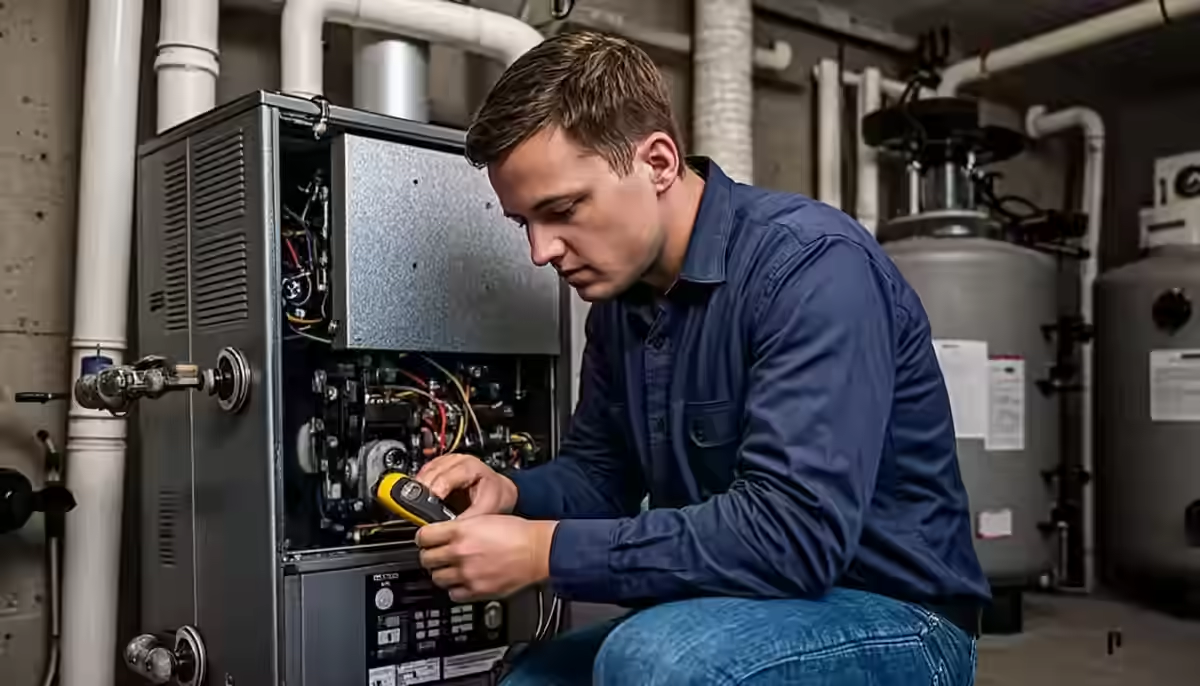
The most important CO technology in your home is not the alarm — it is the combustion analyzer, the handheld meter your technician inserts into the flue, because it measures the risk while it is still a number instead of an event. The $129 tune-up includes the test, and the readings deserve translation. Carbon monoxide in the flue gases: the headline number, with a properly tuned burner typically reading under 100 ppm against standards that allow multiples of that — and with a burner cleaning often cutting a dirty reading dramatically in the same visit, which is the before-and-after story every report should show.
The supporting cast on the analyzer screen tells the rest of the story. Oxygen and carbon dioxide readings describe how the burner is mixing air and fuel; excess-air numbers that have drifted mean the combustion is running rich or lean in ways that raise CO and waste fuel; stack temperature describes how much heat is leaving the house unused; and the calculated efficiency percentage is the number your gas bill actually cares about. On natural-draft equipment, the technician also checks for spillage at the draft hood — combustion gases should go up the vent, and a smoke-pencil or mirror test at the draft hood confirms they are — and measures the furnace's ability to maintain draft under worst-case house conditions, the range-hood interaction made visible.
The living-space measurement completes the picture: a properly working meter on the technician's belt, or your own monitor, showing the ambient number while the furnace runs. Zero to two ppm in the house with the furnace at full song is the passing grade, and it is the reading that turns the entire cracked-exchanger anxiety into a one-line status. Ask for all of it in writing — every tune-up report we issue has the combustion numbers, the before-and-after, and the ambient reading, because a report you keep is the document your warranty conversation and your next technician both want to see. The full tune-up contents guide itemizes the entire visit.
The Red Tag: What Legally Happens When We Find a Problem
The red tag is the most misunderstood document in this trade, so here is the plain version. When a licensed gas fitter in BC finds an appliance creating an immediate hazard — and a heat exchanger crack venting products into the air stream qualifies, as does a blocked flue that cannot be made safe on the spot — they are obligated to shut the appliance down and document it: a tag on the equipment, a report to Technical Safety BC, the homeowner informed in writing of the finding and the reason. The tag is not a sales tactic, it is not optional, and it is not a judgement about your housekeeping; it is the safety system working exactly as designed, and the correct response is a second opinion if you want one — from another licensed fitter with a meter, not from the internet.
What the red tag does not do: it does not force you to buy a furnace from the company that tagged it, it does not condemn the whole system when only one component failed, and it does not mean the house is forever flagged. Some findings are repairable — a blocked flue cleared, a burner serviced back into spec, a venting correction — and the tag comes off when a qualified technician verifies the fix. When the finding is genuinely terminal, the conversation becomes replacement, at the honest prices covered earlier, with the gas permit and Technical Safety BC paperwork filed as part of the installation, which is exactly how our furnace repair and replacement visits handle it.
The homeowner protection in all of this is documentation, and you should insist on it in both directions. A red-tag verdict should come with photographs of the crack or the blocked flue, the analyzer numbers that support it, and the written report — we provide all three because a finding this consequential deserves evidence, and because the honest companies in this trade have nothing to fear from a second opinion reading the same photos. If a verdict arrives without evidence, ask for it; if the evidence arrives and is real, the tag just did the job every alarm, analyzer and law in this guide exists to do.
Venting, Snow and Arctic Outflows: The BC Winter Chapter
High-efficiency furnaces vent through plastic pipes that pierce the exterior wall — usually two, one exhaust and one intake — and those terminations are the winter frontline of CO safety in this region. The failure mode is physical: an arctic outflow night with wind-driven snow, or the once-a-decade dump we get, buries a termination at or near grade, the pressure switch senses the blockage and locks the burner out, and the house goes cold but stays safe. That lockout is the designed response, and it is why buried-vent calls in Abbotsford and Mission present as no-heat emergencies rather than CO events. The homeowner version of the fix is a snow shovel and a habit: after every serious snowfall, walk the wall and clear a metre around both pipes, and never let drifts, planters, or the compost bin overwinter in front of them.
The older equipment version is the one with real CO stakes: natural-draft furnaces and water heaters that vent up a metal B-vent or a masonry chimney can have their draft defeated by a blocked or badly capped termination — bird nests in spring, ice in January, and the creeping failure of an unlined chimney on a pre-1950s house whose mortar has had eight decades of flue gas condensate eating at it. The tune-up includes the vent inspection, and homes with old chimneys serving gas equipment deserve the extra look every few years, because a flue that is partially blocked changes the whole risk arithmetic quietly. Our first-cold-snap failure guide covers the wider November pattern; this chapter is its safety chapter.
Two valley-specific notes worth the drive out. Outflow winds in the Fraser Valley do not just bring cold — they bring pressure effects on terminations, and a vent that worked in October can struggle to maintain draft in a January outflow if it is on the windward wall or undersized for the run; the fix is a termination relocation or correction, a routine repair-band job. And the deep-snow communities from Mission up the valley get the drift-burial scenario annually, which is why we raise terminations and add snow shields when we find them at grade. If your furnace has ever locked out on the coldest night of the year and mysteriously recovered by morning, that was not a ghost — it was a termination breathing through a drift, and it deserves a look before the next one.
When the Alarm Sounds: The Protocol, Once, Calmly
A CO alarm has two voices, and the response to each is different. The emergency voice is the continuous or fast-pattern alarm: treat it as real every time, because the sensor that sounded it does not sound casually. The protocol is the one from chapter three, in miniature: everyone out into fresh air, doors closed behind you to contain the source area if you can do it in seconds, 911 or the FortisBC emergency line from outside, and no re-entry until responders with meters clear the house or the source is found and fixed. The emergency voice is rare, and its rarity is exactly why rehearsing the response once — the same way families rehearse fire exits — is worth ten minutes of any evening.
The second voice is the maintenance chirp: a periodic beep that means low battery or, on an aging unit, an end-of-life signal, and the chirp schedule is written in the manual that is in the drawer. Respond to it the same week, not eventually — the statistics on disabled alarms are dominated by chirps that got old — and use the moment to run the full audit from the placement chapter: date on the back, replacement year on the front, test button held until it speaks. A monthly test-button press and a battery change or unit swap when chirped is the entire maintenance budget of the most important safety device on the bedroom ceiling.
The false-alarm conversation deserves honesty because it is where trust in alarms goes to die. Brief nuisance trips happen most often near the appliance itself — the reason alarms belong near sleepers, not furnaces — and a pattern of them means either the placement needs moving or the appliance on the other side of the wall deserves a look. What a nuisance trip never means is that the alarm should be unplugged for the season; the correct move is one diagnostic visit that reads the house with a meter and settles which side of the wall the problem lives on. That visit is the $89 credited diagnostic, and it is how a chirping distrust turns back into hardware you would bet a night on.
The Prevention List: A Fridge Note, Not a Fear List
Everything in this guide compresses to a short list, and the short list is the point. Annually, before heating season: the $129 tune-up with combustion analysis — the flue CO number, the burner cleaning, the vent inspection, the written report. Continuously: CO alarms in every sleeping area, dates checked, test buttons pressed monthly, batteries and units replaced on schedule rather than on chirp. Habitually: the garage discipline (door open before start, idle less, house door shut while the car breathes), the snow discipline (terminations cleared after every dump), and the generator-and-grill discipline (never inside, never near a window). Annually in old houses: the chimney and B-vent look, especially on pre-1950s stock.
The layered version of the same list, because defense-in-depth is how safety actually works: the alarm protects the sleepers no matter what fails; the tune-up catches the equipment drift before it becomes a finding; the vent habits remove the most common real-world source; the garage habit removes the statistical leader; and the symptom-triage knowledge from chapter three is the backstop for the failure nobody saw coming. No single layer is clever. All five together are why catastrophic CO events are rare in a region full of gas furnaces, and why the honest tone of this guide is confidence rather than fear.
If reading this guide is the first time the house has had any of it: start with the alarms this week, because they are the hardware layer that makes everything else a maintenance question rather than a medical one. Book the tune-up next — October is the calm month, November is the queue, and the $199-a-year plan wraps it with priority booking and 10 to 15 percent off any repair it finds, which for a furnace in its teens is the honest way to hold the whole risk profile still. And if you want the full checklist of what that visit measures and why, the tune-up contents guide itemizes it line by line.
- Every sleeping area has a working CO alarm — the law for fuel-burning homes, and the layer that matters most.
- Check the manufacture date on the back of each alarm; replace at 7-10 years, batteries on chirp, test monthly.
- Annual tune-up with combustion analysis before heating season — flue CO and ambient readings in writing.
- Attached garage: door open before starting the car, minimal idling, house door shut while it runs.
- After every snowfall, clear a metre around exterior vent terminations — the outflow-night habit.
- Generators and grills never inside, never near windows — every windstorm and heat-dome reminder.
- Symptoms in everyone at once, better away from home, pets worst: out, 911, meter, diagnose.
The Calm Version of Ready
The whole guide, one last compression: carbon monoxide is a physics problem with a law, an instrument and a set of habits attached, and every one of those is cheap. The alarm in each bedroom is a statutory requirement and a thirty-dollar device. The tune-up with combustion analysis is $129 flat, once a year, with numbers on a page you keep. The habits are a driveway routine and a snow shovel. None of it requires fear, and all of it works better without fear — fear disables alarms, skips visits and buys furnaces that nobody needed, while data does the opposite of all three.
If your furnace is due, book the visit — the Vancouver furnace maintenance team runs the full combustion analysis and issues the written report, with October calendars wide open and November queues honest about themselves. If the house has never had the alarm conversation, have it tonight: every sleeping area, dates checked, and the number 604-615-2212 on the fridge for the rest. Emergencies answer 24/7 with a flat $150 after-hours premium disclosed before dispatch, typical response 30 to 45 minutes in the core cities, 45 to 60 across Surrey, Coquitlam, Langley and Delta, 50 to 85 through the valley, and the $89 diagnostic credited to any repair.
And keep the tone this guide took, because it is the tone our technicians take in basements: respect, not alarm. The furnaces of this region, maintained, are safe machines with meters on them; the homes with alarms in the bedrooms are ready for the failure nobody predicts; and the households that know the three symptom signatures will never need the internet to tell them whether it is the flu. That is what prepared actually looks like — quiet, boring, scheduled. May your alarms chirp only for batteries, and may your flue readings stay under a hundred for decades.
Frequently Asked Questions
Services That Solve This Faster
Furnace Tune-Ups with CO Testing
The $129 flat visit: combustion analysis, flue and ambient CO readings, burner cleaning, vent inspection and the written report.
Furnace Repair and Red-Tag Second Opinions
Metered diagnosis at $89 credited to the repair, photographed findings, and honest repair-versus-replace numbers on aging exchangers.
Furnace Replacement
Sealed-combustion high-efficiency furnaces from $3,900 to $11,500 installed, permits filed, financing from 7.99%.
Maintenance Plans
$199 a year: the annual tune-up with combustion testing, priority booking, 10-15% off repairs found, records kept for warranties.
Related Guides From Our Team
What a $129 Furnace Tune-Up Actually Includes — the full checklist, measurement by measurement, including the combustion numbers this guide keeps citing.
Furnace Making Noise? What Each Sound Means — the rumbling-with-odour chapter that overlaps with combustion concerns, and the sounds that mean call now.
How Long Does a Furnace Last? 15 Real Signs — the aging-exchanger timeline, planned honestly instead of discovered at red-tag time.
Why Furnaces Fail on the First Cold Snap in BC — the November failure pattern, including the venting and pressure-switch stories from the outflow chapter.
Gas Lines: Installation, Repair and BC Rules — who may legally work on gas equipment in BC, permits, and the FortisBC emergency-line protocol.
Red Seal certified, licensed gas fitters (BC-PL-2019-4421), $2M insured, 15-plus years on the tools, 12,000-plus jobs across Metro Vancouver since 2010, 4.9 stars from verified reviews. We wrote this guide because Metro Vancouver homeowners deserve the numbers, the code references and the honest trade-offs before anyone touches a wrench or a wallet.
More about our team →Get the Numbers, Not the Fear
Combustion analysis with flue and ambient CO readings at the $129 tune-up, metered diagnostics at $89 credited to any repair, photographed findings on every red-tag verdict, and licensed gas fitters under BC-PL-2019-4421. Emergencies: 604-615-2212, 24/7.
Want your home's actual CO numbers?
Book the visit that measures instead of worries: flue CO before and after burner cleaning, ambient readings in the living space, vent and chimney inspection, and the written report you keep for warranties and peace of mind both. Suspected exposure? Leave and call 911 first — then we handle the equipment side with meters, same-day in season, $89 diagnostic credited to any repair.
Call 604-615-2212 WhatsApp Us