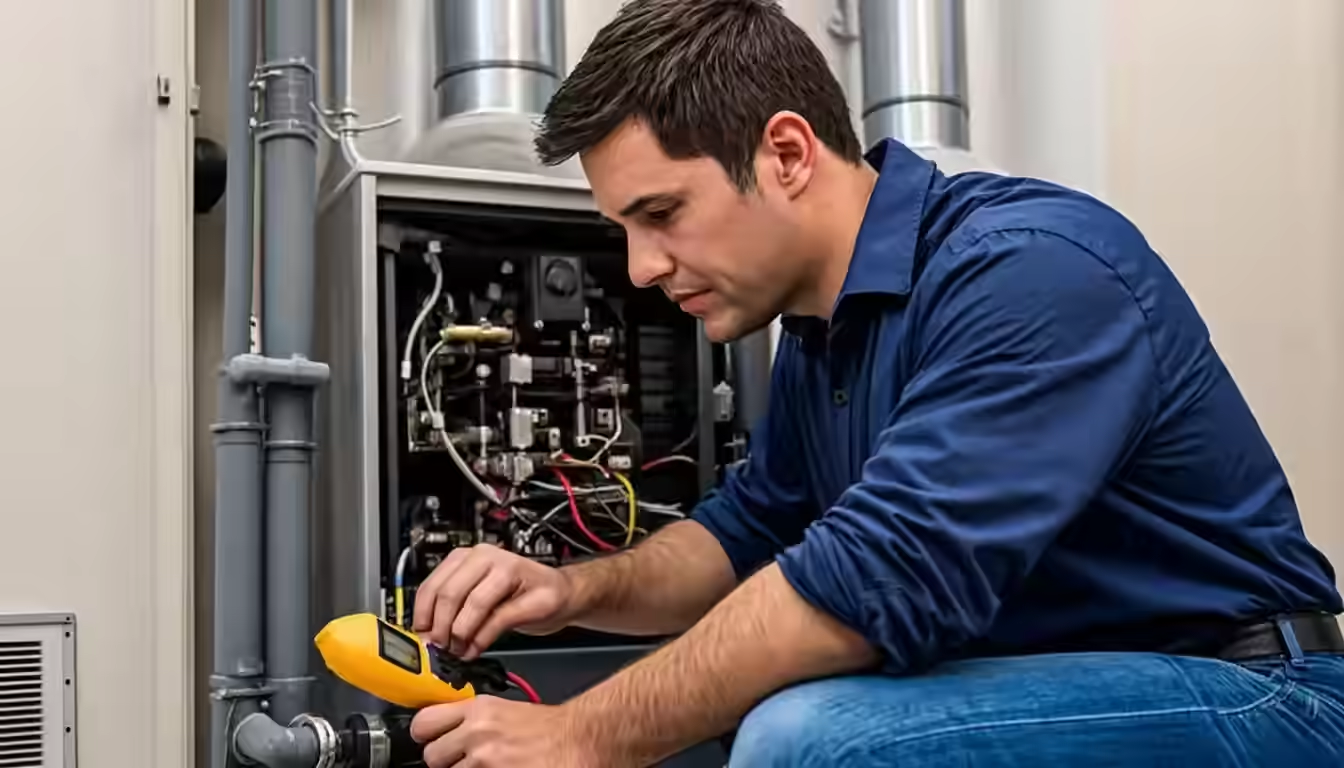
The Honest Answer Up Front
The $129 tune-up is a flat-price, checklist-driven inspection and service of the complete furnace: a combustion analysis with CO measurement, the full safety chain from flame sensor to limit and rollout switches, the airflow and electrical readings that predict failures, the cleaning that keeps burners and sensors healthy, and a written report with the numbers. It is the same visit for the furnace in October and the air conditioner in April — the price does not change by machine or by season — and it takes sixty to ninety minutes when the equipment is clean and accessible. What it is not: a filter swap dressed up as maintenance, a vacuum-and-bill visit, or an upsell appointment wearing a technician's uniform. This guide exists so you can tell the difference in any basement, including ours.
Why the flat price matters more than the low price: a tune-up sold cheap and performed thin is the most expensive maintenance in the trade, because the two things a real visit catches — the drifting capacitor, the filmed flame sensor, the burner quietly making CO — are exactly the things that become $180-to-$650 emergency repairs at 11 p.m. in January. The $129 is priced to be a boring annual habit, the way an oil change is, and the flat structure means the technician has zero financial incentive to find or manufacture work: the visit pays the same whether your furnace is perfect or needs a follow-up quote. Anything the visit does find gets priced in writing, separately, with the readings attached.
What the visit does not include, stated honestly because the distinction matters: deep-disassembly work like pulling and washing the blower wheel or bathing the evaporator coil — that is the $189 deep service, covered in its own chapter — and any repair, part, or refrigerant work, which quotes separately inside the published repair band with the $89 diagnostic credited to it. The tune-up is the inspection-and-clean layer of the maintenance pyramid: comprehensive, measurable, and designed to make everything above it rare.
0 points, measured
Combustion, safety chain, airflow, electrical, controls, venting and condensate — every point is a reading or a documented inspection, not a glance and a nod.
0 flat, furnace AND AC
One price, one visit, one published list. The same tune-up covers the air conditioner or heat pump side when the season calls for it — no tune-up upcharges.
0 percent capacitor tolerance
A run capacitor is flagged when its microfarad reading drifts six percent from label. That single number predicts more dead blowers than any other measurement in the visit.
0 typical visit length
Sixty to ninety minutes for a clean system with access — the honest floor. A visit dramatically shorter than that skipped something on this list.
Why Tune-Ups Matter More Here Than the Brochures Admit
The BC climate gives furnaces a working life the manuals never modeled. Our heating season is long but gentle — eight months of calls, most of them short and mild — which means furnaces here log thousands of ignition cycles without ever getting the long, hot, self-cleaning runs that interior-climate furnaces get. Combustion film builds on burners and flame sensors through months of light duty, and then the first genuine cold snap in November asks the machine for sustained full output it has not delivered since February. That pattern — idle shoulder, sudden load — is why no-heat calls in this region cluster into a single famous week every autumn, a pattern our first-cold-snap failure guide documents part by part, and why the tune-up's natural calendar slot is October: catch the drift before the load.
The coastal variables stack on top. Humidity — the same 2,400-millimetre North Shore reality that keeps everything else damp — condenses in venting and condensate paths, encouraging the corrosion and algae stories that our climate specializes in; arctic outflow nights a few times each winter test freeze protection on condensate lines and vent terminations, especially in the valley; and the wildfire-smoke summers of recent years load filters and blowers with fine particulate months before heating season starts. A tune-up here is not a generic oil-change ritual — it is the regional maintenance the climate actually demands, and the checklist below reflects decades of learning which failure modes Metro Vancouver chooses.
And the economics, stated once and plainly: the $129 visit against the alternative. A flame sensor cleaned in October is a tune-up line item; the same sensor failing in January is the $89 credited diagnostic plus an after-hours premium plus a cold evening. A capacitor flagged at six-percent drift is a Tuesday part; the same capacitor in February is a no-heat call. The annual visit is priced below any single emergency in the repair band, and the failure modes it prevents are precisely the ones that strand houses. That is the whole business case, and it is why we sell the $199 plan as a habit rather than a contract — the math only works for us if it works for you first.
The 24-Point Checklist, Area by Area
Here is the visit in one table — the same list our technicians carry, organized the way the work happens. Every point is one of three things: a measurement with a meter (combustion numbers, microfarads, amps, pressures), a documented inspection (heat exchanger, venting, condensate path), or a service task (cleaning, adjustment, lubrication where the design calls for it). The "why it matters" column is the part most companies never explain, and it is the part that turns a checklist into an education.
Read the table as a homeowner audit tool as much as a description: when any technician — ours or anyone else's — finishes a tune-up, you should be able to match what happened in your basement against these rows and hear a specific answer for any of them. A company that cannot tell you what it checked, with numbers, did not check it. The chapters that follow unpack the rows that generate the most questions and the most value: combustion analysis, the safety chain, airflow and static pressure, and the electrical readings.
| Area | What we do | Why it matters | Catches early |
|---|---|---|---|
| Combustion | Analyzer in the flue: CO, O2, excess air, stack temp, efficiency | The safety and efficiency heartbeat of the burner | CO drift, rich burners, heat loss |
| Safety chain | Test flame sensor, high-limit, rollout and pressure switches | The layer that shuts the furnace down before it hurts anything | Short cycling, no-heat lockouts |
| Heat exchanger | Visual inspection with mirrors and light where design allows | The crack that ends furnaces, found while it is still a finding | Aging exchangers, red-tag avoids |
| Burner assembly | Pull and brush burners; clean flame sensor; measure ignitor draw | Ragged flames make CO; filmed sensors cause click-retry lockouts | Delayed ignition, rumbling, no-heat |
| Blower and capacitor | Amp draw against nameplate; microfarads against label | Predicts the $650-plus blower story weeks ahead | Hum-and-no-start, weak airflow |
| Airflow, static, filter | Measure static pressure and temperature rise; inspect filter rack | Tells us what filter your blower can honestly carry | Limit trips, short cycling |
| Electrical | Tighten connections, inspect wires, check contactor and board | Loose connections arc; nicked wires fail on schedule | Intermittent faults, board death |
| Controls and thermostat | Verify calibration, cycle test, program review | The brain deserves ten minutes too | Overshooting, short cycling |
| Venting | Inspect flue and terminations for corrosion, pitch and blockage | Blocked venting is a top real-world CO source | Bird nests, outflow ice, rust |
| Condensate | Flush and check trap, lines and drain path | The quiet flood and lockout source on high-eff units | Freeze-ups, pressure faults, water |
The 24-point furnace tune-up — what the $129 flat visit measures, inspects and cleans.
Combustion Analysis: The Numbers That Matter Most
The combustion analyzer is the most important tool that enters your basement, and the tune-up's first hour of value runs through it. The probe goes into the flue; the furnace runs at high fire; and the meter reads what your burner is actually doing. Carbon monoxide in the flue gases is the headline: our target is under 100 ppm on a healthy burner — comfortably inside the safety standards — and a reading above that earns a burner cleaning and a re-test on the spot, with both numbers on your report. That before-and-after pair, dirty versus clean, is the single most convincing piece of maintenance evidence this trade produces.
Around the CO number sit the efficiency story: oxygen and carbon-dioxide readings describe the air-fuel mixture; excess-air percentage tells us whether the burner is wasting heat warming the great outdoors; stack temperature tells us how much energy is leaving the house unused; and the calculated efficiency is the number your FortisBC bill actually feels. High-efficiency furnaces add condensing-analysis nuance, and the tune-up sets gas pressure against the nameplate where the meter says it drifted. None of this is guesswork — it is a five-digit meter reading the machine's bloodstream, and the reason a tuned furnace costs measurably less to run through a Vancouver January than the same furnace neglected.
The reading most homeowners do not know to ask about is the ambient one: while the furnace runs, the living-space CO level should sit at zero to two parts per million, and the technician's meter confirms it. That number — not the flue number — is the safety verdict for the household, and it closes the loop with the alarm on your bedroom ceiling. Our carbon monoxide guide covers the full picture; the tune-up chapter of it is simply this: analyzer in the flue, meter in the room, both numbers written down, both before and after the cleaning.
The Safety Chain: Tested, Not Assumed
A furnace is a combustion appliance wrapped in a chain of sensors whose entire job is shutting it down, and the tune-up tests every link. The flame sensor proves fire exists and kills the gas within seconds when it does not — we clean it with the correct abrasive and measure the microamp signal, because a sensor reading weak-when-clean is on a visible countdown. The high-limit switch watches exchanger temperature and stops the burners when airflow cannot keep up; we verify its behaviour against the temperature-rise math from the airflow chapter. The rollout switches sit over the burner compartment watching for flame where flame must not go, and the pressure switches on high-efficiency units verify that the inducer is actually moving combustion air out the vent before the burner is allowed to light.
Why the chain deserves its own chapter: these components are the reason furnace failures in this trade are inconvenient rather than dangerous, and they are also the components that misbehave most quietly. A limit switch that has been tripping all winter — usually behind a clogged filter, the story our short cycling guide tells in full — wears out like any switch worked overtime, and many boards keep a trip count we can read. A pressure switch struggling against a partially blocked vent announces itself as an intermittent lockout that resolves by morning. The tune-up finds the pattern while it is still a pattern, and the finding usually points somewhere fixable in the same visit.
The testing is done in the sequence the furnace itself runs — inducer prove, ignition prove, flame prove, temperature prove — because testing the chain piecemeal tests the parts while skipping the choreography. At the end, the technician runs a full cycle from thermostat call to blower stop and watches the whole system do its job in order, with the analyzer still attached. That single supervised cycle is the tune-up's closing exam, and it is the difference between "all parts test fine" and "the furnace works."
Airflow and Static Pressure: The Number That Predicts Everything
Static pressure is the blood-pressure reading of forced-air systems, and it might be the most underused diagnostic in residential HVAC. The technician drills or uses existing ports to read the pressure the blower is working against, then compares it against the fan table and the rated total external static pressure. High static means the blower is straining — a loaded filter, undersized returns, closed registers, or a coil furring up — and every one of those causes has a cost: longer cycles, hotter heat exchangers, weaker registers at the far rooms, and the limit-tripping short cycling that ages furnaces prematurely. The fix depends on the reading, which is the point of taking it.
Temperature rise completes the airflow picture: the difference between return-air and supply-air temperatures, compared against the nameplate range the manufacturer printed for your exact furnace. A rise above spec means the air is moving too slow across the exchanger — the overheating signature; a rise below spec means heat is being thrown away into the ductwork. Between static pressure, temperature rise and blower amps, the visit produces a three-number profile of your system's breathing that no homeowner check can replicate and no responsible diagnosis should skip. It is also how we answer the MERV question with data: your blower's static reading tells us whether a MERV 13 upgrade is a breath of fresh air or a slow strangulation, which is half of what our filter guide is about.
The blower itself gets its physical during this section: amp draw against the motor nameplate, wheel inspection for the dust loading that our renovation-heavy region specializes in, and the capacitor check that gets its own chapter below. Ductless homes get the parallel inspection on the head side — filter condition, coil face, drain path — with the annual deep clean at $149 to $229 per head available when the wheel and coil need the full bath rather than the inspection. One system, one visit, one set of numbers: that is the airflow discipline.
The Electrical Readings: Microfarads, Amps and the Parts That Die First
Two electrical parts kill more furnaces than everything else combined — the run capacitor and the hot-surface ignitor — and both telegraph their deaths in measurements months in advance. The capacitor: we read its capacitance in microfarads against the label printed on its side, and flag it at six percent drift. A capacitor that has sagged from 10 to 8 microfarads still runs the blower, badly, and the hum-and-no-start morning it is scheduling lands on the coldest day of the year with statistical reliability. The part is inexpensive; the reading is priceless; the replacement is a same-visit, lower-band repair you approve on the spot from the number, not a pitch. Our furnace noise guide covers the hum version of this story in depth.
The ignitor gets its reading in amps: hot-surface ignitors have a cold resistance and a running draw that drift as they age, and the drift predicts the morning the furnace clicks without lighting. Because ignitors take their hardest thermal hit on every cold start, the part that measures weak in October is telling you its February — and a pre-emptive replacement at tune-up time is an honest, cheap insurance decision the report lets you make with the number in front of you. The rest of the electrical sweep is faster but not optional: connections tightened at the board and the junction box (arcing loose connections are how control boards die), wire insulation inspected for the heat-hardened or rodent-nibbled spots, the contactor on systems that have one, and the transformer that hums quietly until it does not.
The W-wire and thermostat circuit get a specific look because of one regional habit: the low-voltage wire that renovation nails find. A nicked conductor makes and breaks with temperature flex, producing the maddening intermittent calls that read as thermostat ghosts — a five-minute inspection item during the visit that saves the kind of troubleshooting visit that bills hours against a two-dollar splice. On the controls side, the thermostat itself gets calibration verification and a program review, and for smart thermostats the conversation covers the schedules and setbacks that actually save money on BC Hydro's time-of-use structure — the subject of its own guide on smart thermostats in BC.
What Gets Cleaned — and What the $189 Deep Service Adds
The cleaning included in the $129 visit is the disassembly-light layer: burners pulled and brushed where the design allows, the flame sensor cleaned to bare metal, the blower compartment vacuumed and the wheel inspected (cleaned in place where access permits), the combustion and blower compartments wiped, the condensate trap and line flushed, and the exterior surfaces checked for the rust and soot patterns that tell stories. For a furnace on a normal maintenance cadence in a normal house, this layer plus the inspection points is genuinely the full annual requirement — the tune-up is not a lesser version of the deep service; it is the correct size of the job for maintained equipment.
The $189 deep service exists for the equipment the tune-up finds beyond that: the furnace that has gone years between visits, the renovation-dust veterans, the homes whose blower wheels are carrying the felted grey load that our climate and construction habits produce. The deep visit adds the disassembly work: blower wheel fully removed and washed, evaporator coil bathed and rinsed with the cabinet protected, the full condensate path detailed, and the additional hour-plus that the word "deep" honestly describes. The upgrade decision is made from the tune-up's own findings — the technician shows you the wheel, the coil, the static pressure number, and the $60 difference prices itself. That is the honest structure: the tune-up diagnoses, the deep service responds, and neither is sold as the default.
The sibling service worth naming because this region runs so much ductless: the mini-split deep clean at $149 to $229 per head — the bagged, containment-washed, blower-wheel-out version of the same discipline, with its own full guide covering what is DIY and what is not. Homes with mixed systems — a central furnace plus a few heads — can sequence the visits into the same truck roll or the same season, and plan customers get exactly that scheduling done for them.
Venting, Condensate and the Freeze Chapter
The venting inspection is the part of the tune-up with statutory weight: the flue or plastic terminations are checked for corrosion, pitch, securement and blockage, because blocked venting is one of the top real-world CO sources and the one our climate specializes in. B-vent on older equipment gets the bird-nest-and-rust look; high-efficiency terminations get the snow-and-clearance check, with the meter out to confirm combustion under real conditions rather than assumed ones. Homes with terminations at grade, on north walls, or buried in the valley outflow belt — Mission, Abbotsford, Chilliwack — get the freeze conversation: raised terminations, snow shields, and the shovel habit after every dump.
The condensate system gets flushed and flow-tested, because a high-efficiency furnace is also a water machine: it condenses litres per day in deep heating season, the trap and line carry it away, and a blockage shows up first as a pressure-switch lockout and eventually as water where water should not be. The trap itself is inspected — a dry trap after a summer idle is normal and simply re-primed; a trap furred with biological growth is a flush-and-tablet conversation. The line's path through unheated crawlspaces and along exterior walls is walked for the freeze exposure that our January outflows turn into a 2 a.m. no-heat call, and heat tape or re-routing is quoted where the exposure is real. The whole freeze chapter costs a fraction at tune-up time what it costs on the coldest night of the year, which is the theme of this entire guide.
Also in this section: the combustion air supply. High-efficiency furnaces draw burner air through the second plastic pipe, and that intake is checked for the same blockages, the same clearance discipline, and — a Metro Vancouver specialty — the landscaping that has grown over it since last October. Intake and exhaust get checked as a pair, because the pressure switches prove them as a pair every single cycle, and the tune-up verifies what the switches only sample. It is unglamorous work with a picture-window view of the garage wall and the garden bed, and it is where a meaningful share of this region's no-heat stories actually begin.
The Written Report: Your Warranty Paper Trail
Everything the visit measures ends up on paper, and that report is not a courtesy — it is half the product. Yours shows the combustion numbers before and after cleaning (CO, efficiency, stack temperature), the ambient CO reading, static pressure and temperature rise, blower amps, capacitor microfarads against label, ignitor draw, the safety-chain results, the heat-exchanger and venting inspection notes with photographs of anything noteworthy, and a plain-language findings section: what is healthy, what is drifting, what deserves watching, what — rarely — needs a quote. You keep it, and we keep a copy: the next technician who opens that furnace starts from evidence instead of zero, which makes every future visit shorter and every future diagnosis cheaper.
The warranty dimension is the part with real money attached. Manufacturer warranties on heat exchangers and major components are conditional on documented annual maintenance in most fine print, and the claim that arrives with a folder of reports sails through where the claim with a shoebox and a memory does not. The report is also the document your home insurer quietly appreciates on a moisture or CO file, the one a home inspection at sale time treats as gold, and the reason our $199-a-year plan stores them for you automatically — the plan's record-keeping is genuinely one of its best features, and the first time a warranty claim asks for five years of maintenance history, it pays for itself in an afternoon.
How to read your report like a pro, in sixty seconds: look for before-and-after pairs on the combustion page (the maintenance story), compare this year's capacitor and amp numbers to last year's (the aging story), and read the findings section with the same skepticism you would bring to a car inspection — anything recommended should come with the reading that justifies it, and "as needed" language deserves the question "what did the meter say?" The report is a conversation starter between you and your equipment, and the annual stack of them is the biography that makes the eventual replacement conversation honest instead of abrupt — the transition our furnace life expectancy guide walks through.
The Tier Math: $129, $189 and the $199 Plan
The three numbers, and how they fit together honestly. The $129 flat tune-up: the annual inspection-and-clean layer described in this entire guide, same price for the furnace and for the AC or heat pump side, booked once or twice a year as the equipment warrants. The $189 deep service: the disassembly tier for equipment the tune-up finds loaded — blower pulled and washed, coil bathed, the extra hour the condition earns; typically a once-every-few-years event on a maintained system, not an annual default. And the $199-a-year maintenance plan: the tune-up included, priority seasonal booking before the November queue forms, 10 to 15 percent off any repair the visits find, and the stored service records that keep manufacturer warranties enforceable.
The plan math, run plainly: a household with one furnace on the plan pays $199 and receives the $129 visit, the scheduling priority, the repair discount, and the records. The plan pays for itself the first time a repair lands — 10 to 15 percent off a mid-band repair recovers most of the difference — and it structures the habit, which is where its real value lives: the plan furnace gets its October visit every October, because the visit books itself. Households with two systems or mixed central-plus-ductless equipment get the sequencing help that genuinely saves a coordination headache, and landlords with suites get the paper trail their insurance and their tenants both benefit from.
What we tell people who ask which tier to buy, because the honest answer varies: a furnace under five years old on its first maintenance cycles needs only the $129 and its own warranty paper trail. A furnace in its teens with a maintenance history earns the same visit, with the deep service held in reserve for what the readings say. The house between owners, the rental with unknown history, and the renovation-dust veteran are the deep-service profiles. And the plan is for the household that wants the whole subject on autopilot — which, after fifteen years of watching which furnaces fail and which sail, describes most of the homes we serve best.
- Before booking, ask for the checklist — a real one, with the measurement points on it, not a brochure.
- During the visit, expect meters: an analyzer in the flue, a meter on the capacitor, a manometer on the ducts.
- Ask the two questions: what is the flue CO, and what is the ambient reading with the furnace running?
- At the end, expect paper: numbers, before-and-afters, findings in plain language, photographs if anything was noteworthy.
- Compare year-over-year: capacitor microfarads and blower amps are the aging curve, and the report should let you see it.
- Price-check the structure, not just the number: flat-rate, disclosed, no surprise line items for the same visit by season.
Booking, Timing and What Happens After
The calendar chapter, because timing is a real variable in this region. The ideal window for a furnace tune-up is late September through October: the queue is short, the weather is forgiving if the visit finds something, and the furnace gets its clean bill before the first cold snap asks the annual question. November is the honest second choice — the queue is the queue, but response times hold. Mid-winter booking still works and still matters (a February tune-up is a February-listened-to furnace), and spring is the natural slot for the AC half of the flat price, which is how two-visit households usually structure the year: October for heat, April for cooling, one price each.
What the visit does not turn into, stated as policy because it should be: a pressure appointment. Findings get explained with the readings and photographed where relevant; recommendations get priced in writing and left with you; nothing gets decided in a basement on the spot unless the safety chain leaves no option — the red-tag scenarios have their own rules and their own published pricing. Repairs found at tune-up quote inside the $180-to-$650 band, the $89 diagnostic is credited to any completed repair, after-hours calls carry one flat $150 premium disclosed before dispatch, and if the honest verdict is ever replacement, the conversation comes with tiers from $3,900 to $11,500, financing from 7.99 percent with approved credit, and the rebate paperwork handled. The tune-up is where trust is either built or spent; we treat it as the former, structurally.
The practical booking details, because they matter: the visit takes sixty to ninety minutes on a clean system and longer on a loaded one, someone ideally home for the walkthrough of findings, and the pets secured because the blower door comes off. Response for urgent follow-ups runs 30 to 45 minutes in Vancouver, Burnaby, Richmond, New Westminster, North Vancouver and Port Coquitlam; 45 to 60 minutes in Surrey, Coquitlam, Langley and Delta; and 50 to 85 minutes through the valley, with the 24/7 line at 604-615-2212 answered around the clock through heating season. Book through the form below with the furnace age and anything you have noticed — noises, cycles, bills — and the truck arrives with the checklist, the meters and the report paper already in mind.
The Visit, Demystified
The whole guide in one paragraph, for the fridge: the $129 tune-up is a 24-point, meter-driven inspection and clean — combustion analysis with CO testing before and after, the complete safety chain, static pressure and temperature rise, capacitor and ignitor readings, burner and sensor cleaning, venting and condensate checks, and a written report with every number on it. It is flat-priced for furnace and AC alike, it takes about ninety minutes, it produces the warranty paper trail, and its two escalation paths — the $189 deep service and the repair band — are decisions the report lets you make from data instead of pitches. The $199-a-year plan wraps it in scheduling and records for the households that want the habit automated.
If your furnace has never had a visit like the one described here, book one — October is the calm month, and the first report on an older machine is the single most informative document in its file. If it has had visits that did not look like this, you now have the audit tool, and the questions to ask, and the right to expect meters and numbers in any basement in this region. And if you are comparing companies on price, compare the checklist too: the $129 that contains this guide is a bargain, and the $79 that contains a filter swap is the most expensive appointment in heating.
Book through the form below or call 604-615-2212 — licensed gas fitters under BC-PL-2019-4421, Red Seal certified, $2 million insured, and thirteen years of Metro Vancouver furnaces behind the checklist. The visit you are buying is the one this guide just showed you, down to the numbers on the report. That is the whole promise, and it is a boring, well-kept one — which is exactly what maintenance should be.
Frequently Asked Questions
Services That Solve This Faster
Furnace Tune-Ups
The $129 flat visit this guide itemizes: combustion analysis, safety chain, full measurement suite and the written report.
Deep Service and Deep Cleans
The $189 disassembly tier for loaded equipment, and ductless deep cleans at $149-$229 per head, quoted from the tune-up's own readings.
Maintenance Plans
$199 a year: the tune-up included, priority booking before the November queue, 10-15% off repairs found, records stored for warranty claims.
Furnace Repair and Replacement
Findings priced in writing from $180, the $89 diagnostic credited to any repair, replacements from $3,900 with financing from 7.99%.
Related Guides From Our Team
Carbon Monoxide and Your Furnace: The BC Guide — the CO numbers the tune-up produces, the alarm law for sleeping areas, and the sources that actually matter.
Furnace Short Cycling: 9 Causes and Real Fixes — the failure mode the static-pressure and airflow points exist to prevent.
Furnace Making Noise? What Each Sound Means — what the capacitor, bearing and burner readings in your report sound like when they go unheeded.
How Long Does a Furnace Last? 15 Real Signs — reading the annual report stack as the aging curve it is, and planning the succession honestly.
Why Furnaces Fail on the First Cold Snap in BC — the November failure pattern, part by part — the reason the tune-up's calendar slot is October.
Red Seal certified, licensed gas fitters (BC-PL-2019-4421), $2M insured, 15-plus years on the tools, 12,000-plus jobs across Metro Vancouver since 2010, 4.9 stars from verified reviews. We wrote this guide because Metro Vancouver homeowners deserve the numbers, the code references and the honest trade-offs before anyone touches a wrench or a wallet.
More about our team →Book the Visit That Comes With Numbers
The $129 flat tune-up with combustion analysis, CO testing, the full 24-point checklist and a written report you keep — same price for the furnace and the AC side. Red Seal gas fitters under licence BC-PL-2019-4421, October calendars open now. Emergencies: 604-615-2212, 24/7.
Your furnace deserves the meters.
Book the full visit: analyzer in the flue, meter on the capacitor, manometer on the ducts, and every number on a report you keep for warranties and year-over-year comparison. October slots fill first and November fills the rest — plan customers book automatically. Emergency? The 24/7 line at 604-615-2212 answers around the clock, flat $150 after-hours premium disclosed before dispatch.
Call 604-615-2212 WhatsApp Us