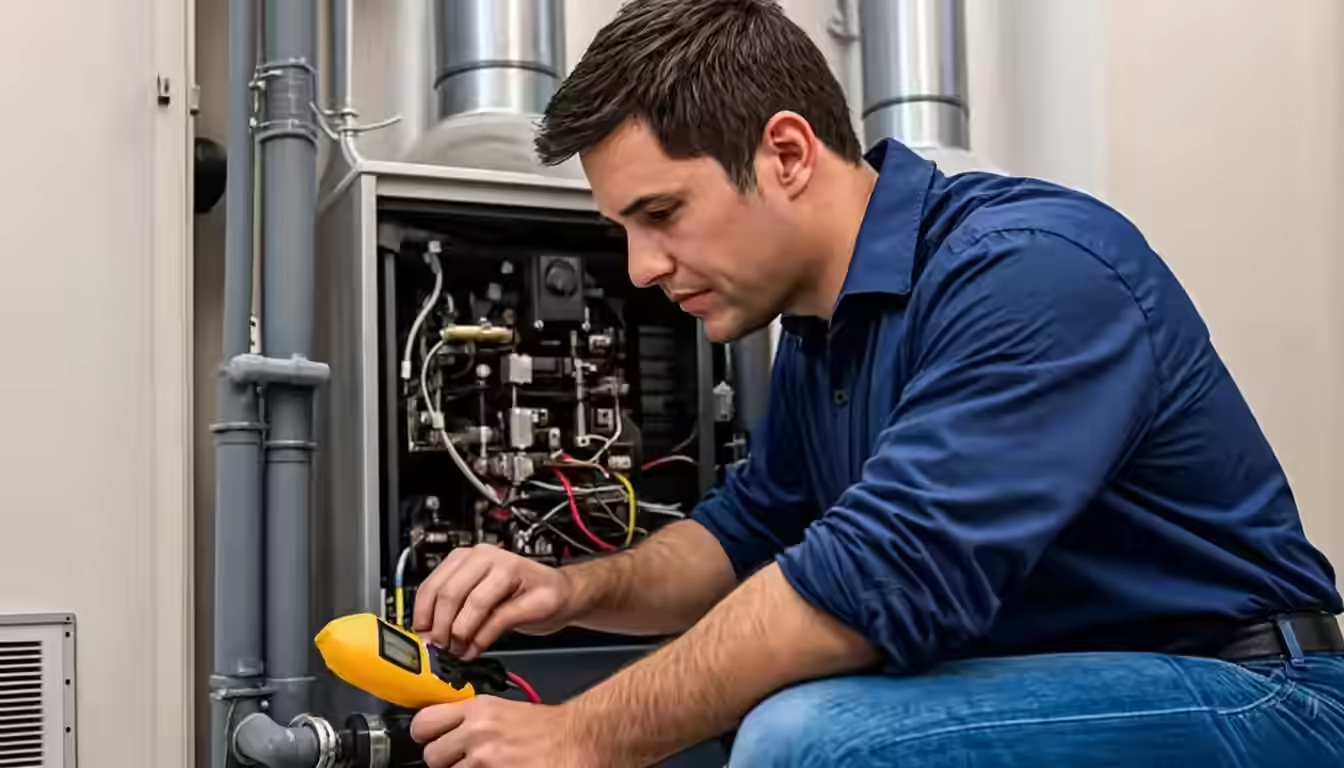
The Honest Answer Up Front
When a gas fireplace stops working, the failure almost always writes its own diagnosis if you know the script. Pilot lights but the main burner ignores the switch: that is the thermopile — the little generator that converts pilot heat into the electricity holding the main valve open — or its oxidized connections, and it is the single most common fireplace fault we see across Metro Vancouver. Pilot will not stay lit at all: thermocouple on standing-pilot units, or a pilot flame starved by a dirty orifice. Clicking but never catching: ignition or flame-sense on electronic units. And a fireplace that runs but looks wrong — lazy yellow flames, soot on the logs, fogged glass — is asking for service rather than repair, which is a different conversation with a different price.
The service economics are the friendliest in the heating trade: annual fireplace service is $129 flat with us — the same visit family as our furnace tune-up — and the $189 deep service exists for units that have gone three-plus years without care and need the full teardown-clean-inspect rather than the annual check. Repairs mostly land in the $180-$650 band: thermocouples and switches at the bottom of it, thermopiles mid-band, gas valves at the top. The $89 diagnostic credits in full against any completed repair, so diagnosis is never a stacked fee — the same flat-rate pricing we publish for every service line. What almost never makes sense is the reflex of buying a new fireplace for what is a $250 tired thermopile — a mistake we talk families out of weekly.
The legal line deserves the last paragraph of the honest answer because it shapes everything else in this guide. A gas fireplace is a regulated gas appliance: in British Columbia, work on its gas train — pilot assemblies, burners, valves, orifices, venting — is licensed gas fitter work under the Gas Safety Regulation, with Technical Safety BC oversight, and the ticket requirements are real (we operate under licence BC-PL-2019-4421 with Red Seal technicians and $2M coverage). Homeowner territory ends at the glass door, the batteries and the exterior of the vent cap. That is not trade protectionism talking; it is the same reason we do not rewire our own panels. The chapters below teach you to diagnose brilliantly and touch nothing you should not.
0 ignition generations
Standing pilot, intermittent pilot, full electronic ignition — three systems, three failure scripts, three different service rhythms.
0 the thermopile's job
A healthy thermopile makes roughly half a volt from pilot heat to hold the gas valve open. Below that, the burner refuses while the pilot burns on.
0 annual service, flat
The flat $129 fireplace service — same visit family as furnace tune-ups; $189 deep for units three-plus years overdue.
0 DIY past the glass
In BC, homeowner work on a gas fireplace ends at cleaning glass and batteries. Burners, pilots and valves are licensed gas fitter work — full stop.
Three Ignition Generations, Three Failure Scripts
Knowing which generation your fireplace belongs to is half the diagnosis, and it takes thirty seconds. Standing pilot (most units before roughly 2000): a pilot flame burns all season, and you start the fireplace with a knob you hold before releasing. Intermittent pilot, sold as IPI (most 2000-2015 premium units): the system sparks a pilot each time you switch it on, then lights the burner — you will hear a rapid ticking before ignition. Full electronic ignition, sold variously as DSI or electronic spark (2015-onward, and the standard on current premium inserts): everything is on demand, often with a remote as the primary control. Each generation fails along its own weak points, and service items differ accordingly.
The standing pilot is the simplest and most robust — a thermocouple, a pilot orifice, and a millivolt valve with almost nothing to break — and its failure script is thermal drift: parts designed for decades of honest service slowly weaken, so the unit that ran perfectly in 2010 needs a thermocouple and a pilot cleaning by 2024. The IPI generation adds spark modules, flame sensors and a control board, which brings furnace-style fault codes and furnace-style electronics failures into the living room; its signature fault is the fireplace that works flawlessly every second day, which is a connection or module on its way out. The full-electronic generation is the most efficient and the most dependent on clean power and working sensors — the price of intelligence is more ways to refuse.
None of the three generations is the wrong one to own, and we service all of them daily — but the maintenance window shifts: standing pilots want their pilot assembly and thermocouple checked and the glass and logs cleaned; IPI units want pilot and burner service plus spark-module and sensor verification; electronic units want all that plus a low-voltage connection inspection. The annual $129 service covers whichever generation sits in your living room, and our technicians arrive carrying thermocouples, thermopiles, switches and ignitors for the major brands — Heatilator, Napoleon, Valor, Regency, Mendota and the builder-grade units that shipped with a decade of Surrey and Langley townhouse construction.
| Generation | Era | How you start it | Signature failures |
|---|---|---|---|
| Standing pilot | Before ~2000 | Hold a knob, release | Thermocouple, dirty pilot orifice |
| Intermittent pilot (IPI) | 2000-2015 | Switch or remote; ticking spark | Spark module, sensor, connections |
| Electronic ignition (DSI) | 2015-present | Remote or wall control | Sensors, board, power quality |
| Millivolt valve (both early eras) | Common to standing pilot | Wall switch or thermostat | Weak thermopile, oxidized contacts |
| Remote receiver (all eras) | Universal add-on | Handheld remote | Battery fade, heat-damaged receiver |
| Fan kit / heat-activated blower | Any era (add-on) | Thermodisc starts the fan | Fan motor, thermodisc, dust buildup |
The three ignition generations at a glance.
When the Pilot Will Not Stay Lit
The thermocouple is the standing pilot’s guardian: a pencil-thin copper probe sitting in the pilot flame, generating a few millivolts that hold the pilot valve open. Hold the knob, the pilot lights, you count to thirty, you release — and if the pilot dies on release, the thermocouple is the prime suspect, with two runners-up: a pilot flame too small or misaimed to keep the probe hot (a dirty orifice is the usual cause, and the flame should wrap the probe’s tip, not tickle its side), and a loose or corroded connection where the thermocouple screws into the valve. The part itself is inexpensive and the swap is a stock truck item; the reason it is not a DIY job is that it lives inside the gas train of a regulated appliance.
The pattern worth knowing, because it changes the service conversation from repair to tune-up: a pilot that lights reluctantly after several attempts, or that stays lit only after a longer hold than the manual claims, is usually a thermocouple on its way down rather than already out — the millivolt output slides for a season before it fails outright. Booking service at the reluctance stage means the part arrives before the failure, which is the difference between a scheduled Tuesday visit and a cold Thanksgiving living room. We keep seasonal slots open in October for exactly this call, and the fix lands at the bottom of the $180-$650 band with the $89 diagnostic credited.
Two adjacent culprits complete the script. A downdraft — the fireplace version of a venting problem — can blow the pilot out on windy nights, and the fingerprint is a pilot that dies on specific stormy evenings while running fine otherwise; that points at vent termination position or a chimney-draft issue, not at the thermocouple at all, and it is diagnosed with the venting inspection that belongs to the annual service. And on IPI units the equivalent fault is the pilot sparking but never proving, which is a flame-sensor or module conversation rather than a thermocouple — the generations share symptoms while disguising different culprits, which is why the diagnosis chapter of this guide starts with identifying the generation first.
The Thermopile: Behind Most No-Burner Calls
If the pilot burns happily but the main burner ignores the wall switch, the remote and your patience, you have met the thermopile — and it is the most common single fault in the gas fireplace trade. The thermopile is a stack of thermocouple-style junctions that generates roughly 500 to 750 millivolts from pilot heat; that half-volt is the entire power supply for the millivolt gas valve, and the fireplace will not open its main burner unless the supply clears the threshold. Thermopiles weaken gradually with age and soot, and the decline has a clean signature: the fireplace works when everything is warm and happy, then one November the pilot is lit, the switch clicks, and the burner declines the invitation.
The dirty secret that saves homeowners real money: a meaningful share of weak-thermopile symptoms are actually connection resistance. The millivolt circuit is low-power and unforgiving — a thin film of oxidation on the thermopile terminals, the wall switch contacts, or the wire nuts en route can drop the circuit below the working threshold while the thermopile itself is still healthy. This is why our service visit includes cleaning and tightening every connection in the millivolt chain and reading the closed-circuit output before condemning any part; it is also why the homeowner test in our thermostat guide — flicking the wall switch a dozen times to burnish its own contacts — sometimes resurrects a fireplace for an evening. The honest fix is the full-chain service, not the prayer.
What the thermopile conversation looks like in practice: the technician reads pilot flame quality, measures thermopile open-circuit output, cleans and reseats the connections, and measures again under load. A thermopile reading healthy after cleaning is a saved part and a happy invoice at the low end of the repair band; one reading weak gets replaced on the spot from truck stock, and the fireplace leaves the conversation working like the day it was installed. If your fireplace has needed the switch flicked twice for a season, this chapter is your unit’s biography — book the service before the burner stops answering entirely, which it does, always, on the coldest Friday of the year.
Glass Fogging and Flame Appearance: Reading the Signs
Fireplace glass fogs in two distinct ways with opposite meanings. A light haze or brief condensation that burns off in the first minutes of a fire is normal — glass is cold, combustion produces water vapour, physics happens. A persistent white film that cleaning removes but which returns within weeks is mineral and chemical residue from combustion, and it is a service indicator: the unit is running rich or the logs and burner want cleaning, and the film is the visible exhaust of that imbalance. Condensation appearing between the two panes of a sealed glass assembly — fog you cannot reach from either side — is a failed seal on the unit’s ceramic glass package, and the glass assembly is the replacement part rather than the fireplace itself.
Flame appearance is the honest dashboard of combustion health. A properly burning gas fireplace shows a vigorous flame with a blue base lifting to yellow or orange tips dancing on the logs; that is the designed look, and the colour mix is set at the air shutter during installation. Lazy, all-yellow, reaching flames mean too little primary air — soot follows within weeks, first on the logs, then on the glass, and soot on logs is the warning stripe of incomplete combustion that deserves prompt licensed attention. All-blue hard small flames mean too much air. Neither adjustment is homeowner territory: the air shutter sits in the burner assembly, and setting it correctly requires a combustion measurement to confirm the result.
Soot deserves its own sentence, because it is the one appearance item with a safety dimension rather than a cosmetic one: soot means carbon is not becoming CO2, which means combustion is incomplete, which raises the CO conversation we treat fully in our carbon monoxide guide. A sooting fireplace gets serviced promptly, not scheduled eventually, and working CO alarms in every sleeping area remain the non-negotiable backup layer they are for every fuel-burning appliance in the province. Log placement belongs in this chapter too — logs knocked out of position by cleaning or curiosity change flame patterns and combustion, and putting them back exactly per the manual’s diagram is part of any proper service visit.
Wall Switches, Remotes and the Low-Voltage Chain
The humble wall switch on a millivolt fireplace is a masterpiece of understatement: it switches a quarter of a volt, and quarter-volt circuits do not forgive dirt. Contacts oxidize over years of seasonal disuse, the resistance climbs, and one winter the switch no longer passes enough millivolts to open the valve — the fireplace works perfectly from the handheld remote while ignoring the wall, and that exact split is the diagnosis. Flicking the switch firmly twenty times burnishes the contacts and often restores function for an evening, which is both a legitimate emergency move and a clear signal to have the chain serviced before the remote’s batteries die and you have nothing left to flick.
Remotes add their own failure theatre. The receiver — the small box that listens for the handheld and switches the fireplace — lives in or near the base of the unit, where summer heat and winter operation cook its electronics; receivers fail from heat more than from age, and the fingerprint is a fireplace that responds at two feet but not across the room, or that requires the remote held at theatrical angles. Batteries fade in both handset and receiver on their own seasonal calendar, and a fireplace dead to the remote but alive to the wall switch is almost always batteries first, receiver second. The thermostat interplay — wall thermostats on millivolt circuits and their oxidization habits — is covered in our thermostat troubleshooting guide, which reads almost word-for-word true for fireplaces.
What service does with the control chain: clean or replace the wall switch, test and often relocate the receiver to a cooler pocket of the firebox exterior, replace batteries, verify the millivolt chain end to end, and leave you with controls that work every time rather than most times. It is ten minutes of a $129 visit that removes a category of frustration that most families have simply absorbed as the fireplace’s personality. If your fireplace has quirks — the twice-flick, the hold-the-remote-high dance — those are not quirks; they are the low-voltage chain asking for its annual cleaning, and the fix is smaller than the annoyance has been.
What Annual Fireplace Service Actually Includes
The $129 flat service is a full lap of the appliance by a licensed gas fitter, and it deserves itemization because the industry is full of cheap visits that are not. Included: the pilot assembly and burner are cleaned and inspected; the thermopile and thermocouple outputs are measured and their connections cleaned; the millivolt and control chain is verified end to end; the logs are checked and reseated per the manufacturer’s diagram; the glass is cleaned and its gasket inspected; the venting — termination, cap and visible run — is inspected for blockage, corrosion and nesting; the valve and controls are exercised; the unit is fired and flame appearance and ignition behaviour are observed; and a CO measurement around the unit confirms clean operation. You receive the readings and findings on a written report — the same document discipline as our furnace maintenance visits, and the same flat price as the $129 furnace tune-up.
The $189 deep service exists for the units that have gone three-plus years without care — the fireplace that came with the house and has been trusted ever since. The deep visit adds the teardown items: burner removal and thorough cleaning, pilot orifice cleaning, full log set and firebox deep clean, and the glass polished inside and out with proper cleaner. On builder-grade units from the townhouse boom across Surrey, Langley and Coquitlam, the deep service routinely transforms a sad yellow-flamed unit back to the fire it was sold as — the before-and-after photos our technicians take are the best marketing the service has.
Timing is the last piece of the value math. October is the month: before the first dinner party that wants a fire, before the seasonal rush fills the calendar, and early enough that anything the visit finds can be repaired in daylight hours at standard rates rather than discovered at 9 p.m. on a stat holiday. The annual rhythm also stacks with our maintenance plan — $199 a year wraps fireplace or furnace service with priority booking and ten percent off any repair the visit uncovers, and the combination is the difference between a fireplace that is simply, boringly reliable for twenty years and one that becomes a recurring character in the household’s winter stories.
- Pilot assembly and burner cleaned and inspected; orifice and flame quality verified.
- Thermopile and thermocouple outputs measured; every connection in the millivolt chain cleaned and tightened.
- Logs checked and reseated per the manufacturer diagram; firebox vacuumed.
- Glass cleaned inside and out; gasket inspected and sealed correctly on reassembly.
- Venting, cap and termination inspected for corrosion, blockage and nesting.
- Unit fired and observed; CO measured at the unit; readings on a written report you keep.
The BC Gas Ticket Reality: Where DIY Legally Ends
This is the chapter every guide should have and most skip: the legal map. In British Columbia, gas fireplaces — all of them, inserts and built-ins alike — fall under the Gas Safety Regulation administered by Technical Safety BC (the successor to the BC Safety Authority). Work on the gas train is restricted to licensed gas fitters, Class B or C depending on scope; installations, gas line work and venting alterations require permits and filings. The homeowner exemptions are narrow and specific: you may clean the glass, replace batteries, operate controls, and visually inspect the exterior of the vent cap. You may not open the burner compartment, adjust the air shutter, touch the pilot assembly, replace a thermocouple, or adjust a valve. The gas-line side of the house has its own rules entirely, which our gas line guide maps in detail.
The reasons are practical before they are legal. A millivolt circuit misdiagnosed can hide a failing valve that should have been caught; an air shutter adjusted by eye can produce carbon monoxide that no eyeball can see; and the sealed-vent system that keeps combustion products out of the living room depends on gaskets and terminations reseated exactly. When an unlicensed repair goes wrong, the consequences extend past the immediate hazard: insurance claims can be compromised by unpermitted gas work, and Technical Safety BC enforcement is real. The ticket on the van — ours reads BC-PL-2019-4421, with $2M in coverage behind it — is the mechanism that keeps a comforting appliance comforting.
What we tell the capable DIYer who asks honestly: clean the glass with the manufacturer’s recommended cleaner or mild soap, replace batteries on schedule, vacuum the exterior vents you can reach without disassembly, and become an expert observer — you now know more about failure scripts than most homeowners in the province. Then let the licensed half of the partnership handle everything behind the glass. The division of labour is honest: your observation catches problems early and describes them precisely, which is genuinely half the diagnostic work; our licence and meters do the other half. That partnership is also why the $89 credited diagnostic goes fast — a well-described symptom meets a well-stocked truck.
Venting, Nesting Birds and the CO Layer
Gas fireplaces in BC vent through two architectures. Direct-vent units — the overwhelming majority of modern installs — use a sealed coaxial pipe: combustion air in through the outer ring, exhaust out through the core, and the living room sealed off from both by the glass. B-vent units, older and still common, draw room air for combustion and exhaust through a conventional chimney-type vent. The architectures share enemies: nesting birds in spring (starlings are the regional specialists, and a nest in a termination is a hard no-light with a rustling soundtrack), snow drifts on low terminations in outflow weeks, and corrosion on caps and screens — which runs faster within sight of the ocean, a fact of life for the beachside and bluffside homes of White Rock, Tsawwassen and West Vancouver.
The sealed-glass principle is the safety heart of the direct-vent design and the reason the glass door matters: the firebox is not meant to breathe room air, and a cracked gasket or a mis-seated glass assembly undermines the seal that keeps combustion products in the pipe. That is why glass seating and gasket inspection are line items on every proper service visit, and why the glass assembly on these units is a clamp-and-bolt operation done carefully rather than a casual lift-off. B-vent homes carry the additional classic risks — chimney draft problems and spillage on windy exposures — and deserve the venting inspection annually without exception, because there is no sealed system as backup.
The CO layer, stated plainly and without scare tactics: a properly serviced, properly vented gas fireplace is a clean-burning appliance, and carbon monoxide production belongs to malfunction — blocked venting, mis-adjusted air, a failing flame. Detection is cheap, legally required in BC homes with fuel-burning appliances and sleeping areas, and non-negotiable in our advice: CO alarms inside every bedroom or within the required distance of sleeping areas, tested on the same calendar as smoke alarms. Our service includes a CO measurement at the unit; our full treatment of placement, symptoms and the science is the CO guide, written because the subject deserves more than a paragraph in every appliance article we publish.
The BC Housing Angles: Builders, Beaches and Suites
The regional fireplace story runs along three housing lines. First, the builder-grade era: the 1990s through 2000s townhouse and single-family boom across Surrey, Langley, Coquitlam and North Delta shipped tens of thousands of mid-range gas fireplaces that are now twenty-plus years old —Heatilator and Napoleon units in particular — and these are the core of our service volume. They are mechanically honest machines, and the twenty-year mark is precisely when thermopiles, pilot assemblies and gaskets want their first real attention. A serviced builder-grade unit will run for another decade; an ignored one fails on schedule in November.
Second, the coastal-corrosion line: salt air is a venting and fastener accelerant, and the homes within a kilometre or two of the water in White Rock, Tsawwassen, Ladner and along the North Shore see vent caps and terminals corrode on a schedule the inland homes never meet. The inspection rhythm matters more there — a corroding termination is a blocked termination in waiting, and the fix is a cap replacement, not a fireplace. Third, the suite-and-laneway line: secondary suites and laneway homes increasingly use small direct-vent gas fireplaces as zone heating, and those units serve tenants, which changes the maintenance question from preference to obligation — BC landlords owe working, safely maintained heating appliances, and a fireplace serving as a primary or supplementary heat source in a rental belongs on the same professional calendar as any furnace. Our service reports double as the landlord’s paper trail.
One seasonal habit completes the regional picture: the summer pilot question. Standing-pilot units burning all summer consume gas, add trace heat to the house, and age their thermocouples for zero benefit — the annual shutdown ritual (pilot off at the valve when heating season ends, glass cleaned, unit inspected at fall re-light) is the traditional rhythm and a reasonable one. Electronic-ignition units make the question obsolete, which is one of their genuine virtues. Whichever you own, the fall re-light is the moment to book service rather than after — the unit that lights on the first try after a serviced summer is the entire point of the calendar.
What Fireplace Repairs Actually Cost
The honest ladder, bottom to top. Diagnostics: $89, credited in full against any completed repair — never a stacked fee. The common repairs: thermocouples, wall switches, pilot cleanings and small electrical fixes land at the bottom of the $180-$650 band; thermopiles and remote receivers mid-band; ignitors, spark modules and pilot assemblies across the middle; gas valves at the top of the band, and sealed glass assemblies quoted by the model. After-hours calls carry one flat $150 premium disclosed before dispatch, and the 24/7 line at 604-615-2212 answers around the clock — though we will say what honest shops say: a fireplace is ambience for most homes, and the after-hours premium buys urgency, not necessity, unless the unit is a primary heat source in a suite or a bedroom.
The service-and-repair boundary is where the money math lives. A $129 annual service that cleans and measures everything catches the weak thermopile, the dirty pilot, the failing gasket at the stage where the fix is a cleaning or a small part; skipping service for years converts those same items into the $189 deep service plus whatever failed outright — and occasionally into a cracked log, a cooked valve, or a venting problem that snowballed. The pattern is identical to furnaces, which our first-cold-snap guide documents part by part: maintenance is not a luxury product; it is the instalment plan for reliability.
The replacement question, honestly framed: a fireplace replacement is a quoted job — unit, venting, finishes and gas work vary too much between homes for honest flat numbers, and anyone who quotes one without seeing the install is guessing. What we can say with confidence: the repair that justifies replacement is rare in this trade. A twenty-year-old unit with a healthy valve, sound venting and a serviced burner is worth every small repair it will ever need; the replacement conversation begins when the heat exchanger-equivalent failures arrive — a cracked firebox, a discontinued valve with no replacement, or a venting system that no longer meets code. Until then, the $250 thermopile beats the five-figure renovation, every winter, on the merits.
| Symptom | Likely culprit | Who fixes it | Typical band |
|---|---|---|---|
| Pilot won't stay lit | Thermocouple or dirty pilot | Gas fitter | $180-$350 |
| Pilot lit, burner ignores switch | Thermopile or oxidized chain | Gas fitter | $180-$450 |
| Remote dead, wall switch works | Batteries, then receiver | Batteries DIY; receiver pro | $0-$350 |
| Wall switch dead, remote works | Oxidized switch contacts | Flick test, then pro | $0-$250 |
| Ticking but no ignition (IPI) | Spark module or sensor | Gas fitter | $250-$550 |
| Lazy yellow flames, soot | Air shutter, dirty burner | Gas fitter — promptly | Service visit plus parts |
| Glass fogs between panes | Sealed-glass failure | Glass assembly replacement | Quoted by model |
| Pilot out on windy nights | Venting or termination | Gas fitter | $150-$450 |
Common fireplace symptoms, likely causes and honest cost bands.
The Ten-Minute Seasonal Ritual (and When to Book)
Before the first fire of the season, a ten-minute homeowner ritual that stays scrupulously on the legal side of the line: walk the exterior and confirm the vent termination is clear — no nest, no snow drift, no corrosion flakes; inside, confirm the glass is seated and its clamps are all home; replace every battery in the system, handset and receiver alike; clean the glass with the manufacturer’s recommended cleaner; and run the first fire with the room ventilated and your nose engaged — a fireplace that smells wrong on re-light after a long summer deserves a service call before its second fire. Write the date of the first fire on the same calendar as your smoke-alarm test and you have built the entire homeowner side of fireplace care.
Book service when the ritual raises a flag or the calendar says annual — and the calendar is the honest default for any unit past year five. The visit is $129 flat, $189 deep for the long-neglected, and it ends with readings and a written report; anything the visit finds is repaired at flat rates approved before work starts, with the $89 diagnostic credited for diagnostic-first calls. October slots move fastest because everyone’s first fire happens the same rainy weekend; November onward, the calendar shares space with furnace season and the emergencies that accompany it. The maintenance plan ($199 a year) exists precisely to make the booking automatic, the priority real, and the ten percent repair discount a standing arrangement rather than a negotiation.
And when something does fail mid-season, call it in with the same discipline our furnace customers learned in the error code guide: the generation of your unit, the exact symptom from this guide’s scripts, what works and what does not, and the age of the fireplace. That phone call takes ninety seconds, shortens the visit by half, and puts the right parts on the truck — the 24/7 line at 604-615-2212, answered around the clock, with the flat $150 after-hours premium disclosed before anyone rolls. The fireplace that anchors your rainy evenings deserves the same seriousness as the furnace that anchors your January; now you have the full playbook for both.
Frequently Asked Questions
Services That Solve This Faster
Gas Fireplace Service and Repair
Licensed gas fitters for pilots, thermopiles, valves and venting — $129 flat annual service, $89 credited diagnostics.
Furnace Tune-Ups
The $129 furnace twin of the fireplace service — combustion analysis, safety chain, written report.
Gas Line Installation and Repair
New runs for fireplaces, ranges and patio heaters by licensed gas fitters — permits and filings handled.
24/7 Emergency Service
Live dispatch at 604-615-2212 around the clock, flat $150 after-hours premium disclosed before dispatch.
Related Guides From Our Team
Carbon Monoxide and Your Furnace: BC Safety Guide — CO science, alarm placement and the combustion checks that keep every fuel-burning appliance honest.
Gas Lines: Installation, Repair and BC Rules — who can legally touch a gas line, permits, and the FortisBC leak protocol.
Thermostat Not Working? The Honest Fix Guide — the millivolt and wall-switch story that reads true for fireplaces too.
Why Furnaces Fail on the First Cold Snap in BC — the November failure rhythm that governs fireplaces as much as furnaces.
What a $129 Furnace Tune-Up Actually Includes — the itemized sibling of the fireplace service visit.
Red Seal certified, licensed gas fitters (BC-PL-2019-4421), $2M insured, 15-plus years on the tools, 12,000-plus jobs across Metro Vancouver since 2010, 4.9 stars from verified reviews. We wrote this guide because Metro Vancouver homeowners deserve the numbers, the code references and the honest trade-offs before anyone touches a wrench or a wallet.
More about our team →Book Your Fireplace Service Before the First Fire
A licensed gas fitter, the full $129 service — pilot, burner, thermopile chain, glass, gasket, venting and CO check — with written readings and flat-rate repairs approved before work starts. Deep service at $189 for long-neglected units. Emergencies answered 24/7 at 604-615-2212.
Fireplace refusing to cooperate?
Describe the symptom — pilot lit but burner dead, remote working but switch not, ticking but no flame — and the truck arrives with the parts those scripts usually need. The $89 diagnostic credits in full against any repair, service is $129 flat, and every fix is flat-rate approved before work starts. Emergency? The 24/7 line is answered around the clock, flat $150 after-hours premium disclosed up front.
Call 604-615-2212 WhatsApp Us