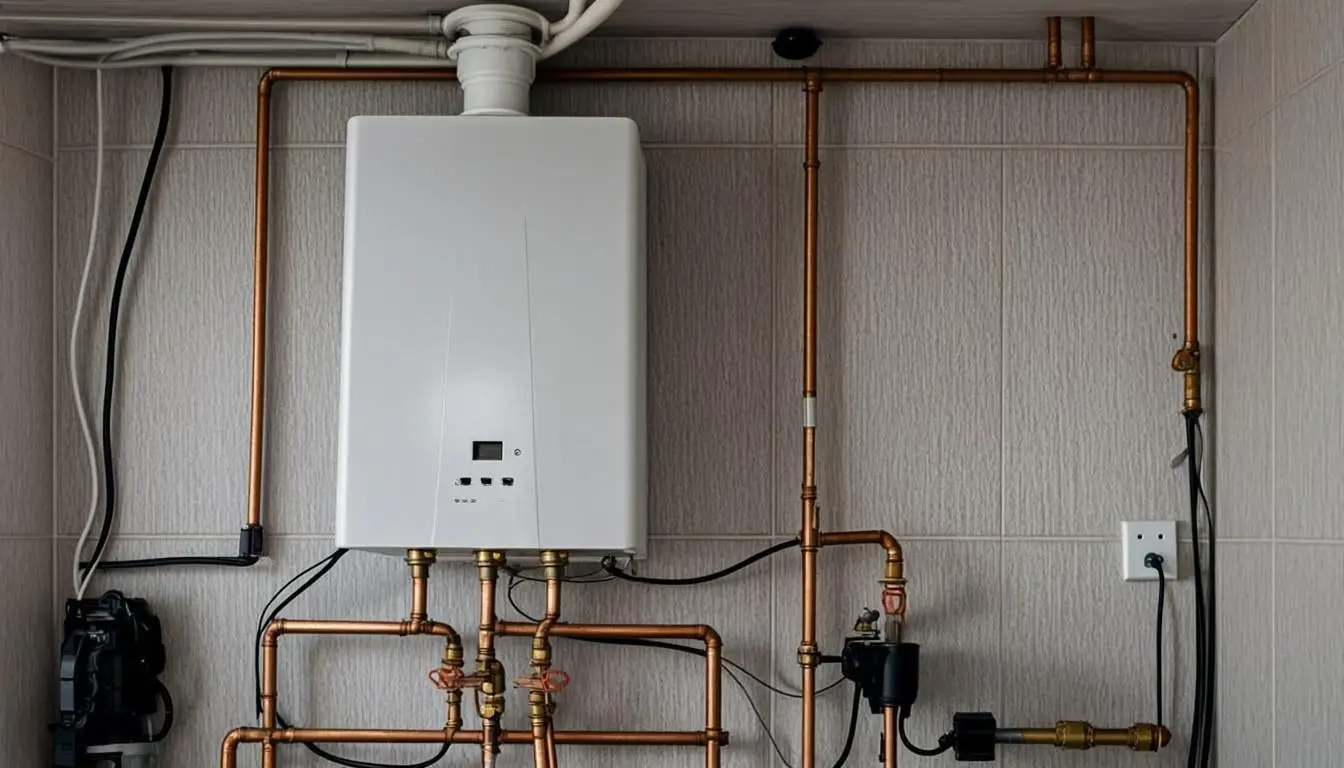
The Honest Answer Up Front
A gas tankless water heater installed in BC in 2026 costs $3,200 to $6,500: non-condensing units land $3,200 to $4,200, condensing units $4,500 to $6,500, with Navien and Rinnai owning the market and Bosch and Rheem in supporting roles. Electric tankless units cost less to buy and more to run, and most houses cannot host them anyway: a whole-house electric tankless wants 100 to 150 amps of dedicated capacity, which is a service upgrade before it is a water heater.
The honest part most quotes skip: the unit is a third of the price. The other two thirds are the gas line, frequently undersized for tankless flow rates and needing a 3/4-inch run, the venting, and the recirculation strategy. A house with a 40-year-old 1/2-inch gas branch and a chimney across the house can see $1,500 of distribution work on a $2,000 unit, and that is normal, not a scam.
And the part nobody likes hearing: some houses should keep a tank. Households with one bathroom, low simultaneous demand and an existing healthy tank are often better served by a $1,800 quality tank replacement than a $5,500 conversion, and a heat pump water heater at $4,000 to $6,500 beats both on operating cost in a household that uses plenty of hot water. The right answer comes from the demand profile, and our water heater desk starts there, not at the brochure.
Endless hot water is a promise about capacity, not about pressure. The pipe from the street has to deliver what the unit promises, or the unit is just an expensive way to find out.
32000 to $6.5k
The 2026 installed band for gas tankless, non-condensing through condensing.
1990 to $599
The gas line and venting swing, the two lines that decide the real price.
0.50 to 1.0 GPM
The BC winter inlet penalty: 7°C groundwater versus 20°C summer supply.
200 yr design life
Twice a tank, when the annual flush actually happens.
The 2026 Field, Priced
The market here is effectively two brands with a supporting cast, and the pricing reflects that concentration. These are the units our install logs show most, with the honest installed brackets on straightforward changeouts.
| Unit class | Equipment | 2026 installed range | Notes |
|---|---|---|---|
| Non-condensing gas | Rinnai RUC-98 class | $3,200-$4,200 | Classic two-pipe venting, simplest installs |
| Condensing gas | Navien NPE-240A2, Rinnai RSC-199 | $4,500-$6,500 | PVC venting, rebates, the Metro default |
| Condensing with recirc | Navien NPE-A with built-in pump | $5,000-$6,500 | The comfort answer for long pipe runs |
| Electric whole-house | Stiebel class | $2,000-$3,000 plus service | Rarely viable without 100-150A capacity |
| Heat pump water heater | Voltex class | $4,000-$6,500 | Cheapest to run, needs air and space |
The sizing question that matters is GPM at winter inlet temperatures, and this is where BC is different from the marketing: groundwater arrives at 7 to 10°C in January, not the 21°C the US rating plates assume. A unit rated 9.8 GPM delivers roughly 5 at a 45°C rise. Sizing for the January morning, not the brochure, is the difference between a good decision and an expensive disappointment, and the Navien versus Rinnai comparison carries the model-level detail.
What Is in a Tankless Quote
This is how a tankless quote should itemize, and where the surprises hide when it does not.
| Line item | Typical range | Why it varies |
|---|---|---|
| Tankless unit | $1,400-$2,600 | Condensing and recirculation add the spread |
| Gas line work | $200-$900 | 3/4-inch runs, new branch from meter, pressure verification |
| Venting | $250-$800 | PVC on condensing; stainless runs and terminations add |
| Valves and isolation | $120-$250 | Service valves, flush ports for the annual service |
| Condensate routing | $100-$300 | Pump or gravity drain to code |
| Electrical | $100-$400 | Most gas units need a standard 120V circuit |
| Permit and inspection | $150-$300 | Gas permit plus TSBC inspection, always |
The gas line is the line that sinks thin quotes. Tankless burners pull 140,000 to 199,000 BTU/h, and a half-inch branch sized for a 40,000 BTU tank cannot feed one. Our techs verify meter capacity and branch sizing before quoting equipment, because discovering it during install is how customers end up paying for a second visit under duress.
Gas, Electric or Heat Pump Tankless
Electric tankless is a category that mostly does not belong in BC detached houses, and it is worth being direct about: whole-house electric tankless draws 100 to 150 amps at 240V, most panels cannot host it without a service upgrade, and at BC Hydro rates it costs more per litre of hot water than a condensing gas unit at FortisBC rates. Where it fits: point-of-use units at a single sink ($300 to $700 installed), remote bathrooms, garages and workshops.
The heat pump water heater angle
For households with moderate hot water demand, the heat pump water heater is the operating-cost champion: it moves heat instead of making it, drawing roughly a third of the electricity of a standard electric tank. It needs roughly 700 cubic feet of air and a space that tolerates mild cooling and dehumidification, which makes it a natural fit for basements and exactly wrong for tight closets. The full comparison is in our heat pump water heater guide.
The honest rule: gas tankless wins on simultaneous demand and endless supply, heat pump tanks win on operating cost and quiet, and standard tanks win on price and simplicity. Everything else is marketing filling the gaps between those three facts.
Recirculation: The Comfort Line Nobody Budgets
The most common complaint we inherit from other companies installs is the wait: hot water takes 40 seconds to arrive, every tap, every time. That is a plumbing-geometry problem, not a heater problem, and it has two honest fixes. A built-in recirculation unit with a small return line ($500 to $1,200 added during install) delivers near-instant hot water at a modest idle cost. A comfort valve retrofit under the far fixture ($150 to $350) gets most of the benefit on existing homes without opening walls.
On the operating side, recirculation costs $5 to $12 a month in gas or electricity depending on strategy and insulation, and it is the difference between tankless feeling like an upgrade and feeling like a science project. Quote it as a line, decide it as a household, and the hot water tank pricing guide shows what the tank path costs by comparison.
What It Costs to Run
At 2026 rates, a condensing gas tankless serving a typical Metro Vancouver household of three to four people costs roughly $28 to $45 a month in gas and standby, against $35 to $55 for a standard 50-gallon gas tank and $60-plus for electric tanks at BC Hydro rates. The efficiency gap is real but narrower than the brochures imply, roughly 20 to 30 percent against a modern tank, because tanks improved and tankless idle losses exist too.
The bigger operating lever is the flush: tankless heat exchangers collect scale in BC hard-water areas like Abbotsford and the valley, and an annual flush at $149 to $250 is what keeps the 20-year design life honest. Skip three years and the flow sensor fouls, the unit derates, and the service call costs more than the flushes would have. The maintenance details live in our service guide, and the tankless versus tank comparison runs the ten-year totals.
The payback arithmetic, honestly: a condensing tankless at $5,800 installed, after a $1,000 FortisBC rebate, against a 50-gallon tank at $1,900, is a $2,900 premium. At $12 to $18 a month saved on gas and standby, the premium returns in 14 to 18 years on operating alone, so the real case for tankless is never the fuel line, it is the 20-year service life against two tank replacements, the reclaimed closet, the endless supply, and the avoided day a decade from now when the tank lets go over the finished basement. Households that value those things buy tankless; households that only run the fuel line should keep the tank and invest the difference in insulation.
Rebates and Incentives
Condensing tankless units qualify for FortisBC rebates, typically $500 to $1,000 on qualifying models, and the maintenance program returns up to $150 on annual service. There is no CleanBC pool for gas tankless, the heat pump water heater is where those dollars live, and that asymmetry is deliberate policy: the province is nudging hot water toward electricity, and your quote should acknowledge it rather than pretend otherwise. Our quotes attach the rebate page with model codes and deadlines, and the FortisBC programs guide tracks the current numbers.
When a Tank Still Wins
The honest list from our booking desk, because about a third of the tankless calls we receive end in a tank and the customers are better for it.
- One-bathroom households with low simultaneous demand: the tankless premium never amortizes.
- Houses with 1/2-inch gas branches and distant meters: distribution work can double the price; the arithmetic collapses.
- Households planning to move within five years: you rarely recover the conversion in resale.
- Households with heavy electricity bias: the heat pump water heater path, not gas tankless, is the money answer.
- Tight budget seasons: a quality 50-gallon tank at $1,600 to $2,200 installed is a respectable decision, not a defeat.
- Houses with seasonal-use suites or long vacancies: tanks lose less standby in an unused mechanical room than homeowners assume, and simpler equipment suits the duty cycle.
The demand profile decides, and the profile is three questions: how many showers at once, how far the far tap is from the mechanical room, and whether anyone is home midday. Our tankless page for Surrey and the city pages under water heaters carry the local versions of this advice.

City Notes From the Install Log
The tankless decision varies by housing era and gas infrastructure more than by geography, and these are the patterns we quote against.
- Vancouver and Burnaby: older gas branches, the gas line line-item does the deciding; combi conversions are common in small mechanical closets.
- Surrey and Langley: newer stock, meter capacity usually fine; biggest tankless adoption in the region.
- North Shore: long pipe runs, recirculation quoted on most jobs; crawl installs need freeze protection.
- Richmond: suite density, twin-tank setups versus combi, flood-elevation habits matter.
- Abbotsford and the valley: harder water, annual flushes earn their keep, propane conversions beyond the mains.
And the maintenance schedule that protects all of it is laid out in the heat pump water heater guide and on every city page under service areas.
The Tankless Cost Cheat Sheet
The hot water money questions, answered at tap speed.
| Question | The honest answer |
|---|---|
| Gas tankless installed? | $3,200-$4,200 non-condensing, $4,500-$6,500 condensing |
| The hidden lines? | Gas 3/4-inch branch, venting, recirculation: up to $1,900 combined |
| Electric tankless? | Point-of-use only in most BC homes, panels cannot host whole-house |
| Cheapest to run? | Heat pump water heater, then condensing gas, then tanks |
| Winter capacity? | Rate for 7°C inlet, a 9.8 GPM plate delivers about 5 |
| Rebate? | FortisBC $500-$1,000 on qualifying condensing models |
| When does a tank win? | Low demand, weak gas branch, short ownership horizon |
| The must-do? | Annual flush, $149-$250, non-negotiable in hard water areas |
One line to keep: size the unit for January, price the gas line honestly, and flush it every year. Call 604-615-2212 for a quote that does all three on page one.
Get a Hot Water Quote Sized for January
Demand profile first, equipment second, gas line verified before the price is promised. Rebate page attached with model codes and deadlines, flush schedule built into the plan, zero obligation.
Frequently Asked Questions
Services From This Guide
Licensed crews, flat-rate quotes and 24/7 emergency response across the twelve Metro Vancouver cities we serve.
Water Heaters
Tank, tankless and heat pump installs and service.
Tankless Surrey
Highest-adoption city in our footprint.
Tankless Vancouver
Old gas branches assessed before pricing.
Water Heaters Abbotsford
Hard-water flush schedules for the valley.
Plumbing
Recirculation lines and the pipe side of hot water.
Financing and Rebates
FortisBC rebate math on every quote.
{esc(a['author'])}
More about our team →Get Your Hot Water Quote From the Demand Profile Outward
Gas line verified before pricing, January inlet math in the sizing, recirculation quoted as its own line. Cash and financed pricing side by side, zero obligation.
No hot water tonight?
24/7 response with a flat $150 after-hours premium posted in advance, and the $89 diagnostic credited to any repair. Cold showers move up the queue.
Call 604-615-2212 WhatsApp Us