The Honest Answer Up Front
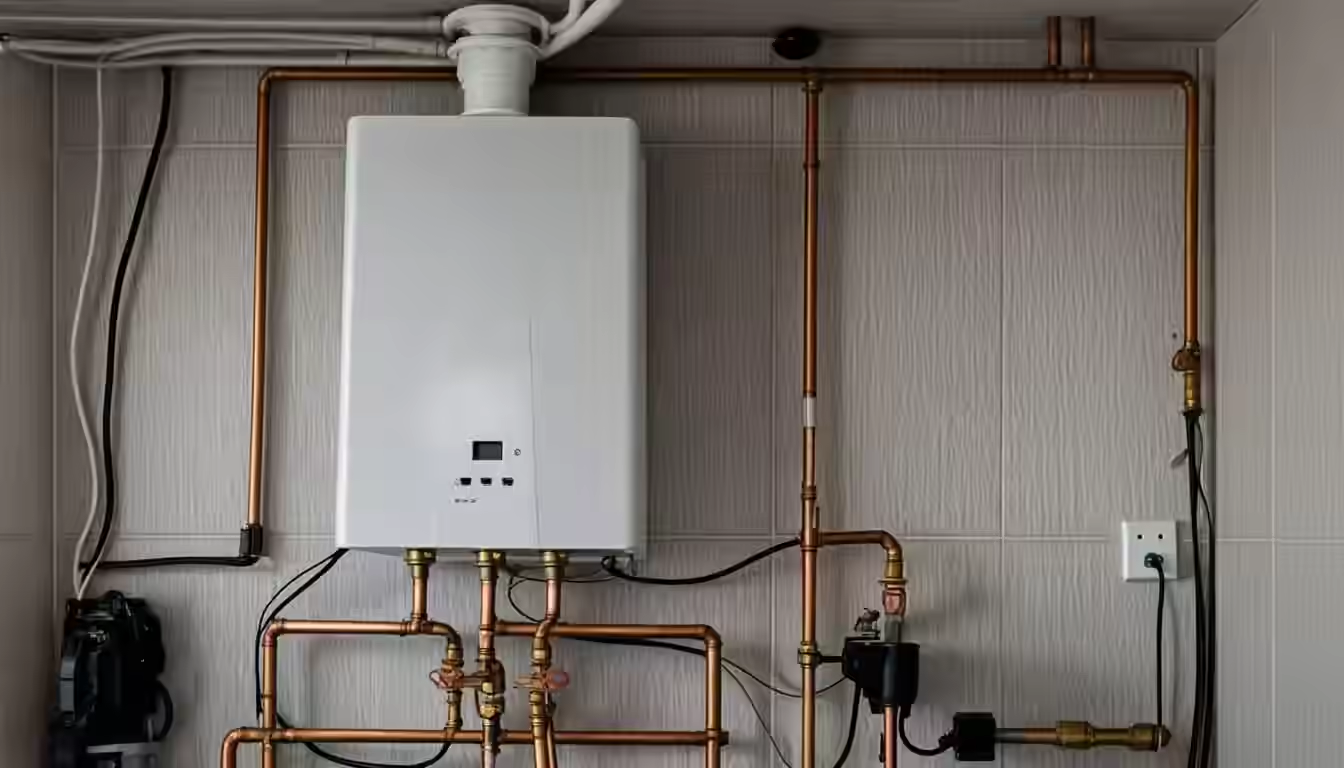
Navien and Rinnai both build excellent condensing tankless water heaters, and we install and service both across Metro Vancouver, so the honest comparison is not about quality, it is about which company's strengths match your house. Navien leads on integration: its Advanced models carry the recirculation pump and buffer tank inside the cabinet, so hot water arrives faster with less added plumbing, and the brand typically quotes a few hundred dollars less installed. Rinnai leads on installed-base depth: it is the largest tankless maker in the world, its diagnostics are famously readable, and any competent tech in BC has serviced hundreds of them.
The numbers both live inside: a tankless installs for $2,500 to $4,500 in Metro Vancouver, with the final number moved mostly by gas-line work, not by the badge. In February, when our inlet water arrives at 6 to 8 degrees C, a 199,000 BTU unit from either brand delivers roughly 4.5 to 5 GPM at shower temperature, enough for two simultaneous showers plus a faucet. Repairs run $180 to $450, the diagnostic is $89 to $129 and credited, and an annual flush, which our soft city water makes forgiving, keeps either unit running past its twentieth birthday.
The blunt recommendations: want the fastest hot water at the tap with the least extra plumbing, buy the Navien NPE-2 Advanced class. Want the deepest service network and the most conservative, overbuilt engineering, buy the Rinnai RU199 class. Renting a tank right now, either one ends the rental payments and wins the decade. And if your goal is the lowest possible operating cost or rebate money, neither gas unit qualifies for CleanBC support, so read Chapter 11 before you sign, because a heat pump water heater changes the math entirely.
The line we give every homeowner standing in front of two brochures: in ten years you will remember whether the hot water arrived fast and the unit was quiet, not which logo was on the cover. Both brands deliver that. The installation quality decides the rest.
0 jobs since 2010
Installs, repairs and flushes across every hot water system we touch, including both tankless brands compared here.
0
We install and service Navien and Rinnai with no dealer allegiance, so the recommendation follows your plumbing, not our margin.
0
The honest winter number for a 199,000 BTU unit from either brand: two showers plus a faucet, at full shower temperature.
0 star rated
From verified reviews, earned across tankless installs, flushes and no-hot-water emergencies alike.
The Two Brands, One Paragraph Each
Navien built its North American reputation almost entirely on condensing technology, and it shows in the product. The current NPE-2 series splits into Advanced models, which carry the ComfortFlow internal recirculation pump and a small buffer tank, and Standard models without them, and both run dual stainless steel heat exchangers that squeeze exhaust heat back into the water. Navien's presence in BC is unusually strong for a brand its size: its pricing, its distribution and its feature set landed well here, and NPE units are all over Vancouver laneway homes, renovations and infill builds. The one honest knock from our service log is complexity; a unit doing more jobs internally has more parts that can ask for attention. Our water heater services page covers what we install and service.
Rinnai has been making gas appliances in Japan since the 1920s and is the largest tankless manufacturer in the world, and that scale is the product. The condensing RU-series, the RU199 class at the top, is conservative, overbuilt engineering: a single robust condensing heat exchanger, error codes any licensed tech can read off a two-digit display, and parts supply so deep that same-day service is close to guaranteed anywhere in the Lower Mainland. Rinnai does not build recirculation into the cabinet; it achieves the same result with an external pump strategy, which is one more component on the wall but an equally good outcome. Rinnai units are, in our experience, the units you forget about, which is the highest compliment a water heater can earn.
What the two-paragraph framing hides is how close these brands actually are. Both condense, both run roughly 0.95 to 0.97 Uniform Energy Factor, both fire at up to 199,000 BTU per hour, both PVC-vent through a wall, both ship Wi-Fi controls and internal freeze protection, and both are backed by wholesale parts counters across BC. The differences that matter are recirculation philosophy, warranty length, and a few hundred dollars, and the rest of this guide puts numbers on each of those.
How Condensing Tankless Actually Works
A tank water heater stores 40 to 60 gallons hot and pays to keep it hot around the clock, losing heat through the tank walls day and night. A tankless fires only when a tap opens: a flow sensor detects demand, the modulating gas burner lights, and water passes through a heat exchanger on its way to the fixture. No stored water, no standby loss, no running out. The trade-offs are equally physical: the unit needs serious gas supply when it fires, and it produces condensate that must drain somewhere.
Both brands in this comparison are condensing, which is the detail that makes them worth the money. A non-condensing unit dumps exhaust hot enough to melt plastic venting; a condensing unit pulls so much heat out of the exhaust that the flue gas condenses into liquid, and the leftover exhaust is cool enough to vent through inexpensive PVC pipe out a side wall. That second heat-exchanger pass is why these units reach 0.95 to 0.97 UEF while an atmospheric tank sits near 0.60 to 0.70, and why a tankless gas bill for a typical Metro Vancouver family of four runs meaningfully below a tank's, winter and summer.
The burner modulation is the comfort part. Instead of on and off, these units throttle, firing anywhere from a pilot-scale flame for a single bathroom faucet to full 199,000 BTU output for two showers, and holding outlet temperature within a couple of degrees while they do it. That is why a tankless shower never goes cold when someone starts the dishwasher, the scenario that ended many a 40-gallon-tank household's patience. The deeper comparison between tank and tankless, including the honest cases where the tank still wins, is in our tankless versus tank guide.
The Spec Sheet, Side by Side
Here is the honest spec comparison, using each brand's flagship condensing class: the Navien NPE-2 240-class Advanced and the Rinnai RU199 class. Marketing numbers appear beside the BC-winter numbers, because the difference between them is the difference between a brochure and a February morning.
| Spec | Navien NPE-2 Advanced (240-class) | Rinnai RU199 class |
|---|---|---|
| Max input | 199,000 BTU/h | 199,000 BTU/h |
| Efficiency | ~0.96 UEF, condensing, dual stainless heat exchangers | ~0.95-0.96 UEF, condensing |
| Max flow, brochure conditions | ~11 GPM at a 35 F rise | ~11 GPM at a 35 F rise |
| Real February flow, Metro Van inlet | ~4.5-5 GPM at shower temperature | ~4.5-5 GPM at shower temperature |
| Recirculation | Built-in pump plus buffer tank on Advanced models | External pump and control strategy |
| Venting | PVC concentric or dual pipe, side-wall | PVC dual pipe or concentric, side-wall |
| Controls | Navien SmartWave Wi-Fi, remote controls | Control-R Wi-Fi, wired and wireless remotes |
| Freeze protection | Internal electric heaters, needs power | Internal electric heaters, needs power |
Read the table twice and the pattern is obvious: at the top of either line-up you are buying the same physics, dressed differently. The brand decision is genuinely about the recirculation philosophy, the warranty terms, the installer's familiarity and the quote, in roughly that order. Anyone who tells you one of these units is dramatically better at heating water is selling, not installing.
Cold Inlets and Real Winter Flow Rates
Here is the chapter most tankless comparisons skip, and in BC it is the one that matters. Flow rate is not a property of the unit; it is a property of the unit and the water entering it. Metro Vancouver drinks surface water from mountain reservoirs, and by January and February that water arrives at your cold tap at roughly 6 to 8 degrees C. Summer inlets run 12 to 15. The same tankless that produces 11 GPM on a spec sheet, calculated at a 35 degree Fahrenheit rise, produces about half that when the physics of a February morning are applied.
The math, so you can check us: heating water from 7 degrees C to 49 degrees C is about a 75 degree Fahrenheit rise. A 199,000 BTU condensing unit at roughly 96 percent efficiency delivers about 191,000 usable BTU per hour, and 75 times 8.33 times 60 minutes of water costs about 37,500 BTU per GPM. Divide and you get approximately 5 GPM of continuous shower-temperature water on the coldest week of the year, from either brand. A modern low-flow shower head draws 1.5 to 2 GPM, so two simultaneous showers plus a sink is comfortably inside the number. Three showers at once is outside it, and everyone in them will notice.

Two honest conclusions follow. First, any household whose peak is two showers plus a faucet is a one-unit household, and both brands handle it identically. Second, households that genuinely run three or more simultaneous hot water draws, big families with teenagers, suites sharing one system, should either accept a scheduling reality or consider a larger combined strategy, and that conversation is worth having with a technician who measured your actual fixture load rather than one who read the brochure aloud. If your current complaint is running out of hot water rather than flow, the failure signs are covered in our water heater failure signs guide.
Bottom line
On a February morning in Metro Vancouver, a 199,000 BTU condensing unit from either brand delivers about 4.5 to 5 GPM at shower temperature. That is two showers plus a faucet, forever, and it is the number to plan a household around. Anyone quoting the brochure's 11 GPM as a winter planning number has never put gauges on one in January.
What They Cost Installed in BC
The installed range for a tankless in Metro Vancouver is $2,500 to $4,500, and within that band Navien typically lands slightly lower and Rinnai slightly higher for comparable equipment. What actually moves the number is almost never the badge. It is the gas line, because a 199,000 BTU unit often needs a larger line than the tank it replaces, the venting path to an exterior wall, the condensate drain location, and whether you add recirculation. A straight swap in a newer home with a right-sized gas line sits near the bottom; a 1970s house with a half-inch line and a long vent run sits near the top for either brand.
| Job | Typical range (CAD) | What moves the number |
|---|---|---|
| Tankless water heater install, either brand | $2,500-$4,500 | Equipment class, gas-line work, venting run, recirculation, condensate routing |
| Navien NPE-2 Advanced class | lower half of the band | Internal recirculation hardware included in the cabinet |
| Rinnai RU199 class | upper half of the band | External recirculation pump and plumbing add components |
| Hot water tank install (the comparison) | $1,400-$2,600 | Vent type, capacity, gas or electric |
| Repairs, either brand | $180-$450 | Part, age, scale history, access |
| Annual flush and service | within $180-$450 | Water hardness by area, access to isolation valves |
Financing starts at 7.99 percent with approved credit, which puts a mid-band tankless near $60 to $100 a month and ends a rental payment of $25 to $45 forever, and the rental-versus-buy math deserves its own ten minutes because BC's rental water heater market is a genuine trap for the inattentive; our rental versus buy guide runs the numbers. One rebate honesty note, because it surprises people: gas tankless units do not qualify for CleanBC or BC Hydro support, which is aimed at electrification. If rebate money is part of your budget, a heat pump water heater belongs in the conversation, and our forthcoming heat pump water heater guide for BC covers it with the same honesty.

Waiting for Hot Water: The Recirculation Question
Tankless does not change pipe physics. If your master bathroom is 60 feet of half-inch copper from the mechanical room, you will wait 30 to 60 seconds for hot water whether the source is a tank or a wall-hung unit, because you are waiting for the cold water standing in the pipe to be pushed out. The fix is recirculation, moving hot water in a loop so the pipe is always warm, and this is where Navien and Rinnai take genuinely different paths.
Navien's Advanced models carry ComfortFlow: the pump and a small buffer tank live inside the cabinet, and with either a dedicated recirculation loop or an under-sink crossover valve at the furthest fixture, the wait shrinks to seconds. It is tidy, it is one warranty, and it is why we quote Navien first when the complaint is wait time. Rinnai achieves the same outcome with an external pump and control strategy, sometimes with its own demand-style controls; it works every bit as well, but it is one more component on the wall, one more thing to power and, eventually, one more thing to replace.
The honest engineering note either way: recirculation trades a little gas and electricity for speed, because keeping a loop warm costs energy, so a timer or a learning schedule that only warms the loop before shower hours captures most of the benefit at a fraction of the cost. A recirculation system running 24 hours a day in a 1980s Vancouver Special with uninsulated pipe runs is quietly expensive. Schedule it, insulate the loop, and it is the best money in the whole system.
Gas Lines, Venting and the BC Code Angle
Every gas appliance installation in this province falls under the BC Gas Code, built on the CSA B149.1 standard, and a tankless stretches two parts of that code that a tank never touched. The first is gas supply. A 40-gallon tank burner draws around 40,000 BTU per hour; a flagship tankless fires at up to 199,000. The line that fed the tank for twenty years, often half-inch, cannot feed the tankless, and the fix means a new or parallel gas run and sometimes a conversation with FortisBC about the meter itself, all of which is permit work for a licensed gas fitter, not a Saturday project.
The second is venting, which is easier here than anywhere in the country. Because both units condense, their exhaust is cool enough for PVC pipe terminated on a side wall, which is exactly how most Metro Vancouver installations run: a short run through the nearest exterior wall, with the clearances to windows and gas meters the code requires, and a condensate drain, often through a small neutralizer, to the laundry or floor drain. That condensate line is the one BC-specific detail that bites: an exterior condensate run that is not sloped and protected will freeze in an outflow wind and shut the unit down on the coldest night of the year.
What install day looks like from us, and from any contractor worth the permit: gas line verified against the whole-house load, venting run and terminated to code, condensate routed and sloped, water connections with isolation valves and flush ports so servicing never requires cutting pipe, gas pressure and combustion verified with a gauge, and the unit registered before we leave. Our Vancouver water heater service page lists how we run these installs across the city, and the same standard applies in every municipality we serve.
The Service Log: Scale, Codes and Cold Showers
Ten years of no-hot-water calls on these two brands produce a short, repeatable list. Scale leads where the water is hard: a coated heat exchanger throws flow errors and delivers lukewarm water at high draws. Flow sensors fail second, often with scale as the accomplice. Ignition faults follow, from gas pressure that drifted or igniters at end of life, and Rinnai's famous code 11, no ignition, is the single most-Googled tankless error code in Canada. Frozen condensate lines and dead freeze-protection elements show up after every outflow wind event, almost always in units installed without proper slope or drained improperly during a power outage.
| Service item | Typical range (CAD) | What our log says |
|---|---|---|
| Diagnostic visit | $89-$129, credited | Error code read, gas pressure and flow checked before any part is quoted |
| Descaling flush | $180-$450 | Yearly in the Fraser Valley, every second year is honest on soft city water |
| Flow sensor replacement | within $180-$450 | A common repair on both badges; scale and debris are the usual accomplices |
| Ignition fault repair | within $180-$450 | Igniter, flame rod or gas pressure; the Rinnai code 11 family |
| After-hours emergency call | flat $150 premium | Disclosed upfront, 24/7 dispatch, 30-60 minute response across most of Metro Van |
The BC water story deserves its own honesty. Metro Vancouver's city water is famously soft, a few milligrams per litre of hardness, which is why tankless units in Vancouver, Burnaby and Richmond rarely scale badly and a two-year flush cycle is defensible. Abbotsford, Mission and parts of Langley run well water that is meaningfully harder, and there the annual flush is not optional; it is the difference between a 20-year heat exchanger and a 10-year one. Wherever you are, install isolation valves with flush ports on day one so the service never becomes plumbing surgery.
When a tankless fails, it fails all at once, no stored reserve, which is why our emergency line exists: no-hot-water calls are answered 24/7, the flat $150 after-hours premium is disclosed before the truck rolls, and the Vancouver emergency plumbing page explains the response times by city. If the unit is over a decade old and quoting a major part, the repair-versus-replace math changes, and that conversation should include the tank option too, because a straight $1,400 to $2,600 tank install is sometimes the honest answer for a household of one.
Warranties and Parts Reality
On current published Canadian residential terms, Navien backs its heat exchanger for 15 years, parts for 5 and labour for 1; Rinnai backs its heat exchanger for 12 years, parts for 5 and labour for 1. Read the exclusions before you count the years, because both warranties assume licensed installation, registration and documented maintenance, and in hard-water areas both can ask for flush records before honouring a heat exchanger claim. A warranty is a promise about paperwork as much as parts, and the paperwork is your installer's job as much as yours.
Parts availability is where both brands earn their BC reputation, and it is a real factor worth saying out loud: flow sensors, igniters, fan motors, boards and service kits for both Navien and Rinnai sit on wholesale counters across the Lower Mainland, and a routine repair on either brand is a same-day affair, not a two-week wait on a container. Our trucks carry the common failure items for both specifically because we refuse to leave a household without hot water over a part.
And the warranty nobody reads until it matters: workmanship. The manufacturer covers the box; the installer owns the gas line, the venting, the condensate, the freeze-prone exterior run and every joint in between, which is where a meaningful share of real-world failures actually live. Ours is 2 years, in writing, on every job, backed by licence BC-PL-2019-4421, $2M in liability coverage and 12,000-plus jobs of answerable history since 2010. Compare that paragraph as carefully as you compare the heat exchanger terms.
The Decision Test
Four questions, in order. How far is your furthest fixture from the mechanical room? Far means recirculation matters, which tilts Navien Advanced. What does your household actually run at peak? Two showers plus a faucet fits either unit; three simultaneous draws needs a conversation about scheduling or bigger strategies. What is your water? City-soft makes either brand a 20-year proposition with light flushing; valley-hard water makes the flush schedule the deciding maintenance item. And what does the quote include? Gas line, venting, condensate, isolation valves, permit and registration should all be line items, because that list, not the badge, is what you actually live with.
The answer key: waiting time is your top complaint, the Navien NPE-2 Advanced class with its built-in ComfortFlow is the cleanest solution. You want the most serviceable, most universally supported unit in the province, the Rinnai RU199 class earns its slight premium. You are escaping a rental tank, either one wins the decade, and the rental exit math will make you wonder why you waited. And if your real goal is the lowest operating cost or CleanBC support, stop and read the heat pump water heater guide first, because electrics and rebates change the equation in ways no gas unit can.
Bottom line
Navien if you want recirculation built in and the friendlier quote; Rinnai if you want the deepest service network in the business and the most forgettable water heater ever mounted on a wall. Both deliver about 5 GPM on a February inlet, both install for $2,500 to $4,500, and both outlast two tanks. The installer matters more than the badge, and the gas line matters more than the brochure.
Frequently Asked Questions
Services That Solve This Faster
Water Heater Services
Tankless and tank installations, repairs, flushes and emergency no-hot-water response across Metro Vancouver.
Plumbing Services
Gas lines, recirculation loops, leaks and repipes: the piping work that makes a tankless install or repair hold up.
Water Heaters in Vancouver
Same-day diagnostics from $89 to $129, credited to any repair, with common Navien and Rinnai parts on the truck.
Water Heaters in Surrey
Fraser Valley hardness and bigger households: tankless sizing, flushing and repairs for Surrey and Langley homes.
24/7 Emergency Plumbing
No-hot-water calls answered around the clock, flat $150 after-hours premium disclosed before the truck rolls.
Related Guides From Our Team
Tankless vs Tank Water Heaters — the honest cases where the $1,400 to $2,600 tank still beats the tankless.
Hot Water Tank Rental vs Buy — the BC rental math every tankless quote should be measured against.
Water Heater Failure Signs — how to tell a dying tank from a repairable part before anyone quotes a replacement.
Heat Pump Water Heaters in BC — the electrified alternative, with the CleanBC and BC Hydro support that gas units cannot get.
Red Seal certified, licensed gas fitters (BC-PL-2019-4421), $2M insured, 15-plus years on the tools, 12,000-plus jobs across Metro Vancouver since 2010, 4.9 stars from verified reviews. We wrote this guide because Metro Vancouver homeowners deserve the numbers, the code references and the honest trade-offs before anyone touches a wrench or a wallet.
More about our team →Get Your Navien vs Rinnai Quote
Tell us about the household and the mechanical room, and we will quote both brands flat-rate: gas-line verification, venting, condensate, isolation valves, permits and registration included, with the real February flow numbers attached. Financing from 7.99 percent with approved credit, and same-week installs across the 17 Metro Vancouver cities we serve.
No hot water right now?
The 24/7 line answers any hour, with common Navien and Rinnai parts on the truck. Repairs run $180 to $450, the $89 to $129 diagnostic is credited to approved work, and the flat $150 after-hours premium is disclosed before the truck rolls.
Call 604-615-2212 WhatsApp Us