The Honest Answer Up Front
Furnaces in Metro Vancouver fail on the first cold snap because it is the first honest workout they have had in eight months. Our climate is mild enough that from May to October most furnaces barely run, and a furnace that sits dormant is not a furnace at rest; it is wear parts quietly finishing their lifespan. Then the first -5 degree night arrives, the system runs for hours instead of minutes, ignitors cycle dozens of extra times, blower motors start cold against stiff bearings, and every marginal part in the cabinet faces the same test on the same night. The failures are predictable enough that our dispatch board can nearly be written from the forecast.
The four usual suspects, in order of how often we see them in November: hot surface ignitors that crack or quit drawing the amperage the control board expects, flame sensors coated in invisible film that shut the gas off as a safety measure, blower capacitors that no longer give the motor the kick it needs to start cold, and pressure switch or venting faults, including high-efficiency condensate lines that freeze on the coldest nights. Every one of those is a part that announces its decline in October to anyone who looks, which is exactly what a $129 furnace tune-up is for.
If the failure has already happened: most cold-snap repairs land between $180 and $650, the diagnostic is $89 to $129 credited to any approved repair, after-hours calls carry a flat $150 premium disclosed before we roll, and the 24/7 line at 604-615-2212 reaches a live dispatcher with typical response of 30 to 45 minutes in Vancouver, Burnaby, Richmond, New Westminster, North Vancouver and Port Coquitlam. If the furnace is fifteen-plus years old, read the repair-versus-replace chapter before you approve anything big, because a cold-snap emergency is the worst possible negotiating position and the honest math is worth knowing in advance.
0 fall tune-up
The price of finding the weak ignitor in October instead of the emergency board in November.
0 typical response
30-45 minutes across the core cities when the heat dies, day or night, all winter.
Flat $150 after hours
Disclosed on the phone before the truck rolls. No mystery night rate, no weekend multiplier.
0 jobs since 2010
The November pattern is not a theory. It is twelve thousand jobs of dispatch history.
The November Pattern, Explained
Coastal BC has one of the gentlest heating climates in Canada, and that mildness is the mechanism behind the failures. In Winnipeg a furnace is a marathon runner that works daily from October to April. In Vancouver the same furnace is a sprinter that barely leaves the couch from May through September, then gets asked to run a race one random night in November when an arctic outflow pushes temperatures from 8 degrees to -5 in thirty-six hours. No warm-up, no ramp, no mercy.
Three things happen on that night. First, runtime explodes: instead of two or three short cycles a day, the furnace runs near-continuously, and every ignitor strike, every flame-sensing cycle, every blower start accumulates in hours what usually accumulates in weeks. Second, everything starts cold: a blower motor that begins life each morning at basement temperature draws harder against its bearings, and a weak capacitor that still managed in September cannot deliver the same kick at -2. Third, the safety systems get picky: pressure switches must prove venting with denser cold air moving through colder pipes, and condensate that drained freely in October can freeze in an exposed exterior line on the first genuinely cold night.
The result is not random. Across our 17-city service area, from Vancouver Specials with 1980s mid-efficiency units to Langley builds with high-efficiency condensing furnaces, the first cold snap produces a surge of no-heat calls dominated by the same four failures, in roughly the same order. Dispatchers in this industry know the pattern the way fishermen know a tide. The following chapters take the four suspects one at a time, because knowing the mechanism is what lets you either prevent the failure or recognize it when the technician explains it at your door at 11 p.m.
Hot Surface Ignitors: Failure Number One
Most furnaces built in the last thirty years do not have a pilot light; they have a hot surface ignitor, a fragile silicon carbide or silicon nitride element that glows orange-hot to light the burners on every single heating cycle. It is, mechanically, a lightbulb filament doing a job it was never thrilled about, and like a lightbulb it has a finite number of starts in it. Manufacturers design around three to five years of typical cycling, and Metro Vancouver's short shoulder-season cycles mean the ignitor on an older furnace may have already banked thousands of starts by the time the house was last warm.
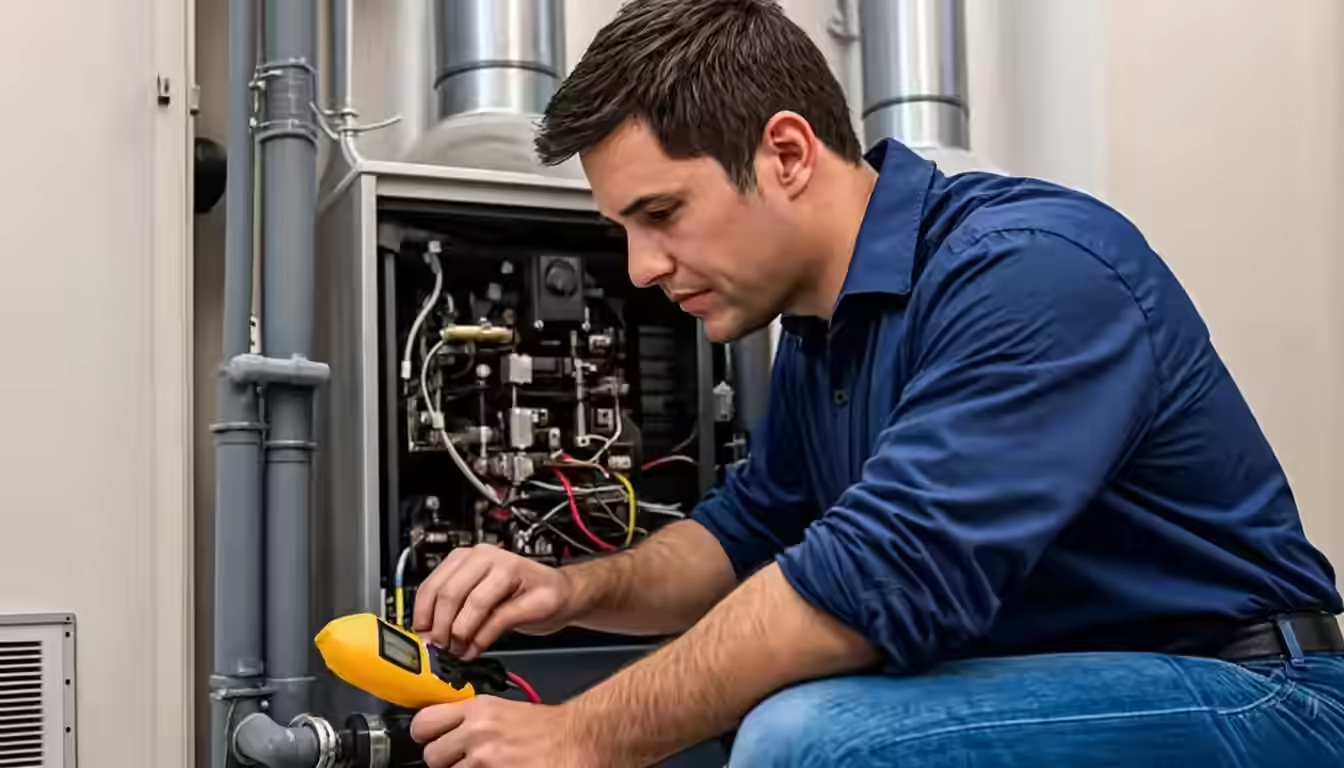
The cold snap finishes the story in two ways. An ignitor near death either cracks outright on a hard cold start, or it still glows but can no longer draw the amperage the control board is programmed to expect, so the board locks out the gas valve and the furnace sits silent while the blower blows cold. The homeowner hears the induced draft motor start, sees nothing light, and calls us. The diagnosis is ten minutes with a clamp meter, and the repair lands in the lower half of the $180 to $650 range.
Here is the part worth knowing before November: a weakening ignitor is measurable. During a tune-up we check the ignitor's current draw against spec, and a reading that has drifted is a part we replace on schedule, at a planned price, on a Tuesday, instead of at midnight on the coldest night of the year at an emergency premium. If your furnace has had one ignitor replaced in the last few years, the second one is on a countdown you can see coming. That is not upselling; that is the whole service existing.
Flame Sensors: The Dirty Little Stranding
The flame sensor is a thin metal rod sitting in the burner flame whose entire job is to answer one question every cycle: is there fire where there is gas? It answers by conducting a tiny electrical signal through the flame itself. When a thin, nearly invisible film of combustion byproduct coats the rod, the signal weakens, and the control board, doing exactly what it was designed to do, shuts the gas valve and locks out after a few failed proofs. From inside the house it looks like the furnace is broken. From inside the cabinet it is a rod that needs six minutes and the right abrasive.
Why the cold snap? Because the first long runtime of the season is when a summer's worth of subtle film accumulation finally crosses the threshold the board will accept, and because more ignition attempts per night mean more chances for the lockout that strands the house. The failure pattern is unmistakable to anyone who has taken the calls: furnace lights, runs a few seconds, shuts down, tries again, eventually locks out, and by morning the kitchen floor is cold and the family is angry at an appliance.
The honest homeowner question is whether to clean it yourself, and the honest BC answer is no: the sensor sits inside the burner assembly of a gas appliance, and gas appliance work in this province belongs to licensed gas fitters, ours included, working under licence BC-PL-2019-4421. The practical economics are on your side anyway: flame sensor cleaning is part of the annual tune-up, and a mid-winter ignition failure is solved with the $89 to $129 diagnostic, credited to the repair. What actually costs families money is not the cleaning; it is skipping the year of service that would have included it.
Capacitors and Blower Motors: The Cold-Start Problem
The blower motor is the workhorse that moves air across the heat exchanger and through the house, and most blowers over ten years old get their starting torque from a run capacitor, a cylinder that stores and releases energy to kick the motor into motion. Capacitors age by losing capacitance, and a capacitor that measured strong five years ago can sit at a fraction of its rating today. In October, when the blower starts once or twice a day in a warm basement, a weak capacitor still gets the job done. On the first -5 night, with the motor cold and the runtime continuous, it hums, struggles, and either fails to start or overheats trying.
Homeowners describe the failure vividly: a hum from the furnace with no airflow, or the classic sign of a blower that starts, stutters, and trips. A capacitor failure is a mid-range repair inside the $180 to $650 band, usually resolved same-visit because capacitors are stocked on every truck. A blower motor itself is the bigger, later-stage failure, and on a fifteen-plus-year-old furnace it is one of the parts that tips the repair-versus-replace math toward replacement, which is Chapter 10's conversation.
The tell that shows up in October is airflow that seems weaker than last winter, rooms at the end of the duct runs that stopped keeping up, or a furnace that shuts down on high limit because air is not moving fast enough to carry the heat away. A tune-up catches the electrical side of this with a meter reading on the capacitor while the motor is still running happily, which is the only time that reading is cheap to act on.
Pressure Switches, Snow and Frozen Condensate
High-efficiency furnaces vent through plastic pipe to the exterior wall, and those terminations spend Metro Vancouver winters being buried by snow, crusted with frost, or claimed by the neighbourhood's most determined birds and wasps between seasons. The pressure switch exists to prove the vent is clear before the burner fires: if it cannot sense proper draft, the furnace will not light, which is the safety system working exactly as intended and also, at 1 a.m. in a snowfall, an exasperating no-heat call.
The first-cold-snap versions of this failure are predictable. Snow drifts over a low termination. Frost builds on a screen that was fine in October. Or the condensate line, which carries slightly acidic wastewater from the heat exchanger to a drain, freezes in an outside run during the first hard freeze, and the furnace locks out rather than flood itself. The fixes range from free, brush the snow off the termination, to quick, thaw and re-route a condensate line with proper slope and freeze protection, and all of them are cheaper than the 2 a.m. version of the same visit.
This is also where BC's rain earns its mention in every one of our guides: a vent or condensate line installed with the wrong slope, or a termination in a spot that takes driveway runoff, is a failure that has been waiting since installation day for its first real freeze. If your high-efficiency furnace is in a crawlspace or the vent exits low on a north wall, that is the profile we check first on cold-snap no-heat calls, before anyone touches a wrench on the ignition side.
The Warnings You Get in October
Almost no furnace that fails on the first cold snap was silent beforehand. The October warnings are there, they are specific, and they are cheap to act on. Short cycling, the furnace running two minutes and quitting repeatedly, is the classic sign of a struggling ignition chain or an overheating limit. Weak airflow, especially at the registers farthest from the furnace, points at the filter, the blower, or the capacitor. Cold spots in rooms that used to heat evenly mean the system is not moving the air it used to. A burner flame viewed through the sight glass that is yellow rather than steady blue deserves attention on its own merits, and a gas bill that climbed more than the weather explains is a system running inefficiently on its way to not running at all.

The list of things you can check without a license is short but real: the filter, the thermostat batteries, the vent terminations outside, and whether the furnace area has become a storage room blocking return air. Everything past that belongs to a licensed gas fitter, and the right time to book one is the week you notice a symptom, not the week the symptom has a family sitting in toques. If you want the full diagnostic picture of a furnace that is misbehaving, our furnace not working guide for Vancouver homes walks the checks room by room.
What a $129 Tune-Up Actually Catches
A furnace tune-up is not a vacuum and a smile; it is a diagnostic visit with a checklist, a meter and a combustion analyzer. Ours runs $129 flat, takes about an hour, and exists specifically to convert November emergencies into October findings. Here is the honest accounting of what each check catches and what it costs to ignore it until the cold snap makes the decision for you.
| Tune-up check | Cold-snap failure it prevents | If ignored until November |
|---|---|---|
| Ignitor current draw test | Dead ignitor on the first hard run | Emergency repair inside $180-$650, plus the $150 after-hours premium |
| Flame sensor cleaning | Ignition lockout from weak flame signal | A no-heat call that a Tuesday visit would have prevented |
| Capacitor and blower check | Blower that hums but will not start cold | Cold air from registers on the coldest night |
| Vent and condensate inspection | Pressure switch lockout, frozen condensate line | Lockouts that repeat every hard freeze until re-routed |
| Heat exchanger inspection | Crack found at 15-plus years, CO risk managed | A safety failure that turns into a replacement decision at the worst time |
| Combustion and temperature-rise test | Efficiency drift, overheat trips, sooting | Higher FortisBC bills all winter and short cycling by January |
The honest limitation: a tune-up catches most cold-snap failures, not all of them. Electronics fail without warning sometimes, and a motor that tested fine in October can still quit in January. But the four failures that dominate our November dispatch board, ignitors, flame sensors, capacitors and venting, are all visible to a technician with a meter and an hour in October, which is why the tune-up is the single best-performing $129 in the heating budget. Book it before the first frost, not after the first failure; the schedule is civilized in September and brutal in November.
The 2 a.m. Playbook: What To Do When Heat Dies Tonight
First, the safety gate, because it outranks everything else in this guide. If anyone smells gas, the playbook is: everyone out of the house first, then FortisBC at 1-800-663-9911 or 911 from outside or a neighbour's phone. Never call a trades company first for a gas smell. Our crews are licensed gas fitters and we will still tell you the same thing, because that is the correct order of operations.
Gas smell protocol
Smell gas: evacuate everyone first, call FortisBC at 1-800-663-9911 or 911 from outside. Do not flip switches, do not look for the leak, and never phone a heating company before the utility. Everything else about furnace failure is an inconvenience; this one is the exception.
With no gas smell, run the five-minute checklist before you call anyone. Thermostat set to heat, temperature turned up, batteries fresh if it uses them. Furnace switch on, breaker on. Filter not plugged, and be honest with yourself about how long it has been. Exterior vent terminations clear of snow and frost. On a high-efficiency furnace, condensate line not frozen where it exits the house. Those five checks resolve a real share of no-heat nights on their own, and if they do not, they are the first things we will ask about anyway.

Then call 604-615-2212, which is answered by a live dispatcher 24/7/365. While the house cools, keep interior doors closed on unused rooms, run nothing that risks frozen pipes overnight, and know that a Metro Vancouver house in a cold snap loses heat slowly; you have hours, not minutes, to make a calm decision. The dispatcher quotes the flat $150 after-hours premium before the truck rolls, and here is what typical response looks like by city:
| Area | Typical emergency response | Local page |
|---|---|---|
| Vancouver, Burnaby, Richmond, New Westminster, North Vancouver, Port Coquitlam | 30-45 minutes | Vancouver furnace repair |
| Surrey, Coquitlam, Langley, Delta | 45-60 minutes | Surrey furnace repair |
| Maple Ridge, Pitt Meadows | 50-70 minutes | Maple Ridge furnace repair |
| Abbotsford, Mission | 60-80 minutes | 24/7 emergency service |
At the door, the technician runs the diagnostic, quotes a flat-rate price for the repair, and you approve it before work starts. Most cold-snap repairs are single-visit fixes with parts from the truck. If the verdict is a cracked heat exchanger or a dead blower on an aging unit, the technician will say so plainly and the conversation moves to Chapter 10, ideally with the furnace limping on safeties until a scheduled replacement, which is a better negotiation than a midnight one. The full city-by-city emergency picture, including plumbing, is on our 24/7 emergency page.
The Cold-Snap Repair-Versus-Replace Math
A no-heat emergency is the worst room in the house to make a five-thousand-dollar decision, so here is the math in advance. The variable that decides almost everything is age, and the second variable is which part failed. Repairs run $180 to $650; a replacement starts at $3,800 for an 80 percent single-stage furnace installed and runs $5,500 to $9,000 for a high-efficiency two-stage, numbers we break down fully in our Vancouver furnace cost guide.
| Furnace age | Honest call on a cold-snap failure | Typical money |
|---|---|---|
| Under 10 years | Repair. Almost always. Check warranty coverage before paying anything. | $180-$650 |
| 10 to 15 years | Repair small ignition parts; start planning replacement if the part is major or the second repair in two winters. | $180-$650, then plan |
| 15-plus years | Replacement is usually the honest math, especially with a failed blower or cracked exchanger. | $3,800-$9,000 |
Two BC-specific notes for the replacement path. If the old furnace is still running on safeties, you can schedule the swap instead of emergency-pricing it, and a scheduled install is a calmer, cheaper room to negotiate in. And if you are replacing anyway, November is the moment to ask the heat pump question, because combined CleanBC, BC Hydro, FortisBC and municipal support can reach $16,000, financing starts from 7.99 percent with approved credit, and the system you install this decade is likely the one that has to handle both colder snaps and hotter summers. The full decision framework, including the $129-versus-$3,800 line we walk with customers, is in our furnace repair versus replace guide.
Bottom line
A $129 October tune-up versus a $650 November repair plus a $150 after-hours premium versus a $9,000 emergency replacement: those are the same three outcomes of the same failing ignitor, decided entirely by which month you find it in.
Dodge It Entirely: The Cheat Sheet
The entire guide compresses to five moves. One: book the tune-up in September or early October, when the schedule is open and the findings are still findings. Two: change the filter on the first cold day of October regardless of what the tune-up found, because a $20 filter kills more airflow than most failing parts. Three: walk the exterior once before the first frost and confirm both vent terminations are clear, uncrushed and above the snow line, and that the condensate line exits with slope and is not sitting in a puddle that freezes.
Four: know your furnace's age and put the number where you will remember it, because every decision in this guide keys off it, and the manufacturing date is on the rating plate inside the cabinet if the paperwork is long gone. Five: put 604-615-2212 in the household's phones tonight, labelled as the 24/7 emergency line, so nobody is searching for a heating company at 2 a.m. with a dark house and a cold toddler. If the wider house is on your list too, our winter prep guide for Vancouver homes covers pipes, gutters and the rest of the cold-season checklist.
The pattern will happen again next November; it happens every November, and it will keep happening as long as this climate gives furnaces eight months off and then one brutal night on. The only variable is whether your house is on the dispatch board when it arrives. One tune-up a year is how the overwhelming majority of our customers dodge it, and the ones who do not are, with respect, the reason this guide needed writing.
Frequently Asked Questions
Services That Solve This Faster
Furnace Repair and Tune-Ups
The $129 tune-up, the $89-$129 credited diagnostic and the flat-rate repairs that keep November boring.
24/7 Emergency Heating
No heat tonight: live dispatch at 604-615-2212, flat $150 after-hours premium, typical response 30-45 minutes in the core cities.
Heat Pumps
If November's verdict is replacement, the heat pump question is worth asking before you sign anything: combined rebates reach $16,000.
Furnace Repair in Vancouver
City page with local response times, pricing and the tune-up booking link for the cold-snap capital itself.
Related Guides From Our Team
Furnace Not Working in Vancouver: The Fix Guide — the room-by-room diagnostic when the heat is already out.
Furnace Repair vs Replace — the age-and-part math behind every cold-snap verdict.
Furnace Costs in Vancouver: The 2026 Guide — what replacement money really buys, line by line.
Winter Prep for Vancouver Homes — the whole house, so the furnace is not the only thing ready for the first freeze.
Red Seal certified, licensed gas fitters (BC-PL-2019-4421), $2M insured, 15-plus years on the tools, 12,000-plus jobs across Metro Vancouver since 2010, 4.9 stars from verified reviews. We wrote this guide because Metro Vancouver homeowners deserve the numbers, the code references and the honest trade-offs before anyone touches a wrench or a wallet.
More about our team →Talk to a Real Technician About This Today
Book a visit with a Red Seal technician: a real diagnostic, a written flat-rate quote before any work starts, honest repair-versus-replace math, CleanBC rebate paperwork handled and financing from 7.99 percent with approved credit. Emergencies answered 24/7 at 604-615-2212.
AC humming instead of cooling?
Diagnostics across Metro Vancouver, usually same-day in cooling season, credited to any repair, with the verdict delivered with gauges attached. Heat-wave emergency? The 24/7 line is answered around the clock, priority for maintenance-plan customers, flat $150 after-hours premium.
Call 604-615-2212 WhatsApp Us