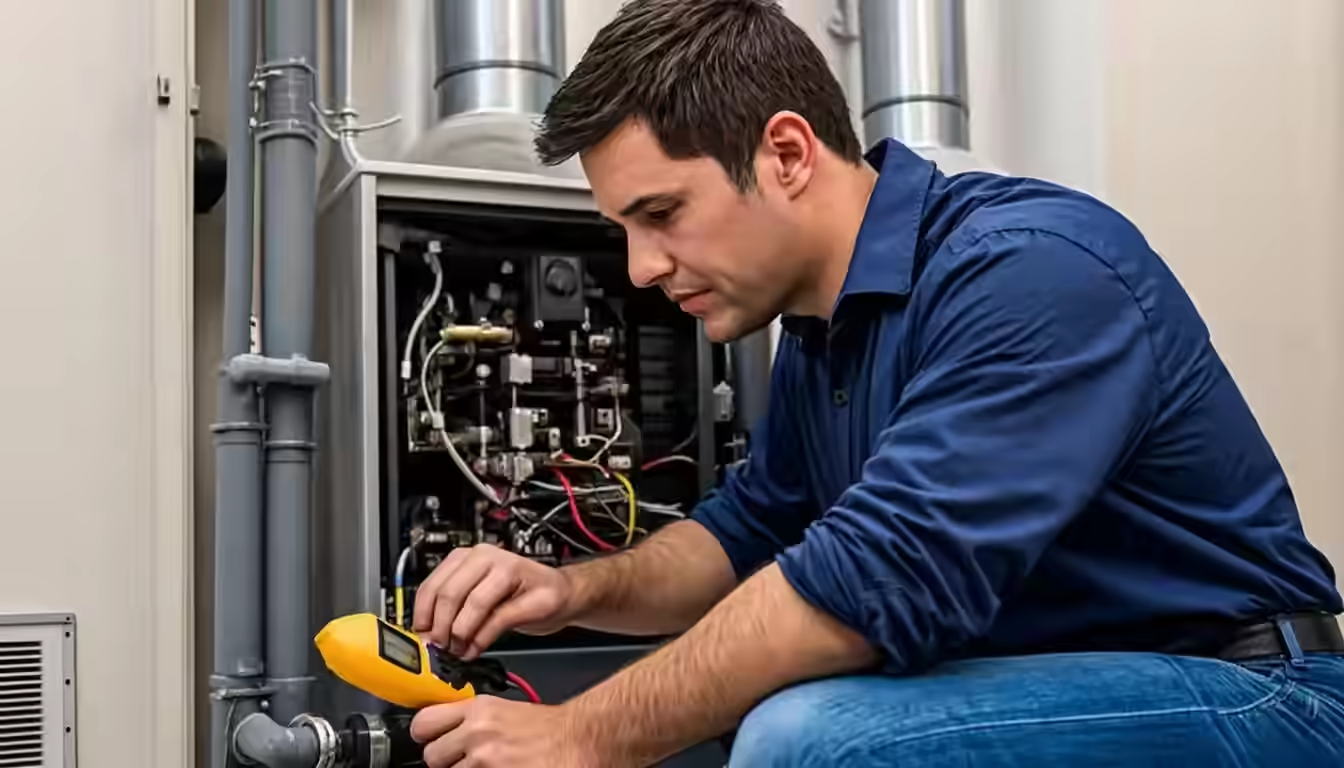
The Honest Answer Up Front
Eighteen to twenty-two years is the honest expectation for a gas furnace in Metro Vancouver, with the spread explained by three variables: climate, maintenance and the two outflow weeks every decade that age a furnace faster than the forty mild weeks around them. The number surprises homeowners who grew up on the fifteen-year folklore of colder provinces, but the mechanism is boring arithmetic — a furnace here logs roughly half the annual burner-hours of one in Winnipeg, and burner-hours are what age ignitors, flame sensors, inducers and heat exchangers. A well-maintained furnace in a mild-climate city can cruise past 25; a neglected one in a damp North Shore crawlspace can be scrap at 14. The nameplate year is where the conversation starts, not where it ends.
The more useful question is condition-based, and it has a discipline: furnaces fail by accumulating small failures, and the accumulation is countable. A furnace entering its final years shows a pattern — one repair last winter, two this winter, a new noise between them, a gas bill drifting against the neighbours’, rooms that stopped agreeing about temperature — and the pattern is what we read on aging-unit calls, not the birth certificate. The 15 signs in this guide are that reading list, organized so you can do the same audit yourself this weekend with a flashlight and your utility bills.
And the framing that matters most: replacement is a planning decision that becomes an emergency decision exactly as late as you let it. A furnace replaced in October is a researched choice, a scheduled install at shoulder-season pricing, and a system commissioned properly before the first cold night. A furnace replaced in January is a decision made at 9 p.m. in a cooling house with a baby crying, from whichever shop answers the phone first, at whatever price urgency commands. Everything in this guide — the signs, the math, the ladder — exists to move your decision from the second column into the first.
0 BC life expectancy
Mild winters mean shorter run-hours than almost anywhere in Canada. Coastal humidity, not runtime, is what finally kills most local furnaces.
0 signs we weigh
Five performance, five behavioural, five physical — the same checklist our technicians run on every aging-unit call, in this guide.
0 gas savings at 95%+
A 30-year-old 80-percent furnace swapped for high-efficiency typically trims $300-$500 a year off the FortisBC bill in our region.
0 replacement starts here
Honest 80-percent single-stage installs begin at $3,900; two-stage high-efficiency runs $5,500-$8,500; variable-speed to $11,500.
Why BC Furnaces Live Long and Rust Odd
The same climate that extends furnace life here quietly attacks it from a different direction. Mild winters mean fewer burner-hours; damp ocean air means corrosion pressure on venting, inducer housings and heat-exchanger seams that a dry Prairie winter never applies. The result is a distinctive regional death pattern: BC furnaces rarely die of thermal exhaustion — the cracked-from-cycling exchangers of colder climates — and frequently retire when rust perforates a vent, an inducer housing seizes, or a secondary heat exchanger corrodes through where condensate sits. If our furnaces had a bumper sticker, it would read: died of damp, not of work.
The microclimates matter more than homeowners expect. A furnace in a dry, heated basement in East Vancouver ages gently; the same unit in a West Vancouver crawlspace with marine air and ground moisture ages on a different curve; a Tsawwassen or White Rock home within sight of the salt water adds an accelerant to every fastener and termination. The valley adds its own chapter — outflow weeks that run equipment at design temperatures it sees nowhere else in the season. When we assess an aging unit, location is part of the diagnosis, and a 19-year-old furnace five blocks from the ocean has had a harder life than its twin in Cloverdale.
The third variable is maintenance, and the honest effect size is moderate rather than magical: annual service does not immortalize a furnace, but it reliably moves the failure curve three to five years rightward by catching the small failures before they cascade — the flame sensor before it starts lockouts, the capacitor before it strains the blower, the heat exchanger’s first rust bloom while it is still cosmetic. The $129 tune-up is not a potion; it is scheduled early detection, the mechanical equivalent of the screening that catches things while they are still cheap. Our tune-up contents guide itemizes exactly what gets checked and why each item is on the list.
Signs 1-5: The Performance and Energy Tells
The first five signs read from your utility bills and your skin, and they run in rough order of how early they appear. One: the gas bill drifts upward against the neighbours’ — not a cold-spike month, a trend across two winters — because aging exchangers, dirty burners and tired blowers all tax efficiency quietly. Two: rooms stop agreeing — the far bedroom that was always two degrees cool becomes four, as blower capacity and duct balance decline together. Three: recovery slows — the house that used to climb from 17 to 21 in forty minutes now takes an hour and a half, because the burner and blower no longer deliver rated output.
Four: the filter stops loading on its usual schedule — a subtle one our technicians use constantly, because a furnace moving less air pulls less dust through the media, and a filter that stays clean is often a furnace that is moving less air, not a house that got cleaner. Five: comfort requires more management — the thermostat gets nudged, the registers get fiddled, the throw blanket migrates to the room that used to be fine. Individually each sign is nothing; together they are the sound of an appliance spending its last years working harder to deliver less.
The utility-bill audit deserves its own instruction because it is free and objective: pull three years of FortisBC statements (or BC Hydro, on the electric side) and compare same-month usage across years, normalizing for the cold months by comparing against a neighbour or a degree-day table if you want rigor. A furnace that burned 8 percent more gas last winter than the winter two years ago, in comparable weather, is telling you its efficiency has slipped — and at 20 years old that slip is the opening entry in the replacement conversation. The performance signs rarely demand immediate action; they demand a plan, which is what the later chapters build.
Signs 6-10: The Behavioural Tells
The second five signs read from the furnace’s behaviour, and they are the ones that bring families to the phone. Six: repair frequency — the second repair in two winters is a coincidence, the third is a pattern, and the fourth is a furnace voting. Seven: short cycling, the start-run-stop stutter that ages everything faster, with its own full nine-cause guide — chronic short cycling at 18-plus years is usually the exchanger or the limit chain announcing their farewell tour. Eight: error codes become seasonal guests — the lockout that happened once last January now happens weekly, and the code guide tells you which repeats are wear and which are accidents.
Nine: the sound track changes — the inducer’s bearing drone that fades in over a season, the blower’s hum gaining an edge, the ignition sequence taking one more click than it used to. New noises on an old furnace are components introducing themselves on the way out, and a screech or a metal-on-metal scrape is a same-day call on any age. Ten: the humidity and dust character of the house shifts — more visible dust on furniture (a blower moving less air, filtering less), drier-feeling winters (a furnace cycling differently), and the faint scorched-dust smell arriving earlier each October and lingering longer. None of these alone retires a furnace; the count is the message.
The behavioural signs have a diagnostic honesty the performance signs lack: they come from the machine itself rather than from your interpretation of comfort, and a technician can verify each one with meters in minutes. Cycle counts from the board’s history, ignitor amperage, blower microfarads, inducer amp draw — the numbers behind the behaviours, trendable year over year on a maintained furnace because the tune-up report records them. This is the quiet argument for the maintenance plan even on an aging unit: the paper trail of decline is exactly the evidence a good replacement decision wants, and it is why our technicians hand you the readings rather than a verdict.
Signs 11-15: The Physical Evidence
The last five signs read with a flashlight, and one of them outranks the other fourteen combined. Eleven: visible rust and corrosion — surface bloom on the cabinet is cosmetic, but rust scaling on the vent piping, the inducer housing or around the burner compartment is structure failing in slow motion, and it is our region’s signature failure. Twelve: soot anywhere it should not be — around the burner door, on the register screws, as a dark film near the return — because soot is incomplete combustion made visible, and incomplete combustion on a gas appliance is a professional visit this week, not a note for spring.
Thirteen: the burner flame has changed colour — the confident blue with dancing tips has gone lazy, yellowed or ragged, which means combustion is off and the air shutter, the burners or the exchanger are the suspects. Fourteen: visible cracks or bulging near the burner and exchanger areas — rare to catch by eye, which is why this sign usually arrives secondhand, from a technician’s inspection with a light down the cell or a combustion analyzer in the flue. Fifteen — the one that outranks everything: any carbon monoxide history. A CO alarm that has sounded, symptoms that track the furnace’s runtime (headaches that clear at work, nausea that arrives with the heating season), or a technician’s elevated reading: that is the end of the deliberation. The furnace stops running until a licensed gas fitter clears it, full stop, and our CO safety guide covers the whole protocol.
A calibration note on the physical signs, because the internet terrorizes with them: most visible aging on a 20-year furnace is benign. Rust blooms, discoloration marks, the cosmetic patina of two decades in a damp basement — none of that is disqualifying, and a furnace with surface rust and a clean combustion report has years left. The physical signs matter as a cluster and in combination with the performance and behavioural lists: rust plus recurring lockouts plus a drifting gas bill is a furnace retiring; rust alone is a furnace aging normally. The audit is fifteen signs precisely because no single one is a verdict — the count and the combination are.
- Gas bill trending up across comparable winters.
- Rooms drifting further apart in temperature.
- Slower recovery from setbacks and cold mornings.
- Filter loading slower — less air being moved.
- Comfort needs constant nudging and fiddling.
- Third repair in two winters — the pattern, not the incident.
- Chronic short cycling at 18-plus years.
- Error codes as repeat seasonal guests.
- New sounds: inducer drone, blower edge, extra ignition clicks.
- House dustier, drier, and the October smell earlier.
- Rust scaling on venting, inducer or burner areas.
- Soot where it should never be.
- Burner flame gone lazy or yellow.
- Visible cracks or bulging at the exchanger — usually found by a tech.
- Any CO alarm history — stop the furnace, call immediately.
The Part-by-Part Repair Math (No Folklore Rules)
The old “replace when the repair exceeds five thousand dollars” rule was always bad arithmetic — five thousand dollars of what, against what furnace, at what age? — and the honest version is a two-line calculation per repair. Line one: what does this repair buy in remaining life, honestly? An ignitor on a 14-year-old furnace buys years; the same ignitor on a 22-year-old furnace that also needs an inducer buys months. Line two: what is the repair’s cost against the replacement’s monthly cost spread over the same period? A $650 repair that credibly buys two winters costs about $27 a month — cheaper than financing a new furnace. A $650 repair buying one shaky season costs $54 a month and buys the stress with it.
The part-by-part ladder in our service data, with honest remaining-life implications. Flame sensors and ignitors ($180-$450 installed): consumables; repair them on any furnace with a clean combustion report. Pressure and limit switches ($180-$450): consumables with a cause — fix the cause or meet them again. Blower capacitors ($180-$250): fair game to 20 years. Control boards ($500-$900): the honest tipping part — a board on a 15-year-old furnace deserves a calculation, on a 20-year-old it usually deserves a replacement conversation. Inducer assemblies ($450-$900): the rust signature part of our region; on a 19-plus-year unit with visible venting corrosion, the inducer is usually the last part worth buying. Blower motors ($650-$1,200): the same math. Heat exchangers: the end of the line — the labour and risk of an exchanger swap on an aging chassis outweighs the part’s warranty value in nearly every case we see.
The rule we actually give customers, condensed from those ladders: through year 15, repair almost anything that is not the exchanger; years 15 to 18, repair with the calculation above and start planning; past 18, repairs should be cheap, temporary and explicitly framed as bridge spending while the replacement is quoted. And one unifier across every row: the combustion and CO readings gate everything. A furnace with clean combustion numbers earns repairs; a furnace with drifting readings has a failing exchanger in its future regardless of what else you fix, and no repair arithmetic changes that.
| Repair | Typical band | Worth it to ~15 yrs | Worth it past 18 |
|---|---|---|---|
| Flame sensor clean/replace | $180-$350 | Always | Yes — consumable |
| Ignitor | $180-$450 | Always | Usually |
| Pressure/limit switch | $180-$450 | Yes, fix the cause | Case by case |
| Blower capacitor | $180-$250 | Yes | Yes — cheap bridge |
| Control board | $500-$900 | Usually | Rarely — do the math |
| Inducer assembly | $450-$900 | Usually | Seldom in our climate |
| Blower motor | $650-$1,200 | Case by case | No — quote instead |
| Heat exchanger | Quoted | Case by case | The end of the line |
Repair-by-repair honesty on an aging furnace (diagnostic $89, credited to the repair).
The Heat Exchanger Warranty That Outlives the Furnace
The famous trick in furnace warranties is the heat exchanger coverage: manufacturers register 20-year, 30-year, even lifetime exchanger warranties because the exchanger is the part that almost never fails inside the warranty’s first fifteen years — and because a warranty-honoured exchanger is usually a terrible buy anyway. Do the arithmetic with us: the part arrives free, but the labour to swap an exchanger is six to twelve hours of dismantling the entire furnace around it, the adjacent parts (inducer, burners, gaskets) age accordingly, and the chassis that receives the new exchanger carries every other year of its life. The warranty is real; the economics of using it on an old furnace usually are not.
The registration half of the trick matters more than most homeowners know. Manufacturer warranties are commonly tied to timely registration — the card, the portal, the model and serial to the manufacturer within the window — and unregistered equipment can drop to a shorter default coverage. If you are not sure whether your furnace was registered, the manufacturer’s warranty line can check by serial number in minutes, and it is a worthwhile call before any major repair decision on a unit under ten years old. Our installers register every unit we ship, and the documentation lives in the commissioning report you keep with the manual — the paper habit that pays for itself years later.
Where exchanger warranties genuinely matter: on younger furnaces with a confirmed exchanger defect (rare, but it happens — a manufacturing flaw surfacing at year eight is a warranty case, not a replacement case), and as a signal of manufacturer confidence when comparing new equipment. A 30-year exchanger warranty on a new unit is a statement about design margins, and it costs the manufacturer nothing to print; the coverage that actually distinguishes brands is the parts-and-labour length — the 10-year manufacturer coverage standard on our installs, paired with our own 2-year workmanship guarantee. When a salesperson leads with the exchanger warranty, you now know what that number is worth: exactly as much as the arithmetic in the first paragraph says, and not a dollar more.
Old Versus New: The Efficiency Math That Funds Itself
A furnace installed in the early 2000s is an 80-percent machine or an early 90; the current high-efficiency standard runs 95 to 98 percent AFUE, and the difference lands on the FortisBC bill annually. The arithmetic for a typical Metro Vancouver single-family home: 80 gigajoules a year of gas at the old efficiency delivers 64 GJ of heat; the same heat from a 96-percent furnace costs 67 GJ — a 16-percent gas reduction before the secondary savings even start. Secondary savings are where the modern units pull ahead of the brochure: variable-speed blowers with ECM motors cut the electricity a furnace consumes per winter dramatically (the blower is a furnace’s biggest electrical draw), and modulating burners eliminate the overshoot-waste that single-stage 80-percenters baked into every cycle.
In regional dollars, honestly hedged: the gas-side savings for a home converting from a functional 80-percent furnace to a 96-percent two-stage typically run $250 to $450 a year at recent rates, with the ECM blower adding $50 to $150 of BC Hydro savings on top depending on fan habits. Against a $5,500-$8,500 two-stage install, that is a 12-to-20-year pure-efficiency payback — which is exactly why we say the efficiency savings alone do not justify replacement while the old unit still works. They are a substantial line in the ledger when the 15 signs have already made the decision, not a reason to force it early. The carbon-pricing direction on natural gas strengthens the same ledger line by a little every year, which our carbon tax guide tracks honestly.
The efficiency conversation’s honest asterisk: savings only bank when the old furnace was actually running at its rated efficiency, and aging units rarely are. Dirty burners, cracked heat damper doors, leaky cabinet seams and tired blowers drag a nominal 80-percenter into the low 70s in its final years — which means the real-world upgrade gap for a 20-year-old machine is often wider than the nameplates suggest, and the performance signs from the first chapter (the drifting gas bill) were the measurement all along. Our tune-up reports record combustion efficiency each year, so maintained furnaces carry their own honest before-numbers into the replacement math.
The Replacement Ladder: $3,900 to $11,500
The current installed-price ladder for our region, by tier. $3,900: the honest 80-percent single-stage — a straightforward replacement where the venting already suits non-condensing equipment, right-sized by calculation, no corners cut on commissioning. $5,500 to $8,500: the two-stage high-efficiency tier that fits most Metro Vancouver homes — 95-96 percent AFUE, two-stage gas valve, usually an ECM blower, new PVC venting where the configuration requires it. $6,800 to $11,500: the variable-speed, fully modulating premium tier — the quietest, most even, most efficient gas option, with the comfort difference (room-to-room consistency, near-imperceptible operation) that families either value immediately or never notice.
What moves a quote within a tier, honestly: venting rework (a b-vent-to-PVC conversion is real labour), condensate management, electrical and thermostat upgrades done right, line-set and gas-pipe details, and the installation quality items that separate a ten-year furnace from a twenty-year one — a load calculation instead of a repeat of whatever the last house had, sealed and tested ductwork connections, commissioned with measured readings. What should never move a quote: urgency, weather, or the season — and what does move it, regionally, is the November rush, when the calendar compresses and everyone pays in scheduling rather than dollars if they can be scheduled at all. Every tier above is flat-rate, published, and comes with the 10-year manufacturer warranty, our 2-year workmanship guarantee, and financing from 7.99 percent with approved credit — the full price list lives on its own page.
The pivot that belongs in every replacement conversation now: the moment you are replacing a furnace, you are also choosing whether the next twenty years of heating burn gas or electricity — and the heat pump alternative arrives with rebate support up to $16,000 that gas equipment has never matched. The honest comparison for most homes: a dual-fuel or cold-climate heat pump configuration against the two-stage tier, with the BC Hydro-versus-FortisBC rate math and the cooling bonus counted. Our heat pump pages carry that whole comparison, and our baseboard-versus-heat-pump guide runs the electric-side arithmetic; every furnace quote we write shows the heat pump road beside it, because pretending the option does not exist is how homeowners end up with the 2026 version of a 2005 decision.
Succession Planning: The October Discipline
The single highest-value advice in this guide costs nothing: move the replacement decision to the shoulder season. September and October are the months when furnaces can be replaced calmly — quotes gathered without urgency, installs scheduled at convenience, equipment availability at its best, and the commissioning done in daylight weather. March and April are the second window, for families whose furnace survived the winter on its last legs and wants retiring before next season. November-to-February is the emergency corridor: it works, we run it 24/7 all winter, but it is the corridor where decisions compress and options narrow, and the difference between the two experiences is entirely a matter of when you decided to decide.
The succession-planning version, for households whose furnace is showing five-plus signs but still heating: get the assessment now — the 15-sign audit with a technician, the combustion numbers, the repair history reviewed, and a written replacement plan that answers three questions. What tier and configuration fit this house (with the heat pump comparison included)? What budget, financing or rebate paths apply? And what triggers the plan — which repair, which month, which reading? A family with a written trigger (“if the inducer or board fails this season, we replace in April; if it reaches October, we replace then”) has converted an emergency into a scheduled event, and the difference shows up in price, in choice, and in the quiet of their January.
The discipline has a maintenance-side companion that keeps the plan honest: the annual $129 tune-up on an aging furnace is not contradiction — it is the monitoring program for a known-aging asset, the visit that catches the bridge-spending repairs cheaply and updates the readings your trigger conditions depend on. Our maintenance plan ($199 a year) wraps it with priority booking and ten percent off repairs, which on a bridge-season furnace is precisely the arithmetic that keeps the bridge cheap. The families who navigate the last years of a furnace best treat it like a car at 250,000 kilometres: maintained, monitored, and replaced on a planned date rather than a tow-truck date.
The BC Housing Angles: Specials, Ranchers and Closets
The regional housing stock tells the furnace-replacement story in three archetypes. The Vancouver Special and its East Vancouver siblings: 1980s-vintage 100,000-plus-BTU furnaces installed when gas was cheap and load calculations were folklore — oversized from day one, short-cycling for four decades, and now the strongest candidates for right-sized replacements that cut capacity by a third while doubling comfort. The 1970s Burnaby-Coquitlam ranchers: honest mid-size furnaces on slab or crawlspace, aging on the damp curve, frequently sharing utility space with a water tank and thirty years of stored paint — the replacements here are routine, with crawlspace units needing the corrosion assessment that chapter two described.
The condo-closet furnaces and townhouse units: compact horizontal furnaces in ceiling and closet spaces, common across the region’s decades of strata construction, and the configuration where the replacement conversation meets the heat pump pivot hardest — because the compact-ductwork world suits small ducted heat pumps and ductless heads well, and the strata’s electrification sympathies increasingly matter. The basement-suite homes of Surrey and Langley: furnaces serving two households, running double duty, aging at double speed, and carrying the landlord’s obligation to keep both households warm — the succession planning chapter applies twice over, with tenants, and the cold-snap failure guide describes exactly the November these homes fear.
The valley-and-outflow archetype completes the map: Abbotsford, Maple Ridge, Mission and Chilliwack homes where the design temperature is genuinely colder and the equipment tier should acknowledge it — oversized-for-safety instincts have some basis here, though modern practice still prefers right-sizing with proper cold-climate staging over brute capacity. In every archetype the sequencing advice is identical, because the physics does not care about architecture: audit the signs, run the math, plan the succession, and book the shoulder season. The house type changes the equipment specification; it never changes the discipline.
The Age-and-Condition Decision Table
The guide’s fifteen signs, three ladders and two planning chapters compress into one table — the same grid our technicians sketch on the hood of the truck. Age bands run down the side, condition findings across the top, and the honest advice at the intersections. Read your row honestly: the temptation is always to read the row above your furnace’s age, and the years are not kind to that habit.
Two rows deserve commentary. The “18-plus, well-maintained, minor repair” row is the most common call we run, and the advice is genuinely “repair and plan” rather than “replace now” — a clean-combustion 19-year-old with one tired ignitor has winter left in it, and the succession-planning chapter is written for exactly this household. The “15-to-18, exchanger or major part” row is the row where spending discipline matters most, because it is the row where large repair money against an aging chassis starts buying less than the same money as a down payment on replacement. The table gives the direction; the written quote gives the numbers for your house; the combination is the decision.
And the closing note that belongs on every version of this table: none of it applies to a furnace with a CO reading, a rollout fault or a confirmed exchanger crack. Those are not rows in a decision matrix — they are a licensed gas fitter’s immediate call, a red-tag if the finding warrants it, and a replacement conversation that has already had its verdict delivered by the equipment itself. Everything else in this guide is the luxury of deliberation; those three findings are why the deliberation always happens with a technician’s numbers attached.
| Age and condition | Honest advice | Next step |
|---|---|---|
| Under 12, any single failure | Repair — you are in the prime years | Fix the cause, not just the part |
| 12-15, minor repairs only | Repair and maintain | Annual tune-up; start the file |
| 15-18, 2-3 signs appearing | Repair with calculation; begin planning | Written succession plan this year |
| 18-22, 5+ signs, clean combustion | Bridge spend only; quote replacement | Shoulder-season install, heat pump compared |
| 18-22, board/inducer/motor failed | The calculation now says replace | Flat-rate quote, both roads shown |
| Any age, exchanger cracked | Replace — the verdict is in | Licensed gas fitter, same week |
| Any age, CO or rollout fault | Stop running it. Now. | 604-615-2212 — 24/7 line |
Age bands meet condition findings — the honest intersections.
Frequently Asked Questions
Services That Solve This Faster
Furnace Replacement Quotes
Manual J sizing, three tiers from $3,900, heat pump comparison on every quote, 10-year manufacturer warranty.
Furnace Repair and Diagnostics
Meter-backed diagnosis with the readings in your hands — $89 credited to any repair, $180-$650 typical band.
Maintenance Plans for Aging Furnaces
$199 a year: the $129 tune-up monitoring your succession plan, filter delivery, priority booking, ten percent off repairs.
24/7 Emergency Heating
No heat tonight? Live dispatch at 604-615-2212, flat $150 after-hours premium, 30-45 minute core-city response.
Related Guides From Our Team
Furnace Repair vs Replace: The Full Decision — the deeper repair-versus-replace arithmetic, with regional examples.
Furnace Short Cycling: 9 Causes and Real Fixes — the behavioural sign that ages a furnace fastest.
Furnace Cost in Vancouver: The Full Breakdown — what goes into each tier of the $3,900-$11,500 ladder.
Baseboard Heating vs Heat Pump: The BC Math — the electric-side arithmetic for the pivot every furnace quote now includes.
Why Furnaces Fail on the First Cold Snap in BC — the November failure rhythm — and why October decisions beat January ones.
Red Seal certified, licensed gas fitters (BC-PL-2019-4421), $2M insured, 15-plus years on the tools, 12,000-plus jobs across Metro Vancouver since 2010, 4.9 stars from verified reviews. We wrote this guide because Metro Vancouver homeowners deserve the numbers, the code references and the honest trade-offs before anyone touches a wrench or a wallet.
More about our team →Get an Honest Verdict on Your Furnace
A 15-sign audit with combustion numbers, the repair-versus-replace math laid out on paper, a written flat-rate quote in three tiers with the heat pump comparison beside it, and succession planning that turns a January emergency into an October decision. Emergencies answered 24/7 at 604-615-2212.
Furnace showing its age?
One visit gives you the count that matters: the fifteen signs, the combustion readings, the part-by-part repair math and the flat-rate replacement ladder from $3,900 — with the heat pump alternative and its $16,000 rebate stack shown honestly beside it. The $89 diagnostic credits to any repair; quotes are written; and the 24/7 line is answered around the clock.
Call 604-615-2212 WhatsApp Us