The Honest Answer Up Front
A whole-home PEX-A repipe in Vancouver costs $4,800 to $12,000, quoted per home after a walkthrough. The low end of that range is a one-bathroom bungalow with good access — think a 1940s Kerrisdale house on an open crawlspace. The high end is a three-bathroom, two-storey with a finished basement, vaulted ceilings and tile everywhere the pipe needs to hide behind. Copper costs more in material and labour, and it is the right call in some homes; Chapter 3 compares the two honestly instead of selling one.
What the number includes in every quote we write: all supply lines replaced from the main through every fixture, new shutoffs at each fixture, the water heater tie-in, a plumbing permit and the inspections, drywall access openings patched paint-ready, pressure testing, and a 2-year workmanship warranty on the whole system. Nothing in that list is an add-on discovered later, because a repipe discovered-after is the worst version of this project.
Who this guide is for: homeowners of the poly-B era (roughly 1978 to 1995) watching fittings embrittle, owners of pre-1960s galvanized systems watching pressure drop and water discolour, and buyers whose inspection turned up the word polybutylene and an insurance question in the same week. Start with the plumbing services hub, the PEX repipe guide for Vancouver homes, or the plumber page for Vancouver for booking standards.
0 PEX-A repipe range
Quoted per home after a walkthrough, flat-rate, with permit, patching and warranty inside the number.
0 typical job
Water off during work hours, on every evening; most families stay in the home through the project.
0 jobs since 2010
Repipes, repairs and installs across Metro Vancouver, Red Seal crews, flat-rate quotes.
0 star rated
Verified reviews across 17 cities, with a 2-year written workmanship warranty on every repipe.
Why Vancouver Homes Repipe: Poly-B and Galvanized
Vancouver's repipe demand comes from two generations of pipe. Polybutylene — poly-B — was installed across the region roughly between 1978 and 1995, and it ages badly at exactly the points you cannot see: the fittings embrittle, the plastic loses flexibility, and the first failure tends to arrive without warning, usually inside a wall or above a ceiling. It does not need replacing today because a calendar says so; it becomes a repipe when the leak pattern says so, and by then the conversation is usually already late.
The other generation is galvanized steel, standard before the 1960s. It corrodes from the inside out, so the symptoms build for decades: pressure that drops when two fixtures run at once, water with a rusty tinge after a vacation, aerators that clog with debris. Galvanized that is still dry and functional can be lived with, but every year narrows its interior, and the day it starts leaking it tends to keep going.

Copper homes are not exempt — pinhole leaks can appear in copper that is decades old, driven by water chemistry — and some homeowners repipe simply because they are opening every wall for a renovation anyway and this is the cheapest moment in the home's life to do it. If you are unsure which era your home belongs to, the hidden leak detection guide lists the signs worth checking, and a 30-minute walkthrough with one of our technicians answers it definitively.
PEX-A vs Copper: The Real Trade-Offs
This is the decision every repipe quote forces, and the honest version has no villain. PEX-A costs less in material and dramatically less in labour, because flexible pipe fishes through walls and floor assemblies the way rigid copper never will; it carries water with fewer joints, and it expands rather than splits if water freezes inside it. Copper costs more, takes longer, and buys the traditional material: rigid, impermeable, immune to UV in exposed runs, and familiar to every plumber who will touch the house for the next fifty years.
| Factor | PEX-A | Copper |
|---|---|---|
| Material cost | Lower per run | Higher, and rising with metal markets |
| Labour | Fishes through walls; fewer openings | Rigid runs need more access cutting |
| Joints | Expansion fittings, very few per run | Soldered fittings at every change of direction |
| Freeze behaviour | Expands with frozen water, usually survives | Splits along seams when frozen hard |
| Exposed runs | Needs protection from UV and mechanical damage | Takes exposure, heat and outdoor duty |
| Service life | 50-plus years; fittings decide | 50 to 70 years; water chemistry decides |
Our default recommendation for Vancouver homes is PEX-A, with copper reserved for exposed runs, mechanical rooms and owners who want the traditional material at its price. Neither is wrong; they are trade-offs, and a quote that shows the line-item difference for your home is doing its job. For the deeper version of this comparison, the PEX repipe guide walks fittings, manifolds and routing in detail.
What Moves a Repipe Quote
The $4,800-to-$12,000 spread is not negotiation room; it is scope. These are the factors that decide where your home lands, in rough order of weight.
| Factor | Effect on the quote | The honest version |
|---|---|---|
| Bathroom count | Largest driver | Each bath adds fixtures, supplies, access and venting work |
| Storeys | Two-storey costs more than slab-on-grade | Vertical runs add length and access work |
| Finished ceilings and tile | Pushes toward the top end | Openings and patching in finished space take longer |
| Water heater tie-in | Usually quoted into the project | Every supply line terminates there; doing it later costs more |
| Permit and inspection | A modest line, never optional | Included in our quotes; the record matters to insurers and buyers |
| Drywall patching | Its own line item | Patched and paint-ready; compare quotes on this line |
A note on material prices: copper tracks metal markets, and the spread between quotes two months apart can reflect the commodity, not the contractor. PEX pricing is steadier. When you compare repipe quotes, ask each company what material and what generation of fittings the price assumes, because PEX-A at expansion-fitting quality and PEX-B at crimp-ring quality are different products with different long-term behaviours.
Room by Room: What Each Scope Adds
A repipe is priced by fixture count and routing difficulty, which means the room list below is really the quote's table of contents. This is the scope we measure on the walkthrough, and it is why two houses on the same street can land $4,000 apart honestly.
| Room / scope | What gets replaced | What it adds to the job |
|---|---|---|
| Kitchen | Hot and cold to sink, dishwasher line if applicable | Under-sink access, one set of shutoffs |
| Main bathroom | Lavatory, toilet supply, tub and shower valves | Wall access behind tile is the biggest single item |
| Ensuite / second bath | Same fixture list, shorter runs | Each additional bath compounds the total |
| Laundry | Boxed supplies with drain consideration | Small scope, quoted with or after the mains |
| Hose bibs | Exterior supplies, frost-safe where possible | Exterior wall routing; the classic freeze point |
| Main line and manifold | Entry, shutoff, manifold and home runs | The backbone every other line hangs from |
The one scope decision worth making deliberately: valve quality at the fixture. A repipe is the moment to install proper quarter-turn shutoffs everywhere, because ten years from now the person fixing a faucet will either thank you or curse the multi-turn stops that were cheaper on the day.
The Job Itself: 3-5 Days, Permitted and Tested
Here is what the week actually looks like, because homeowners picture this project worse than it is. Day one: floor protection out, the plumbing permit posted, access openings cut where routing demands them, and the new main, manifold and trunk lines started. Middle days: home-run lines fished to each fixture, new shutoffs set, fixtures reconnected. Final day: pressure test on the whole system, the plumbing inspection, drywall patches finished paint-ready, and the old pipe hauled out.
Water is off during working hours — typically 8 to 4 — and back on every evening, with the kitchen and one bathroom hooked up first so the house stays liveable. Most families stay home for the whole project; the house is dustier than usual and there are a few holes in the wall on Wednesday that are patched by Friday, which is the honest description of a repipe week, not the brochure version and not the horror version.

The inspection is worth a paragraph of respect. A permitted repipe in any Metro Vancouver municipality is inspected, and the record of that permit is the single document that settles insurance questions, buyer questions and resale-value questions years later. Skipping the permit to save a small fee is the most expensive economy available in this trade; we include it in every quote without being asked.
Poly-B, Insurance and the Paper Trail
The insurance angle is now the quiet driver of most repipe decisions in Vancouver. Several insurers ask about polybutylene on new applications; some load the premium, some exclude water damage from poly-B failures, and some require replacement before binding. If you own a poly-B home, the practical sequence is: read your policy language, ask your broker directly, and get the answer in writing, because this is a market that shifts year to year and the answer belongs on file, not in a phone call.
What a completed, permitted repipe does is remove the question. The documentation our jobs close with — permit record, inspection sign-off, materials list, flat-rate invoice, photos, and the 2-year workmanship warranty — is exactly the package an underwriter wants, and exactly the package a buyer's inspector will hand to their client as a resolved item rather than a flagged one. In transactions we see, that paper routinely pays for itself in negotiation, and always pays for itself in certainty.
Bottom line
A documented, permitted PEX-A repipe turns a question your insurer and your buyer will both ask into an answer you can hand them on paper. On a poly-B home in Vancouver, that is usually the whole argument.
Partial Repipe vs Whole Home: The Honest Test
We do spot repairs every week, at $180 to $420, and they are the right call constantly: an isolated failure on an otherwise sound system deserves exactly that, and nothing more. The honest test is pattern. One leak in fifteen years is a repair. Three leaks in three years is the material telling you its plans, and on poly-B or galvanized, the material's plans are always the same — the failures continue, in places you cannot see, until the system is replaced or the house is opened for something else.
The economics compound quietly. A partial repipe moves the failure down the line, because the pipe you did not replace is the same age as the pipe that just leaked; two or three $400 repairs plus one $850 burst inside a finished ceiling, inside a few years, is repipe money spent without a repipe. And each emergency visit carries the possibility of the 2 AM premium, which Chapter 9 of the emergency plumbing guide explains, because after-hours failures on aging pipe are where the real cost of deferring a repipe shows up.
There is also a legitimate middle path we quote regularly: whole-home repipe with a phased schedule — wet walls this year, remaining runs at the next renovation — priced so the phasing is deliberate rather than accidental. The honest framing is that deferring is a decision; make it on purpose, with numbers, not by hoping.
Why PEX-A Is Our Default
PEX-A is the expansion-fitting generation of PEX, and the difference is in the joint. The fitting is inserted with an expansion tool, and the pipe shrinks back around it, forming a seal with no crimp ring biting the pipe — which means the failure points that age in a crimped system simply do not exist here. In a wet, mild climate with occasional hard freezes in exterior walls, the other property matters too: PEX expands with frozen water and usually survives it, where copper and older plastics split.
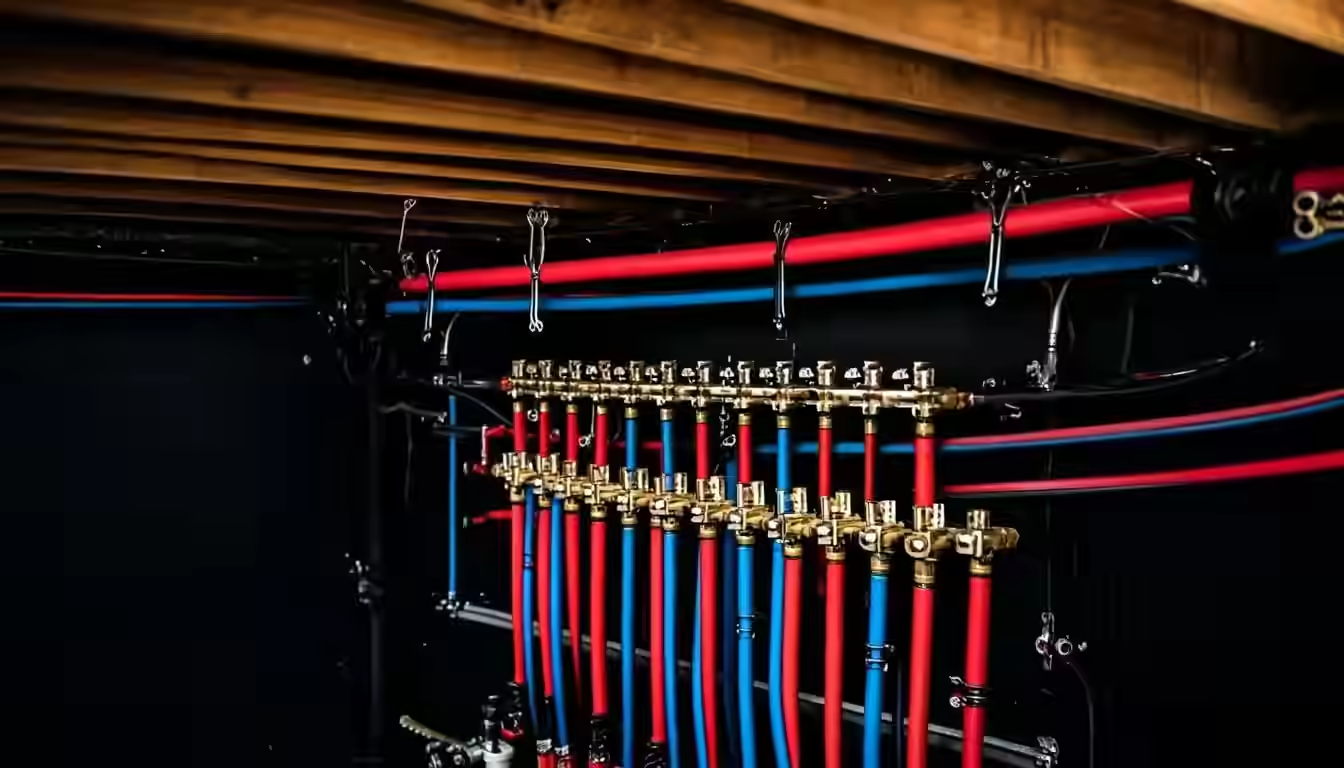
The manifold-and-home-run architecture we install with it is a quiet upgrade to daily life: each fixture gets its own dedicated line from a central manifold, so a shower stays steady when a toilet flushes, a fixture can be shut off alone at the manifold, and pressure balances across the house the way trunk-and-branch systems never quite managed. It costs a modest premium over PEX-B per foot — small against the total of a whole-home job — and it is the standard we install, backed by the 2-year workmanship warranty on the system.
What PEX is not: a material for long UV exposure or unprotected mechanical damage, which is why exterior and exposed runs get copper or protection. Every material has a lane; the honest design uses each one where it belongs, and the plumbing services hub covers the rest of the list.
How to Compare Repipe Quotes
Repipe quotes are the easiest in the trade to compare dishonestly, because the bottom numbers look similar while the scopes hide the difference. Five lines decide it: the material by type and generation (PEX-A at expansion fittings is a different product from PEX-B at crimp rings), the drywall scope (who patches, to what finish), the permit line (included or not, and it should be), the fixture valves (proper quarter-turns or the cheapest stops), and the warranty in writing.

Our answers to the five, so you have a baseline: PEX-A with expansion fittings by default; patching included and left paint-ready; permit and inspection included; quarter-turn shutoffs at every fixture; 2-year workmanship warranty, licence BC-PL-2019-4421, $2M insured. For standard repair rates to compare against, the plumber cost guide for 2026 has them, and the city pages — like plumber Burnaby — carry the same model region-wide.
Bottom line
Compare repipe quotes on material, patching, permit, valves and warranty — the five lines that outlive the price. A quote silent on any of them is not cheaper; it is shorter.
The Repipe Budget Cheat Sheet
Find your situation, read the honest band, and remember every number is a flat rate approved in writing before work starts, with permit, patching and warranty inside it.
| Your situation | Honest 2026 band | Watch for |
|---|---|---|
| One-bath bungalow, good access | $4,800-$7,000 | The low end of PEX-A; copper adds material and labour |
| Two-bath home with laundry | Mid-range | Water heater tie-in quoted into the same project |
| Three-plus baths, finished basement | $10,000-$12,000 end | Finished ceilings and tile access are the drivers |
| One isolated leak, sound system | $180-$420 repair | One leak in fifteen years is a repair, not a project |
| Third leak in three years | Repipe conversation | The pattern is the material announcing its plans |
| Insurance asking about poly-B | Ask in writing | A permitted repipe answers the question permanently |
The one-sentence version of this guide: $4,800 to $12,000 for a PEX-A whole-home repipe, bathrooms and access decide most of it, permits and patching belong inside the quote, and the paper trail is part of the product. For a walkthrough on your home, the form below reaches a Red Seal technician directly, and 604-615-2212 answers 24/7.
Frequently Asked Questions
Services That Solve This Faster
Plumbing Services
Whole-home repipes, spot repairs and diagnostics, flat-rate quoted before work starts.
Plumber Vancouver
Repipe walkthroughs across the city, from character homes to Vancouver Specials, six days a week.
Plumber Burnaby
The same repipe model across Burnaby's poly-B era subdivisions, with permit included.
24/7 Emergency Service
Burst lines on aging pipe answered around the clock, with the flat $150 after-hours premium.
Related Guides From Our Team
PEX Repipe Guide for Vancouver Homes — the deep version: fittings, manifolds, routing and the poly-B history.
How to Detect Hidden Water Leaks — the signs that distinguish a repair from the start of a pattern.
Emergency Plumbing in Vancouver — what after-hours failures on aging pipe cost, and why they argue for repiping.
Plumber Cost in Vancouver 2026 — standard daytime repair rates to compare against any repipe pitch.
Winter Prep for Vancouver Homes — the checklist that protects exterior lines and hose bibs until repipe day.
Red Seal certified, licensed gas fitters (BC-PL-2019-4421), $2M insured, 15-plus years on the tools, 12,000-plus jobs across Metro Vancouver since 2010, 4.9 stars from verified reviews. We wrote this guide because Metro Vancouver homeowners deserve the numbers, the code references and the honest trade-offs before anyone touches a wrench or a wallet.
More about our team →Talk to a Real Technician About This Today
Book a visit with a Red Seal technician: a real diagnostic, a written flat-rate quote before any work starts, honest repair-versus-replace math, CleanBC rebate paperwork handled and financing from 7.99 percent with approved credit. Emergencies answered 24/7 at 604-615-2212.
Poly-B, galvanized or just planning?
A walkthrough with a Red Seal technician is where the real number comes from: $4,800 to $12,000 for a PEX-A whole-home repipe, flat-rate and in writing, with permit, inspection, patching and the 2-year workmanship warranty inside it. Emergencies answer 24/7 at 604-615-2212.
Call 604-615-2212 WhatsApp Us