
Your AC Sat Damp for Eight Months. Here Is What That Costs.
Air conditioning in BC lives a strange life. In Phoenix a condenser runs four thousand hours a year; in Vancouver, Surrey or Richmond it might run three hundred to six hundred hours, and most of those hours are packed into a handful of weeks each summer. The rest of the time the equipment sits outside in coastal drizzle, green algae growth on the cabinet, spiders in the control box, and styrofoam cups of condensate standing in the drain pan. Then the first 32 degree day of July arrives, every unit on the block starts at once, and every marginal part on eight months of neglect meets the worst day of its year.
That is the argument for an annual AC tune-up in a place with a short cooling season: not routine polishing, but catching the specific damage that idleness and coastal air cause before the heat wave does the testing for you. A proper tune-up in BC runs $129 to $189, takes sixty to ninety minutes, and follows a written checklist. This guide walks through that checklist the way our technicians actually perform it, explains which findings save you from which repairs, and shows the real 2026 costs when small problems are left to become big ones.
Since the 2021 heat dome, when Lytton hit 49.6 degrees and Metro Vancouver emergency rooms filled with heat illness, cooling has stopped being a luxury in this province, and equipment that was optional in 2019 is now protecting infants, seniors and shift workers trying to sleep through 28 degree nights. Treat the tune-up the way you treat a furnace check: cheap insurance before the season you cannot afford to miss. Our cooling services page covers the full range of AC and heat pump work we do across the region.
Why a Short BC Cooling Season Still Beats Up Your Air Conditioner
The coil-fouling pattern in Metro Vancouver is unlike anything in the Interior or the Prairies. In June, cottonwood fluff drifts like snow through Langley, Maple Ridge and the Fraser Valley, and a condenser pulling air through its coil mats that fluff into a felt blanket within days. Homes in Richmond and along the coast add salt-laden air, which corrodes the thin aluminum fins and the copper tubing inside them faster than inland conditions. Add eight months of autumn leaves, storm debris, moss spores and the wasps that nest in warm control boxes every spring, and the machine that greets July is rarely the machine that finished last September.
Idleness is its own wear mechanism. The run capacitor that starts the compressor ages by heat and by sitting; contactors corrode in the damp and then pit themselves arcing on start; drain lines grow algae in the dark and then clog on the first long run of the season, tripping float switches or overflowing pans. Refrigerant circuits that sat tight all winter can reveal small leaks once pressures and temperatures swing. None of these failures announce themselves in May. All of them fail in the last week of July, when the temperature will not drop below 24 overnight and every HVAC company in the Lower Mainland is booked three days deep.
The tune-up question is not whether your AC will survive an average July. It is whether it will survive the one week of heat dome weather that shows up every second or third year, running eighteen hours a day with no cooldown at night.
The Full Tune-Up Checklist, Point by Point
A legitimate BC tune-up is eighteen to twenty-two documented points. If a company cannot show you the checklist with readings written on it, you did not get a tune-up; you got a visit. Here is the sequence our technicians follow, grouped the way we explain it on site.
Controls and thermostat
Verify thermostat calls, mode switching and temperature accuracy, check the furnace switch and disconnect, and confirm the control board's cool sequence from call to blower ramp.
Electrical, the part that matters most
Measure the run capacitor against its rated microfarads within five percent, inspect the contactor for pitting, pull amp draws on compressor and fan motors, and torque every lug and wire nut in the control box.
Refrigerant circuit
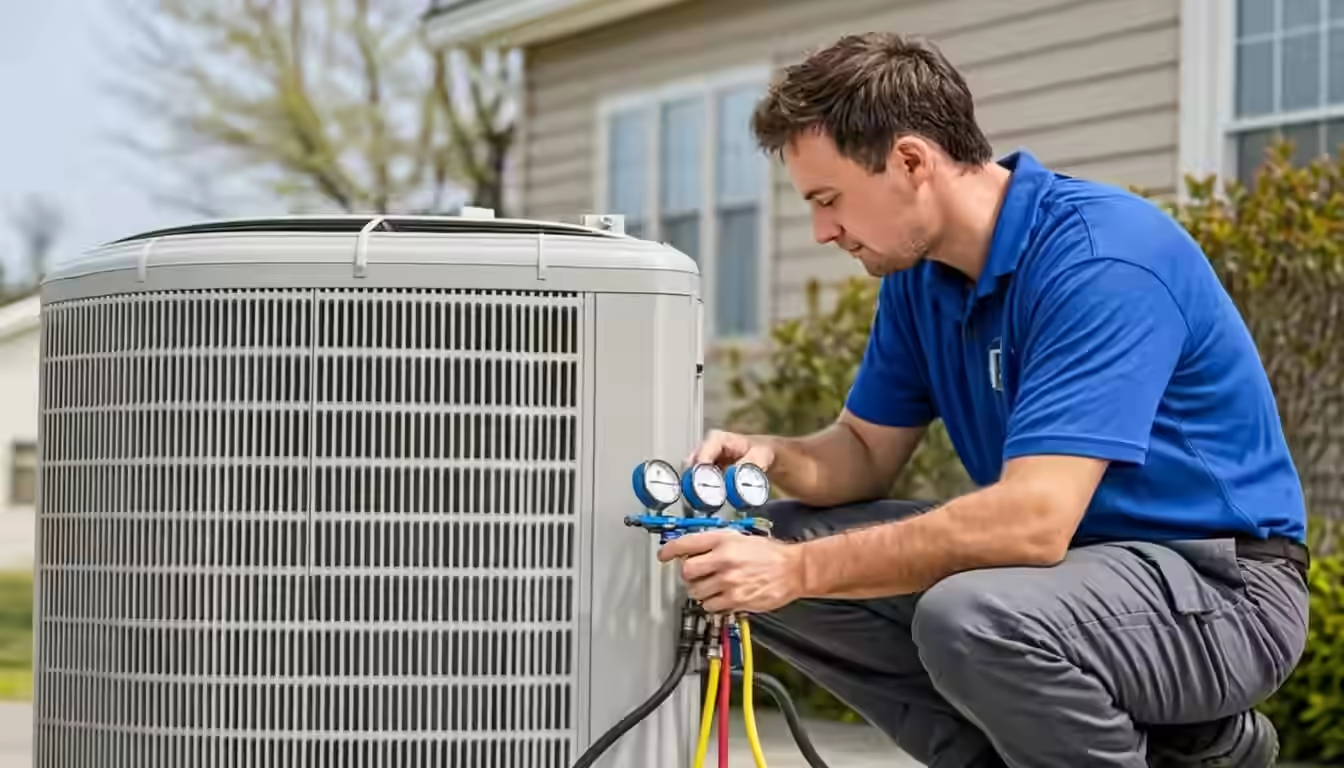
Attach manifold gauges, compare pressures and temperatures against the nameplate and outdoor ambient, calculate superheat and subcooling, and log both numbers for next year's comparison.
Coils, drainage and airflow
Wash the condenser coil and inspect the evaporator, flush the condensate line and test the float switch, check the filter, inspect the blower wheel, and measure static pressure where access allows.
Mechanical and run test
Check fan blade balance and motor bearings, inspect mounts and isolation feet, clear debris from the cabinet, then run a full cycle and measure the supply-return temperature split, which should land roughly 8 to 12 degrees.
Report and walkthrough
You receive the completed checklist with readings, photos of anything flagged, and plain-language priorities: what was corrected on the spot, what to watch, and what genuinely needs nothing.
Two readings deserve a special mention because they carry more diagnostic weight than everything else combined. The capacitor measurement matters because a capacitor drifting outside its tolerance is the single most common cause of compressor start failures during heat waves, and replacing one proactively costs $180 to $350 versus the compressor it can take with it. The temperature split matters because it is the end-to-end proof of the whole system: a correct split with clean coils, correct charge and healthy airflow means the machine is doing its job, and a split outside the 8 to 12 degree window tells us exactly which subsystem to investigate.
What a Tune-Up Catches Before It Becomes a $650 Repair
The economics of maintenance are simple: the parts that fail during heat waves are cheap when replaced on a schedule and expensive when they fail on a Saturday night in a 35 degree week. Here are the findings we document most often on BC tune-ups, and what each one costs as a planned repair versus an emergency.
| Tune-up finding | Planned repair cost | If ignored until the heat wave |
|---|---|---|
| Run capacitor out of tolerance | $180 - $350 | Compressor will not start on a hot day; repeated hard starts shorten compressor life, a $1,800-$2,800 part |
| Pitted contactor | $180 - $280 | Chattering, melted lugs, no cooling call at 8 pm on the hottest day of July |
| Matted condenser coil | cleaned on the spot | High head pressure, 5-15% higher BC Hydro bills, compressor strain all season |
| Algae-clogged drain line | flushed on the spot | Overflowed pan, stained ceiling, float switch shut-down with the house at 33 degrees |
| Low refrigerant, small leak | $300 - $900 | Frozen evaporator coil, then a warm house and an emergency leak search in peak season |
| Worn condenser fan bearing | $450 - $850 | Fan seizes on the hottest afternoon, high-pressure cutout, no cooling until parts arrive |
| Loose electrical connections | torqued on the spot | Resistive heat, damaged control board or burnt wire, $400-$900 and a second visit |
Notice how much of the left column reads "on the spot": coil washing, drain flushing and lug torquing are included in the tune-up itself, which is why the service pays for itself most years even before it prevents anything. When a repair is recommended, you should get the reading that justifies it, the photo, and a price range you can compare. For the full breakdown of what cooling repairs cost when they do happen, our AC repair cost guide for 2026 lists part-by-part ranges across Metro Vancouver.
When Should You Book an AC Tune-Up in BC?
For AC-only systems in Vancouver, Surrey, Richmond and the rest of the Lower Mainland, the sweet spot is May: the snow is gone, the cottonwood has not fully flown, technicians have same-week availability, and anything the inspection uncovers can be repaired calmly before the season. By the second week of June, the first mini heat wave has usually arrived, the phones fill, and tune-ups start competing with no-cooling emergencies for van time. July and August tune-ups still happen, but expect longer waits and expect the appointment to feel more like triage than maintenance.
There is also a legitimate fall slot that BC homeowners overlook. A late-September visit, once the cooling season is done, checks the damage the season actually dealt: coil condition after the cottonwood and the heat waves, contactor pitting from a summer of starts, and refrigerant readings compared against the numbers logged in spring. It also stacks naturally with furnace preparation for the winter ahead, and families who book both systems in one visit save the second-trip charge on each. For heat pump households, the fall visit is the more important of the two, because defrost operation and strip-heat staging are winter problems a spring check never sees coming.
Heat pump owners should think differently, because a heat pump is also the home's heating system and runs from October to March as well. A spring visit that checks cooling mode, refrigerant charge and the reversing valve covers the cooling season, and a fall check of defrost operation and strip heat covers winter, with many heat pump families booking both or alternating. If you are only going to do one, book the spring visit: cooling failures are discovered on the worst possible day, while heating problems announce themselves gradually enough that you can usually get a same-week repair in January.
One BC-specific timing note: homes near heavy cottonwood corridors, which in practice means anywhere near the Fraser River from New Westminster out through the Fraser Valley, benefit from a second quick condenser rinse in early July, after the fluff season ends. That rinse is a fifteen-minute job most homeowners can do themselves with a garden hose, and it is the difference between a coil that gets through the season and one that spends July suffocating.
What an AC Tune-Up Costs in BC (2026)
These are the prices we actually charge across Metro Vancouver, and the ranges you should treat as normal anywhere reputable. Be suspicious of the $49 tune-up: no company can perform a real twenty-point inspection with gauge work for that price, and the business model depends on finding something expensive to sell you once the technician is in your driveway.
| Service | Price | What is included |
|---|---|---|
| AC or heat pump cooling tune-up | $129 - $189 | Full 18-22 point checklist, coil wash, drain flush, readings documented, small corrections on the spot |
| Second system, same visit | $99 - $139 | Duplexes, laneway homes and homes with two condensers |
| Spring and fall heat pump pairing | $229 - $339 | Cooling check plus defrost, strip heat and winter readiness |
| Annual maintenance plan | $199 - $289 | One or two visits per year, priority booking, small discounts on repairs |
| Diagnostic (no repair performed) | $89 | Full fault-finding when the system is already misbehaving; credited toward any repair |
| After-hours premium | flat $150 | Weeknight, weekend and holiday visits; disclosed before dispatch, never multiplied |
Every tune-up includes the written report with measurements, and our work carries the two-year workmanship warranty on anything we install or correct. The full rate card for repairs, installs and maintenance lives on our pricing page, and if your tune-up reveals a system near the end of its life, the cost calculator helps you compare repair against replacement with real BC numbers.
Five DIY Jobs Between Professional Tune-Ups
Maintenance is a partnership: the annual visit handles the refrigerant circuit, electrical measurements and deep cleaning, while five habits through the season keep the system from sliding backward between visits.
Check the filter monthly in summer
Cooling season, wildfire smoke season and renovation dust all load filters fast. A choked filter starves the evaporator coil and mimics a refrigerant problem.
Rinse the condenser with a garden hose
Power off first, then a gentle inside-out rinse after cottonwood season. Never a pressure washer, which bends the delicate aluminum fins.
Keep 60 cm of clearance around the unit
Trim shrubs, rake leaves and pull the hedge back. Condensers need to exhale, and choked airflow shows up as high pressure and weak cooling.
Nudge the setpoint, not the system
Each degree lower adds roughly three to five percent to cooling energy on a BC Hydro bill. Aim for 24-25 when home rather than 20 in a panic.
Listen for changes and call early
New buzzes, chattering or weak airflow in June are $200 problems. The same symptoms in the August heat wave become emergency-rate problems.
Wildfire smoke weeks are the exception to the usual open-windows advice: when the Air Quality Health Index climbs, close up and filter, which means the AC and its filter are doing double duty and deserve an extra check. If you are deciding whether central AC or a heat pump is the better long-term fit for your home, our heat pump vs air conditioner comparison for BC walks through the costs and trade-offs, and the heat pump buyer's guide covers what the upgrade path looks like.
How to Pick a Tune-Up Company (and Spot the $49 Trap)
Every June, Metro Vancouver classifieds fill with tune-up specials priced below the cost of the technician's hour. The model is straightforward: arrive, spend twenty minutes finding something alarming, and sell a repair, a refrigerant top-up or a replacement on the spot. The tell-tale signs are consistent. The special price buys no gauges and no readings. The findings are urgent and unverifiable. The quote is good only today. The company cannot show you a licence number or a written checklist.
A legitimate tune-up company does the opposite of every one of those. You get the checklist with numbers, before-and-after readings where they matter, photos of anything flagged, and recommendations you can sleep on. Credentials are verifiable: BC Home Service works under BC License BC-PL-2019-4421 with $2M liability coverage, WorkSafeBC coverage for everyone on your property, and a two-year workmanship warranty, and we are happy to be the second opinion on anyone else's alarming findings. A 4.9-star rating over years of Google reviews exists precisely because we tell people when nothing needs fixing.
Book the same way you would for any trades visit: confirm what the price includes, ask whether the technician will document readings, and be wary of any company that insists the compressor must be replaced today based on a meter reading you cannot see. Compressors do fail, but the honest diagnostic path looks like measurements, explanation and options, not pressure. If you want a second set of eyes on a cooling system anywhere from Vancouver to Langley, the $89 diagnostic is credited toward whatever the findings turn out to be.
Questions worth asking before you book are cheap and revealing. What exactly does the price include, and will I receive the readings in writing? Is the technician licensed, and is the company insured for work on my property? And what happens if the tune-up finds a problem: do I get options and photos I can think about, or a same-day quote only? A company that answers those three comfortably has nothing to hide, and one that bristles at being asked has told you something too. The tune-up is also your low-risk audition for the relationship that really matters, the emergency call at eight in the evening during the next heat dome, and that vendor deserves to be chosen deliberately.
FAQ
AC Tune-Ups in BC: FAQ
A proper 18-22 point tune-up runs $129 to $189 for a single central AC or heat pump cooling check in Metro Vancouver, with second systems discounted to $99-$139 on the same visit. A diagnostic when the system is already failing is $89 and credited toward the repair. After-hours visits add one flat $150, disclosed before dispatch.
Thermostat and control verification, capacitor and contactor testing with amp draws, refrigerant pressures with superheat and subcooling, condenser coil wash, evaporator inspection, condensate drain flush and float switch test, filter and airflow checks, blower and fan inspection, lug tightening, and a full run test with a supply-return temperature split of roughly 8 to 12 degrees, all documented.
Once a year, ideally in May before the first heat wave. Heat pumps deserve a spring cooling check and a fall heating check, or at minimum an annual visit that covers the refrigerant circuit both ways. Homes near cottonwood corridors along the Fraser should add a quick July condenser rinse.
Yes, because the risk is not average weather, it is the heat dome weeks that arrive every second or third summer. BC units idle eight damp months, which corrodes contactors, clogs drains and kills capacitors precisely when July stresses them hardest. The $129-$189 visit prevents $180-$650 repairs and buys priority response when it matters.
Yes. Dirty coils alone cost five to fifteen percent in cooling efficiency, an out-of-tolerance capacitor makes every start harder, and a low charge forces long run times for the same comfort. Restoring coils, charge and airflow on a mid-sized home commonly trims a noticeable slice off the summer electricity bill, and the tune-up report gives you a baseline to compare year over year.
The run capacitor is the small cylindrical part that gives the compressor and fan motors the torque jolt they need to start. It ages with heat and with sitting, so a unit that idles through eight damp Metro Vancouver months and then runs eighteen hours a day in a heat wave is the perfect storm. Replacement runs $180-$350 and is the most common proactive catch on our tune-ups.
Book May for AC-only systems: snow is gone, cottonwood has not fully flown, and same-week slots are available before the June rush. Heat pump families should book spring and fall visits, or at least alternate. From late June through August, tune-ups compete with no-cooling emergencies, so waits stretch and the visit feels more like triage.
KEEP READING
Related Guides
AC Repair Costs in Vancouver (2026)
Part-by-part repair prices, from capacitors to compressors, across Metro Vancouver.
The Complete Heat Pump Guide for Vancouver
Sizing, cold-climate performance, costs and rebates for BC's most popular upgrade.
Heat Pump vs Air Conditioner in BC
Which cooling investment makes sense for your home, ducts and energy bills.
BC HOME SERVICE
Book Your AC Tune-Up Before the First Heat Wave
A $129-$189 tune-up in May buys you the checklist, the readings and the peace of mind that July will not find your compressor's weakest part first. Same-week spring availability across Vancouver, Surrey, Richmond, Langley and the whole Lower Mainland. Call 604-615-2212 or book online.
Call 604-615-2212