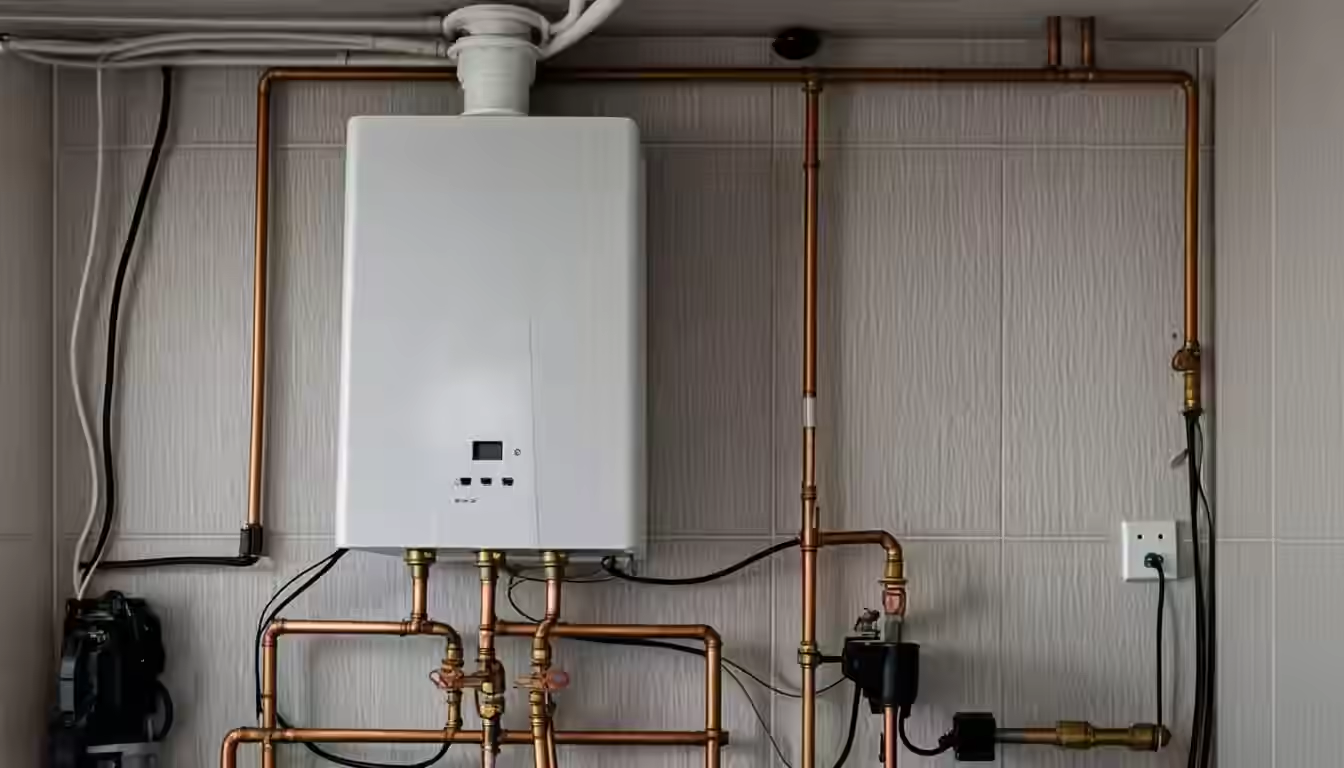
The Honest Answer Up Front
A hot water tank installed in Vancouver runs $1,400 to $2,600. A tankless water heater installed runs $2,500 to $4,500. Repairs on an existing tank run $180 to $450, and the diagnostic that decides repair-or-replace is $89 to $129, credited in full to any work you approve. Those are our real 2026 numbers for this region, and they are flat-rate: the number you approve is the number you pay, whatever the job throws at us.
Three decisions drive where you land inside those ranges. First, tank versus tankless, which is an upfront-cost versus running-cost and lifestyle trade-off that Chapter 4 puts in one table. Second, gas versus electric, which is mostly decided by what already feeds your mechanical room. Third, rent versus buy, the BC institution that quietly costs renting households several times the purchase price over a tank's life, which is why it gets its own chapter. And hovering over all three: the combi boiler option at $7,000 to $11,000, which replaces both the furnace-era heating plant and the tank in one machine, and the heat pump water heater, the efficiency class above a tank that attracts the program interest a plain tank swap never will.
What this guide does with those facts: real ranges for every option, what moves them in Vancouver's housing stock specifically, the rental arithmetic nobody does at the kitchen table, the repair-or-replace age rules, and the questions that expose a padded quote in under a minute. Our hot water tank teams have replaced and repaired thousands of these systems across Metro Vancouver since 2010, and every number here is one we actually charge.
0 jobs since 2010
Plumbing, heating and cooling calls across 17 Metro Vancouver cities, including a few thousand hot water tanks.
0 tank installed
The flat-rate range for a hot water tank install, decided by tank choice, venting and code scope.
0 star verified rating
From customers whose new tank was running hot the same day it was quoted.
0 written workmanship warranty
On every install and repair, with manufacturer parts warranties registered on your behalf.
What a Hot Water Tank Costs Installed
The $1,400 to $2,600 range prices the complete job: the tank itself, delivery, removal and disposal of the old one, connection to gas or electric, water and, on gas tanks, the venting work needed to meet code. What moves you inside the range: the tank's size and tier, from a basic 40-gallon unit to a high-recovery 60-gallon with a longer warranty; whether the existing shut-off valve and supply lines need replacement, which on a 1990s install they usually do; and venting, because a gas tank's flue connection is part of the job, not an optional extra.
Two BC realities that shape tank installs here. First, seismic strapping: tanks in this province are strapped to the wall so an earthquake does not turn 50 gallons of hot water into a missile, and a proper install checks the strapping as part of the job rather than leaving the old kit to chance. Second, the drain pan: where a tank sits above finished space or on interior floors, a pan piped to a drain is the difference between a slow leak you catch and a ceiling you replace. Neither item is glamorous, and both belong in an honest quote's scope lines.
What the range does not include, honestly: chimney lining work when an old flue is found unsuitable, which a pre-install check should catch, and electrical upgrades on electric tanks fed by undersized circuits. Those are real costs when they appear, and the honest move is finding them before the old tank is drained, not after. The diagnostic conversation exists precisely for that, which is why we look before we quote, every time.
What a Tankless Costs Installed
A tankless water heater installed runs $2,500 to $4,500, and the range is honest because the job varies more than a tank swap. The unit itself is sized by flow: how many gallons per minute of hot water it must deliver in January, when Metro Vancouver's incoming water is coldest and the temperature rise demanded is steepest. A household that runs two showers and a dishwasher simultaneously needs a different machine than a condo that never runs two taps at once, and the quote should start with that demand survey, not with a flyer price.
The two scope items that move tankless numbers in Vancouver's older housing stock: the gas line and the venting. Tankless units draw gas at a rate many 1970s-to-90s homes' half-inch lines were never sized for, so a gas line upgrade is a common, legitimate line item. And a tankless needs its own properly terminated vent run rather than sharing the old tank's chimney connection, so venting work is part of the honest quote. Retrofit installs in older homes sit toward the top of the range for exactly these reasons, and a company that quotes tankless without looking at the gas line first is quoting a number, not a job.
What you get for the difference over a tank: hot water that does not run out, no standby losses from 50 gallons cooling all day, a wall-hung unit that frees a closet, and typically a longer service life with periodic flushes, which in Metro Vancouver's soft water is a gentler maintenance story than in harder-water provinces. The full trade-off list, including the households for whom a tank honestly remains the better buy, is the next chapter's table.
Tank vs Tankless: The Real Comparison
Here is the comparison Metro Vancouver households actually ask for, with our numbers and the honest trade-offs side by side:
| Factor | Tank ($1,400-$2,600) | Tankless ($2,500-$4,500) |
|---|---|---|
| Upfront installed cost | Lower | Higher, driven by gas line and venting scope |
| Hot water supply | Fifty gallons, then a recovery wait | Continuous, sized by winter flow |
| Standby losses | Yes, the tank cools between uses | None, it heats on demand |
| Service life | Roughly 8-12 years | Longer, with periodic flushes |
| Space | Floor footprint, about 2x4 feet | Wall-hung, frees the closet |
| Cold-water sandwich | Not an issue | Brief cool burst between back-to-back draws |
| Power-outage behaviour | Gas tank keeps working | Controls need power, a real November consideration |
The honest summary our installers give at the kitchen table: tankless wins for households that run out of hot water, value the space, or are doing a mechanical-room renovation anyway; the tank wins for modest, spread-out use, tight budgets, and homes where the gas-line and venting upgrades erase the operating savings for years. The tankless versus tank guide expands every row of that table with BC-specific detail, and we quote both options rather than steering, because the right answer genuinely varies by household.
Rental vs Buying: The BC Institution
BC is the last stronghold of the rental hot water tank, a model where an energy company owns the tank in your basement and bills you monthly for it, sometimes on the same bill as your gas. Tens of thousands of Metro Vancouver homes are still renting tanks installed in the 1990s. The pitch was convenience: no upfront cost, no repair bills. The arithmetic, 30 years later, is that the monthly fees, paid over a tank's entire service life, typically total several times the $1,400 to $2,600 it costs to buy and install a tank outright, and the repairs the rental was supposed to cover are increasingly billable anyway as the contracts age.
The honest decision framework: if you are renting, the buyout number in your rental agreement is the figure to price against a new install, because in many cases buying out an aging rental just to keep an aging tank is worse than replacing it with a new owned one. If you are buying a home with a rental tank in the basement, the purchase is your moment: the agreement transfers with the house, and the sellers rarely mention it. And if the cash timing is genuinely wrong, rental exists as a bridge, though our financing from 7.99% with approved credit usually beats the rental schedule for anyone who qualifies.
Bottom line
Over its full life, a rental tank typically costs several times the $1,400-$2,600 of buying and installing one. If a rental agreement is in your basement, read the buyout clause before the next renewal, and price a new owned tank against it. Our rental versus buying guide walks the full math.
Repair or Replace: Reading the Age
Hot water tank repairs run $180 to $450, and the common findings are cheap, honest fixes: elements and thermostats on electric tanks, thermocouples and gas valve components on gas tanks, pressure relief valves on both. A tank inside its service life, roughly 8 to 12 years in Metro Vancouver, is usually worth repairing. The arithmetic turns when the tank's age crosses its warranty and the failure is the tank itself rather than a part on it.
| Situation | Honest answer | The numbers behind it |
|---|---|---|
| Tank under 8, part failure | Repair | $180-$450 against years of remaining tank life |
| Tank 8-12, first part failure | Repair, then plan | Repair now, and price the $1,400-$2,600 replacement before the next one |
| Tank over 12, any failure | Replace | The lining, not the part, is the aging component |
| Rusty water, rust streaks, weeping base | Replace, soon | These are lining failures; the next symptom is a flood |
| Puddle under the tank | Emergency | Shut the tank valve, kill power or gas, call: a full failure dumps every gallon |
The diagnostic that sorts repair from replace is $89 to $129, credited in full to whichever you choose, and it ends in a written report that names which row of that table your tank is in and why. The hot water tank failure signs guide covers the symptoms in depth; the short version is that rust-coloured water, rumbling sediment and moisture at the base are the tank telling you the lining is done, and no $400 part changes that verdict.
Vancouver Factors: Why Your Quote Moves
Vancouver's housing stock is the reason two identical tanks can install at different numbers two blocks apart. The 1960s-to-90s majority carries original venting that sometimes needs modification before a new gas tank can connect legally, shut-off valves seized since the Expo era, and mechanical rooms in finished basements where the tank sits in a pan under a platform nobody wants to cut twice. East Side character homes add narrow chimneys and long vent runs; the city's laneway and infill homes add high-efficiency sidestreams where the install is clean and the number lands low in the range.
Strata is a Vancouver factor of its own. In condo and townhouse stock, the hot water tank often serves the strata's arrangement rather than the owner's preference, and replacement may need coordination the individual owner cannot authorize alone. And the region's soft water cuts both ways: it is gentle on elements and anodes, which stretches tank life toward the top of the 8-to-12-year range, but it also means the sediment rumble that warns homeowners elsewhere is quieter here, so age and visual inspection carry more of the diagnostic weight. Our crews swap tanks across the whole map, and the Vancouver hot water tank crews see every version of this list in a single week.
The last factor is seasonal and predictable: hot water tank failures cluster from late October through February, when cold incoming water makes tanks work hardest and aging ones quit. The November and January rush is real, and a household with a 10-year-old tank that books a proactive replacement in June gets the same flat-rate number with none of the schedule pressure. The winter prep guide covers the whole October checklist.

Rebates and Running Costs
The honest rebate sentence first: a straight like-for-like tank swap carries no CleanBC, BC Hydro or FortisBC support. The hot-water equipment that attracts program interest is the efficiency class above the tank, chiefly heat pump water heaters, which move heat rather than generate it and draw a fraction of the electricity a conventional tank does; that equipment is quoted per system after a look at your space, and our heat pump water heater guide covers both the equipment and the current program details. Anyone who promises a rebate on a plain tank install without naming the program is decorating a quote.
Running costs deserve the same honesty. A tank's operating cost is the standing charge for keeping 40 to 60 gallons hot around the clock, and the levers are the tank's efficiency rating, the fuel, gas or electricity, and the household's habits: shorter showers, cooler setpoints, insulating the first six feet of pipe, and off-peak laundry where your BC Hydro plan rewards it. Tankless reduces the standing charge by eliminating standby losses, which is where its operating advantage comes from, and why the tank-versus-tankless math is a five-year conversation, not a one-year one.
When a job does qualify for support, we complete the CleanBC, BC Hydro, FortisBC and municipal paperwork as part of it, because the paperwork is genuinely the annoying half of a rebate. The CleanBC rebates guide is the right next read for the program landscape, and our standing rule applies here too: rebates are the last page of the conversation, never the first, and never quoted as guaranteed before eligibility is checked.

What Install Day Looks Like
A standard tank replacement is a same-day job of two to four hours, and knowing the sequence removes most of the anxiety. The crew shuts the water at the tank, kills the power or gas, and drains the old tank, which is the slow part, 40 to 60 gallons leaving through a garden hose. The old tank comes out and goes to proper disposal. The new tank goes in: connections for water, gas or electric, the new flex connectors and shut-off that honest quotes include, seismic strapping to code, and the pan where the location calls for one. Refill, purge the air through the taps, light or power up, verify temperature at the farthest faucet, and clean the floor on the way out.
Tankless retrofits run longer when the gas line or venting work is in scope, occasionally across two visits when a gas upgrade means coordination with FortisBC's side of the meter. What does not change is the structure: flat-rate approved before work starts, the number fixed before the old tank is drained, and hot water restored the same day in all but the rarest retrofit complications. On gas work our licensed gas fitters handle the whole scope, and the standing safety rule never changes: if you smell gas at any point, evacuate first and call FortisBC at 1-800-663-9911 or 911, never a trades company.
Two practical notes for the day. First, plan for a hot-water-free window of a few hours: showers before the crew arrives, dishwasher run the night before. Second, if your tank fails before you have chosen a replacement, the emergency path is real, a tank-failure flood is a plumbing emergency handled through our 24/7 emergency line with the flat $150 after-hours premium, and same-day replacement is usually possible because common tank sizes ride in the vans. Households from Surrey to the North Shore get the same promise: the number approved is the number paid, and the hot water comes back the same day.
How to Get a Fair Quote
A fair hot water tank quote has four features. It is flat-rate: one number for the complete job, tank, delivery, disposal, connections, venting scope, strapping, approved before work starts. It names the equipment: the brand, the size and the warranty tier, because a 40-gallon tank with a 6-year warranty and a 50-gallon with a 12-year are different purchases that share a category. It itemizes the scope lines that separate honest quotes from headline quotes: valve and supply line replacement, pan, seismic strapping, and the disposal of the old unit. And the company is verifiable: our licence is BC-PL-2019-4421, Red Seal certified, $2M liability insured, WorkSafeBC covered, and gas work is done by licensed gas fitters.
The red flags: a quoted number with no tank size named, disposal billed as a surprise, venting work discovered after the old tank is already drained and on the lawn, and any pressure to decide on the spot for a job that is not an emergency. The rental buyout deserves special caution: a company that only ever recommends renting, or that quotes a buyout without showing you the agreement's own numbers, is not working your side of the table. The deeper checklist for comparing companies is in our guide on choosing an HVAC contractor, and every line of it applies to tank quotes unchanged.

Bottom line
Flat-rate in writing, the tank named by brand, size and warranty, the scope lines itemized, and a licence you can verify. Four checks, one minute, and the two quotes in front of you become comparable.
The One-Page Cheat Sheet
If you remember nothing else from this guide, remember this page. Print it, screenshot it, or read it to the next company you call and see how they do against it.
- Tank installed: $1,400-$2,600, flat-rate, same-day in almost every case.
- Tankless installed: $2,500-$4,500, sized by winter flow, gas line and venting are the movers.
- Repairs: $180-$450, diagnostic $89-$129 credited in full to approved work.
- Tank life: roughly 8-12 years; over 12, replace rather than repair.
- Rental math: monthly fees over a tank's life typically total several times the buy-and-install price. Read the buyout clause.
- Rebates: a like-for-like tank swap carries none; the efficiency class above it is where programs look, and we handle that paperwork.
- Decision rule: out of hot water regularly, go tankless; modest use, keep the tank; renovating the mechanical room, price both.
- Emergency: a puddle under the tank means shut the tank valve and call. 604-615-2212, 24/7.
- Warranty: 2-year written workmanship on every install and repair.
Behind the numbers: a real look before any quote, flat-rate approved before work starts, honest tank-versus-tankless math instead of steering, and same-day hot water in nearly every replacement. When the tank chooses its own morning, that standing offer is the whole difference between a bad day and a warm shower.
Frequently Asked Questions
Services That Solve This Faster
Hot water tank service
Tank and tankless installs and repairs, same-day replacements, flat-rate with a 2-year workmanship warranty.
Hot water tanks in Vancouver
City crews with common tank sizes on the vans, same-day replacement, 30-45 minute emergency response.
Hot water tanks in Surrey
45-60 minute response across Surrey, gas and electric tanks, licensed gas fitters on every install.
Plumbing services
The supply lines, valves and pans that make a tank install last, flat-rate, $89-$129 diagnostic credited back.
24/7 emergency service
Tank-failure floods and no-hot-water emergencies answered around the clock, flat $150 after-hours premium.
Related Guides From Our Team
Tankless vs Tank Water Heater — the full comparison behind Chapter 4, with the households each option honestly suits.
Hot Water Tank Rental vs Buy — the full rental arithmetic, including the buyout clause almost nobody reads.
Water Heater Failure Signs — the five symptoms that mean the lining, not a part, is done.
Heat Pump Water Heaters in BC — the efficiency class above the tank, and where the program interest actually is.
Winter Prep for Vancouver Homes — the October checklist that beats the January no-hot-water rush.
Red Seal certified, licensed gas fitters (BC-PL-2019-4421), $2M insured, 15-plus years on the tools, 12,000-plus jobs across Metro Vancouver since 2010, 4.9 stars from verified reviews. We wrote this guide because Metro Vancouver homeowners deserve the numbers, the code references and the honest trade-offs before anyone touches a wrench or a wallet.
More about our team →Talk to a Real Technician About This Today
Book a visit with a Red Seal technician: a real diagnostic, a written flat-rate quote before any work starts, honest repair-versus-replace math, CleanBC rebate paperwork handled and financing from 7.99 percent with approved credit. Emergencies answered 24/7 at 604-615-2212.
AC humming instead of cooling?
Diagnostics across Metro Vancouver, usually same-day in cooling season, credited to any repair, with the verdict delivered with gauges attached. Heat-wave emergency? The 24/7 line is answered around the clock, priority for maintenance-plan customers, flat $150 after-hours premium.
Call 604-615-2212 WhatsApp Us