
The Honest Answer Up Front
A combi boiler is one wall-hung appliance that heats your house and makes your hot water, with no tank anywhere, and in the right Metro Vancouver home it is the best decision in the mechanical room. Installed by our licensed gas fitters it runs $7,000 to $11,000, it hands you back the closet the old tank lived in, it heats a radiant floor or cast-iron radiators beautifully, and it never stores a cylinder of water you pay to keep warm at 2 a.m. For townhomes, laneway houses, small-to-medium detached homes and basement-suite properties, the honest recommendation comes up more often than any other heating-and-hot-water configuration.
The honest counterweights matter just as much. Hot water capacity is flow-limited, not tank-limited, so a combi comfortably runs two showers in summer, closer to one and a half on a January morning when street water arrives colder, and a household that regularly stacks a shower, laundry and a dishwasher at 7 a.m. should size up or plan the schedule. One appliance doing two jobs means one failure takes both away, which raises the stakes on the annual $149 to $250 service. And the swap itself is real plumbing and gas work, permitted through Technical Safety BC, not a weekend project.
This guide walks what a combi actually is, which homes fit it best, the space and hot-water math people get wrong, what the install costs in our flat-rate book, the maintenance that gets one to twenty years, and the alternatives compared fairly on the same numbers. It is written from installs across Vancouver, Surrey, Burnaby and the Fraser Valley, not from a brochure, and the decision table at the end compresses all of it.
0 jobs since 2010
Heating, cooling and plumbing jobs completed by our Red Seal team across Metro Vancouver and the Fraser Valley.
0 star rated, 26 reviews
Homeowners rating the work flat-rate, on time and explained honestly before the wrench turns.
$0 diagnostic, credited
The full system read on your first visit, deducted from any repair that follows the same day.
0 on workmanship
Every boiler and hydronic repair carries it, under BC licence BC-PL-2019-4421 and $2M liability coverage.
What a Combi Boiler Actually Is
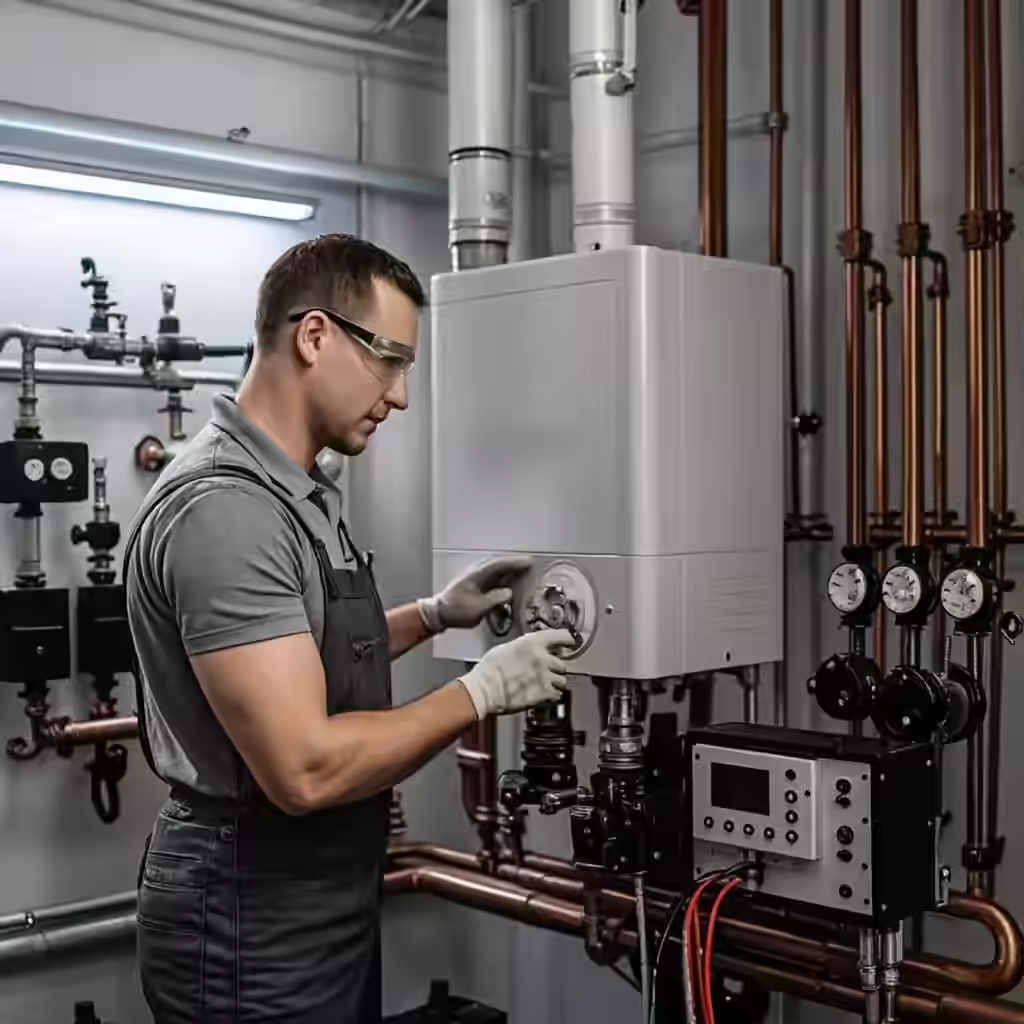
Strip the cabinet and a combi is two machines sharing one burner. On the heating side it is a normal sealed, pressurized boiler: a gas burner, a primary heat exchanger, a circulator, and a loop of water feeding your radiators, baseboard or in-floor tubing. On the hot water side it is a tankless water heater: when a tap opens, a valve prioritizes the burner away from heating and pushes primary-loop water through a compact plate heat exchanger, and domestic water crossing the other side of that plate picks up heat instantly on its way to the tap.
The magic of the design is not complexity, it is the valve logic. Heating and hot water never run simultaneously, because domestic hot water gets priority: open a tap mid-heat-call and the house loop pauses for the length of the shower, then resumes, usually without anyone noticing in a well-insulated home. Close the tap and the combi returns to the thermostat conversation. The result is a machine that behaves like a boiler and a tankless water heater, costs less than installing both separately, and occupies less wall than either.
Nearly every combi on the BC market is a condensing design, meaning it extracts extra heat by condensing flue gas water vapour before it leaves, which pushes efficiency into the mid-90s range and, more usefully for comfort, lets the burner modulate down to a fraction of full output in mild weather. That modulation is why combis pair so well with low-temperature emitters, a subject Chapter 6 covers properly. Our boiler services page covers the install, repair and radiant work around these units, and the tankless half of the story is compared against tank water heaters in our tankless versus tank guide.
Which BC Homes Fit a Combi
The fit question has three parts: hot water load, heating load, and space. Hot water load is about bathrooms and schedules, how many simultaneous showers the household actually runs, because the combi answers flow, not storage. Heating load is about envelope and emitters, and BC housing spans leaky 1920s character homes to airtight townhomes with heat-loss numbers a combi laughs at. Space is about the mechanical room and the tank closet you want back. Where those three line up, the combi wins on total cost of ownership, and where one is badly out of line, it does not, and the table below is the honest version of that sentence.
| Home profile | Combi fit | The reason |
|---|---|---|
| Townhome or row house, 2 baths, moderate schedule | Excellent | Heating load small, hot water demand fits one unit, tank closet freed |
| Laneway or garden suite, 1 bath | Excellent | Small loads both sides, space premium, one appliance to maintain |
| Detached home, 2 to 3 baths, 2-shower mornings | Good with sizing | Larger combi or accept scheduling around January flow |
| Detached home, 3-plus baths, simultaneous peak use | Poor to fair | Flow limits bite, a boiler plus tank serves the peak better |
| Home with big soaker tub or rain-shower arrays | Fair | High draw rates favour storage volume over on-demand flow |
| Retrofit with aging tank plus aging boiler | Excellent timing | One swap replaces two failing appliances and one fuel bill conversation |
| Home planning future suite or rental addition | Plan with us | Loads change, and the unit and gas line should be sized for the plan |
The question that decides combi fit is not how big your house is, it is how many hot water taps you run at once. Heating size follows square metres, but hot water size follows behaviour, and behaviour is the part a floor plan never shows.
The Space Math
Metro Vancouver homes pay some of the highest prices per square metre in North America, which makes the combi space story a financial story. A traditional setup dedicates a tank closet or utility corner to the water heater, often 60-centimetre-class floorspace and a clearance zone around it, plus a floor area for the boiler. A combi consolidates the whole plant into a wall-hung cabinet that a person can stand beside in a laundry alcove, a hallway closet end, or a garage wall, and returns the old tank footprint to the floor plan as storage, a pantry conversion, or simply usable room.
Two space notes from real installs deserve the attention. The tank closet on upper floors is often valuable precisely because it is upstairs, close to bedrooms and bathrooms, and reclaiming it sometimes nets more livable space than the mechanical room did. And the combi location is not entirely free, the unit needs combustion air, venting to the exterior with the right terminations, service clearance in front, and a condensate drain route, so the wall it hangs on is chosen by the estimator, not the decorator. Where venting runs long or a drain is far, the install labour is where it shows, which is why quotes are site-walked and flat-rate rather than priced from a floor plan over the phone.
Hot Water Performance, Honestly
The tankless half of a combi delivers hot water by heating street water on its way through, so its capacity is a flow rate, and that flow rate depends on how cold the incoming water is. This is the chapter where marketing numbers and January reality part ways, because the same unit that lists a summer shower figure can deliver meaningfully less mid-winter, and Metro Vancouver sits in a mild but real version of that reality. Our winter street water commonly arrives in the single digits Celsius, versus the mid-teens in August, so the temperature rise the burner must supply is roughly half again larger in January, and the flow the unit can hold at shower temperature drops accordingly.
- Summer duty: two comfortable showers at once is the realistic two-bathroom benchmark for the mid-size combis we install.
- Winter duty: one strong shower plus a modest second draw, or two moderate showers, depending on unit size and fixtures.
- Fixture reality: modern low-flow showerheads flatter a combi, old high-flow shower roses punish it, and fixture choices belong in the sizing conversation.
- Endless runtime: unlike a tank, a combi never empties, so a long shower stays hot forever, the trade is how many can run at once, not how long each lasts.
Sizing honestly means treating the household schedule as data. Our estimators ask what mornings actually look like, who showers when, whether the laundry and dishwasher run overnight, and whether a soaker tub or a rain shower exists, because those answers size the unit more than the floor area does. The household that answers two showers at 7 a.m. plus a dishwasher gets the larger combi or a boiler-plus-tank discussion, and the household that answers staggered schedules fits the mid-size unit with room to spare. It is the same flat-rate book either way, the difference is which page of it your house lives on.
A tank asks how much hot water you store. A combi asks how fast you make it. Neither question is better, but only one of them matches a January morning, and matching the right question to your household is what sizing means.
The Heating Side: Every Emitter Type
The heating half of a combi is a condensing, modulating boiler, which pairs differently with each emitter type Metro Vancouver homes actually have. In-floor radiant loops want the lowest water temperatures, often under 40 degrees Celsius at the slab on a mild day, and a combi modulating down to a trickle of burner output holds those temperatures with condensing efficiency the whole season. That is the single best pairing in residential heating, and it is why so many radiant-floor homes and laneway suites in this region heat from one wall-hung cabinet.
Cast-iron radiators and fin-tube baseboard were designed for hotter water, and a combi drives them well with one planning note: because those emitters were sized for higher supply temperatures, the estimator verifies the heat loss each room actually has against what the existing radiation can deliver at combi-friendly temperatures. Most Metro Vancouver rooms pass easily, since original radiation was generously sized and modern envelopes leak far less than 1950s envelopes did. Where a room runs marginal, the fix is usually a length of baseboard or an emitter upgrade in that one room, not a different boiler.
Mixed systems, radiant in a renovated main floor with baseboard upstairs, are common here and fully workable, with mixing valves tempering the loop that needs cooler water while the combi serves the hotter loop directly. That is design work, and it is exactly what the site-walk and load calculation are for. If you are earlier in the journey and still choosing between hydronic and forced air as a system, our boiler versus furnace comparison for Vancouver homes walks the comfort and cost trade-offs honestly, and our water heater services cover the tankless-versus-tank side in install detail.
What It Costs in BC
These are the flat-rate ranges our estimators quote across Metro Vancouver and the Fraser Valley, and the honest way to read them is as complete installed prices: appliance, permitted gas work, venting, condensate, commissioning and the 2-year workmanship warranty. A combi is a mid-range option, not a cheap one, and the reason it wins so many comparisons is that it replaces two appliances, not one, so the right comparison is combi versus boiler plus tank, where the combi usually comes out ahead on total installed cost and always wins on floor plan.
| Configuration | Installed range | What you get |
|---|---|---|
| Combi boiler | $7,000 - $11,000 | Heat plus on-demand hot water, one wall-hung unit, no tank |
| Condensing boiler plus tank | $8,500 - $14,000 (boiler) plus tank | Two premium appliances, highest capacity, most redundancy |
| Cast-iron boiler plus tank | $5,500 - $12,000 (boiler) plus tank | Simple, heavy, long-lived mid-efficiency heat with storage |
| Standalone tankless water heater | $2,500 - $4,500 | On-demand hot water only, pairs with a separate boiler |
| Annual combi service | $149 - $250 | Combustion check, both heat exchangers, prioritizing valve and pressure |
What moves a combi quote inside its range, in order of weight: the unit size the hot water schedule demands, venting length and termination work, whether the gas line needs upsizing for the new burner, the state of the heating loop it inherits, and any emitter or zone work the house needs to balance. None of those are surprises, they are line items the site walk exists to find. Rebates for high-efficiency gas equipment may apply, and we check eligibility and handle the paperwork with every quote, the same hands that handle the permit filings, so the install week is yours to spend on the tank closet conversion instead.
Lifespan and Maintenance
A combi that gets its annual service lives 12 to 20 years in this climate, and the BC duty cycle is genuinely gentler than most of the continent, five months of real heating rather than eight, no deep-freeze Manitoba January, and mostly soft water across the region, which spares the domestic plate exchanger the scaling that kills combis in hard-water cities. The lifespan levers are mundane and controllable: a $149 to $250 service visit once a year, system pressure kept in its band, clean treated water in the heating loop, and small faults addressed the week they appear rather than cycled through reset buttons.
The service visit on a combi is two services in one appointment, which is part of why the maintenance story is honest rather than burdensome. The heating half gets its combustion analysis, burner inspection, primary exchanger and condensate check, vessel charge and relief valve. The domestic half gets the plate exchanger inspected, the prioritizing valve exercised, and the flow sensor verified. One visit, both machines, and the technician reading a season of combustion numbers can see a failing component a winter before it fails a household.
Skipping service on a boiler risks a cold house. Skipping service on a combi risks a cold house and no hot water at once. The stakes are why the annual visit is the cheapest insurance in the mechanical room.
Repairs on a combi are ordinary boiler repairs in our flat-rate book, $180 to $550 for the common sensors, valves, pumps and ignition parts, with the $89 diagnostic credited when we do the work. Two notes specific to combis. Parts availability on the major brands we install is strong in this region, so same-visit repairs are the norm rather than the exception. And the prioritizing valve and flow sensor are combi-specific parts that generic troubleshooting misses, so a house that runs out of hot water but still heats fine is a combi-specific complaint worth a combi-literate crew, which our boiler repair teams in Vancouver and across the region are.

What the Swap Day Looks Like
A combi replacing a boiler and tank is usually a one-to-two-day install, sometimes three when venting runs long, and the sequence is worth knowing because the honest version of install day has a few hours without heat or water. The gas permit is filed with Technical Safety BC before the wrenches move, and our licensed gas fitters handle it as part of the flat-rate quote, along with the final inspection. Here is the shape of a typical day.
Arrival, protection and isolation
Floors protected, gas and water isolated, the old boiler drained and the old tank disconnected and hauled away.
Wall and piping
The hanging bracket goes up level, the combi mounts, and supply, return and domestic lines run to the unit with new isolation valves.
Venting and condensate
Vent terminations through the wall or roof per the listing, condensate drain routed and primed, combustion air arranged.
Gas and electrical
The gas line is pressure-tested, up-sized if the burner needs it, and the unit wired to power and controls.
Fill, flush and treat
The heating loop fills, bleeds, pressure sets in the cold band, and inhibitor goes in, because clean treated water is lifespan.
Commissioning
Combustion analysis with the meter, gas rates recorded, both heating and hot water modes verified at the taps, controls walked through with you.
The day ends with hot water at the tap, heat at the emitters, a commissioning sheet in your file, and the inspection booked. What the day does not end with is mystery: our estimator walks the sequence at the quote, flags the house-specific items that add hours, and the invoice matches the written number, which is what flat-rate means and what twelve thousand jobs and a 5.0-star rating across 26 Google reviews were built on.
The Alternatives, Compared Fairly
The combi is one honest option among four, and the fair comparison needs the same numbers on every row. A boiler plus tank pair, condensing boiler at $8,500 to $14,000 with a separate water heater, is the capacity and redundancy champion: a tank delivers a bathtub-fill no flow rate matches, and two appliances mean one failure never takes both services. The cast-iron route, $5,500 to $12,000 plus tank, trades efficiency for legendary simplicity and lifespans measured in generations. The standalone tankless, $2,500 to $4,500, solves hot water alone and pairs with whatever heats the house. And the combi, $7,000 to $11,000, is the value-and-space answer when the loads fit.
The electrified corner of the comparison deserves its own sentence rather than a row, because it is a different question. Heat pumps carry the region's incentive story, with combined CleanBC, BC Hydro, FortisBC and municipal top-ups that can reach $16,000 for cold-climate heat pumps in 2026 and the paperwork handled on our side, but a heat pump is an air question and a combi is a water question, and homes with existing hydronic emitters are often choosing between gas-side upgrades rather than between fuels. Our estimator conversation covers both honestly, including the gas combi rebates that may apply, where we check eligibility and handle the paperwork, and the financing page covers the monthly math from 7.99 percent with approved credit.
| If your priority is | Best fit | Why |
|---|---|---|
| Lowest total installed cost, both jobs | Combi | One appliance, one vent, one permit set, one service plan |
| Maximum hot water capacity | Boiler plus tank | Storage beats flow for tubs and stacked morning loads |
| Redundancy, never lose both services | Boiler plus tank | Two independent appliances |
| Simplest long-lived heat plant | Cast-iron plus tank | Heavy, serviceable, generational parts availability |
| Smallest mechanical footprint | Combi | Wall-hung cabinet, tank closet returned to the floor plan |
| Radiant floor comfort, new build or reno | Combi | Low modulation and low water temperatures, made for slab loops |
City Notes Across Metro Vancouver
The combi conversation shifts subtly by city because the housing stock does. Vancouver Specials and character-house suites push tankless-flow limits with stacked morning schedules. Surrey and Langley family homes fit the mid and large combis with suite loads planned in. Burnaby townhome corridors are combi country by design. New Westminster heritage conversions weigh wall-hung modernity against cast-iron charm. Our crews install and service all of it, and these local pages carry the same flat-rate book and the same 2-year workmanship warranty.
Combi boiler service in Vancouver
Wall-hung combis in suites, laneways and character homes, repaired and commissioned by Red Seal gas fitters.
Combi boiler service in Surrey
Family-home and suite installs with loads planned for the schedule the household actually runs.
Combi boiler service in Burnaby
Townhome-row combi country, with annual service slots and stocked combi-specific parts.
Combi boiler service in Coquitlam
Ridge-and-plateau homes with radiant floors and combis, sized and commissioned for the elevation.
Combi boiler service in Langley
Acreage and propane combi installs, where venting and gas-line work get the site-walk respect they deserve.
Combi boiler service in Richmond
Slab-radiant homes and low-elevation bungalows, the region best pairing for wall-hung condensing units.
The Decision Cheat Sheet
One dark table for the whole decision. Find the household on the left, and the right two columns tell you what to book and what to expect, from the $89 diagnostic that starts any repair conversation to the $7,000 to $11,000 installed range that starts any replacement one. Annual service at $149 to $250 keeps whichever row you choose on the long half of its lifespan.
| Your household | The honest call | Expect |
|---|---|---|
| Townhome or suite, staggered hot water | Combi, mid-size | $7,000 - $11,000 installed, tank closet back |
| Family home, two showers at 7 a.m. | Combi, large, or boiler plus tank | Sizing conversation at the site walk |
| Radiant floor, new build or major reno | Combi | Best pairing in residential heating |
| Big tubs, rain showers, stacked peaks | Boiler plus tank | Storage volume beats flow rate |
| Aging boiler plus aging tank together | Combi swap on one flat-rate quote | One day, one permit set, both problems gone |
| Combi already installed, fault or service | $89 diagnostic or annual service | Repairs $180 - $550, service $149 - $250 |
A combi is not the right answer for every house, it is the right answer for a specific set of habits and floor plans, and the household that sizes it by behaviour instead of square metres gets the appliance the brochure promised.
Frequently Asked Questions
Services From This Guide
Site-walked combi installs, flat-rate boiler repairs and annual service across seventeen Metro Vancouver cities, Red Seal certified with Technical Safety BC permits handled.
Boiler install and service
Combi, condensing and cast-iron installs flat-rate quoted, with repairs from $180 to $550 and service from $149 to $250.
Water heater services
Tank, tankless and combi domestic hot water, installed and maintained by Red Seal licensed gas fitters.
Boiler repair in Vancouver
Combi-literate crews with the prioritizing valves and flow sensors that generic troubleshooting misses.
Financing and rebates
Installed-cost plans from 7.99 percent with approved credit, rebate eligibility checked and paperwork handled.
Related Guides
Tankless vs Tank Water Heaters
The storage-versus-flow question behind the domestic half of every combi decision.
Heating & CoolingBoiler vs Furnace in Vancouver
The hydronic-versus-forced-air decision the combi heating half lives inside.
SeasonalWinter Prep for Vancouver Homes
The October checklist that keeps a combi, or any boiler, off the January emergency list.

Red Seal certified, licensed gas fitters (BC-PL-2019-4421), $2M insured and 15-plus years in the field, with more than 12,000 jobs completed across Metro Vancouver since 2010 and a 5.0-star rating across 26 Google reviews. We wrote this guide because a combi is the most recommended and most misrecommended appliance in the region: it is genuinely excellent for the household whose behaviour fits it, and the honest sizing question is about morning schedules and tubs, not square metres and sales sheets. To book instead of DIY, see boiler repair in Burnaby — same-day across the city.
More about our team →Get Your Combi Boiler Quote Started
Book a free combi estimate with a Red Seal gas fitter. You get a load calculation sized to your household schedule, a flat written price for the swap and for the boiler-plus-tank alternative, rebate eligibility checked with the paperwork handled, and financing from 7.99 percent with approved credit. Zero obligation, same-day quotes on most calls. If you would rather hand this to a pro, our boiler services pages cover Metro Vancouver.
No heat and no hot water right now?
A combi takes both services down together, so we answer those calls 24/7 with live dispatch and the $150 flat after-hours premium posted in advance. Daytime? The $89 diagnostic is usually same-day in Vancouver, Burnaby and Surrey.
Call 604-615-2212 WhatsApp Us