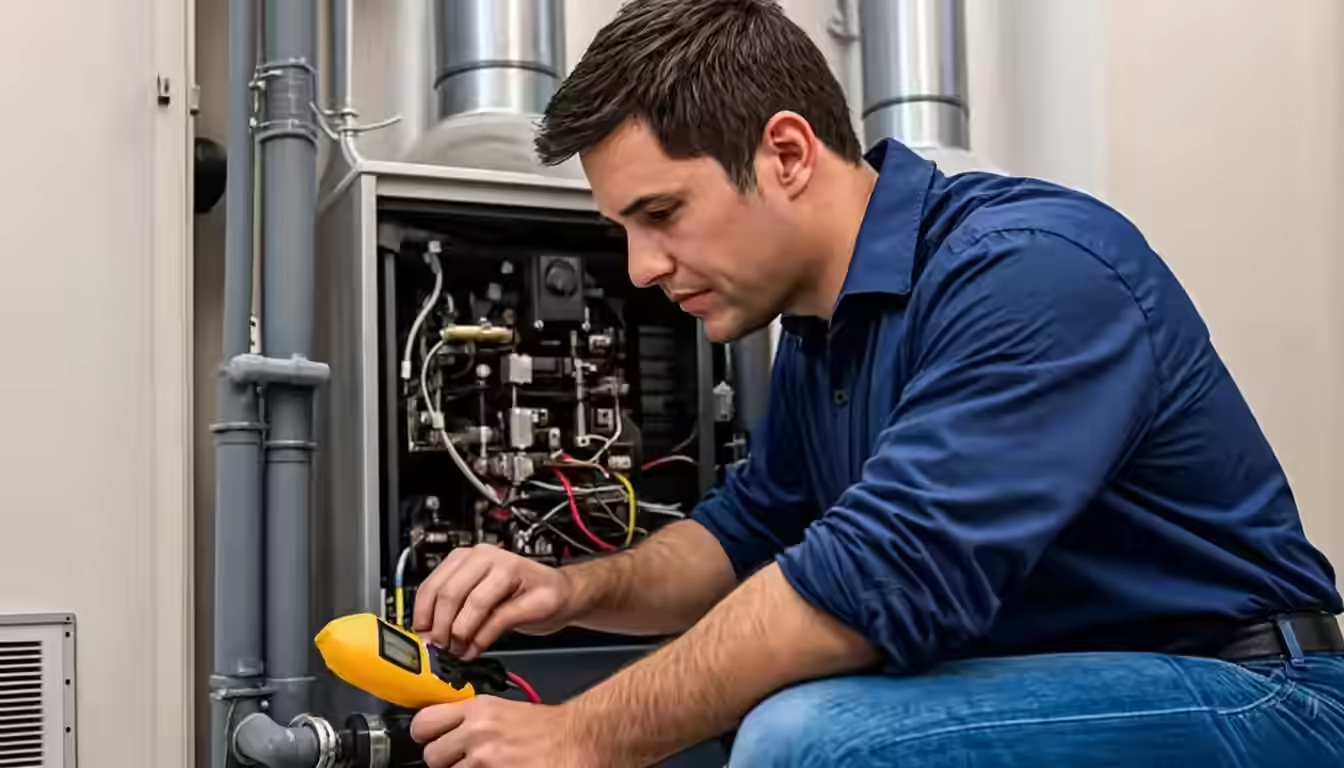
The Honest Answer Up Front
For most BC homeowners with equipment three or more years old, maintenance pays for itself and then some: a $149 to $250 annual visit recovers roughly $60 to $250 a year in energy, prevents one expensive class of mid-winter failure after another, keeps the manufacturer warranty enforceable, and stretches equipment life by years, which is where the real money lives. The plan part, the subscription wrapper companies sell around that visit, matters far less than the visit itself, and the perks bundled into most plans are worth roughly what they cost to print. Buy the maintenance, not the membership, unless the membership's specifics beat the à la carte math in your situation, which Chapter 9 tabulates.
The honest exceptions: brand-new equipment under the builder's first-year warranty needs filter discipline more than paid service; homeowners who genuinely do the monthly homeowner checklist and book a single visit a year are already capturing 90 percent of the value; and equipment past the 18-year line is usually better served by a repair-versus-replace decision than by a maintenance subscription. What follows is the full ledger, run the way we'd run it for our own houses: energy, repairs, lifespan, warranty and risk, each with the numbers attached, so you can re-run it with your bills and your equipment's age plate.
5-10% energy penalty
The approximate annual efficiency cost of a neglected system, dirty coils, fouled burners, choked airflow, before any failures arrive.
15-20 vs 10-12 years
Maintained versus neglected heat pump life in this climate; furnaces follow the same pattern on a longer clock.
$150 flat, after hours
The premium on the Sunday-night emergency call that a fall visit makes dramatically less likely. The cheapest dollar in HVAC is the one spent before November.
What Maintenance Actually Costs in BC
Start with the unbundled truth, because everything else prices against it. A single professional maintenance visit in Metro Vancouver runs $149 to $250 depending on equipment type and head count, and takes sixty to ninety minutes when done properly. That is the product. The subscription versions, marketed as maintenance plans, comfort clubs and priority programs, typically bundle that same annual visit with perks, and price from roughly $199 to $399 a year depending on what's wrapped around it, sometimes less as loss-leaders tied to equipment purchases, sometimes more in multi-equipment households. Our own position is simple and worth stating up front: we sell the visits at $149 to $250, we don't require a membership to get one, and this guide prices the perks at what they're actually worth.
| What you can buy | Typical price in BC | What's inside | Honest value read |
|---|---|---|---|
| Single maintenance visit | $149-250 | The full checklist, written report, commissioning comparisons | The benchmark; everything else must beat it |
| Annual plan, one system | $199-399/yr market range | Visit plus priority booking, 10-15% repair discounts, fee waivers | Worth it only if you'd use the perks; the visit is the value |
| Multi-system or landlord plan | Scaled, per property | Batched visits, tenant coordination, documentation trails | Strongest case; paperwork is the product for rentals |
| Free tune-up promotions | $0 up front | A short inspection built to find work to sell | Free diagnostics that find $900 of urgent repairs are not free |
| Emergency repair, no maintenance | $89 diagnostic + $180-450 repair + $150 after-hours | Triage, fix, warmth restored | The price of skipping the plan, paid one Sunday at a time |
Read the free-tune-up row with BC eyes: nothing in this province's HVAC economy is free, and the business model of the free inspection is the finding. A genuine maintenance visit from a company that also does repairs, like ours, includes findings and recommendations as facts on a report, not as a script; the difference shows up in what the technician does when the equipment is healthy, which is write "healthy" and leave. That behaviour is the single best signal of whether any maintenance program, plan or visit, is worth your money.
What a Real Visit Includes, and What Cheap Ones Skip
The $149-to-$250 visit, done properly, is an hour to an hour and a half of measurement. On gas furnaces: combustion analysis with the readings recorded, heat exchanger inspection, burner and flame sensor service, inducer and pressure switch verification, blower amp draw, filter and airflow assessment, venting and condensate checks, and a CO measurement at the registers that either passes or fails with a number attached. On heat pumps: refrigerant charge verification against the manufacturer's chart, defrost system test, outdoor coil inspection and cleaning where the grime justifies it, electrical readings on the contactor and capacitors, condensate drainage, and the control settings that decide when auxiliary heat starts spending your money. On the cooling side, the same discipline arrives in spring, and the AC spring checklist covers the homeowner half.
What the cheap versions skip is everything with a gauge on it. The tell-tale signs of a twenty-minute "tune-up": no combustion analyzer appears, the heat exchanger is not physically inspected, no readings are written down, the refrigerant circuit is never opened or verified, and the report, if any, is a checkbox sheet with nothing measured. Maintenance performed that way is theatre, and it is the reason half the homeowners asking whether plans are worth it are asking about the wrong product entirely. A maintenance purchase is a purchase of measurement: before-and-after numbers on a piece of paper you keep. If the company cannot show you what that paper looks like before you book, book elsewhere.
Maintenance without measurement is a ritual. The entire value of the visit lives in the numbers: combustion readings, temperatures, pressures, amps, written down and compared year over year, because the trend line is what tells you the compressor is failing two winters before it agrees to.
The Energy Math, Worked
Efficiency claims are where maintenance marketing goes to be vague, so here are the honest ranges with the arithmetic shown. A gas furnace heating a Metro Vancouver home plus domestic hot water typically draws $1,200 to $2,000 a year on FortisBC rates, and neglected equipment gives up roughly 5 to 10 percent of that to fouled burners, dirty filters and compromised combustion, $60 to $200 a year. An electrically driven heat pump on BC Hydro's residential steps, roughly 11 to 12 cents per kWh at Step 1 and 14 to 15 at Step 2, rates shift annually, is more sensitive still: a dirty outdoor coil alone can cost 10 to 30 percent of capacity, and when capacity drops, runtime climbs to compensate, $75 to $250 a year for a typical household. Add the choked-filter airflow penalty and a poorly maintained home runs its equipment measurably longer for the same warmth.
| System and state | Annual energy, typical home | Neglect penalty | Recovery per $149-250 visit |
|---|---|---|---|
| Gas furnace, maintained | $1,200-2,000 heat + hot water, FortisBC | 5-10% efficiency loss | $60-200/yr |
| Heat pump, coils clean | BC Hydro steps, household-dependent | 10-30% capacity loss from a dirty coil | $75-250/yr in avoided runtime |
| Ductless, filters rinsed | Per head, seasonal | Choked filters cut airflow and efficiency together | $40-150/yr, plus the frozen-coil repair avoided |
| Boiler, serviced annually | $1,500-2,500 typical for radiator homes | Fouled burners, drifting aquastat settings | $75-250/yr |
Stack those recoveries against the visit price and the pattern is consistent: energy alone repays somewhere between a third and the full cost of the annual visit, every year, before a single repair is prevented. The assumptions are stated so you can re-run them, your FortisBC or BC Hydro bill, your equipment, your runtime, and the regional truth that our climate is the enemy of coils: damp air, salt near the coast, cottonwood near the rivers, and a heating season that runs eight months. The heat pump services page covers the equipment-specific details, and the boiler page does the same for radiator homes, where servicing is less optional than anywhere: a neglected boiler is an efficiency problem on a good day and a safety decision on a bad one.
The Repair Math: What Maintenance Actually Prevents
Energy pays a third of the ticket; repair prevention pays the rest, and it works differently, not as a guarantee but as probability shifted. A maintained furnace does not never fail, it fails predictably, cheaply, and in October. An unmaintained one fails randomly, expensively, and at 9 p.m. on the coldest Sunday of the year, which in this province is a schedulable event: the January-February no-heat surge is the most reliable phenomenon in BC HVAC, and our furnace repair dispatch sees its entire year compressed into those eight weeks. Here are the common preventables, priced honestly:
| Failure | Typical repair cost | How maintenance prevents it | BC frequency note |
|---|---|---|---|
| Fouled flame sensor, no-heat call | $180-250 with diagnostic | Cleaned and tested at every visit | The wet-coast classic; our most common winter call |
| Clogged condensate, water damage | $180-350 repair, plus ceiling or flooring | Drain flushed and flow verified annually | High-efficiency furnaces make a litre-plus of condensate a day in winter |
| Frozen evaporator coil | $180-350 plus the underlying airflow cause | Filter and airflow checks catch the cause first | Almost always a maintenance problem wearing a repair costume |
| Failed capacitor or contactor | $250-450 | Readings trend before failure; replacement at the visit | Capacitors drift measurably before they quit |
| Cracked heat exchanger found late | Furnace replacement, $4,800-9,500 | Annual physical inspection, combustion readings trend | The safety failure; finding it early is the visit's most serious job |
| Heat pump dead in defrost season | $180-450, after-hours premium likely | Fall defrost test, sensor and drainage checks | Coastal defrost cycles run hundreds of times a winter |
The Lifespan Math: Where the Real Money Hides
Energy repays a third of the visit and repairs repay the rest, but the largest numbers in the ledger are at the end of the equipment's life, in the replacement you defer. Our field numbers for this climate: maintained heat pumps deliver 15 to 20 years, neglected ones 10 to 12, and furnaces follow the same shape on a longer clock, maintained units routinely reaching 18 to 22 years while neglected ones exit at 10 to 15. The mechanism is boring, small failures caught early, coils kept clean, capacitors replaced at $250 instead of being allowed to take the compressor with them, and boring is what compounding sounds like when it's working.
| Scenario, heat pump at $10,000 installed | Equipment life | Effective cost per year | Annual maintenance spend |
|---|---|---|---|
| Maintained, replacement at year 18 | 18 years | $556 | $200 x 18 = $3,600 |
| Neglected, replacement at year 11 | 11 years | $909 | $0 spent, $353/yr more in depreciation |
| Furnace equivalent at $7,000 installed | 20 vs 13 years | $350 vs $538 | Same shape, same conclusion |
Read the middle column as the honest headline: maintenance spending of $3,600 across eighteen years is roughly offset by $3,500 to $4,300 in avoided depreciation alone, on a single $10,000 machine, before energy and before repairs. That is the calculation most "is it worth it" arguments skip, because it's not a bill you ever see; it's the replacement date that quietly slides five years right. And the second-order benefit compounds too: the well-documented machine sells better, because the buyer's inspector reads your service file and prices confidence instead of risk.
The Warranty and Resale Angle
Manufacturer warranties on HVAC equipment are registration papers plus fine print, and the fine print's favourite sentence is "properly maintained." Registered equipment commonly carries ten-year parts coverage, labour usually a single year, and when a $600 control board or a $1,800 compressor fails in year six, the claim lives or dies on records. A homeowner with dated service reports listing what was done has a claim. A homeowner with "I change the filter, mostly" has a negotiation they will lose. This is the least glamorous and most absolute argument in the whole ledger: the visit's paper trail is what converts a warranty from marketing material into an insurance policy.
The same file works twice. At resale, BC buyers and their agents increasingly ask for service records on furnaces, heat pumps and tankless systems, and a folder of annual reports reads as proof of life for equipment whose replacement costs are known, a heat pump at $6,500 to $14,000, a furnace at $4,800 to $9,500. Documented equipment supports price and closes questions; undocumented equipment invites conservative assumptions on the buyer's side of the ledger. Our reports are written to be filed, photographed at inspections and forwarded to lawyers, in that order of appearance, and the habit costs nothing beyond the visit it documents.
One nuance worth knowing: extended warranties and maintenance plans are frequently sold together, the plan making the extended coverage conditional on the plan, which is a tidy arrangement for the seller and sometimes for the buyer. If the bundled price beats à la carte visit pricing plus the warranty's actual market value, it can be honest; if the bundle's warranty covers parts that rarely fail while the labour, the expensive half, stays excluded, the arrangement is theatre again. Chapter 9's question table covers exactly what to ask before signing either.
The Four Cases Where You Shouldn't Buy One
A guide written by a company that sells maintenance owes you the exceptions chapter, and here it is without asterisks. First: brand-new equipment in its first one to two years under builder or installer warranty. The first-year visit is usually covered by the installing contractor, the equipment is clean, the failure modes are infant-mortality items covered anyway, and your job is filter discipline and a documented start date. Book the first paid visit in year two. Second: end-of-life equipment, furnaces past roughly 18, heat pumps past 15, water heaters past 10. The visit will mostly document what you already suspect, and the money serves you better in the replacement fund; the repair-vs-replace math in the guide linked earlier draws that line precisely, and we tell customers the same thing on site.
Third: the genuinely DIY-competent owner. If you rinse ductless filters monthly, change ducted filters on schedule, keep the outdoor unit clear through snow and cottonwood season, and can tell a defrost cycle from a failure, you are already doing the homeowner half, and the professional half, once a year, is a $149-250 visit you can buy without a subscription. Paying for a plan's priority perk you'll never use is a donation. Fourth: any plan whose economics depend on you not reading it, multi-year lock-ins with escalating fees, perks that expire, discounts that exclude the repairs you're statistically most likely to need. A plan should be simpler than the alternative, not more complex; if the paperwork doesn't fit on one page, the value probably doesn't either.
What none of the four exceptions are: an argument against the maintenance itself. Every case above still ends with a recommendation to service the equipment on some schedule, because the physics in Chapters 4 through 6 does not care who owns the calendar. The question was never whether, it was whether the subscription wrapper earns its keep over the plain visit, and in four cases out of the common ones, it doesn't.
The Fine-Print Checklist Before You Sign Anything
Whether it's our visit or a competitor's plan, these are the questions whose answers determine whether you're buying maintenance or buying marketing. Bring the table:
| Ask this | Good answer | Walk-away answer |
|---|---|---|
| What exactly does the annual visit include, in writing? | A task list with measurements: combustion, refrigerant, defrost, electrical, drains, report | "Full 20-point inspection" with no gauge-work named |
| Who performs it? | Named Red Seal techs; licensed gas fitters for gas equipment, licence number provided | "A qualified technician" with no licence numbers anywhere |
| Is the price locked, and for how long? | Locked term stated, escalation clause plain | Year one promotional, renewals at "then-current rates" |
| What do repairs and parts cost on the plan? | Percentage discount stated, parts and labour both, ranges published | Discount applies to labour only, at rates you can't see until the invoice |
| Can I cancel, and is it transferable? | Plain cancellation terms, transfer to a buyer is a resale asset | Auto-renewing multi-year commitments with termination fees |
| What's excluded? | Exclusions listed, typically parts, refrigerant, after-hours premiums | "Everything is covered" — nothing is ever everything |
| Does it satisfy my warranty requirements? | Yes, with dated reports that list tasks performed | Reports that are checkboxes without dates or measurements |
The pattern in the middle column is measurement and plainness, and it's the same test this guide has been applying since Chapter 2. Maintenance is one of the last categories in home services where the honest product and the marketed product still diverge visibly, which is inconvenient and useful: the divergence makes the good providers easy to identify, because they put their task lists and their prices in writing before you ask. Ours are on the choosing a contractor guide's checklist too, and if a company fails that table's first row, it fails the whole subject.
Timing: The Cheap Part of the Decision
Half the value of maintenance in this climate is timing, because our failure seasons are as scheduled as anything in HVAC gets. Heating equipment should be serviced in September or October: before the rain loads the defrost cycles, before the first November cold snap loads the phones, and while the technician can still do the ninety-minute version of the job instead of the triage version. Cooling gets its pass in May, before the first heat-dome rehearsal, and the pattern repeats itself with comic reliability: the homeowners who book in the fall window meet us for an hour in October; the ones who don't meet us in February with a $150 after-hours premium and a space-heater narrative. Our furnace troubleshooting guide covers what to check before that February call happens, but the better version of that sentence is that October already covered it.
For households running both a furnace and an AC, or a heat pump doing both jobs, the calendar is simpler than the equipment: one fall visit covers the heating side and the defrost system, and the same visit's checks largely cover the cooling side, with a May filter-and-hose pass as the homeowner's contribution. For landlords, the fall visit is also the RTB visit: it satisfies the Residential Tenancy Act's maintenance duty, generates the documentation that wins disputes, and coordinates with the 24-hour entry notice habit, three obligations cleared in one appointment. That stacking, legal, mechanical and warranty, all in a single $149-250 hour, is why landlords are the one group for whom even the subscription wrappers usually make arithmetic sense.
The Honest Ledger, One Screen Tall
The whole guide compressed to a screen: for equipment three to fifteen years old, the $149-250 annual visit recovers $60-250 in energy, shifts a meaningful share of mid-winter failures into October appointments, keeps a parts warranty worth thousands legally enforceable, and defers a five-figure replacement by three to seven years, which alone pays for every visit the equipment will ever receive. For new equipment, wait until year two. For end-of-life equipment, put the money in the replacement fund. For the DIY-competent, buy the visit and skip the membership. For landlords, buy the version that does your paperwork too. That is the entire decision, and you now have every number that went into it.
The last word belongs to the pattern we see from the inside, because it is the closest thing this industry has to a controlled experiment. Every January, the emergency queue fills with systems nobody has looked at in years, and every October, the maintenance list is full of systems we've looked at every year, and the overlap between those two lists is close to zero. Same climate, same equipment, same cities. The only variable is the hour a year, booked in the right season, by someone who kept the report. Be the October household; February will never know your name.
Book the Visit, Not the Upsell
Annual maintenance runs $149 to $250 and includes the full measured checklist, combustion and defrost testing, coil cleaning where needed, and a written report that protects your warranty and your resale file. Zero obligation to buy anything else, ever, and if your equipment doesn't need the visit this year, we'll tell you. 24/7 emergency coverage with a $150 flat after-hours premium posted in advance, $89 diagnostic credited to any repair.
Frequently Asked Questions
Services From This Guide
Red Seal certified, licensed gas fitters BC-PL-2019-4421 and $2M insured, maintaining equipment across all twelve Metro Vancouver cities from Vancouver, Burnaby and Richmond through Surrey, Langley and Coquitlam out to Abbotsford and Maple Ridge.
Related Guides

We are in the awkward position of selling maintenance visits and being asked, weekly, whether maintenance is worth it. The honest answer involves arithmetic, and this guide is that arithmetic written down: our own service pricing, our own failure data from 12,000-plus jobs across Metro Vancouver, and the four cases where we tell customers to keep their money. To book instead of DIY, see HVAC service in Langley — same-day across the city.
More about our team →Book the Annual Visit, Not the Upsell
A maintenance visit runs $149 to $250 and includes the full checklist, combustion and defrost testing, coil cleaning where needed, and a written report that protects your warranty and your resale file. Zero obligation to buy anything else, and if your equipment doesn't need the visit this year, we'll tell you and see you next year. If you would rather hand this to a pro, our heating & furnace services pages cover Metro Vancouver.
Furnace or heat pump down now?
Emergency calls are answered 24/7 with live dispatch, a flat $150 after-hours premium posted in advance, and the $89 diagnostic credited to any repair, most jobs $180 to $450. Maintenance customers skip the queue in January because they're not calling in January.
Call 604-615-2212 WhatsApp Us