
The Honest Answer Up Front
Most low water pressure in Vancouver homes is not a mystery and not a city problem. In roughly nine out of ten pressure complaints we diagnose, the cause is one of three things: a worn-out pressure reducing valve (PRV) on the incoming main, a partially closed or corroded shutoff somewhere between the street and your fixtures, or decades of rust scale narrowing the inside of galvanized steel supply pipe in pre-1960s housing stock. The remaining cases are usually clogged aerators, a hidden leak, or the simple physics of a house sitting high on one of this region's gravity-fed pressure zones.
Here is the short version we give at the kitchen table. If the pressure dropped suddenly across the whole house, suspect the PRV, the main shutoff, or a leak, and get it looked at quickly. If it faded gradually over years and the shower is worst when the laundry or a second tap runs, your supply pipes are closing up, which is a repipe conversation, not a repair. If only one fixture is weak, it is almost always a $0 aerator clean or a seized fixture stop. And if your neighbours are weak too, it is the city's side of the line, and you should be calling the municipality, not a plumber.
The $89 diagnostic we run measures the system instead of guessing at it: static pressure, flow under load, fixture-by-fixture isolation, and a meter check for hidden leaks. It is credited toward any repair, so you are never paying twice for the same answer.
Water pressure is the one plumbing complaint you can put a number on. Any company that quotes a repipe without first putting a gauge on your hose bib and opening a second tap is selling, not diagnosing.
0 jobs since 2010
Heating, cooling and plumbing jobs completed by our Red Seal team across Metro Vancouver and the Fraser Valley.
0 code pressure limit
BC plumbing code requires a pressure reducing valve where street pressure exceeds roughly 80 psi, which covers much of low-lying Metro Vancouver.
0 avg emergency response
Sudden pressure drops and burst pipes are answered 24/7 with live dispatch across 17 Metro Vancouver cities.
0 star rated
From 26 verified Google reviews, because honest diagnosis earns trust one gauge reading at a time.
How Vancouver's Water System Shapes Your Pressure
Metro Vancouver's drinking water is unusual in North America, and it explains a lot about local pressure behaviour. The water comes from three mountain watersheds, Capilano, Seymour and Coquitlam, and reaches most homes almost entirely by gravity. Pumps move water between reservoirs and up to high-elevation zones, but the pressure at your curb is largely a function of how far your house sits below the reservoir serving your area. That is why the same city can serve a Kitsilano basement suite with generous street pressure and make a British Properties hillside home depend on carefully managed pressure zones.
Two consequences follow. First, in lower zones the street pressure can exceed the plumbing code limit of roughly 550 kPa (80 psi), so code requires a pressure reducing valve at the service entrance, and thousands of Vancouver, Richmond and Burnaby homes have one, whether the owner knows it or not. Second, the water itself is famously soft and lightly chlorinated, which is gentle on water heaters and kind to soap, but which also means scale deposits are rarely the issue here the way they are in hard-water cities. When Vancouver pipes clog, it is usually corrosion in the home's own galvanized supply lines, not mineral scale from city water.
| Where your home sits | Typical street pressure behaviour | What it means for you |
|---|---|---|
| Low-lying (Richmond, parts of Vancouver, North Delta) | Higher static pressure from gravity head | PRV required and doing real work; PRV failure often shows up as HIGH pressure first |
| Mid-slope (Burnaby, New Westminster, Coquitlam) | Moderate, zone-dependent | Pressure varies block to block; some zones boosted by pumps |
| Hillside (North Vancouver, West Vancouver high zones) | Lower supply, sometimes pump-assisted zones | Weaker supply is normal; booster or zone issues affect whole streets |
| Fraser Valley flats and well-served rural (Langley, Abbotsford) | Municipal zones plus some private wells | Well systems have their own pressure-tank quirks |
The practical takeaway: your pressure ceiling is set by the city before a drop of water reaches your property line, and everything after the curb stop, the PRV, the main shutoff, the supply piping, the fixture stops, is your home's equipment and your responsibility. Our plumbing services in Metro Vancouver cover that entire inside-the-line stretch.
Is It Your Home or the Whole Street?
Before anyone opens a toolbox, establish whose problem this is, because the fix and the bill belong to very different parties. The five-minute version: ask two neighbours on the same block whether their showers feel weak too. If they say yes, and especially if the weakness tracks with municipal water main work notices in your area, call your city's water service line. Repairs, flushing operations, and seasonal demand in fast-growing subdivisions can all dip street pressure temporarily, and no plumber can fix that from inside your house.
If your neighbours are fine, the restriction is inside your property line, and the detective work begins. One more boundary case trips people up in strata-titled buildings: in many condos the pressure you feel depends on the building's booster pump and a PRV at your suite isolation valves, so a building-wide problem is the strata's to solve while an in-suite restriction is yours. Chapter 8 untangles that split in detail.
- Whole street weak: municipal supply issue. Call the city water department; save your plumber money.
- Only your home weak, suddenly: PRV failure, a bumped main shutoff, or a leak. Diagnose this week, not this season.
- Only your home weak, gradually over years: corroding supply pipe, usually galvanized. This is the repipe trajectory.
- One fixture weak: aerator, fixture stop, or the fixture itself. Genuine do-it-yourself territory.
- Weak only at peak hours (evenings, summer): demand on the local main or a shared supply restriction in multi-unit buildings.
The 8 Causes of Low Water Pressure, Ranked
This is the elimination order our technicians actually work through, ranked by how often each cause turns out to be the one. Notice that the top three account for the overwhelming majority of calls, which is why a systematic diagnostic beats guesswork: you test the cheap and likely things first.
| # | Cause | What you notice | Honest fix path |
|---|---|---|---|
| 1 | Worn pressure reducing valve (PRV) | Whole-house drop, sudden or drifting; sometimes pressure that creeps HIGH overnight instead | Adjust first, replace if it will not hold, quoted flat-rate after the $89 diagnostic confirms it |
| 2 | Partially closed main shutoff or curb stop | Sudden weak flow everywhere after plumbing work or landscaping; valve handle not fully open, or a seized quarter-turn ball valve | Reopen the valve properly; replace seized stops |
| 3 | Galvanized supply pipe corrosion | Years-long fade, worst when two fixtures run, hot lines often first, rust-tinted water at start-up | PEX-A repipe, $4,800 to $12,000 for most homes |
| 4 | Hidden leak on the supply side | Pressure sag plus meter movement with everything off, damp drywall, warm floor spots, bill jump | Leak trace then repair, $180 to $420 in most accessible cases |
| 5 | Clogged aerators and fixture stops | One or two fixtures weak, others strong; spray pattern sputters or sprays sideways | Remove, soak and clean the aerator; free during a diagnostic |
| 6 | Water softener or filter restriction | Whole-house drop that vanishes when the softener is put on bypass | Service or bypass the treatment unit; re-test |
| 7 | Elevation and zone physics | Top floor always weaker in a three-storey home on a hillside; consistent since day one | Normal behaviour; booster pumps exist for genuine cases |
| 8 | Undersized or half-closed supply after a renovation | Newly finished suite or addition with weak flow, especially showers fed through long narrow runs | Correct sizing at the source; sometimes a manifold upgrade |
Cause 4 deserves a special note: a hidden supply leak is the only cause on this list that gets more expensive every day you live with it, because a slow leak inside a wall becomes mould, rot and a restoration claim. If your pressure sag comes with any sign of water where it should not be, read our guide on detecting hidden water leaks in Metro Vancouver homes before anything else, and consider it an urgent call.
The Pressure Reducing Valve: Suspect Number One
The PRV is the bell-shaped brass valve sitting just downstream of your main shutoff, and in lower-lying Metro Vancouver zones it is code-required equipment doing real work every day: it takes 90-plus psi of street pressure and knocks it down to a safe 50 to 75 psi for your pipes, fixtures and water heater. It is also a wear part. After ten to twenty years, its internal diaphragm and spring fatigue, and the valve starts doing its job badly in either direction, choking flow down to a trickle or drifting closed overnight, or in the opposite failure, letting full street pressure through, which shows up as banging pipes and a dripping temperature/pressure relief valve on the water heater.
The homeowner test
Screw a pressure gauge onto an outside hose bib (they thread on like a garden hose) and read the needle with the house quiet. Write it down. Run one tap for thirty seconds and read again. Then check the gauge in the morning before anyone uses water. A healthy system reads a steady 50 to 75 psi, sags only modestly under one open tap, and returns to the same resting number overnight. A reading that has fallen far below where it used to sit, or that creeps upward while you sleep, is the PRV announcing its retirement.
One adjustment caution: a PRV and a water heater together make a sealed system. Raising house pressure without a functioning thermal expansion tank is a classic way to make the water heater's relief valve spit water. If the TPR valve starts dripping after any pressure work, that is the system telling you the expansion tank needs attention, not a fault in the heater.
A careful quarter-turn of the adjustment screw is a reasonable homeowner move, tested with a gauge each time. But when the valve will not hold a setpoint, chatters audibly, or has simply reached a dignified old age, replacement is the honest answer, and it is one of the best-value plumbing jobs in the region: one accessible valve swap restores the entire house. We carry the common sizes on the truck and quote it flat-rate on the spot once the diagnostic confirms the valve is the fault.
Galvanized Pipe: The Slow Squeeze in Older Homes
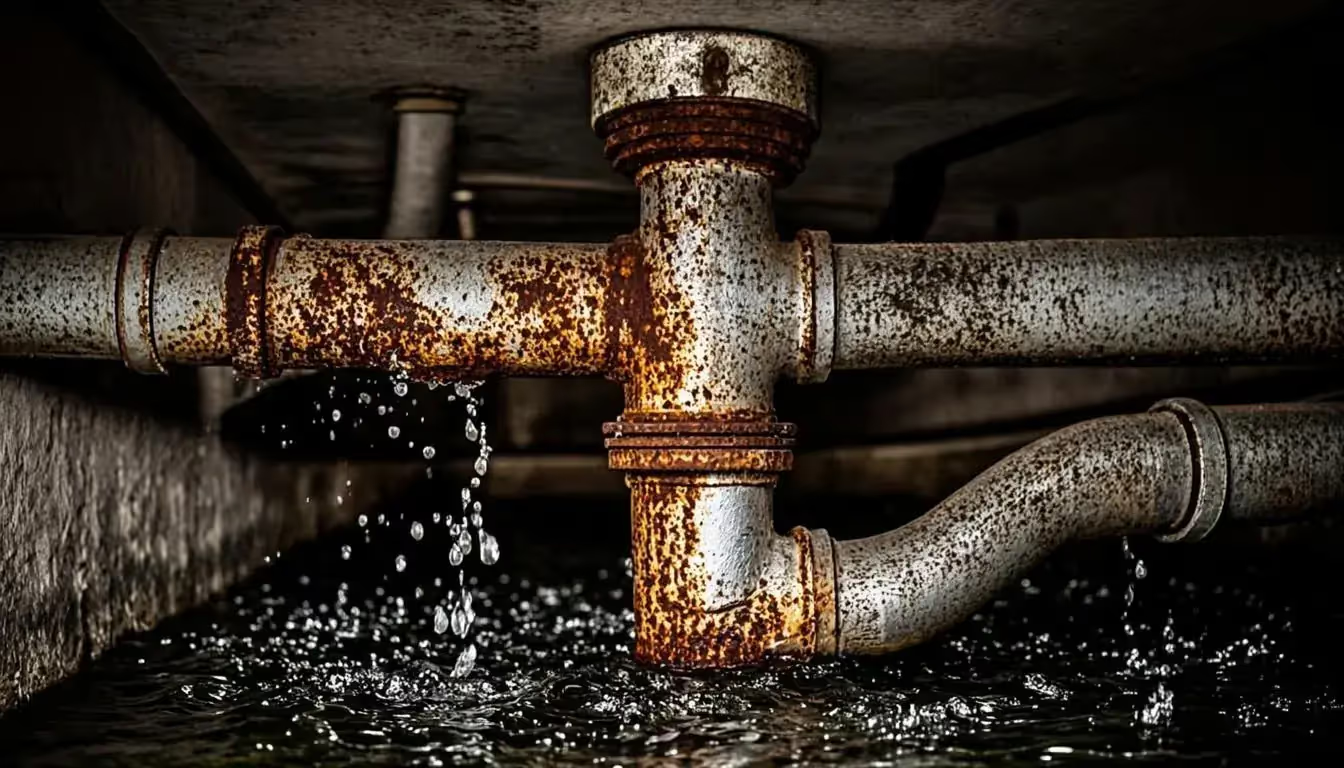
Before copper and plastic took over, Metro Vancouver builders ran water supply lines in galvanized steel, zinc-coated pipe that was expected to last a generation and has now lasted two or three. The zinc coating fails from the inside out, the steel rusts, and every year of rust deposits narrows the pipe's interior diameter the way cholesterol narrows an artery. A half-inch line that once flowed freely can eventually carry the effective opening of a pencil. No chemical, no machine and no gadget restores that opening; the pipe is simply finished, section by section.
The signature symptoms are unmistakable once you know them: pressure that starts strong for a few seconds then fades; showers that collapse entirely when someone runs a kitchen tap; hot water lines degrading faster than cold (heat accelerates the corrosion); and rust-tinted water on first draw in the morning. Pre-1960s character homes in East Vancouver, Kitsilano, New Westminster and North Vancouver are the regional epicentre, but any renovator should look before buying, because a hidden galvanized supply is one of the most common surprises behind older walls.
The cure is a repipe, and the honest price range for a PEX-A repipe in Metro Vancouver is $4,800 to $12,000, driven by square footage, bathroom count, fixture count and how much wall and ceiling access the layout demands. Our PEX repipe guide for Vancouver homes walks through the full material comparison, the day-by-day process and the financing math. What a repipe buys you is not just pressure: it is clean flow at every fixture for the next half-century, a documented plumbing system your insurer likes, and two-year workmanship warranty coverage from us on top of it.
Weak Shower? Put a Number on It for $89
Our pressure diagnostic is credited toward any repair, and if a repipe is the honest answer, you will hear that with a written price and zero pressure. Call 604-615-2212 or get a free quote.
How We Diagnose It: The $89 Pressure Workup
A pressure complaint gets the same systematic workup every time, because the order matters: measure before you touch, and eliminate the cheap causes before naming the expensive one. Here is exactly what happens during the visit.
Static pressure reading
Gauge on the hose bib, house quiet. This single number separates supply problems from in-home restrictions.
Flow-under-load test
Open fixtures in sequence and watch how far pressure sags. Healthy supply sags a little; a corroded or choked supply collapses.
Fixture isolation
Aerator and fixture-stop checks at the weak fixture, hot-versus-cold split, and treatment-equipment bypass tests. This is where one-fixture causes get solved, usually at no parts cost.
Valve and PRV inspection
Main shutoff position and condition, PRV adjustment behaviour, curb stop if accessible. Worn valves are identified, not guessed at.
Meter check for hidden leaks
Everything off, watch the meter. Movement means a leak trace, $180 to $420 to repair in most accessible cases, before any repipe conversation starts.
Written findings and flat-rate options
You get the gauge numbers, the diagnosis, and fixed written prices for every honest path, from a $0 aerator clean to a full repipe estimate. The $89 is credited toward whichever repair you choose.
Flat-rate pricing matters here as much as the diagnosis itself. You should never pay a plumber by the hour to hunt for a cause that a $15 gauge and a checklist will find in under an hour.
Strata Homes, Condos and Booster Systems
Condo and townhouse pressure is a different animal. Above a few storeys, buildings pump water up with booster pump systems, and each suite typically sits behind its own isolation valves and sometimes a suite PRV. That architecture creates three pressure problems unique to strata living. First, a failing building booster affects everyone at once, and the fix belongs to the strata, not to you. Second, a suite PRV that has drifted closed chokes only your unit, and that valve is usually your side of the line. Third, high-floor suites naturally see a few psi less than the floor below them, which is physics, not a fault, unless the building's pump settings have slipped.
The practical playbook: compare notes with neighbours above and below you before calling anyone. If the whole stack is weak, document it and take it to property management, ideally with dates and times, because booster scheduling issues often show up at evening peak. If only your suite is weak, find your isolation valves (typically in a hallway or utility closet access panel), confirm they are fully open, and then it is worth having a plumber assess the in-suite side. And if you are renovating a suite, that is the moment to replace old fixture stops and verify the suite PRV, because access is cheap while walls are open. Vancouver's older concrete and wood-frame condo stock hides plenty of original 1980s valves that have never once been exercised.
Prevention and Monitoring
Pressure problems announce themselves months before they become emergencies if you know the baseline. The routine below takes an hour a year and catches nearly everything.
| Task | Frequency | Who | What it catches |
|---|---|---|---|
| Gauge reading at a hose bib, written down | Twice a year (spring and fall) | You | Drift that identifies a failing PRV early |
| Clean faucet aerators and showerheads | Yearly, or when spray sputters | You | Debris restrictions that mimic supply problems |
| Exercise the main shutoff and fixture stops | Yearly, a quarter turn each way | You | Seized valves before an emergency needs them |
| PRV service and thermal expansion tank check | Every 3 to 5 years | Pro | Diaphragm wear, waterlogged expansion tanks |
| Watch the meter with the house quiet | Occasionally, 15 minutes | You | Hidden leaks while they are still small |
| Full plumbing inspection with tune-up | Yearly in homes over 30 | Pro | Corrosion progression, valve and connector condition |
One habit worth stealing from strata buildings: keep a pressure log. Two numbers a year on the fridge door turns a vague "the shower seems weaker" into "pressure fell 15 psi since March," which is a diagnosis you can act on before the failure cascade starts.
Pressure Notes by City and Neighbourhood
Fifteen years of local calls give each city a personality when it comes to water pressure. This is the pattern, not a guarantee for your specific block, but it tells you where to look first.
Vancouver
The galvanized capital. Pre-1960s character homes from Point Grey to Hastings-Sunrise carry the region's oldest steel supply lines, and PRVs installed in the 1980s are now decades past their design life. A pressure fade that has run for years is a repipe conversation. Our Vancouver plumbing team carries gauges, PRVs and PEX on every truck.
North Vancouver
Steep terrain means pressure zones stacked on pressure zones. High-zone homes see naturally lower supply that booster zones supplement, so "weak" is sometimes normal, and true faults usually trace to a PRV working against a hillside main. Ask what zone your block sits in before assuming the worst.
Burnaby & New Westminster
Hillside zones meet century-old housing stock. New Westminster's pre-war homes combine galvanized supply with ageing fixture stops, and Burnaby splits between strong low-zone pressure near the flats and gentler upper-zone supply on the slopes.
Surrey, Delta & the Tri-Cities
Newer stock means newer pipe, so pressure complaints skew toward PRVs, softener restrictions and peak-hour demand in fast-growing subdivisions rather than corrosion. Secondary suites add fixture count the original supply was never sized for.
Wherever you sit in the region, the starting move is the same: measure, then decide. We cover every one of these cities through our Metro Vancouver service areas, and a plumber in Surrey works from the same checklist as one in Vancouver.
What the Fixes Actually Cost
Every number below is a real, quoted range we stand behind, flat-rate, no hourly surprises. The $89 diagnostic is credited toward any completed repair, so it is a floor, not a fee on top.
| Service | Honest price | Notes |
|---|---|---|
| Pressure diagnostic | $89 | Full workup from Chapter 7, credited toward any repair |
| Leak repair (accessible) | $180 - $420 | Located and repaired; tracing included in the diagnostic flow |
| PRV adjustment | Included in diagnostic | If the valve holds its setpoint, the fix costs nothing further |
| PRV replacement | Flat-rate, quoted on site | Priced once the diagnostic confirms the valve; common sizes on the truck |
| PEX-A whole-home repipe | $4,800 - $12,000 | Size, bathrooms and access drive the number; free estimate |
| After-hours emergency visit | +$150 flat | Posted premium, 24/7 line, average 45-minute response |
Two flat-rate honesty notes. First, PRV replacement is the one job on this table we quote on site rather than publish a range, because the fair price genuinely varies with valve accessibility, and we would rather quote the real number at your main shutoff than a marketing number here. Second, beware any quote that jumps straight to a repipe without a gauge reading behind it: galvanized corrosion is confirmed with flow tests and, where needed, a look at the pipe itself, not with a shrug.
The Decision Cheat Sheet
Find your situation in the left column and act on the right. When two rows apply, start with the cheaper one.
| Your situation | The honest next move |
|---|---|
| One fixture weak, everything else fine | Clean the aerator, then check the fixture stop. Free. |
| Whole house weak, started suddenly | Check the main shutoff is fully open, then book the $89 diagnostic this week. |
| Pressure creeps UP overnight, pipes bang, water heater relief valve drips | Failing PRV or thermal expansion issue. Diagnostic, not a new water heater. |
| Meter moves with everything off | Leak trace now; repairs run $180 to $420 if accessible. Do not wait. |
| Neighbours weak too | Call the city. Save your plumbing budget. |
| Years-long fade, two fixtures collapse the shower | Supply piping is closing. Get a PEX-A repipe estimate, $4,800 to $12,000. |
| Top floor always a little weak, since day one | Normal elevation behaviour. A booster is only worth it in genuine cases. |
Whatever row you landed on, the first step is the same one: put a number on it. A $89 diagnostic with the fee credited toward the fix is the cheapest honest answer in Metro Vancouver plumbing, and our line at 604-615-2212 is staffed around the clock if the number turns out to be urgent.
Frequently Asked Questions
Services From This Guide
Flat-rate pressure diagnostics, PRV service, leak tracing and full PEX-A repipes across Metro Vancouver — same-day slots most days.
Plumbing services Metro Vancouver
Diagnostics, PRVs, repipes, leak repair and every pressure-related fix, flat-rate and Red Seal certified.
Plumber Vancouver
Same-day pressure diagnostics across the city, from character-home galvanized repipes to strata suite valves.
Plumber Surrey
PRV service, suite supply upgrades and repipe estimates across Surrey's newer subdivisions and older pockets.
Water heater service
Pressure problems and water heaters interact through thermal expansion; we check both sides of that system.
Related Guides
How to Detect Hidden Water Leaks
The meter test, the eight hiding spots and the symptoms that mean a pressure sag is actually a leak.
RepipesThe PEX Repipe Guide for Vancouver Homes
Material comparison, day-by-day repipe process, insurance notes and honest cost drivers in one place.
EmergencyEmergency Plumbing in Vancouver
Burst pipes, sudden pressure loss and backups: what to do in the first hour and what it costs.

Red Seal certified, licensed gas fitters (BC-PL-2019-4421), $2M insured and 15-plus years in the field, with more than 12,000 jobs completed across Metro Vancouver since 2010 and a 5.0-star rating across 26 Google reviews. We wrote this guide because water pressure is measurable: the answer is a gauge reading and a systematic elimination, not a guess and not a sales pitch for a repipe your home does not need. To book instead of DIY, see plumber in Vancouver — same-day across the city.
More about our team →Get Your Water Pressure Tested in Vancouver & Surrey
Book the $89 diagnostic (credited toward any repair) or a free repipe estimate with a Red Seal plumber. You get a measured pressure reading, an honest explanation of what your home needs, a fixed written price for every option, and financing from 7.99 percent if a repipe is the answer. Zero pressure, same-day quotes on most calls. If you would rather hand this to a pro, our plumbing services pages cover Metro Vancouver.
Pressure dropped suddenly?
A sudden pressure drop can mean a burst pipe or a hidden leak dumping water into a wall or crawlspace. Our 24/7 line is answered around the clock with a flat $150 after-hours premium posted in advance, and daytime diagnostics are usually same-day in Vancouver, Burnaby and Surrey.
Call 604-615-2212 WhatsApp Us