
The Honest Answer Up Front
The honest answer is that twelve tools cover essentially all of the plumbing work a homeowner should attempt, and the list is shorter and cheaper than the hardware store wall implies. The kit is built around three jobs: moving water, holding things, and reaching where hands cannot. Everything on the list earns its drawer space with specific tasks in this guide, and nothing on it exists to sell a second trip.
The second honest answer is that the tool list is half the value. The other half is the boundary map: which jobs these tools unlock safely, and which jobs they only make possible, which is a different and more dangerous property. Our crews run repairs from $180 to $420 on the far side of that boundary every week, and a striking share of those calls began as a confident homeowner with the wrong tool for a job the right tools would never have attempted.
The third honest answer: the most important plumbing tool in your house is free, and it is the main shutoff valve. Every other tool in this kit is safer and more effective when the water can be isolated from the work. Our plumbing service pages cover the professional side of the same territory, and this guide is its homeowner mirror: what you should own, what you can do with it, and where the line sits.
The kit is not about doing the plumber job yourself. It is about the five-minute jobs never becoming the five-hundred-dollar evenings.
0 jobs since 2010
The professional side of the ledger: repairs, repipes and installs across Metro Vancouver since 2010.
0 star rated, 26 reviews
Including the homeowners who tried first, told us exactly what they did, and made the fix faster.
0 average response
Live 24/7 dispatch across 17 Metro Vancouver cities, with the $150 flat after-hours premium posted in advance.
$0 diagnostic, credited
For the job that outran the toolkit: the diagnostic is deducted from any repair booked from it.
The Do-It-Yourself Line
Before the tools, the boundary, because a toolkit without a boundary is an invitation. Four rules separate the homeowner-safe jobs from the professional ones, and the rules are about risk, not skill.
If the water can be isolated, the job is a candidate
Every fixture with its own shutoff, and every house with a working main, can be made dry before work begins. Dry work is calm work. Jobs that cannot be isolated, anything on the main line or the shared stack in a strata building, are professional territory from the first minute, no matter how simple they look.
If failure means water damage, the job is professional
The question is not can I do this but what happens if this goes wrong at 6 p.m. on a Sunday. Replacing a faucet washer risks a drip. Replacing a shower valve body inside a finished wall risks a flood inside a finished wall. The first is a homeowner job, the second is not, and the difference is the consequence, not the difficulty.
If code, gas or permits are involved, the job is professional
Anything touching the gas side, anything altering venting or drain structure, and any water heater work beyond surface parts belongs to licensed trades. This is where the Red Seal credential, the BC licence and the $2M liability coverage exist for a reason, and it is why our installs carry a 2-year workmanship warranty that a homeowner attempt cannot.
If the diagnosis is uncertain, stop and diagnose first
A slow drain is a cleaning job if it is hair and a main-line event if it is roots, and the plunger treats both identically while solving one. The $89 diagnostic exists precisely for the moment the toolkit has done its honest work and the answer is still unknown, and it is credited to any repair booked from it.
Within those four rules sits a surprisingly large country: faucet cartridges and aerators, toilet flappers and fill valves, supply lines, strainers, drain hooks, angle valve swaps on accessible lines, and the entire maintenance rhythm of a healthy house. The twelve tools that follow are the equipment for exactly that country.
Tools 1 to 3: The Blockage Kit
The blockage kit earns its keep more often than the rest of the drawer combined, because blockages are the most frequent plumbing event in any household. Three tools, one philosophy: move the obstruction with pressure, suction or retrieval, and never with chemistry.
1. The flange plunger
The toilet plunger, with the soft rubber funnel that seals into the toilet throat. The single most valuable tool in the house. Technique over force: seal, slow press down, pull up with intent, repeat, and let the water do the arguing.
2. The cup plunger
The flat-bottom plunger for sinks and tubs, where the flange model has nothing to seal against. Two technique rules carry all the value: block the overflow with a wet rag, and use controlled strokes rather than a frenzy, because air escaping past the seal is air not moving the clog.
3. The drain hook tool
The flexible barbed plastic strip that reaches past the stopper and pulls hair out of the trap mouth. Costs less than a coffee, prevents a genuine share of the drain cleaning calls in this region, and belongs in the drawer under every bathroom sink, not the garage.
Together those three cover the blockage events that are actually hair-and-flush level. The class they do not cover, and should not be asked to, is the recurring multi-fixture backup, which is a main-line conversation: professional drain cleaning from $149 to $389, and a camera scope at $149 to $250 when the pattern demands the truth. The blockage kit is for the fixture, not the system.
Tools 4 to 6: The Wrenching Kit
Wrenching is where the homeowner kit earns quality money, because the failure modes of cheap wrenches, slipping, rounding and marring, create the problems they were bought to solve. Three tools, with a strict division of labour.
4. The adjustable wrench, two sizes
A modest one for faucet and angle-valve hex nuts, a larger one for supply and compression fittings. Buy smooth-threaded, squarely machined examples and keep the jaw tightened onto the fastener: a properly seated adjustable wrench behaves, and a loose one chews.
5. Channel-lock pliers
The grip tool for irregular shapes: trap nuts, slip nuts on drains, and anything a hex wrench cannot hold. The sacred rule: never let them touch a visible chrome or plated surface directly. Wrap jaws with tape or cloth on anything cosmetic, and use the adjustable wrench wherever a proper hex exists.
6. The basin wrench
The long-handled, spring-jawed specialty tool for the deep, dark nuts that hold faucets against the underside of sinks, where no ordinary wrench fits. Nothing else reaches them, which makes this the one specialized tool on the list, and the reason a faucet swap goes from frustrating afternoon to straightforward job.
The deep stainless fastener on a sink flange, the plastic trap nut hand-tightened and then nudged a quarter turn, the angle valve swapped with the water off and a towel under it: those are the jobs the wrenching kit exists for, and the technique note that governs all of them is the same, snug, never heroic. Plastic trap nuts crack and compression fittings distort under enthusiasm, and the repair for the over-tightened is the same as for the corroded.
Job Outgrew the Toolkit?
Flat written pricing before work begins, a $89 diagnostic credited to any repair, and honest advice on what genuinely suits a homeowner. Call 604-615-2212.
Tools 7 to 9: The Precision Kit
The precision kit costs the least and saves the most hardware-store trips, because modern fixtures have moved toward small fasteners, replaceable cartridges and threaded connections that need sealing rather than force.
7. Thread seal tape
The white tape wound onto threaded water connections before assembly. Three wraps in the direction of the threads, snug assembly, and the joint seals without heroic torque. Keep a roll in the kit and a spare, because it runs out at the exact moment a supply line needs re-seating.
8. The hex key set
Faucet handles, single-handle cartridges, shower trim and set screws across the modern fixture world run on hex fasteners, and a full metric-and-imperial folding set covers all of them. The set screw on a shower handle is the most common hex job in the house, and it is also the one that rounds out when attempted with the wrong size.
9. The multi-bit screwdriver
One handle, flat and Phillips bits in the common sizes, plus the square bits that Canadian fixtures favour. It disassembles stoppers, removes overflow plates, opens access panels and swaps toilet seats, which is the majority of the small-fastener work a bathroom generates.
The precision kit is also where the honest caution lives, because the jobs it enables sit closest to the diagnostic boundary. A faucet cartridge swap is well inside homeowner territory when the fixture is common, the water is isolated and the parts store recognizes the brand; the same swap on an obscure fixture with no shutoff access, attempted twice, is how a $180 to $450 repair becomes a $180 to $450 repair plus a faucet.
Tools 10 to 12: The Water-Side Kit
The last three tools are the ones nobody thinks to buy and everyone borrows during an event. They share a theme: managing water itself, from removing it to controlling it to tracking it.
10. The wet-dry shop vacuum
The most underrated plumbing tool in any house. It empties a toilet tank before valve work, clears the P-trap water before trap work, vacuums a spill faster than towels, and in skilled hands can pull a soft blockage back out of a drain by sealing the hose against the opening. Buy the modest shop model; the capacity matters more than the horsepower.
11. Needle-nose pliers
Fine retrieval and holding: the clip that fell into the drain, O-rings during cartridge work, the small parts that ordinary pliers crush. They are also the finishing tool for hair removal when the hook tool cannot get purchase on a felted mass.
12. The water meter key
The long-handled T that operates the curb stop, the municipal shutoff at your property line. In a main burst, it is the tool that stops the house from the outside when the inside valve is underwater or seized. Practise once in daylight, and verify which of your two valves, the curb stop or the house main, actually controls what.

The Jobs This Kit Unlocks
Here is the honest map of what the twelve tools cover, job by job, with the professional boundary marked where it actually sits. If a job is not on the left side of this table, the toolkit is not the reason to attempt it.
| Job | Tools called up | Homeowner or pro |
|---|---|---|
| Toilet blockage, standard flush-and-fill complaint | Flange plunger, wet-dry vacuum for tank work | Homeowner: the plunger resolves most, the tank jobs are calm and dry |
| Running toilet, flapper or fill valve | Multi-bit screwdriver, needle-nose, wet-dry vacuum | Homeowner: the classic first repair, parts are standardized and the water isolates at the wall |
| Slow sink or tub drain, hair and buildup | Cup plunger, drain hook, wet-dry vacuum | Homeowner, up the clearing ladder until force is needed |
| Aerator cleaning, weak single-faucet flow | Adjustable wrench, cloth for the finish | Homeowner, always: the ten-minute fix that imitates a pressure problem |
| Faucet cartridge swap, common fixture, isolable | Hex keys, screwdriver, adjustable, needle-nose, tape | Homeowner with patience; the boundary is obscure fixtures and no shutoff access |
| Replacing a supply line or accessible angle valve | Adjustable wrench, tape, towels, bucket | Homeowner with the water off; test before the cabinet goes back on |
| P-trap removal and cleaning under a sink | Channel-locks with taped jaws, bucket, wet-dry vacuum | Homeowner: hand-loosen, catch the water, clean, snug on reassembly |
| Recurring or multi-fixture blockages, main-line events | None of the above | Professional: drain cleaning $149 to $389, camera $149 to $250, jetting $350 to $550 |
| In-wall valves, sewer, gas, water heater, anything pressurized unisolated | None of the above | Professional, and the sooner the better: leak repairs $180 to $420 once sourced |
Read the last two rows twice, because they are the ones the toolkit cannot bend. The drain side of that boundary is mapped fully in our seasonal drain guide, and the leak side begins with the diagnostic: crews serving Surrey and the whole region run the same $89 credited visit for the jobs whose source is not visible from the drawer.
What Not to Buy
The honest toolkit has a shadow list, the equipment that sells confidence and delivers complications. Four entries, each of which we meet professionally in its aftermath.
| The tempting item | Why it earns its shadow listing |
|---|---|
| Chemical drain cleaners | They run through a dense clog via the remaining channel, generate heat against plastic and old metal, and complicate every professional step that follows. Mechanical clearing beats chemistry for hair in every category. |
| Full-size drain machines | Cable torque that clears mains in trained hands whips, scratches and cracks in untrained ones. Fixture work belongs to the hook and plunger; machine work belongs to the trade at $149 to $389 flat. |
| The pipe wrench, for most households | A magnificent tool for iron pipe and exactly the wrong one for everything chromed, plated or plastic that a home fixture is made of. Channel-locks with jaw protection and the adjustable cover the homeowner cases. |
| Soldering kits for the ambitious weekend | Copper work is a genuine skill and a leak behind a wall is a poor classroom. Push-fit and compression repairs exist for the homeowner cases; soldered joints belong to the licensed side of the line. |
Every item on the shadow list shares one property: it converts a small job into a larger one with unusual efficiency. The good tools all share the opposite property.
Storage and the Shutoff Map
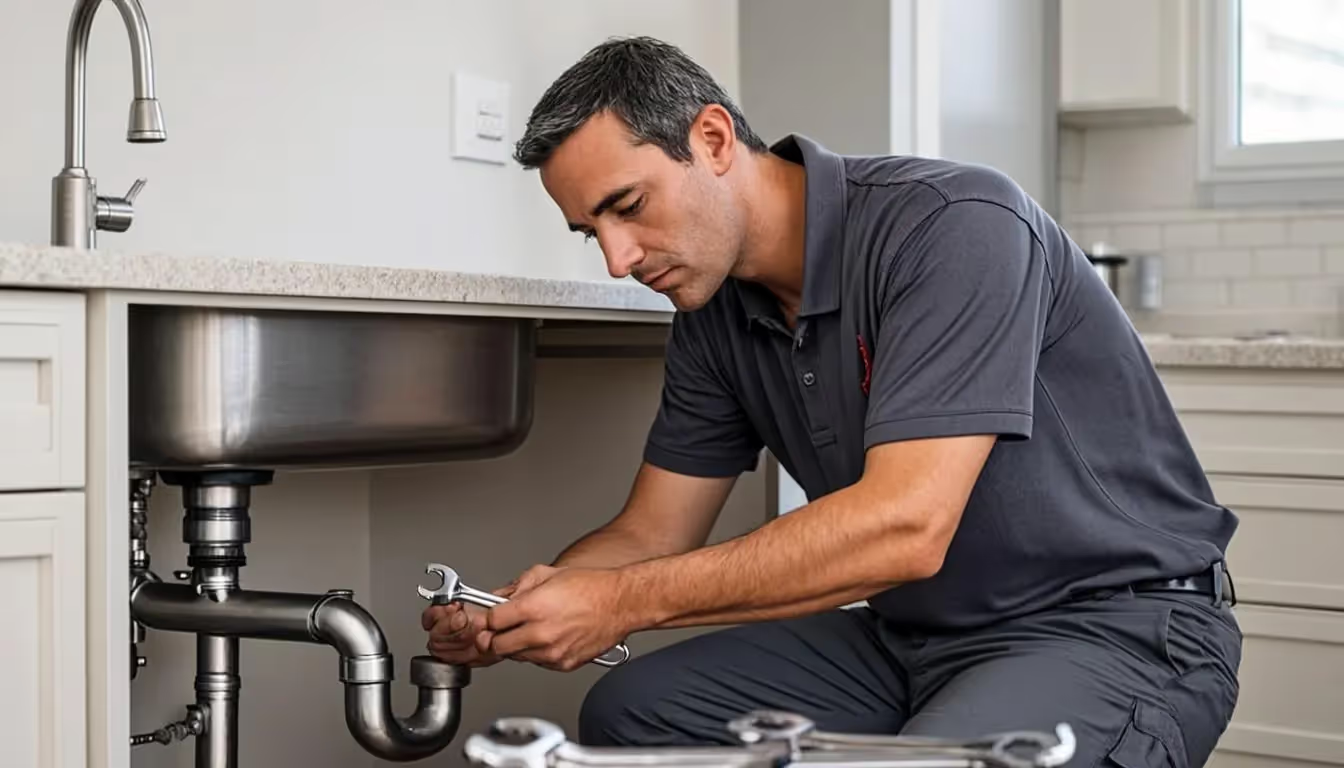
A kit lives or dies by its geography. The blockage tools belong under the bathroom sink or in the nearest closet to the bathrooms they serve, because the moments they answer arrive fast and wet. The wrenching and precision kits belong in one container, labeled, with the tape and the spare parts that accumulate around real repairs: a flapper, a fill valve cap, an assortment of O-rings for the fixtures actually installed in the house.
The water-side tools live near the water heater or the main shutoff, at the point of the house where the big events begin, and the meter key hangs where it can be grabbed with wet hands. The geography rule is simple: every tool should be closer than the disaster is loud.
And taped inside the same cabinet door, the shutoff map: the main, the water heater valve, every fixture stop, the curb stop, drawn or written in the handwriting of the person who verified each one turns. That page is the most valuable thing in the kit, it costs nothing, and our technicians update one for free on every service visit, because a house with a map is a house where every other tool works better.
Practice Before the Emergency
Tools are habits, and habits rehearse badly at midnight. The household that takes one Saturday per year to walk the kit performs a specific, short sequence that turns every tool from a stranger into a colleague.
The sequence: shut the main valve and confirm it actually turns, then restore it; close and open each fixture stop; pull every stopper and clean the crossbars with the hook tool; plunge the toilet once as a rehearsal of the technique; disassemble one aerator, descale it in vinegar, and re-seat it with the adjustable wrench and a cloth; and vacuum the toilet tank down and check the flapper seating. One hour, one afternoon at most, and every job in the homeowner column of the jobs table has now been performed once in daylight.
The companion habit is knowing when to close the drawer. The $89 diagnostic exists to be cheaper than the second hour of a losing afternoon, and it is credited to any repair booked from it, which makes the early call a rounding error against the cost of the late one. Our Vancouver crews and the teams across the region treat a homeowner who says I tried this and here is where it stopped as a collaborator, not a cautionary tale, and the hiring guide covers how to vet us or anyone else you bring to the jobs past the drawer.
City Notes Across Metro Vancouver
The toolkit is universal, but the houses it serves have regional habits, and our crews see the city patterns behind the calls.
Vancouver
Character homes with original galvanized era valves: the shutoff map walk matters most here, and frozen valves get replaced before they are needed.
Surrey
Family homes and poly-B era utility rooms: hex and cartridge work dominates, and the meter key gets real use on larger lots.
Burnaby
Post-war bungalows and basement suites: two households, one toolkit per suite, plungers within reach of every bathroom.
Coquitlam
Split-levels with long branch drains: the hook tool and cup plunger rhythm pays off between professional cleanings.
Richmond
Slab townhouses and condos: no basements to drain toward, so the wet-dry vacuum earns double duty during valve work.
Langley
Well and long-run homes in the rural pockets: the meter key is for the curb, the pressure tank gets its own map entry.
The Toolkit Cheat Sheet
The whole guide in one dark table: what to buy, what it unlocks, and where the drawer closes. Tape this inside the cabinet door next to the shutoff map.
| The situation | The honest move |
|---|---|
| Building the kit from nothing | Buy 1 through 3 this week, 4 through 9 in one hardware trip, 10 through 12 before the next wet season |
| Toilet blocked, water rising | Flange plunger, technique over force, and know where the tank stop is if the flange fails |
| Sink or tub slowing down | Hook tool monthly, cup plunger with the overflow sealed when needed, never chemicals |
| Faucet dripping, fixture is common brand | Hex keys and cartridge, water isolated, parts photographed before the store trip |
| Under-sink drip, trap or supply | Bucket, wet-dry vacuum, snug-not-heroic reassembly, tape on the threads |
| Job needs a wall opened, a main shut, or a diagnosis | Drawer closed: $89 diagnostic credited, leak repairs $180 to $420, drains $149 to $389 |
| Any tool whose job description includes the word force | Re-read the technique: in household plumbing, force is a symptom of the wrong approach |
| One free Saturday per year | The practice sequence, main valve to aerator: an hour that makes every other row of this table calmer |
Twelve tools, one map, one practised Saturday. That is the entire homeowner side of the partnership, and it is enough.
Frequently Asked Questions
Services From This Guide
Leak repair from $180 to $420, drain cleaning from $149 to $389 and full service plumbing by one Red Seal team across 17 Metro Vancouver cities, flat-rate and written.
Full service plumbing
Repairs from $180 to $420, drain cleaning from $149 to $389 and installs by Red Seal crews, flat-rate and written.
24/7 emergency response
For the jobs past the toolkit at the worst hour: the $150 flat after-hours premium posted in advance.
Crews across 20 cities
From Vancouver character homes to Langley acreage, one licensed team for the whole region.
Financing and payment options
Plans from 7.99 percent with approved credit when a repair grows into a replacement project.
Related Guides
How to Choose a Plumber in Surrey
The vetting checklist for the day the drawer closes and a professional enters the house.
MaintenanceDrain Cleaning Before Winter
The drain-side boundary of the toolkit: when cleaning becomes a professional rhythm.
PlumbingDetect Hidden Water Leaks
The meter test and stain forensics for the moisture the toolkit cannot see.

Red Seal certified, licensed gas fitters (BC-PL-2019-4421), $2M insured and 15-plus years in the field, with more than 12,000 jobs completed across Metro Vancouver since 2010 and a 5.0-star rating across 26 Google reviews. We wrote this guide because we arrive at emergencies that a ten-dollar strainer or a properly used flange plunger would have prevented, and the best tool investment in any house is the one that never calls us. To book instead of DIY, see plumber in Langley — same-day across the city.
More about our team →For the Jobs Past the Toolkit
Book a $89 diagnostic, credited to any repair, when a job is beyond the toolkit or beyond your comfort. You get flat written pricing before work begins, honest advice on the jobs that genuinely suit a homeowner, and no judgment about the ones you tried first. Zero obligation, same-day quotes on most calls. If you would rather hand this to a pro, our plumbing services pages cover Metro Vancouver.
Water where it should not be?
Active leaks and burst connections are answered 24/7 with the $150 flat after-hours premium posted in advance. Isolate the fixture, shut its valve, and call: leak repairs run $180 to $420 once the source is found.
Call 604-615-2212 WhatsApp Us