
HYDRONIC HEATING 101
Thousands of Metro Vancouver homes heat with hot water radiators, from the cast-iron column radiators in Kitsilano craftsman houses to the compact convectors under windows in 1950s North Vancouver and West Vancouver builds. The system is elegantly simple: a boiler heats water, a pump circulates it through loops of pipe, and each radiator releases heat into its room. The valves are where that simplicity gets its intelligence, and where most radiator problems actually live.
Homeowners tend to discover valves the hard way. The bedroom that is always ten degrees hotter than the living room. The radiator that is scalding at the bottom and cold at the top. The stuck valve that will not turn no matter how much force is applied. The boiler that short-cycles because every radiator is wide open and water races through the system without giving up heat. All of these are valve problems, and all of them are fixable for a fraction of what people assume a boiler problem costs.
This guide walks through every valve type you will meet on a BC hydronic system: manual wheelheads, thermostatic radiator valves, lockshields, bleed valves, zone valves and the newer smart radiator valves, what each does, how to operate them correctly, what they cost to replace, and when valve work is the smarter investment versus a full boiler replacement. Our boiler crews service radiators across Vancouver, New Westminster, Burnaby and Surrey year-round, and the $89 diagnostic is credited toward any work you approve.
WHY VALVES MATTER
Why the Little Valve on Your Radiator Matters So Much
A boiler does not know how warm each room is. It knows its own water temperature and, if it has outdoor reset, the weather outside. Everything room-specific about hydronic comfort comes from the valves: they apportion the boiler's output among the rooms, they stop heating rooms that are already warm, and they protect the boiler itself from the flow problems that come with every radiator demanding water at once.
The energy argument is the one that surprises people. Without any valve control, every radiator runs flat out whenever the boiler runs, which means a bedroom nobody occupies is held at 22 degrees all winter alongside the living room. Independent field studies on thermostatic radiator valves put zone-control savings in the range of 5 to 15 percent of heating energy, depending on how thermally lopsided the house is. On a heritage Vancouver home with a winter gas bill north of $150 a month, valves pay for themselves inside two or three heating seasons.
Comfort is the other half of the story. Old hydronic systems, especially the one-pipe monoflo loops common in mid-century Vancouver Specials and post-war Burnaby subdivisions, favour whichever radiator is closest to the pump. Water takes the path of least resistance, so the dining room near the boiler bakes while the far bedroom shivers, and homeowners wrongly blame the boiler. Balancing the valves, an afternoon job, frequently fixes "uneven heating" complaints that households have lived with for a decade.
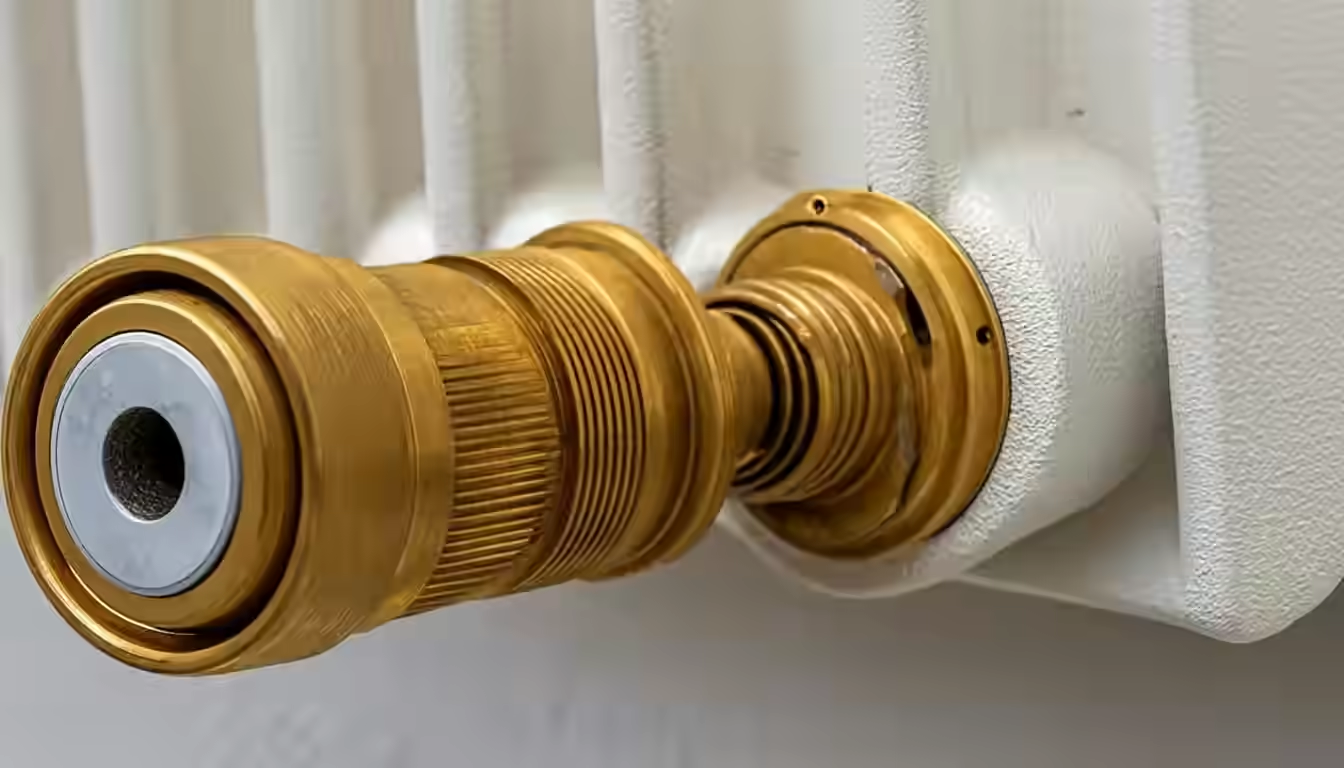
A quick vocabulary note before the sections on each type, because the words trip people up. On each hot-water radiator there are normally two pipe connections: the flow side, where hot water enters, and the return side, where cooled water leaves. The valve you can turn, whether manual or thermostatic, sits on the flow side. The covered valve on the return side is the lockshield. The little square or slotted fitting at the top corner is the bleed valve, which has nothing to do with water flow; it releases trapped air. Different jobs, different valves, and knowing which is which is half of radiator literacy.
TYPE ONE
Manual Wheelhead Valves: The Simple On-Off Lever
The manual valve is the oldest and simplest type: a handwheel or lever that opens and closes a disc inside the valve body. Turn it clockwise and the radiator receives less hot water; counter-clockwise, more. It is binary-ish by nature, sturdy, cheap to replace at $120 to $250 installed, and found on a large share of the region's older installations because it was what plumbers installed from the 1930s through the 1980s.
The limitation is that a manual valve has no idea what temperature the room is. You set it once, winter arrives, the sun comes out, guests arrive, the season turns, and the setting that was right in November is wrong in February. Most homeowners respond by treating manual valves as on-off switches, which is exactly how rooms end up 26 degrees with the windows cracked in January.
Correct use of a manual valve is still worth knowing. In rooms you want warm, open it fully; a half-closed manual valve does not make the room "half warm", it makes the radiator weaker and the room slower to heat. In rooms you want cooler, close it fully or nearly. If you are leaving the house unoccupied in winter, never close every radiator: the system needs somewhere to send heat, and a fully closed system with a running boiler is how you create pressure and noise problems. Leave at least one radiator partly open.
The failure mode of manual valves is mechanical: the internal packing dries out and the valve weeps at the stem, or the disc corrodes and seizes, and a valve that has sat in one position for twenty years does not appreciate being asked to move. If a wheelhead will not turn by hand, stop. Forcing it with a wrench cracks the pipe fitting or the radiator bushing, and a weeping valve on a full system becomes a small flood. A seized valve is a one-hour professional replacement, not a wrench exercise.
TYPE TWO
Thermostatic Radiator Valves (TRVs): How They Actually Work
A thermostatic radiator valve is a self-operating room thermostat for one radiator. The head contains a temperature sensor filled with wax or liquid that expands as the room warms and pushes a pin that progressively closes the valve. When the room cools, the sensor contracts and the valve reopens. No batteries, no wiring, no app: it is entirely mechanical feedback, and it works with a quiet reliability that has kept the design essentially unchanged for fifty years.
The numbered dial, 1 through 5 plus a snowflake or star setting, is a temperature scale, not a speed setting. Each number corresponds roughly to a room temperature, and the mapping is consistent across brands:
| TRV setting | Approximate room temperature | Typical BC use |
|---|---|---|
| ∗ (snowflake/star) | About 7°C | Frost protection for vacant rooms and holidays |
| 1 | 10-12°C | Storage rooms, unused basement rooms |
| 2 | 14-16°C | Bedrooms used with the window cracked |
| 3 | About 20°C | Living rooms, kitchens, most daily rooms |
| 4 | About 24°C | Bathrooms, homes with elderly residents |
| 5 | 26-28°C | Fast recovery only; never a permanent setting |
Three placement rules decide whether TRVs deliver their promise. First, do not cover them: long curtains that swallow the radiator, furniture pushed against the valve and radiator covers all insulate the sensor from the room, so it reads a pocket of warm air and closes the valve while the room is still cold. Second, never install a TRV in the same room as the main boiler thermostat: the two controls fight, with the TRV closing first and the room thermostat keeping the boiler firing into a system with nowhere to send heat. That room's radiator keeps a simple manual valve. Third, remember that a TRV controls the radiator, not the room's heat loss: in a drafty New Westminster bedroom with single-pane windows, a TRV at setting 3 holds the valve open a long time to chase 20 degrees, and the correct fix is the window, not the valve.
Cost to add TRVs in Metro Vancouver: $150 to $350 per valve installed, depending on whether the valve body under the new head needs replacing at the same time, which is common on systems over twenty years old. A quality TRV body and head from a mainstream brand is $60 to $140 in parts; the rest is the hour of draining, swapping and refilling the loop correctly, which matters, because an improperly refilled hydronic loop introduces the air problems covered later in this guide.
TYPE THREE
Lockshield Valves and the Art of System Balancing
The lockshield valve is the covered valve on the radiator's return side. It ships with a plastic cap over a set screw, and the cap is not meant to be turned by residents: the lockshield is the installer's tuning valve, set once during balancing and then left alone. When we find a home where every lockshield is wide open, and it is common, we are looking at a system that was never balanced at all.
Balancing is the process of restricting each radiator's return so that every radiator in the house receives its fair share of flow. The pump pushes water through the path of least resistance first; without balancing, that is the radiator nearest the boiler, which heats beautifully while the far rooms wait. The procedure is methodical: open all TRVs and wheelheads fully, start with the radiator furthest from the boiler with its lockshield fully open, then progressively close each nearer radiator's lockshield until the temperature drop between flow and return pipes is similar, roughly 11 to 20 degrees Celsius, at each radiator.
The symptoms of an unbalanced system are the ones that get misdiagnosed as boiler problems: the dining room roasts while the back bedroom never warms, the boiler short-cycles because water returns too hot and tells the boiler its work is done, and certain radiators only heat when others are closed. A professional balancing visit runs $150 to $300 and is, dollar for dollar, one of the highest-value jobs available on an older hydronic home. Our crews balance radiators in heritage Vancouver and New Westminster houses weekly, and the usual customer response is some version of "this room has never been warm in the thirty years we have lived here."
Lockshield replacement, when the valve itself weeps or seizes, runs $120 to $280 installed, slightly less visible work than a TRV because it usually means opening the floor or wall side panel access. A practical homeowner tip: when a service tech balances your system, ask them to mark or photograph the final lockshield positions. If someone opens them all during a later renovation, the record restores the balance in minutes instead of another visit.
TYPE FOUR
Bleed Valves: Solving the Cold-Top Radiator
Every hydronic radiator has a small bleed valve at its top corner, and its job is to let out air. Air collects at the high points of a water system over time, and a radiator with an air pocket heats at the bottom while staying cold at the top, because water is not reaching the upper section. If you own a radiator that is hot on the lower half and cool up top, you do not have a boiler problem. You have a two-minute bleed job.
The procedure: with the heating off so the pump is not pushing, hold a rag or small container under the valve, insert a bleed key, which costs about $5 at any hardware store, and turn counter-clockwise a quarter turn. You will hear hissing as air escapes, then a spurt of water, at which point close it snug, not gorilla-tight. On a two-storey home, start with the highest radiators, since air migrates upward. On a sealed system, check the pressure gauge afterwards; bleeding lowers pressure, and the fill valve may need topping back to around 1 to 1.5 bar when cold.
When bleeding graduates from maintenance to symptom: a radiator that needs bleeding every month is telling you the system is admitting air continuously. The usual suspects are a slow leak at a fitting or under a floor, an expansion tank that has lost its air charge and cannot absorb pressure changes, or a failing automatic feed valve. A $89 diagnostic visit, credited toward repair, identifies which, because ignoring it means recurring cold radiators, ongoing corrosion inside the radiators from oxygenated water, and eventually pinhole leaks at exactly the worst time of year.
One regional note for owners of very old buildings: some pre-1930 heritage buildings in Vancouver and New Westminster still run true steam systems rather than hot water. Steam radiators have air vents that look different and operate differently, and they do not take TRVs without specialized hardware. If your radiators hiss and clank like a documentary about old New York, ask your service tech to confirm which system you have before buying any valves.
TYPE FIVE
Smart Radiator Valves and Zone Control
The newest category replaces or augments the TRV head with a battery-powered motorized actuator that a phone app or schedule controls. A smart radiator valve can hold different temperatures by hour and day, warm the home office at 8 AM and let it drift at 6 PM, hold bedrooms at 17 overnight and 20 in the morning, and frost-protect the whole house from a departure-lounge gate. Installed cost runs $180 to $350 per radiator including the valve hardware, which typically sells for $70 to $160.
The honest value proposition: smart valves do not save energy a plain TRV at the right setting would not also save, they save the energy a plain TRV at the wrong setting wastes, which, for human beings, is most of it. Schedules adapt the house to your actual week instead of your best intentions. Multi-zone smart setups also generate usage data that makes it obvious when one room's heating demand jumps, which is often the first visible sign of a failing window seal or missing insulation.
Compatibility has two checkpoints in older BC homes. On standard two-pipe radiator systems, smart valves fit the way TRVs do, onto the existing valve body or with a new body. On one-pipe monoflo systems, the mid-century loops common in Vancouver Specials and post-war subdivisions, a closed valve can stop the whole loop's circulation, so installation needs a bypass fitting that keeps water moving; this is routine for our crews but is exactly the detail a DIY weekend discovers at 11 PM in January. The second checkpoint is the boiler interaction question again: keep at least one radiator, in the thermostat's room or a hallway, on plain manual control, and if you are coordinating smart valves with a smart thermostat, choose equipment ecosystems that actually talk to each other. The smart thermostat and controls guide covers the ecosystem choices and any rebate angles that apply.
The larger cousin of the smart radiator valve is the motorized zone valve: a wired valve on a piping loop or manifold, controlled by a wall thermostat, that heats whole zones, typically floors or wings, rather than single radiators. Zone valves are standard on modern in-floor hydronic installations and retrofittable where loops are accessible, with installed costs of $250 to $600 per zone depending on access and control wiring. Between TRVs for rooms and zone valves for floors, a house gains real room-by-room command of its heating.
2026 PRICING
Radiator Valve Problems and Repair Costs in BC (2026 Prices)
Here is the working menu for valve problems on hydronic systems across Metro Vancouver, with the ranges we were quoting at publication. Every job starts with the $89 diagnostic, credited toward the repair you approve, and gas-side boiler work is done under our BC license with Technical Safety BC permits where required.
| Valve job | 2026 cost (CAD) | Typical symptom it fixes |
|---|---|---|
| Manual valve replacement | $120-$250 | Seized or weeping wheelhead |
| Lockshield replacement | $120-$280 | Return-side leak or corroded body |
| TRV installed (body and head) | $150-$350 | Room overheats, no zone control |
| TRV head swap only | $90-$180 | Failed sensor on a healthy body |
| Smart radiator valve installed | $180-$350 per radiator | Rooms needed on schedules, not memory |
| System balancing visit | $150-$300 | Near rooms hot, far rooms cold |
| Motorized zone valve installed | $250-$600 per zone | Floor or wing needs independent control |
| Annual boiler and radiator tune-up | $129-$189 | Bleeding, pressures, combustion check |
For context on the jobs that sit beyond valves: typical boiler repairs across the region run $180 to $650, and the boiler repair cost guide for Surrey breaks down the common failures, from circulator pumps to aquastats, with real part prices. A full boiler replacement runs $6,000 to $12,000 installed, which is the number that makes valve work worth taking seriously first.
INVEST OR REPLACE?
When to Upgrade Valves Instead of the Whole System
The decision framework is simpler than most homeowners expect. Valves are the right investment when the boiler itself is sound: it fires reliably, holds pressure, was serviced in the last few years, and heats the water to temperature. In that case, uneven rooms, hot bedrooms, cold offices and high bills are almost always distribution problems, and valves plus balancing fix distribution for hundreds, not thousands.
The system is telling you to think bigger when the boiler is over 20 years old, when parts are becoming hard to source, when it has needed two or more repairs in a season, or when your gas bill has crept up year over year with no change in habits. At that point, valve work still matters, but as part of a planned replacement rather than a standalone fix: there is no sense paying to balance a system around a boiler with two winters left, and every modern high-efficiency boiler expects the flow discipline that TRVs and balancing provide to reach its rated efficiency.
BC's incentive landscape tilts the math further toward high-efficiency equipment when the time comes. FortisBC offers rebates on qualifying high-efficiency boilers and on switching from older systems, and the FortisBC furnace and boiler rebates guide covers current program rules and amounts, with the CleanBC rebates guide covering the provincial layer, including the incentives available on heat pump conversions for homes weighing a bigger pivot. For the classic BC debate of keeping hydronic versus going forced air, our boiler vs furnace comparison for Vancouver lays out comfort, cost and longevity honestly.
If you take one action from this guide, make it this: before next heating season, walk the house and note which radiators are which, hot spots, cold spots, seized valves, covered TRVs, and bring that list to a $89 diagnostic or a $129 to $189 tune-up. Half the radiator complaints in this region resolve in that first visit, and the ones that do not leave you with a precise, priced plan instead of a winter of guesswork. Our boiler services team covers Vancouver to Surrey and the whole Lower Mainland, with 24/7 emergency response when a valve lets go at the worst moment.

FAQ
Radiator Valves in BC: FAQ
A TRV senses room temperature at the radiator and throttles hot water flow to hold a set level, typically 1 through 5, where 3 corresponds to roughly 20 degrees Celsius. It controls one radiator rather than the whole system, so you can keep a bedroom cool and a living room warm without touching the boiler. Installed cost is $150 to $350 per valve in Metro Vancouver.
A manual valve replacement runs $120 to $250 installed; a quality TRV runs $150 to $350; smart TRVs with app control run $180 to $350 per radiator. Most homes do the three or four rooms that matter most for $600 to $1,200 total. Our $89 diagnostic is credited toward the work you approve.
Trapped air is blocking hot water from filling the top of the panel. Bleed it with a $5 key at the top-corner valve, heating off, with a rag and small container ready, and close it when water runs steady. If the radiator needs bleeding monthly, the system is admitting air through a leaky fitting, a spent expansion tank or a failing feed valve, which is worth a diagnostic visit.
The TRV or wheelhead sits on the flow side and is the one you adjust; the lockshield sits on the return side, has a set screw under a plastic cap, and exists to balance the system so every radiator receives its share of flow. Opening all lockshields fully destroys balance and creates cold rooms at the far end of the loop.
Most two-pipe hot-water systems accept them directly, but one-pipe monoflo loops, common in older Vancouver and New Westminster homes, usually need a bypass fitting so circulation continues when the valve closes. Avoid smart valves in the room containing the main thermostat, or the two controls will fight each other all winter.
Yes. Zone control with TRVs stops heating rooms you are not using, and independent studies put the savings around 5 to 15 percent of heating energy. With winter gas bills for a Vancouver heritage home often over $150 a month, a $600 to $1,200 valve upgrade typically pays for itself within two or three heating seasons.
Leave at least one radiator, usually in the room with the main thermostat or a hallway, on a plain manual valve so the system always has somewhere to release heat. Every other radiator benefits from a TRV. Pair them with a proper balancing visit and, if the boiler supports it, outdoor reset for the full efficiency gain.
BC HOME SERVICE
Warm Every Room, Not Just the Ones Near the Boiler
From a seized wheelhead to a full TRV and balancing upgrade, our licensed boiler technicians fix radiator problems properly across Metro Vancouver, with Technical Safety BC permits handled on every gas job. Book the $89 diagnostic today, credited toward your repair.
Call 604-615-2212