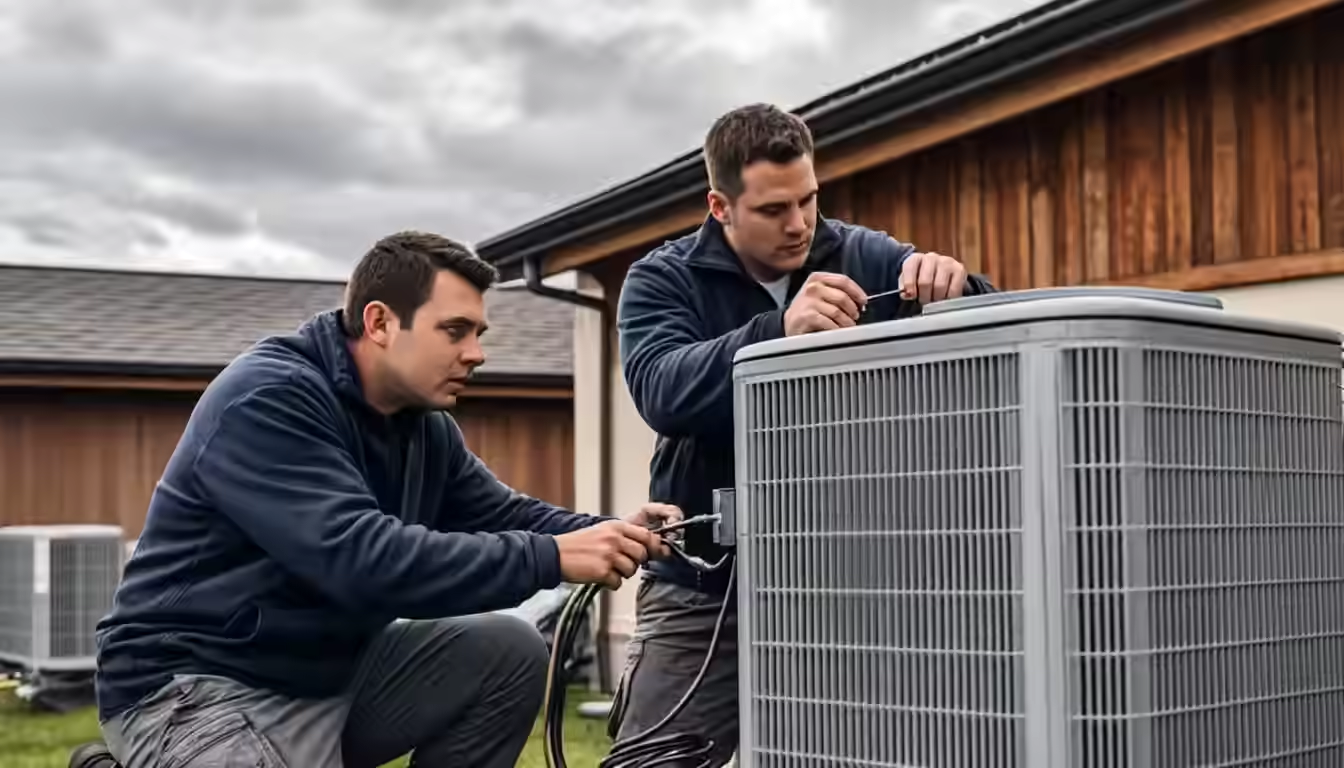
The Honest Answer Up Front
An air conditioner and a heat pump are the same outdoor box, the same indoor coil, the same refrigerant, the same compressor — minus one part. The heat pump carries a reversing valve that flips the refrigerant loop in winter, so the outdoor coil absorbs heat from the air and the indoor coil releases it into your ducts. Cooling performance, installation day and your August electricity bill are effectively identical between the two. What the valve buys you is a heating season, and in Metro Vancouver the heating season is the whole ballgame: we log roughly 2,900 heating degree days a year against barely 120 cooling degree days. About nine-tenths of the annual work a heat pump does is work an air conditioner simply cannot do at all.
On the same house, same ducts, same tonnage, the heat pump typically lands $1,500 to $3,000 above the cooling-only unit. That delta buys a compressor and refrigerant charge that must work in both directions, the reversing valve itself, defrost logic, and an indoor coil and metering device sized for heating duty. That number is the entire decision. Everything else in this guide — BC Hydro rates, the electrification push, rebates that stack to $16,000, the outflow nights that hit the valley every January — is just the math that tells you whether the valve pays for itself on your house.
Our summary after installing both across Vancouver, Surrey and the Fraser Valley since 2010: if you are buying central equipment for a house you will keep for five or more years, the heat pump wins on the numbers in most of Metro Vancouver, and it is not particularly close. The air conditioner still wins in specific situations — a young high-efficiency furnace you intend to keep, a mild microclimate like Tsawwassen or White Rock, or a budget ceiling the rebates cannot lift. We install both without embarrassment, and this guide shows you the same two roads we draw in quotes.
0 typical price delta
What the heat pump adds over the same-size AC on the same ductwork — before rebates that apply to the heat pump alone pull the math the other way.
0 heating efficiency
A heat pump moves about three units of heat per unit of electricity. Electric baseboards make one. That ratio is the whole electrification argument.
0 max stacked support
CleanBC plus municipal top-ups on qualifying heat pump installs for income-qualified households. Air conditioners qualify for exactly zero of it.
0 typical response
No-cooling and no-heat calls across Vancouver, Burnaby and Richmond; 45-60 minutes in Surrey, Coquitlam, Langley and Delta; 50-85 in the valley.
Same Hardware, Different Winter
Start with what is physically different, because the marketing copy never does. Inside every heat pump sits a four-way reversing valve; in cooling it is straight through, in heating it swaps the roles of the indoor and outdoor coils. Around that valve the manufacturer adds an accumulator to protect the compressor from liquid refrigerant returning in heating mode, a defrost board that senses ice on the outdoor coil and runs a controlled melt, and on cold-climate models a bigger outdoor coil and an economizer or vapour injection circuit that holds heating capacity when the temperature drops. An air conditioner has none of that, because it never has to run below +10.
The installation differences ripple outward. The refrigerant charge on a heat pump is calculated for heating duty, where the run times are longer and the load is heavier, so line lengths and risers get checked against manufacturer tables that an AC install can ignore. The thermostat wiring gains an O or B terminal to command the reversing valve. Condensate management matters in winter too: a heat pump makes water outdoors in heating mode and needs a drain path or a slab that sheds it away from walkways before it becomes December ice. None of this is exotic — our technicians do it daily — but it explains why the two quotes are not identical line for line.
The rating labels differ as well. Both machines carry SEER2 for cooling efficiency, and on that score a 16 SEER2 AC and a 16 SEER2 heat pump cost the same to run through a Vancouver summer. Only the heat pump carries HSPF2, the heating-season efficiency number, and that is the number that decides your February. When a contractor quotes you an AC and a heat pump at the same SEER2 as if they were interchangeable, they are half right: identical in July, wildly different in January.
The BC Climate Math: Heating Runs the Table
Metro Vancouver is a heating climate that occasionally wants cooling. Vancouver International Airport averages on the order of 2,900 heating degree days a year — the interior valleys run higher — against somewhere near 120 cooling degree days. In plain terms: our heating season runs October to April with a genuine shoulder in May, while real air conditioning weather is six to ten weeks of July and August, with a heat dome every few years to remind everyone why the phone rings. Any box that only cools is idle ninety percent of the year in this climate, which is why the electrification conversation in BC is almost never about air conditioning.
The efficiency math is where it gets decisive for electrically heated homes. Baseboards and electric furnaces make one unit of heat per unit of electricity — a coefficient of performance of 1.0, the floor of physics. A modern heat pump in our climate delivers a seasonal COP around 2.5 to 3.5, meaning the same heat for a third to a quarter of the electricity. The rough translation for a house that pays BC Hydro $240 a month for baseboard heat in January: expect something like $80 to $100 for the same warm house, before any time-of-use shifting. Our baseboard versus heat pump guide runs that math house by house, including the panel-capacity questions that come with it.
Against a gas furnace the race is closer on raw dollars some winters, and honest contractors say so. FortisBC gas at current rates can still deliver a January BTU for less than a mediocre heat pump can, though a cold-climate unit closes most of that gap and the carbon price trajectory is published law rather than speculation. The tie-breakers usually decide it: one machine instead of two to buy and maintain, the cooling you get anyway, and the carbon-pricing direction that only points one way. If those tie-breakers point at a heat pump for you, the next three chapters show what that means in dollars.
When a Cooling-Only AC Is Still the Right Call
The air conditioner is not a straw man here; there are Metro Vancouver houses where we recommend it with a straight face. The clearest case: a high-efficiency furnace under ten years old that you like, in a neighbourhood where winter gas bills are already reasonable. Pairing that furnace with a two-stage AC gives you excellent summer comfort for less capital than a heat pump, and your winter heating stays on the machine you already own and trust. Replacing a young furnace to chase a heat pump is the kind of electrification math that only works on a spreadsheet somebody else has to live with.
Microclimates matter more than most homeowners realize. Tsawwassen, White Rock, Ladner and the North Shore waterfront carry some of the lowest heating loads in the province — sea-moderated, rarely below freezing, famously windless in winter where the Fraser meets the Strait. The heat pump savings in those pockets are real but smaller, because there is simply less heating work to do at a COP advantage. Combine a mild microclimate with an existing good furnace and the honest recommendation often lands on the cooling-only install, banked at $4,500 to $8,500 central, and a clear conscience.
Two more honest cases: strata and budget. Some condo buildings and laneway arrangements make an electrical service upgrade for a full heat pump load genuinely awkward, and a small AC keeps the July problem solved without touching the panel. And for a rental suite or a house being sold inside five years, the capital that rebates cannot fully offset may honestly belong elsewhere. A tenant does not pay a premium for HSPF2. If any of these describe you, the AC is not the compromise choice — it is the correct one, and we will say so in writing.
The Rebate Math Changes Everything
Here is the part of the comparison that no other province gets to enjoy: in BC, the government has picked a side. CleanBC Better Homes and its income-qualified streams pay for heat pumps — and pay meaningfully, with combined federal, provincial and municipal support reaching up to $16,000 for qualifying households, on top of municipal top-ups that cities like Vancouver, North Vancouver, Surrey and Burnaby have run at various times. An air conditioner qualifies for exactly none of it. The programs are an electrification policy with paperwork attached, and pretending otherwise would be doing you a disservice.
Run the numbers on a typical central comparison and the rebate effect is bigger than the equipment delta. Say a central heat pump install lands around $8,000 to $9,500 on a straightforward ducted job, against $6,000 to $7,000 for the equivalent AC — call it a $2,000 gap. A mid-tier CleanBC grant of even $2,000 to $4,000 erases it; an income-qualified stack can turn it inside out and leave the heat pump thousands cheaper than the machine that does less. Our CleanBC rebates guide and the municipal top-ups guide carry the current program details, and we handle the paperwork in-house on every qualifying install we sell.
Two cautions keep this honest. First, rebate programs change their numbers, eligibility windows and required equipment lists more often than the weather does — always confirm the live program before you let it decide your budget, and be suspicious of any contractor who quotes rebates as certainties without checking your household against the criteria. Second, the cheapest rebate-eligible tier is not automatically the right equipment; a unit sized and commissioned properly for your house beats a slightly bigger cheque attached to a compromise. The rebate is a tailwind, not the destination.
Cold Snaps: What a Heat Pump Actually Does at Minus 15
The objection we hear most from homeowners who read Alberta forums: heat pumps quit when it gets cold. The modern answer is more specific. Cold-climate rated units — the Mitsubishi Hyper-Heating line, the Daikin Aurora series, and their peers — hold the majority of their rated heating capacity down to about -15, and keep producing useful heat below that, at a COP that slides from around 3 at +5 to roughly 1.7 to 2.0 at -10. Our Daikin versus Mitsubishi comparison gets into the brand-level numbers for exactly this reason.
Now overlay the BC map, because the province is not one climate. Vancouver proper, Richmond, Burnaby and the North Shore see maybe a handful of nights below -5 in a normal winter; a standard cold-climate unit runs those without breaking a metaphorical sweat. The Fraser Valley is a different animal: arctic outflow winds push Abbotsford, Chilliwack and Mission to -10 or -15 several nights most Januaries, occasionally colder, and those are the nights that decide equipment sizing and backup strategy. Valley homes are where the cold-climate tier and the auxiliary-heat question genuinely matter, and where we spend the most commissioning time.
Defrost deserves one paragraph because it frightens people who have never watched it. A heat pump in damp near-freezing Metro Vancouver air will frost its outdoor coil — that is physics, not failure — and periodically it reverses briefly to melt the frost, sending a plume of steam off the condenser while it does. Your indoor fan stops, the supplemental heat kicks on for a few minutes, and then everything resumes. If steam alarms you, read our heat pump defrost guide before you call anyone; ninety percent of "my heat pump is on fire" service calls are a healthy machine taking a shower.
Dual-Fuel Hybrids for Valley Homes
The dual-fuel system is the answer for a specific and very BC configuration: a house with a good gas furnace and a valley winter. The heat pump replaces the air conditioner and handles the shoulder seasons and mild winter days, the gas furnace takes over automatically on the coldest outflow nights, and a properly configured thermostat decides the handoff based on outdoor temperature or, with the newer controls, on the live economics of FortisBC gas versus BC Hydro electricity. You get heat pump efficiency for eighty percent of the heating hours and furnace muscle for the twenty percent that punish it.
The honest engineering caveat is the switchover point, and it is where dual-fuel installs succeed or fail. Set the changeover too warm and the furnace runs all winter and your savings evaporate; set it too cold and you discover why the manufacturer publishes a capacity table. We commission the balance point against the actual load calculation of the house, not a rule of thumb, and we revisit it once we have a winter of data — a two-visit discipline that separates a hybrid from two machines arguing in your basement. If the existing furnace is nearing replacement anyway, the furnace tier ranges from $3,900 to $11,500 stack onto the heat pump side in a single coordinated project.
Who should not bother: coastal homes that rarely see -5, where a straight cold-climate heat pump with a small electric booster element covers the design day for less capital and one less fuel bill. Who should: Mission, Chilliwack, Abbotsford and Maple Ridge houses with furnaces under fifteen years old, anyone who wants heating redundancy for outflow-week power or gas interruptions, and homeowners who like the idea of their backup heat being a whole second system rather than a strip of elements. It is a premium configuration, and for the right house it is worth every dollar of the premium.
Installed Costs, Compared Honestly
Numbers first, with the reminder that a real quote starts with a load calculation and a look at your ducts and panel, not a table. What follows are the honest Metro Vancouver ranges we work inside, including the equipment, the labour, the commissioning and the disposal of the old unit. The heat pump row is expressed as a delta over the equivalent AC because that is the true comparison on the same house.
What moves a job inside those ranges is rarely the box. Electrical work lands on the heat pump side of the ledger — a supplemental heat strip and the breaker capacity to feed it can add real money on a house with a small panel, and strata arrangements that complicate a load swap show up here too. Duct condition cuts both ways: a trunk that needs sealing or a return that needs enlarging costs the same whichever machine you hang on it, which is why we quote the distribution once and the equipment separately. If a quote you are holding shows none of that detail, it is a number looking for a reason.
One comparison discipline worth insisting on: make both quotes describe the same housework. A heat pump quote that quietly includes a new thermostat, a condensate pump and coil cleaning beside an AC quote that includes none of them is not a comparison, it is a stage set. Our practice is to write both roads on the same letterhead — same commissioning checklist, same disposal line, same warranty terms — so the only variable left on the page is the valve, which is the only variable this decision actually has.
| System | Installed range | Best fit | Notes |
|---|---|---|---|
| Central air conditioner | $4,500-$8,500 | Young furnace, mild microclimate | Cooling only; zero rebate eligibility |
| Central heat pump | AC price + $1,500-$3,000 | Most homes keeping 5+ years | Rebates can exceed the delta |
| Ductless single zone | $3,800-$6,000 | Additions, suites, hot rooms | AC or heat pump; HP versions rebate-eligible |
| Ductless multi zone | $7,500-$14,000 | Baseboard homes going ductless | 2-4 heads; rebate-eligible on HP units |
| Cold-climate heat pump | AC price + $2,000-$3,000 | Valley homes, outflow nights | Holds capacity to -15; top rebate tier |
| Dual-fuel system | HP + furnace tier | Valley homes, cold outflows | Furnace tiers $3,900-$11,500 |
Installed price ranges across Metro Vancouver, 2026 — same house, same ductwork, rebates not yet applied.
Winter Operating Costs: The Numbers
Take a representative 1,800-square-foot Burnaby single-family house, decent 1990s insulation, and run the three heating futures past it. Electric baseboard at a seasonal COP of 1.0: in a typical January, on the order of $250 to $300 in BC Hydro charges at current residential rates. A mid-efficiency ducted heat pump at a seasonal COP near 3: roughly $85 to $110 for the same warm house. A high-efficiency gas furnace: somewhere between those two depending on the gas market that month, plus the fixed service charge on the gas account for the privilege. Your house will vary — orientation, envelope, suite loads, thermostat habits — but the ratios hold remarkably steady across the region.
Summer operating costs are a non-event either way, which is worth saying out loud in a guide about air conditioning. Our cooling season is short and our summer electricity is among the cheapest grid hours in the country. A properly sized central system of either type adds perhaps $30 to $60 a month for July and August, less if you set it to 25 and let it dehumidify rather than chase 21. The BC Hydro time-of-use guide covers the shifting and pre-cooling tactics that shave even that, if you are the optimizing type.
One number people forget until the first bill: the annual furnace-versus-heat-pump maintenance question is a wash, and we price it as one. The $129 flat tune-up covers a furnace and an AC or heat pump in the same visit — combustion side if there is one, refrigerant side if there is one, blower and filters either way. Whichever box you buy, the servicing cost of this decision is a rounding error compared to the winter electricity math in the paragraph above.
Comfort Differences Nobody Tells You About
Heating with a heat pump feels different from heating with a furnace, and nobody puts this in the brochure. A furnace is a sprinter: 55-degree air in short powerful bursts that warm the room in waves. A heat pump is a walker: 32-to-40-degree air in long patient cycles that even out the temperature across the whole house. Give it two weeks and most people prefer the walking — fewer cold pockets upstairs, fewer temperature swings, less of the dry scorched-air feeling — but the first November week reliably generates a "something is wrong with my heat" call from new heat pump owners expecting furnace blast. The air is warm. It is just politely warm.
The winter you can hear is different too, in both directions. Modern inverter heat pumps are quieter at low speed than the AC they replaced, but defrost cycles add an occasional whoosh of reversing-valve action on humid near-zero nights, and on the coldest mornings the outdoor unit works audibly harder. Placement matters: three feet from a bedroom window in Deep Cove is a different experience than beside the garage in a British Properties backyard, and we plan around that on every layout. Cooling season, for the record, is acoustically identical to an AC of the same tier.
There is a filtration dividend as well. Because a heat pump runs its blower for heating all winter, the whole house passes through the filter continuously rather than in short summer bursts, which means your MERV 11 or 13 media actually earns its keep against winter dust and — increasingly, in our Junes — wildfire smoke particulate. Our wildfire smoke and indoor air quality guide covers that side of the equation; the short version is that a heating machine that filters all winter is a minor air-quality asset, not just an appliance.
Lifespan and Maintenance: Closer to a Wash Than You Think
The durability question gets argued in both directions and the honest answer is boring: in this climate, both machines live 15 to 20 years, and the environment matters more than the badge. The coastal variable is salt air — North Vancouver, West Vancouver and anything with a Strait view oxidizes outdoor cabinets faster than a Burnaby backyard, so we spec coated-coastal models and pedestal placement away from prevailing salt wind where the lot allows. The valley variable is outflow dust and leaf debris; both are solved by the same annual visit.
Maintenance is where the heat pump quietly wins a small point: it gets serviced twice a season in effect — heating behaviour in the fall visit, cooling behaviour in the spring — which means gradual failures get noticed earlier. The flat $129 tune-up covers either machine, and the $199 a year maintenance plan wraps the visits with priority seasonal booking, 10 to 15 percent off any repairs found, and stored service records that keep manufacturer warranties enforceable. Ductless owners have their own version: the annual deep clean runs $149 to $229 per head, and our mini split cleaning guide shows which parts of that are honestly DIY.
One lifespan nuance worth knowing before you choose: the heat pump accumulates compressor hours faster than an AC would in the same house, because it works all winter while the AC sleeps. Cold-climate inverter compressors are built for exactly that duty and the field data supports the 15-to-20-year expectation, but a heat pump in a heavy-heating valley house is working closer to its design life than the same unit in Tsawwassen. It does not change the recommendation; it does mean the valley is where the quality-tier money is best spent.
The Decision Framework (Two Minutes, Honestly)
Everything above compresses into two lists. Work down them with your own house in mind and you will land within one honest conversation of the right answer — and if the lists disagree with each other for your situation, that is precisely the conversation to have with a technician who installs both without a quota.
A word on how to use them honestly: do not hunt for the answer you already want. Homeowners who have fallen in love with the rebate math read past a young furnace, and homeowners loyal to their gas bill read past a baseboard-heated house that is begging for the upgrade, and both biases are more expensive than either machine. The lists are a sorting tool, not a verdict — the verdict comes from the load calculation, the panel check and the rebate eligibility screen that any competent quote includes, and it usually takes about an hour of a technician's time on site.
- Your furnace is under ten years old, high-efficiency, and heating bills are already reasonable.
- You are in Tsawwassen, White Rock, Ladner or another mild pocket with a low heating load.
- You are selling or renting the property within about five years — efficiency premiums rarely clear in that window.
- Your electrical panel or strata situation makes a full heating load swap genuinely awkward.
- The budget ceiling is firm and you do not qualify for the meaningful rebate tiers.
What We Recommend (and How We Quote)
If you want our default in one sentence: in most of Metro Vancouver, for most houses most homeowners will keep, we quote the cold-climate heat pump, because the delta is small, the rebates are real, the winter efficiency triples, and the January resilience is better than the forums claim. The exceptions in chapter four are genuine exceptions, and we write "air conditioner" on plenty of quotes a year with a clean conscience. What we never do is quote one machine when the house is asking for the other, because commissioning a mis-sized box in either direction just schedules a future service call — or a short cycling problem wearing a brand-new sticker.
Every replacement quote we write starts with a proper load calculation, shows the equipment tier and the commissioning plan in writing, prices flat before work starts, handles the CleanBC and municipal paperwork for you, and lays out financing from 7.99 percent with approved credit for the portion that remains. Our licence is BC-PL-2019-4421, our technicians are Red Seal, and we have been installing both machines across this region since 2010 — the how to choose a contractor guide is a decent checklist to hold any company to, including us.
Sizing questions, ductless-versus-central questions, or a second opinion on a quote you are holding? That conversation is free, and the number is 604-615-2212 — a real dispatcher answers, including evenings. Or use the form below: tell us the house age, the current heat, and what a July afternoon and a January morning each feel like, and we will tell you honestly which box belongs outside your wall.
Frequently Asked Questions
Services That Solve This Faster
Heat Pump Installation
Cold-climate units sized by load calculation, CleanBC and municipal paperwork handled, rebates stacking to $16,000, financing from 7.99%.
Air Conditioner Installation
Central AC from $4,500 and ductless from $3,800 — honestly recommended when a young furnace or a mild microclimate says cooling-only.
Tune-Ups for Either Machine
The $129 flat annual tune-up covers furnace and AC or heat pump in one visit; the $199/yr plan adds priority booking and 10-15% off repairs.
24/7 Emergency HVAC
No heat on an outflow night or no cooling in a heat dome: live dispatch at 604-615-2212, flat $150 after-hours premium, 30-45 minute core response.
Related Guides From Our Team
CleanBC Rebates 2026: The Full Guide — every program, eligibility tier and stacking rule for heat pump support in BC.
Baseboard Heating vs Heat Pump: The BC Math — the electrification numbers for electrically heated homes, panel capacity included.
BC Hydro Time-of-Use and Your HVAC — how TOU rates change the running-cost math for heat pumps versus everything else.
Ductless vs Central AC in Surrey — the other fork in the road — distribution type, and what it costs either way.
Heat Pump Ice in Winter: Defrost, Explained — the steam, the frost and the difference between defrost and a real fault.
Red Seal certified, licensed gas fitters (BC-PL-2019-4421), $2M insured, 15-plus years on the tools, 12,000-plus jobs across Metro Vancouver since 2010, 4.9 stars from verified reviews. We wrote this guide because Metro Vancouver homeowners deserve the numbers, the code references and the honest trade-offs before anyone touches a wrench or a wallet.
More about our team →Get the Honest Comparison for Your House
A free load calculation and a written quote on both roads — heat pump and cooling-only AC — with rebate eligibility checked before you decide, financing from 7.99% with approved credit, and Red Seal installation under licence BC-PL-2019-4421. Emergencies answered 24/7 at 604-615-2212.
Still weighing the valve?
Tell us the house age, what heats it now, and what January costs you — we will answer with numbers, not a brochure. Load calculation included on every quote, CleanBC paperwork handled in-house, and a flat-rate price you approve before anything is ordered. Emergency? The 24/7 line at 604-615-2212 is answered around the clock.
Call 604-615-2212 WhatsApp Us