The Honest Answer Up Front
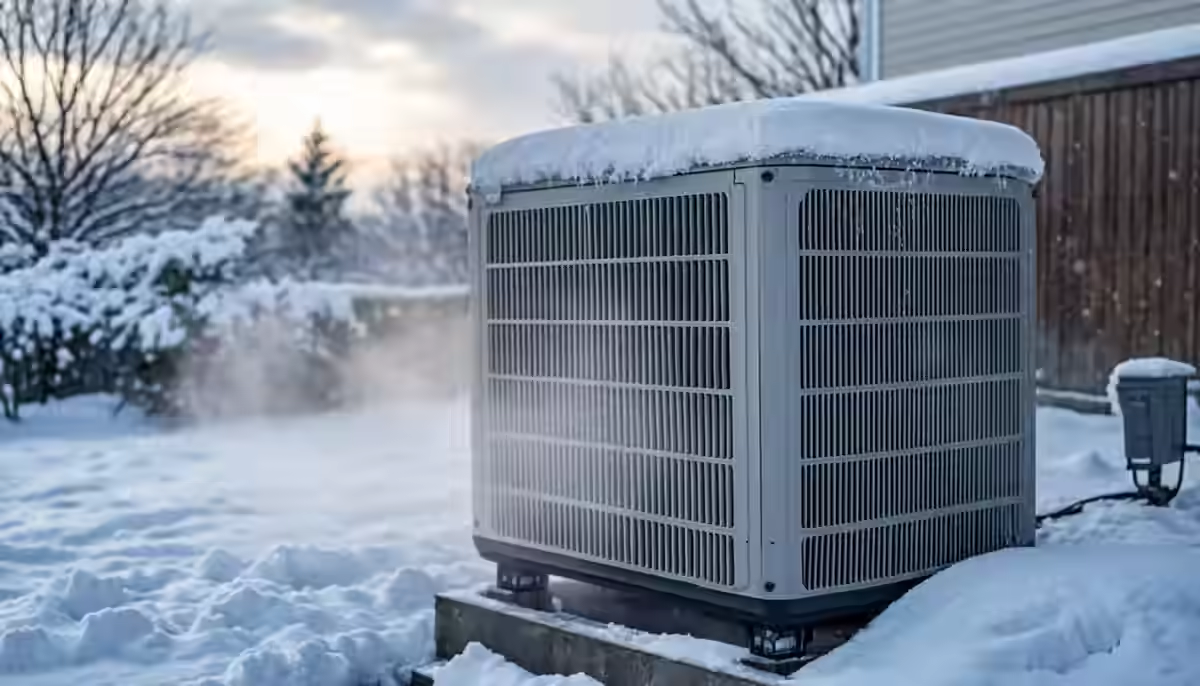
Ice on your heat pump's outdoor coil in winter is normal operation in this climate, not a malfunction. When a heat pump is heating a house, the outdoor coil works as the evaporator: refrigerant boiling inside it runs five to ten degrees colder than the outdoor air, which makes that coil the coldest object in the yard. In air that sits between roughly plus-seven and minus-five with 85-95 percent humidity — a description of a Metro Vancouver January — moisture condenses on the coil and freezes, hour after hour. A rainy Tuesday at plus-four can put a glaze on a coil running at minus-four faster than a dry Prairie week at minus-twenty ever could.
So the question is never whether there is ice. The question is whether it clears. The healthy pattern is a light, even frost that builds for half an hour to ninety minutes, then disappears: the unit pauses its outdoor fan, the compressor changes pitch, steam billows off the coil, water runs out of the base, and three to ten minutes later heating resumes with clean aluminium showing through the cabinet. The unhealthy pattern is ice that thickens cycle after cycle and never fully clears — a solid block wrapping the coil, ice bridging up into the fan guard, or one section of the coil frozen while another stays suspiciously bare.
The economics deserve the same bluntness. Watching costs nothing, and most of what you can safely do — clearing snow, checking the pad, photographing the pattern — is free. When defrost genuinely fails, the repairs typically land in the $180 to $650 band with the $89 diagnostic credited against the work, and the annual $129 tune-up exists precisely to catch the sensor, drainage and refrigerant issues that cause it. Ignored, a failed defrost turns into a BC Hydro problem first and a no-heat call second, because iced-over equipment leans on auxiliary electric heat, which is baseboard economics on a compressor's payroll. The full equipment story is on our heat pump page; this guide is the operating manual for the frost season.
0 a healthy defrost
Frost clears in roughly three to ten minutes, every 30-90 minutes in frost weather. Runs longer or closer together are a fault pattern, not a cold day.
0 typical winter humidity
Marine air on the North Shore and across the region holds the moisture that turns a cold coil into a frost factory. Wet and mild ices a coil faster than dry and bitter.
0 typical repair band
Defrost sensors, reversing valve faults and board failures mostly land here. The $89 diagnostic is credited in full against any completed repair.
0 tune-up that audits it
Defrost sensor readings, reversing valve operation, refrigerant numbers and drainage — the whole defrost chain checked in one flat fall visit.
Why a Working Heat Pump Grows Ice Here
Start with the counterintuitive physics, because it resets every instinct the internet gave you. A heat pump in heating mode does not make heat outdoors — it absorbs it. The outdoor coil contains refrigerant at a pressure and temperature deliberately kept below that of the surrounding air, so that heat flows inward from the air into the refrigerant, even when the air feels cold. Cold air still holds heat down to absolute zero; our mild coastal winter is, from the equipment's point of view, a lukewarm bath it is sipping from. But a coil running below the freezing point in damp air is also a dehumidifier and a freezer in one, and everything it condenses, it keeps.
Our region then supplies the world's best ice-making weather for this equipment. The Lower Mainland spends most of the heating season in the band between zero and seven degrees with humidity routinely near ninety percent — the exact conditions under which frost accumulation on a below-freezing surface peaks. Add the rain-then-freeze cycles that define our cold snaps: an atmospheric river soaks everything at plus-six, arctic outflow arrives the next night, and a coil that took on water freezes it into a glaze in minutes. Homeowners in North Vancouver and the valleys know the sequence by heart; their heat pumps live it.
Manufacturers are not surprised by any of this. Defrost strategy is engineered into every cold-climate unit sold here — sensors, timers, valve logic and drain paths all exist because the engineers assumed wet, mild, frost-forming winters. When we size and configure a Vancouver heat pump installation, mounting height, pad drainage and clearance are part of the design specifically so the defrost system has a fair fight. Ice is the operating condition. The engineering answers it.
- Air cold enough to freeze on contact with the coil — in practice anything below about plus-seven, because the coil sits several degrees under the outdoor temperature.
- Moisture in that air — rain, drizzle, fog or plain 90 percent marine humidity. Dry arctic air at minus-twenty actually frosts a coil more slowly than our wet plus-two.
- Runtime — the compressor has to be heating long enough for frost to accumulate between defrost cycles, which is why the pattern shows up hardest on the coldest, dampest evenings.
How the Defrost Cycle Actually Works
Defrost is a brief, deliberate reversal of the entire machine. The control board watches a sensor clipped to the outdoor coil and a clock. When the coil temperature sits below its frost threshold, the outdoor temperature is low enough to matter, and enough time has passed since the last defrost, the board initiates: the reversing valve — the component that decides whether the system heats or cools — shifts the refrigerant circuit into cooling mode. The outdoor coil stops being the evaporator and becomes the condenser, with hot discharge gas from the compressor flowing through it, and the frost that took an hour to build meets refrigerant that may be running fifty degrees warmer than the outdoor air.
Two supporting moves make the cycle work. The outdoor fan stops, because blowing sub-zero air across the coil would fight the melt; with the fan still, the coil warms quickly and evenly. Indoors, the auxiliary heat — electric strips on most of our installations, or the backup stage on dual-fuel setups — carries the house for those minutes so nobody gets a blast of cooling from the registers while the machine is busy outside. The board ends the cycle when the coil sensor reports it has reached its termination temperature, typically well above freezing, or when a safety timer caps the run at around ten minutes. Then the valve shifts back, the fan restarts, and heating resumes.
How often this happens is the number that surprises people: in sustained frost weather, a healthy heat pump may defrost every 30 to 90 minutes of compressor runtime, several times an evening, all winter. That is not a fault; it is the scheduled maintenance the machine performs on itself. The pattern to watch is the clearing: each cycle should end with bare coil visible, not with a slightly smaller glacier. The stage-by-stage sequence below is what a normal defrost looks and sounds like from the window.
| Stage | What the machine is doing | Typical duration | What you notice |
|---|---|---|---|
| Frost build | Coil runs colder than outdoor air; frost accumulates | 30-90 min of heating | White fuzz growing evenly on coil fins |
| Initiation | Board sees low coil temperature plus elapsed time | Seconds | Outdoor fan stops; compressor tone changes |
| Reversal | Valve shifts to cooling; hot gas flows to outdoor coil | Under a minute | Loud click or whoosh from the outdoor unit |
| The melt | Coil warms; frost melts and boils off as vapour | 3-10 minutes | Steam plume; water streaming from the base |
| Termination | Coil sensor reads warm enough; board ends the cycle | Seconds | Fan restarts; heating resumes indoors |
| Recovery | System returns to heating; timer resets | 1-2 minutes | Registers blow warm again; house settles |
One normal defrost cycle, stage by stage — what the machine is doing and what you notice from the window.
Steam, Stopped Fans and Whooshes: The Sounds of Health
The steam plume is the thing that generates 911 calls, so let us deal with it directly: a heat pump in defrost can look like it is on fire. Warm, wet coil surfaces meeting cold outflow air produce a thick white column that behaves exactly like smoke — it rises, it drifts, it can be impressive from across the lane. It is water vapour. If you watch the sequence — fan stops, click, steam builds, water runs, fan restarts within about ten minutes — you are watching the healthiest thing your heat pump does all winter. We have talked more than one anxious homeowner through this on the phone at seven in the morning, always happily.
The other normal noises deserve equal billing because they get misread as failures. The outdoor fan stopping is correct behaviour, not a dead motor — check that it restarts at the end of the cycle before worrying. The reversing valve announces its shift with a pronounced click or a short whoosh as pressures equalize through the refrigerant circuit. The compressor changes working tone because it genuinely is doing a different job for those minutes. And water streaming out of the bottom of the cabinet is the melt going where it should go: away.
What is not normal is a shorter list, but an important one. Grinding or scraping at any point usually means fan blades meeting ice that has bridged where it should never be — shut the system off and make the call, because a blade striking the coil can turn a drainage problem into a refrigerant one. A hissing that continues for many minutes or never ends can be a refrigerant leak rather than a defrost byproduct. And a unit that runs defrost after defrost without ever showing bare coil is telling you the melt is not winning — which is the subject of the next chapter and, honestly, of most of the service calls that start with the word ice.
The Line Between Normal and Not: Reading the Frost
Uniform light frost across the whole coil, cleared several times a day, is the baseline — leave it alone and let the machine work. The decoder is in the exceptions, and there are four that matter. Ice that survives all day without a full clear, thickening week over week, means defrost is initiating too rarely, terminating too early, or losing to accumulation faster than it can melt — the failed-defrost signature. Ice on top of the cabinet and bridging into the fan guard is usually a drainage story: meltwater or gutter drip refreezing where the defrost heat never reaches. One section of coil frozen solid while another stays bare points at refrigerant distribution — a charge or restriction problem wearing a costume. And ice that persists into a mild afternoon, with the outdoor temperature well above freezing, is never normal: at plus-six outdoors, a heat pump that cannot shed frost has a fault, full stop.
The two-day photograph test settles most arguments, including the one in your own head. Same hour, two days running, three pictures each: the whole cabinet, the coil face through the grille, and the top of the unit. A healthy system shows bare fin surface at some point each day and never lets the frost build past a light coat. A failing one shows monotonic growth and the fan guard starting to disappear. Those six photographs also make the eventual service visit dramatically more efficient — the technician arrives already knowing which family of fault the pattern suggests, which is why we ask for them when you book.
Where the ice sits is as diagnostic as how much. Coil-face frost is an operating condition; top-of-cabinet ice is a sitework problem; ice encapsulating the entire unit including the refrigerant lines and the base pan suggests long-term failed defrost compounded by refreezing drainage; ice on the insulated suction line running into the cabinet is a classic low-charge marker our technicians treat as nearly conclusive before gauges even come out. The table below is the field guide version of what we teach apprentices in their first winter on trucks across Burnaby and New Westminster service routes.
| What you see | Verdict | Likely cause | Next step |
|---|---|---|---|
| Even light frost, clears daily | Normal operation | Nothing — this is the design condition | Watch and enjoy the steam |
| Thick block, never fully clears | Failed defrost | Sensor, valve, board or refrigerant | Book the $89 credited diagnostic |
| Ice on top of cabinet and fan guard | Sitework problem | Gutter drip, refreezing meltwater, low pad | Fix drainage; service if unsure |
| One coil section iced, one bare | Refrigerant issue | Low charge or a restriction | Gauges and numbers — technician |
| Frost on the insulated suction line | Low-charge marker | Refrigerant leak probable | Leak search, then repair |
| Blades scraping, grinding noise | Stop the system | Fan meeting bridged ice | Shut off; call before damage spreads |
| Frost persists on a mild afternoon | Fault, not weather | Defrost not initiating at all | Same-day service in outflow weeks |
The frost-pattern decoder: what the ice you are looking at usually means, and what to do next.
When Defrost Fails: The Five Usual Suspects
When a defrost system stops winning, the culprit is almost always one of five components, and each has a fingerprint. The defrost sensor or thermostat — a small clip-on device strapped to the coil — is the most common failure: if it never closes at its threshold temperature, the board never sees frost worth clearing, and the ice simply grows. Corrosion at the clip, a chafed lead, or a sensor drifted out of calibration all produce the same lazy-defrost pattern, and salt-air exposure makes coastal units in Richmond, Delta and White Rock slightly overrepresented in our service data.
The reversing valve is the dramatic failure: the board commands defrost, the valve does not actually shift, and the system keeps heating with a coil that needed a melt. You hear the relay and sometimes the solenoid hum, but never the pressure-change whoosh, and the frost keeps building right through the attempt. Control boards fail more politely — a defrost relay or timer circuit that stops initiating, or initiates and cannot terminate, often alongside other oddities like erratic fan behaviour or fault codes on the board's diagnostic LED, which our error code guide explains the grammar of.
The fourth suspect is refrigerant charge, and it is the one that disguises itself best: a low charge lowers the coil temperature even further below ambient, so frost forms faster, in the wrong places, and defrosts struggle because there is not enough hot gas volume to warm the whole coil. The fifth is drainage — not a defrost component at all, but the reason defrosts lose anyway: meltwater that cannot leave refreezes at the base and builds a plinth the next cycle has to melt again. Ranked by how often our technicians actually find them: sensor first, drainage second, charge third, valve fourth, board fifth — and the honest diagnostician tests in that order rather than replacing what is easiest to sell.
- Defrost sensor: ice builds with no defrost attempts at all — no fan stops, no steam, no whoosh. Cheapest fix in the family, squarely in the $180-$650 band.
- Drainage: defrosts happen, water leaves the coil, but the base and cabinet keep icing anyway. Fix is sitework, not refrigeration.
- Low charge: fast, uneven frosting; bare sections; frost on the suction line; aux heat running long. Needs gauges, not guesses.
- Reversing valve: the command happens, the shift does not — you hear the attempt, never the whoosh, and the coil never warms.
- Control board: defrosts that never start or never end, often with other misbehaviour and a fault code on the LED for the diagnosing technician.
The Pad, the Gutters and the Drainage Question
Half the ice complaints we investigate are not refrigeration problems at all — they are sitework problems, and most were preventable on install day. The pad is the first suspect: a slab that has settled toward the house, or a unit sitting on risers in a puddle, means every defrost's meltwater pools under and inside the base pan, then refreezes on the next cold night. A heat pump can melt its coil faithfully all winter while building itself an ice pedestal from below, until the fan guard starts eating the icicles. Level matters, height above grade matters, and a pad that has heaved after a decade of frost cycles is a routine correction on our service trucks.
Look up before you look in. A gutter or downspout discharging near, over, or onto an outdoor unit is an ice machine aimed at your equipment: every rainy thaw-and-refreeze cycle glazes the cabinet top, and the glaze grows exactly where defrost heat cannot reach it. We have seen units in North Vancouver and Coquitlam wearing ice bridges from eavestrough drip lines that had nothing wrong inside the refrigeration circuit. The fixes are boring and effective — clean and re-pitch the gutter, add a downspout extension to carry water past the unit, and in tight spots, a small canopy or drip shield that sheds water outside the cabinet instead of through it.
Then keep the machine's working space clear. Thirty centimetres of clearance minimum on all sides, more on the discharge side, so defrost water and shed snow have somewhere to go; snow drifted against the cabinet insulates the coil and hides drainage exactly when both matter most. If your unit sits where the plow throws or the roof sheds, that is worth knowing before the first outflow week, not after. These details are part of the sitework conversation on every North Shore heat pump installation we run, because elevation, rainfall and freeze-thaw are the operating environment there — the equipment was engineered for it, provided the installation respects it.
Deep Cove to Chilliwack: Our Frost Geography
Metro Vancouver is not one climate, and defrost behaviour tracks the local one. The North Shore — Deep Cove, the British Properties, anything up the mountain — gets the rain-then-freeze cycle in its purest form: heavy precipitation at elevation, followed by outflow cold that turns a wet coil into a glaze before the drizzle has even stopped. Units up the hill log substantially more frost hours and more defrost cycles per heating day than the same equipment down at sea level, which is why we spec cold-climate tiers with robust defrost logic as the default for those addresses rather than an upsell.
The valley floor is the opposite problem in the same season. Abbotsford, Mission, Chilliwack and the eastern valleys sit in the arctic-outflow lane: colder, drier air that spends more hours below zero, plus the valley fogs that deposit rime — frost that forms directly from fog on any surface below freezing, including a coil that was clean at breakfast. A heat pump in Chilliwack may frost less often than one in Deep Cove but fight harder when it does, because the meltwater refreezes faster and the coil runs deeper below ambient on the genuinely cold nights. The balance point and auxiliary heat staging matter more out there, which is the honest reason valley quotes lean toward the premium cold-climate tier.
And the flat marine municipalities — Richmond, Delta, Ladner, Tsawwassen, White Rock — run the mildest winters in the region, with fewer frost hours but a steady salt-air humidity that expresses itself differently: corrosion at sensor clips and terminal strips, which shows up years later as the lazy defrost of a sensor that no longer reads honestly. Burnaby, Coquitlam and the Port Moody plateau sit between, with clear-night cold that drops coils below freezing under clear skies even when the airport reports plus-three. The equipment is the same across all these geographies; the wear pattern is local, and so is the maintenance that anticipates it — which is the practical argument for the tune-up over the panic call.
When Ice Means Refrigerant Trouble
Refrigerant is the silent variable in every ice story, so here is the physics without the jargon. The temperature of the outdoor coil is set by the pressure of the refrigerant inside it, and the charge — the amount of refrigerant in the sealed circuit — is what keeps that pressure in design territory. A system that has lost charge runs its coil even colder than it should, in the wrong distribution pattern: frost forms fast on the sections with flow and not at all on the starved sections, the whole coil never quite warms during defrost because there is not enough hot gas volume to carry heat across it, and the compressor runs longer against worse heat transfer. The visible signature is the uneven frost — part glacier, part bare aluminium — and the frost-caked suction line mentioned earlier.
Diagnosis is a numbers exercise, and it is worth insisting on numbers whenever anyone proposes to add refrigerant to a system. Our technicians put gauges on the service ports and read pressures against the pressure-temperature relationship of the actual refrigerant in the machine — R-410A on most installs of the last fifteen years, R-32 on the newer generation — then confirm subcooling and superheat to separate a charge problem from a restriction problem, and measure the defrost sensor's resistance against its temperature chart to clear the control side. That is twenty minutes of measurement that prevents the classic double error: topping up a system that was never low, or adding charge to a leak that will be low again by February.
The repair economics run honest in both directions. A leak found at a flare nut or a Schrader valve is a tighten-and-verify repair squarely inside the typical $180-$650 band; a leak in the outdoor coil itself turns the conversation toward replacement arithmetic, because coil parts on older units can exceed the value of the equipment around them. What we refuse to do is the annual top-up ritual some homeowners have been sold elsewhere — refrigerant is not a consumable, a heat pump that needs a yearly drink has a wound, and the right service finds it. The full pricing landscape, including what drives quotes up and what never should, is laid out in our heat pump service cost guide.
Defrost and Your BC Hydro Bill: The Auxiliary Heat Tax
Every defrost cycle has a price, and it shows up on the BC Hydro bill, not the gas bill. While the machine is melting its coil, the house is being heated by the auxiliary strips — resistive electric heat with the same physics as a baseboard: one kilowatt-hour in, one kilowatt-hour out, at the upper-tier rates a heat-pump household is trying to avoid. A healthy defrost spends that money in three-to-ten-minute doses and earns it back with a clean coil running at full efficiency between cycles. A sick defrost spends it relentlessly, because an iced coil transfers less heat, the runtime stretches, the aux heat stages in more often, and the cycle that was supposed to be maintenance becomes the operating mode.
Run the regional math the way we do on kitchen tables. A typical 1,500-square-foot home on a well-behaved cold-climate heat pump spends roughly $85 to $115 on a January heating month at blended rates — the same home we walk through in our baseboard-versus-heat-pump cost guide. When defrost misbehaves, that January picks up an aux-heat surcharge that commonly lands between $40 and $80 before anyone feels colder — the thermostat holds temperature; the strips just carry more of the load. Left for the season, a fully failed defrost pushes the bill toward baseboard territory, which is three times the money the compressor was hired to save.
That is the quiet argument for treating frost patterns with respect: the symptom is visual, but the damage is arithmetic. The homeowner who photographs a block of ice in early December and books the $89 diagnostic spends less than the homeowner who waits for the February statement to explain itself. And the maintenance math is starker still — the $129 annual tune-up reads the defrost sensor, confirms the charge, clears the drainage and stages the auxiliary lockouts before the season starts, which is why we book the majority of Metro Vancouver heat pump maintenance in October and November, ahead of the first outflow week, when the calendar is still on your side.
What You Can Do Yourself (and What Never to Do)
The safe homeowner list is short but genuinely valuable. Keep thirty centimetres of clearance around the cabinet clear of snow, leaves and stored items, and brush loose snow off the top of the unit gently with a broom — downward pressure is for driveways, not fan guards. Check the pad with a spirit level in autumn. Look up at the gutters after the first big storm and confirm nothing drips onto or beside the unit. Photograph the coil face at the same hour for two days to confirm it clears fully at least once daily. And watch one entire defrost from the window with a coffee: fan stops, click, steam, water, restart inside ten minutes. That is the full inspection, and it costs a Sunday morning.
The never list is where good intentions do damage. Never chip at the ice with a screwdriver, paint scraper or hammer — the aluminium fins bend at a touch, and the refrigerant lines run directly through the coil a quarter-inch below the frost you are attacking; one slip converts a defrost fault into a refrigerant leak and a coil replacement conversation. Never pour hot water over the unit: it refreezes within minutes in outflow weather and thermal-shocks components designed for gentler gradients. Never wrap the unit in a tarp, blanket or plastic sheet — it blocks the airflow the machine needs, traps moisture against the cabinet, and voids warranties faster than any fault. And do not build a solid enclosure around it; if sitework demands shelter, it must be an airflow-open design, and it deserves a professional opinion first.
Then there is the judgement layer: when watching ends and calling starts. Steam on a schedule and even frost that clears daily — watch. Ice that survives a mild afternoon, frost that grows across two days, a fan guard disappearing into the build, any scraping sound, or aux heat running constantly — call. In outflow weeks, when overnight lows head toward the teens below zero, that call should be same-day; the 24/7 emergency line at 604-615-2212 exists for exactly that week, with the after-hours premium a flat, disclosed $150 and no weather multipliers.
- Walk the unit: thirty centimetres clear on all sides, snow brushed off the top with a broom, nothing stored against the cabinet.
- Look up: gutters and downspouts shedding water away from the unit, not onto or beside it.
- Photograph the coil face at the same hour two days running: bare fins should appear at least once every day.
- Listen for one defrost from indoors: fan stop, click, steam, water, warm air back inside ten minutes.
- Glance at the BC Hydro usage graph after cold weeks: a failed defrost shows up there before it shows up as a cold house.
The Service Visit: What Gets Checked and What It Costs
When the pattern says call, the visit has a shape. The diagnostic starts at $89 and is credited in full against any completed repair. On it, the technician reads the defrost sensor against its temperature chart, commands a defrost and watches the reversing valve actually shift, puts gauges on the circuit to separate charge from restriction, inspects the drain paths and the pad, pulls the fault history from the board where the platform allows it, and hands you the numbers behind each verdict. That last item matters more than it sounds: a defrost diagnosis you can see — sensor ohms, coil temperature, pressure readings — is the difference between an informed repair and an act of faith, and we do not ask homeowners for faith.
The repair ladder from there is refreshingly ordinary. Defrost sensors, drain corrections, valve solenoids and board-level fixes sit inside the typical $180 to $650 band, with the sensor being the most common and least expensive of the family. Refrigerant work depends entirely on where the system leaks: a flare-nut or valve-core leak is a same-visit repair; a coil leak turns the page to replacement math, which our technicians present alongside the honest numbers on repair — including the fact that a fifteen-year-old unit with a leaking coil is usually past the point where repair money behaves like an investment. The $129 tune-up and the $189 deep service exist for the years when the answer is none of the above, and the $199-per-year maintenance plan wraps priority booking and ten percent off any repair it eventually finds.
And the timing layer, because this is a seasonal trade with a seasonal calendar: book the diagnostic the week the pattern turns, not the week the house goes cold. Outflow-week demand compresses same-day capacity across every honest shop in the region, while a November visit is often same-week with no premium attached. The published flat-rate price list is on the site precisely so the call happens without a price negotiation — what is quoted at the door is what was quoted at the phone, and the after-hours premium is the one flat $150, disclosed before the truck rolls, every time.
| Situation | What it usually is | Typical cost | Who does it |
|---|---|---|---|
| Even frost, clears daily, steams on schedule | Normal winter operation | $0 — keep watching | You |
| Ice on top, guard bridging, unit level | Drainage and gutter sitework | Low end of $180-$650 or DIY gutter work | You or us |
| No defrost attempts, frost builds for days | Defrost sensor most likely | $89 diagnostic, then $180-$650 | Licensed technician |
| Defrost commands but coil never warms | Reversing valve fault | Mid $180-$650 band | Licensed technician |
| Uneven frost, bare sections, iced suction line | Low charge or restriction | Diagnostic plus leak search | Licensed technician |
| Frozen solid, aux heat running, house cold | Long-failed defrost, compounding | Diagnostic now; repair-versus-replace talk | Same-day service |
The honest cost ladder for ice-season service calls, from free watching to replacement conversations.
A November-to-March Routine That Keeps It Healthy
The households with the fewest ice emergencies share a calendar, not a brand. It starts in October or November with the tune-up: sensor readings, valve operation, charge numbers, drain paths and auxiliary staging all confirmed before the first frost forms, while appointments are still same-week and the weather is still an ally. From December through February it is the five-minute monthly walk-around plus a check after each named storm — snow load, gutter discharge, clearance — and the two-day photograph test whenever a frost pattern starts looking ambitious. March ends the season with whatever the machine tells you: clean coil and normal bills file the year as a win; anything else books the visit while it is still a spring conversation instead of a November emergency.
Behind the calendar sits the same honest advice we give on every heat pump topic: respect the sitework, trust the numbers, and let the machine do the maintenance it was engineered to do. A heat pump that wears frost by day and sheds it by night is doing exactly what its designers intended for exactly this climate — the wettest, mildest, most freeze-thaw-energetic heating market in Canada. The equipment tier that earns its keep here is the cold-climate one, and the installation details that matter most are the boring ones: level pad, real clearance, drainage that leaves, gutters that miss. Our winter prep guide collects the whole-home version of that checklist, heat pump chapter included.
If this winter is the one where the pattern has already turned — the block of ice, the climbing BC Hydro graph, the aux heat that never seems to rest — then the next step is a conversation, not a commitment: the $89 credited diagnostic, the readings in your hands, the flat-rate verdict, and the repair-versus-replace math laid out honestly including the equipment options for this region and financing from 7.99 percent with approved credit if the answer is replacement. Call 604-615-2212 or use the form below — a real dispatcher answers, around the clock, and in frost season that is exactly the voice you want on the other end.
Frequently Asked Questions
Services That Solve This Faster
Heat Pump Repair and Diagnostics
The $89 credited diagnostic, metered verdicts on defrost faults, and repairs in the honest $180-$650 band across Metro Vancouver.
Heat Pump Tune-Ups
The $129 flat tune-up and the $199/year plan: defrost sensor, valve, charge and drainage audited before the frost season starts.
Heat Pump Installation
Cold-climate tiers sized for our freeze-thaw winters, level pads and real drainage, CleanBC paperwork to $16,000 handled in-house.
24/7 Emergency Heating
Frozen-solid unit in an outflow week? Live dispatch at 604-615-2212, flat $150 after-hours premium, no weather multipliers.
Related Guides From Our Team
Heat Pump Service Costs in BC: The Honest Numbers — what tune-ups, repairs and diagnostics actually cost here, and what should never move a quote.
The Complete Heat Pump Guide for Vancouver Homes — equipment tiers, cold-climate ratings and the sizing logic for this specific climate.
Baseboard Heating vs Heat Pump: The BC Math — the kWh arithmetic, the $16,000 rebate stack, and which homes should convert.
Heat Pump vs Air Conditioner: The BC Answer — same outdoor box, different winter — the $1,500-$3,000 delta and what it buys in heating season.
Winter Prep for Your Vancouver Home — the whole-home freeze-season checklist, heat pump chapter included.

Red Seal certified, licensed gas fitters (BC-PL-2019-4421), $2M insured, 15-plus years on the tools, 12,000-plus jobs across Metro Vancouver since 2010, 4.9 stars from verified reviews. We wrote this guide because Metro Vancouver homeowners deserve the numbers, the code references and the honest trade-offs before anyone touches a wrench or a wallet.
More about our team →Get a Real Answer on the Ice Before the Next Cold Snap
Book a visit with a Red Seal technician: the $89 diagnostic credited to any repair, meter readings you can see, flat-rate verdicts, and the defrost chain audited end to end. Emergencies answered 24/7 at 604-615-2212.
Heat pump wearing a coat of ice?
Defrost diagnostics across Metro Vancouver — usually same-week in frost season, same-day in outflow weeks, with the $89 diagnostic credited against any repair. The verdict arrives with gauge readings and a flat-rate price you approve before work starts. Emergency? The 24/7 line is answered around the clock, priority for maintenance-plan customers, one flat $150 after-hours premium.
Call 604-615-2212 WhatsApp Us