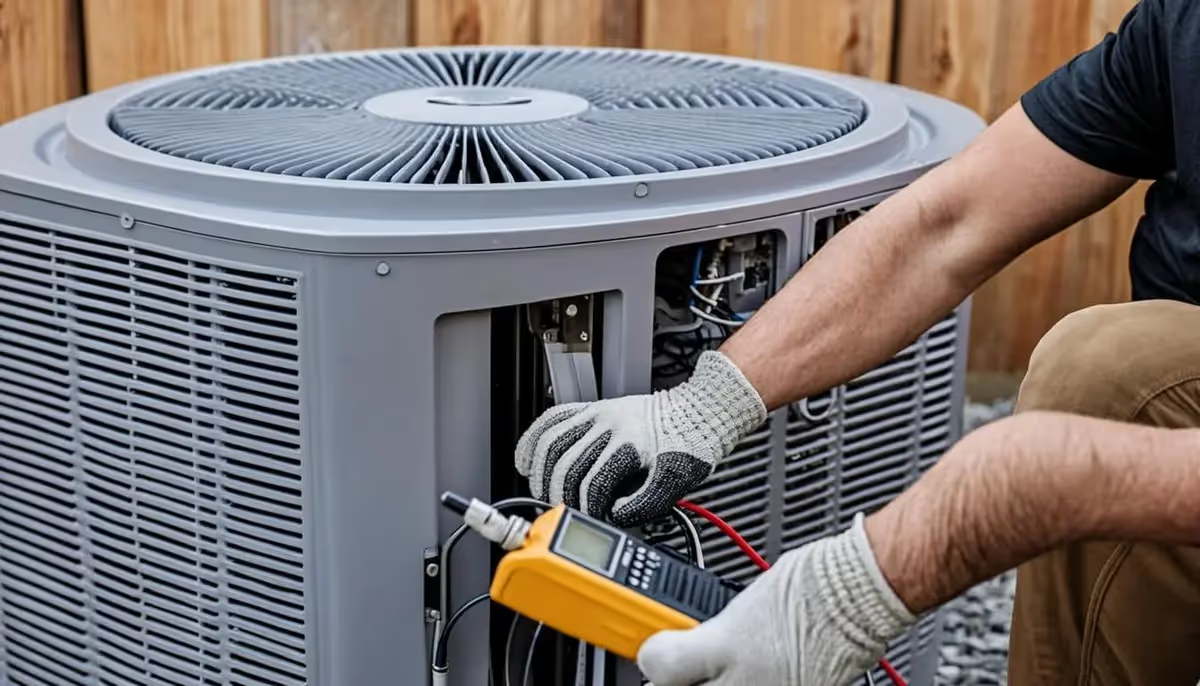
The Honest Answer Up Front
A condenser fan that isn't spinning has four usual culprits, and together they account for almost every no-fan call we take between May and September: a failed run capacitor (roughly 40 percent of them), a seized or dying fan motor (about 25 percent), a contactor or control fault (15 percent), and debris or a damaged blade stopping the wheel (10 percent). Almost all of it repairs inside our standard $180-450 band, most of it in a single visit, because the parts ride on the vans. The number that matters more than any of those percentages: if the compressor is humming and the fan is still, you are on a clock measured in minutes, and the right first move is to switch the system off at the thermostat and get a tech out.
The clock deserves repeating, because it is the difference between a Tuesday afternoon and a September replacement. The outdoor fan pulls roughly 2,000 to 3,000 cubic feet of air per minute through the condenser coil, and that airflow is the entire mechanism the system uses to reject the heat it collected from your house. No fan, no heat rejection. Head pressure climbs, and the compressor, the most expensive component in the system by a wide margin, runs hot until a high-pressure switch trips or, on units without one, until the damage is done. So: off at the thermostat, then read on. The four causes are easy to tell apart from the ground, and knowing which one you have tells you whether this is a $200 afternoon or a $4,000 September.
This guide walks the same ladder our techs climb on every call, in the same order, with honest costs attached to each rung. The short version of who is writing it: Red Seal certified, licensed gas fitters (BC-PL-2019-4421), $2M insured, 12,000+ jobs since 2010, 5.0 stars across 26 Google reviews. Every cooling repair starts with an $89 diagnostic that is credited to the repair, the full cooling menu lives on the cooling and AC page, and no-fan calls book quickly because we keep the common parts stocked.
0 are capacitors
Of the no-fan calls we log, four in ten are a $180-280 run capacitor, usually a one-visit fix.
0 to danger
Roughly how long a humming compressor with a still fan takes to trip a high-pressure switch or start cooking.
$0 to $0 repairs
The standard band, with the $89 diagnostic credited toward any repair we perform. Flat, printed, no games.
0 jobs since 2010
Across twelve Metro Vancouver cities, 5.0 stars across 26 Google reviews, one flat-rate sheet for all of them.
What the Fan Actually Does
The outdoor unit is a heat dump. Hot, high-pressure refrigerant arrives from the house as a vapour at 45 to 55 degrees Celsius, and the condenser coil is where it gives up that heat, condenses back to liquid, and heads inside to absorb more. None of that heat goes anywhere without air. The fan is a 22 to 26 inch blade on a shaft, typically turning 800 to 1,100 RPM, pulling air in through the coil sides and throwing it out the top. On a working July afternoon you can stand at the unit and feel the difference: air entering the sides ten to fifteen degrees above ambient, hot air rising out the top like a slow hair dryer. That temperature split is the system paying its bill.
Take the fan away and the physics turns on you fast. Condensing temperature rises, the pressure the compressor has to pump against rises with it, and every step up the pressure curve costs capacity and compressor life. A rough rule our trade works by: every 10 degrees of extra condensing temperature costs around 10 percent of cooling capacity and a real slice of longevity. That is why a fan fault rarely announces itself as warm air. It announces itself as a unit that runs, then trips, then sits dead in the sun, which is exactly the sequence that brings people to this page in July.
Electrically, the fan is a 240-volt motor that cannot start or run properly on its own. It leans on a run capacitor, a small oval or cylindrical can that stores charge and gives the motor winding the phase shift it needs to spin. That capacitor is the weak point by design: it is a consumable with a five to eight year life in our climate, and it is the first thing we test on any no-fan call, because testing it takes ninety seconds and it is the cheapest fix on the board. Chapter 4 is all about it, and our full AC capacitor guide covers the part in depth if you want the long version.
The Sixty-Second Triage, From the Ground
You can narrow the four causes to one or two without tools, without opening anything, and without sticking anything near a live blade. This is the same sequence our dispatchers talk homeowners through on the phone, and it takes about a minute:
Confirm the call is real
Set the thermostat a few degrees below room temperature, cooling mode, fan on auto. Indoors, is the air handler running and pushing air at the registers? If the indoor side is silent too, your ladder is a different one, and the AC not cooling guide covers it.
Look through the grille
Leaves, cottonwood fluff, a lost blade clip, a blade sitting visibly crooked in its shroud. Also look for the obvious: a service panel left loose, a disconnect hanging out, a nest that should not be there.
Listen at the unit
A hum with a still fan points at the capacitor or a seized motor. Total silence outdoors points at the contactor, a control, or the 24-volt circuit. Rapid clicking points at a relay or board trying and failing to pull in.
Spin test, power off
Only after switching off at the thermostat AND pulling the disconnect: give the blade a gentle spin. Freespinning points at the capacitor. Stiff, gritty, or seized points at the motor bearings.
Eyeball the capacitor, if you can see it safely
From outside the panel, nothing. But if a tech has the panel off or a photo exists: a bulged or domed top, or oily residue around the can, is a capacitor that has vented. Verdict reached before the meter comes out.
Where you land after the minute: hum plus freespin points at the capacitor, Chapter 4. Silence outdoors points at the contactor or controls, Chapter 5. Gritty or intermittent spin points at the motor, Chapter 6. Visible obstruction or damage is Chapter 7. Each chapter tells you what it means, what it costs, and whether it is the afternoon version or the serious version.
Cause One: The Run Capacitor, 40 Percent of No-Fan Calls
The capacitor is the part that gives the fan motor its twist. When it weakens, the motor hums, strains, and either never breaks away or labours up to speed like a truck in the wrong gear. The signature from the ground: a healthy hum from the outdoor unit, a fan that is still or crawling, and a blade that spins freely by hand with the power off. On the meter, a capacitor reading more than about six percent under its printed microfarad rating is done, and we find plenty reading half their rating on hot afternoons.
The failure pattern in this region is predictable and seasonal. Capacitors die in heat, and they die in pairs of bad luck: the first real heat wave of the season clears out the population of five-to-eight-year-old cans all at once. Our capacitor call volume in the last week of June and the first week of July routinely runs triple the rest of the year, and the July 2024 stretch was the busiest our cooling desk has ever seen. If your fan stopped during or right after a heat dome, put money on the capacitor before anything else.
The repair is the friendliest one on the board: $180-280 installed, twenty to thirty minutes, and the part rides on every van. We always replace at the printed microfarad rating, never higher, and at the same or a higher voltage rating, and on most residential units the fan shares a dual-run capacitor with the compressor, so the replacement covers both sides of the can. One honest caution from the field: let a tech do it. The charge behind that terminal strip does not care that the system is switched off, and the discharge procedure is a two-minute job in trained hands and an ambulance ride otherwise.
Cause Two: The Contactor and the Controls Behind It
The contactor is the heavy switch that lets 24 volts from the thermostat command 240 volts to the compressor and fan. When your indoor blower runs happily and the outdoor unit is dead silent, no hum, no click, nothing, the contactor and the small-control chain behind it are the prime suspects. The contacts pit and carbon up over a decade of arc-on, arc-off, until they no longer close the circuit. Sometimes they weld shut, which is the opposite failure: the outdoor unit runs and will not shut off, a fun one we also get called to.
Two BC field notes belong here. First, bugs love these panels. Boxelder bugs, spiders and ants find a warm, dry, magnetically humming enclosure to be premium real estate, and a squashed bug across the contactor coil terminals is a genuine warranty-line item in our books. Second, the 24-volt circuit is where a lot of innocent parts live: a blown control fuse, a tripped float switch on a clogged condensate line, or a thermostat wire nicked by a gardener can all present as a dead outdoor unit. A tech checks the chain in order, because replacing a contactor that was never the problem helps nobody.
Costs stay friendly here: a contactor is $180-250 installed and often gets replaced alongside the capacitor in the same visit, since the panel is already open and the parts are cheap insurance against a second truck roll. Control boards are the exception. Basic single-stage boards are inside the normal band, but inverter-driven units from the last decade can carry boards running $350 to $900, above our standard repair range. We test first, then quote those in writing, and the $89 diagnostic is credited toward whichever way you go.
Cause Three: The Fan Motor Itself
When the capacitor tests good and the blade is stiff, gritty, or rough by hand, the motor has worn out its bearings, and no amount of electrical optimism fixes mechanical wear. These motors are sealed, no oil ports, no maintenance schedule, five to ten years of quiet service and then a decline. The tell almost everyone ignores: a screech or chirp for the first minute after morning start-up, weeks or months before the final failure. The noise fades as the shaft warms and loosens, so it hides in the daytime noise floor. By the time it stops hiding, the motor is hot to the touch and cycling on its internal thermal overload: runs ten minutes, quits twenty, runs again, worse each cycle until it does not start at all.
The replacement is $350-450 installed in our flat-rate book, roughly an hour to ninety minutes, and the details matter more than the price. The new motor has to match frame size, RPM, horsepower, and rotation, because a motor spinning the wrong direction pushes air down instead of up, and the unit trips on high head pressure within minutes of starting. We check the blade while we are in there: a worn shaft often chews the hub, and putting a new motor behind a sloppy hub is a comeback waiting to happen. Blade replacement, if needed, is $180-280 with the balance checked.
If you are in the City of Vancouver reading this with a screechy morning unit, this is the window where a scheduled call beats an emergency one, and our Vancouver AC repair page books the diagnostic with the fee credited to the repair. Waiting past the screech stage does not save money. It converts a $350-450 planned repair into a same-day emergency call in a heat wave, with a flat $150 after-hours premium attached and a compressor running hot in the meantime.
Cause Four: The BC Debris Calendar
The fourth cause is the one this region writes itself. June brings cottonwood fluff, and along the Fraser from Surrey through Langley to Abbotsford it falls like warm snow, packing into condenser coils and locking blades. October brings maple leaves, which slot perfectly into fan grilles. Smoke seasons bring fine ash that coats coils in an insulating blanket. And every month brings the classic landscaping crimes: hedges planted sixty centimetres from the unit, grass clippings blown across the coil, laurel grown in until the fan cannot breathe. A fan physically stopped by debris is rare; a fan working at half duty behind a blocked coil is common, and it presents as the warm-house puzzles covered in our other cooling guides.
Blade damage is the mechanical version of this chapter. A blade that clips a loose panel or a dropped-in branch bends, and a bent blade is an unbalanced blade: it shakes, hammers the bearings, and takes the motor with it months later. Sometimes the whole event is audible from the deck as a periodic tick-tick-tick at speed. The fix is a straightened or replaced blade with the balance verified, $180-280, plus whatever the impact did to the motor, which we test with an amp draw before signing off. Critters close the list: wasp nests in the shroud and rodents caching seeds in an undisturbed winter unit are both real line items in our spring call logs.
The prevention is unglamorous and free: keep a metre of clearance around the unit, trim the hedge back, blow the clippings the other way, and hose the coil gently from the inside out once or twice a season. It is also the cheapest form of compressor insurance on the market, which is the honest reason we keep repeating it in every cooling article we publish.
Why Minutes Matter: The Compressor Clock
Here is the mechanism, because it explains every urgency in this guide. With the fan stopped, the condenser cannot shed heat, so the pressure on the high side climbs. On a typical residential R410A system, normal high-side pressure on a 28 degree day sits in the 250 to 330 psi range; units with a high-pressure switch trip somewhere north of 400, usually inside 30 to 60 minutes of the fan stopping. Units without that switch, and there are plenty, just keep pumping against a wall. Discharge temperatures climb past 100 degrees, the refrigerant oil circulating with the charge overheats and loses the film strength that protects the moving parts, and the winding insulation ages in fast-forward.
A condenser fan is a three-hundred-dollar part protecting a twenty-five-hundred-dollar compressor. When the fan stops, the clock starts, and on a hot afternoon the clock is measured in minutes, not days.
The practical translation: if the compressor is humming and the fan is still, off at the thermostat, now, and the outdoor disconnect out if you know where it is. Then call. During a heat dome, when bedrooms are heading past 28 degrees and the sun is still up, that is an emergency call, and our 24/7 emergency page dispatches around the clock with the $150 after-hours premium posted flat in advance. A same-day capacitor is a story you tell at a barbecue. A cooked compressor is a September you do not want.
What It Costs, In the Flat-Rate Book
Our pricing is flat-rate by job, not open-ended by hour, and the book looks like this for no-fan calls across the twelve cities we serve. Dispatches out of our Surrey base reach Surrey AC repair territory in under an hour and every other city in the region same-day most weeks:
| Repair | Installed price | Time on site | Honest notes |
|---|---|---|---|
| Diagnostic visit | $89, credited | 45-60 min | Fee deducted from any repair we perform |
| Run capacitor | $180-280 | 20-30 min | 40% of no-fan calls; matched microfarad, equal or higher voltage |
| Contactor | $180-250 | 20 min | Often done same visit as the capacitor |
| Fan blade | $180-280 | 30 min | Balance checked, hub wear checked |
| Condenser fan motor | $350-450 | 60-90 min | RPM, rotation and frame matched; amp draw verified |
| Inverter / control board | $350-900 | 60-120 min | Above the standard band; tested then quoted in writing |
| After-hours premium | $150 flat | — | Disclosed upfront, never multiplied or hidden |
All of it is confirmed in writing after on-site assessment, which is the phrase that keeps us honest: the tech tests, you see the finding, the quote follows the flat book. The overwhelming majority of no-fan calls resolve in one visit, because capacitors, contactors, blades and the common motor models travel on the vans for the brands we see most in this market: Carrier, Lennox, Trane, Daikin, Goodman, York and their badge-engineered cousins.
Repair or Replace: The Honest Math
The fan fault itself almost never justifies replacement. The question is what the fan fault is riding on, and the answer lives in three numbers we check on the same visit: the age of the unit, the condition of the coil, and the health of the refrigerant charge. This table is the one we walk homeowners through at the kitchen table, and it is the same math whether the call is a fan, a capacitor, or a compressor:
| Your situation | The honest call |
|---|---|
| Under 8 years, clean coil, charge healthy | Fix the fan. You are years from the serious money. |
| 10-15 years, second or third repair in four seasons | Run the numbers: a repair habit is a payment plan for a dead unit. |
| 12+ years on R22 refrigerant | Replacement conversation. New R22 stopped in 2020; reclaimed stock is priced like collector's items. |
| Quoted repair above half of replacement cost | Walk away. That money belongs in the next system, not the last one. |
| No ductwork in the house | Ductless single zones at $3,800-5,500, sized room by room, instead of duct surgery. |
| Furnace also 15+ years old | Price a heat pump conversion once, not two systems twice. Central AC installs run $3,800-6,500; heat pump paths carry the CleanBC stack. |
Financing starts at 7.99 percent OAC for qualified homeowners, so a replacement does not have to be a cheque-writing event, and every quote prices the repair and the replacement side by side so you can see the crossover yourself. The rule we actually use in the field: put big money into a system only when the rest of the system earns it. A $450 motor behind a clean coil and a tight charge is a good buy. The same $450 behind a coil held together with corrosion is charity.
Keeping the Fan Alive
Every cause in this guide has a cheap countermeasure, and they all fit inside a spring maintenance visit at $149-250. On that visit we test the capacitor under load with a microfarad meter, inspect and clean the contactor, wash the condenser coil, spin and gauge the blade and bearings by hand, verify motor amp draw against the nameplate, and clear the metre of clearance around the unit. It is thirty to forty-five minutes that deletes most of July's emergency calls before they exist, and it is the exact list in our spring AC maintenance checklist.
The homeowner half of the deal costs nothing: keep hedges and laundry-line clutter a metre back, blow grass clippings the other direction, rinse the coil gently from the inside out a couple of times a season, and treat the first screechy morning start as the alarm it is rather than a quirk. Between the heat domes getting hotter and the smoke seasons running longer, the outdoor unit is earning harder every year in this province, and the units that make it to fifteen years are almost always the ones that got one professional visit a year and a metre of breathing room.
If you are reading this with the fan already still: off at the thermostat, then call. The $89 diagnostic tells you within the hour which chapter you are in, the fee is credited to the repair, and the honest answer about whether this unit deserves the fix comes with it. That is the whole arrangement, and it has kept a 5.0-star rating across 26 Google reviews since 2010.
Get the Fan Turning Before the Compressor Pays
The $89 diagnostic sends a Red Seal tech to your yard with capacitors, contactors and fan motors on the van. You get the finding in plain language, the flat-rate quote in writing, and the diagnostic fee credited to any repair. Zero obligation, and if the honest answer is replacement instead, you will hear that too, with the numbers to back it.
Frequently Asked Questions
Services From This Guide
Red Seal cooling crews from our Surrey base cover Vancouver, Burnaby, Richmond, Surrey, Langley, Coquitlam, Delta, New Westminster, North Vancouver, Maple Ridge, Port Coquitlam and Abbotsford.
AC repair & diagnostics
Repairs $180-450 with the $89 diagnostic credited, brand-common parts on the vans.
AC repair in Vancouver
Same-day cooling repairs across the city, from Dunbar to Hastings-Sunrise.
AC repair in Surrey
Fast dispatch from our 152A Street base to Cloverdale, Fleetwood and Newton.
24/7 emergency service
Live dispatch around the clock, flat $150 after-hours premium disclosed upfront.
Related Guides
AC Not Cooling? 10 Causes and the Fixes
Fan spinning fine but the house stays warm: the other nine causes.
CoolingAC Capacitors: Signs, Costs and Lifespan
The little part behind most no-fan calls, explained properly.
CoolingSpring AC Maintenance Checklist for BC Homes
The May visit that keeps fans spinning through August.

This one comes straight from our dispatch logs. Our Red Seal crews replaced dozens of condenser fan motors and capacitors during the July 2024 heat wave alone, most of them on units whose owners heard the hum for days before calling. The vans carry capacitors, motors, contactors and blades for the major brands, so a no-fan call across the twelve cities we serve is usually a one-visit fix. To book instead of DIY, see AC repair in Surrey — same-day across the city.
More about our team →Get the Fan Turning Before the Compressor Pays
Book the $89 diagnostic and a Red Seal tech tests the capacitor, contactor and motor in order, quotes the repair in writing, and credits the diagnostic fee if you go ahead. Prefer a straight repair-vs-replace opinion? Same visit, zero obligation. If you would rather hand this to a pro, our cooling & AC services pages cover Metro Vancouver.
AC down in a heat wave?
Emergency lines are answered 24/7 with live dispatch and a flat $150 after-hours premium posted in advance, no multipliers and no surprises. In a heat dome, a silent outdoor unit is an emergency, not a next-week call.
Call 604-615-2212 WhatsApp Us