The Honest Answer Up Front
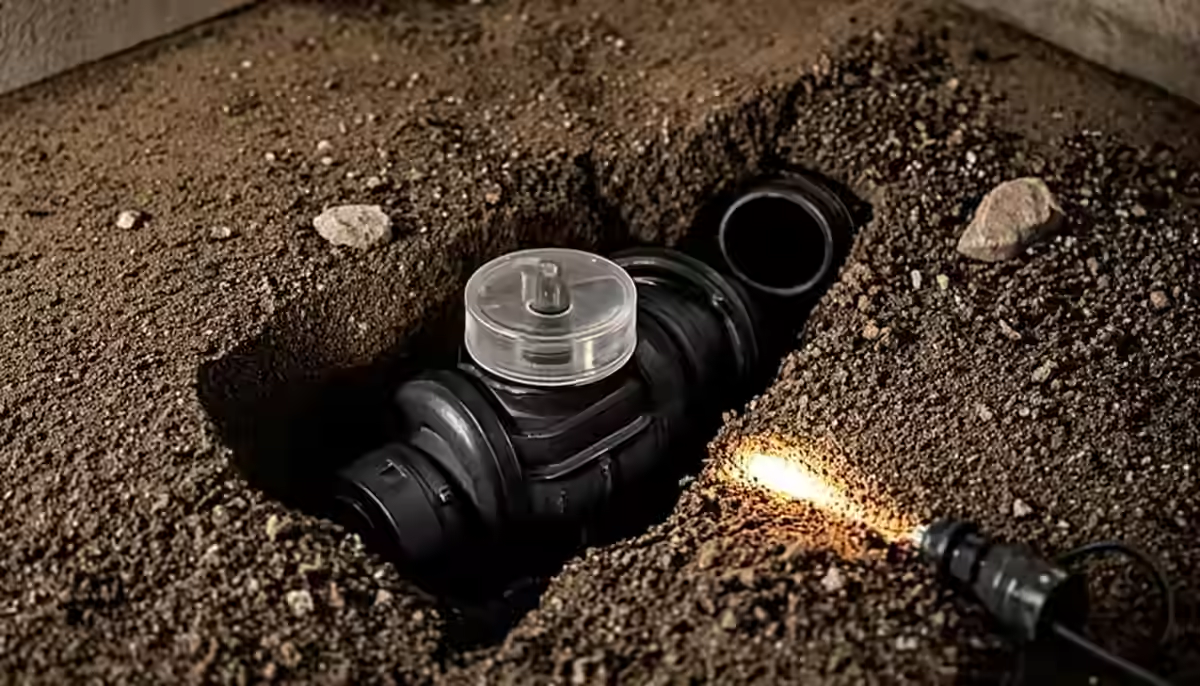
A mainline backwater valve costs $2,500 to $5,000 installed in Metro Vancouver, and it is the single most effective device you can buy against the region's most common basement disaster: the sewer surcharge, when storm-swollen city mains push sewage backward up your lateral and out your basement floor drain. The valve is a door in your main drain that slams shut the instant flow tries to reverse, and it does this with no electricity, no batteries and no attention from you, which matters in exactly the storms that cause the problem.
The public money is real but fickle. Vancouver, Surrey and New Westminster have all run rebate programs that knock a slice off the installed price, historically in the $500-to-$1,000 range, because a protected basement saves the city money too. The honest caveat: municipal programs are revised every budget cycle, amounts and caps move, and some years a program pauses. Confirm current terms with your city before you book, or ask us to check when we quote, we track them across the region as part of the job.
And the bylaw picture: the plumbing code requires backwater protection where fixtures sit below the level of the next upstream manhole, which quietly describes most basements in this region's flat neighbourhoods, and Vancouver's floodplain bylaw goes further, requiring valves and sump systems for new homes in designated flood-prone areas. For existing homes there's no retroactive order knocking on your door, but there's a strong argument for acting as if there were: November 2021's atmospheric river put a month of rain into the region in two days, and every home that stayed dry through it had a story about a door that closed. This guide covers how the door works, whether your home needs one, what the install involves, and how to keep it working for the decades it's built for.
A backwater valve is the only flood protection that works during a power outage, in the dark, with nobody home. It has exactly one moving part, and it has one job. Plumbing rarely gets this elegant.
$0-$0 installed
The honest mainline band in Metro Vancouver, permit and inspection included, access box you can actually open.
Up to $0 back
Where municipal rebate programs run, subject to each budget cycle's mood. We check current terms when we quote.
Zero watts required
The valve is fully passive. The storms that surge sewers are the storms that cut power, and it works through both.
0 of work
A typical install: cut, set, connect, inspect, restore. The planning before it matters more than the digging.
How the Door Works
In normal operation, sewage leaves your house the way it always has: down the main drain, through the valve's open port, out the lateral to the city main. The valve's heart is a float-and-flapper mechanism held open by gravity. When the street side surcharges, rising sewage lifts the float, the flapper swings shut against its seat, and the pressure of the surge itself holds the door closed. When the surge recedes, the float drops, the door opens, and your house resumes draining, all without a motor, a sensor or a human in the loop.
Design matters here, and the type we install for whole-home protection is the normally-open mainline valve: full-port opening, so the valve never restricts your everyday flow, and closed only during an actual surcharge. The alternatives you'll see online, individual fixture valves and inline check valves on single lines, have their uses in specific situations, but a check valve that sits closed all the time is a clog developing on a schedule, and fixture-by-fixture protection always misses a drain somewhere. One properly sized mainline valve, downstream of your fixtures and upstream of the lateral, protects the entire house at once, and the model gets specified per your pipe size and local code.
The mechanism also explains the maintenance story in Chapter 9: a normally-open valve sits open in flowing sewage for years between closures, and anything that can foul the seat, grease, debris, the remains of a flushed "flushable" wipe, can keep the door from sealing when the moment comes. The access box exists so that a human can look at the seat once in a while. That's the entire partnership the device asks of you: a ten-second glance each season, and an annual service if you'd rather we do the looking.
One structural note before the money chapters: the valve lives inside your house, in the main drain, usually set into the basement floor or a service trench. That placement is not negotiable, code requires it inside the building envelope, accessible, maintainable, protected from frost, and it's why the install conversation in Chapter 6 is mostly about your basement floor, not your yard. More on the full flood-protection stack, including where our plumbing crews fit valves into larger drain work, continues through the rest of this guide.
The Rebate Programs: Free Money, With Paperwork
Municipalities hate flooded basements more than you do. Every backup pumps claims, calls and contaminated water through the city's side of the system, so several Metro Vancouver municipalities have paid homeowners to install valves. The table below describes the programs as they have typically run; the numbers move with each budget cycle, so treat this as the shape of the offer, and confirm the current terms with your city, or with us at the estimate, before booking anything.
| Municipality | Typical program shape | Typical amount | Notes |
|---|---|---|---|
| Vancouver | Backwater valve rebate for single-family and duplex homes in designated areas | ~$500-$1,000 | Pre-approval often required before work starts; permit must be pulled |
| Surrey | Sewer backup prevention incentives in targeted basins and eras | ~$500-$1,000 | Program windows open and close; eligibility tied to property details |
| New Westminster | Backflow prevention device rebate program, historically for qualified installs | ~$500-$1,000 | Combined-sewer heritage neighbourhoods are the priority zones |
| Other municipalities | Most have run no program or occasional pilots | Varies, often $0 | Ask anyway; utility-run programs appear and vanish quietly |
The paperwork is the price of the money, and it's bureaucratic but simple: most programs want pre-approval before the work begins, a plumbing permit, a receipt from a licensed contractor, and proof the valve model meets code. Install first and apply second is how rebate applications die. Our quotes include the program terms for your city and the paperwork support to match, because a $1,000 rebate that fails on a technicality is a $1,000 discount we failed to deliver.
Worth naming plainly: the rebate is a nice-to-have, not the reason. The reason is the actuarial one, a single finished-basement backup routinely runs five figures in damages, contents, remediation and the kind of renovation you didn't choose, and the valve that prevents it costs a fraction of that even at full price. Rebates shift the math from obviously worth it to easy yes. They are not the load-bearing part of the argument.
The Bylaw and Code Rules, Decoded
The legal picture has three layers, and each one affects a different kind of homeowner. The first layer is the plumbing code, which requires backwater protection where a fixture sits below the level of the next upstream manhole on the street, the classic basement-in-flat-neighbourhood situation. If your basement floor drain is lower than the manhole cover down the block, the code's answer is that the drain needs a door, and this rule attaches itself to your home through permits: renovate the basement, legalize a suite, replace the main drain, and the valve requirement arrives with the paperwork.
The second layer is municipal floodplain regulation, and Vancouver's is the regional flagship: under the floodplain bylaw, new single-family and two-family construction in designated flood-prone areas requires flood protection measures that include backwater valves and sump systems, a direct lesson from the 2021 atmospheric river era and the decades of engineering sense before it. Richmond and Delta, living behind dykes at sea level, run their own drainage and flood construction rules that show up in the same place: the permit counter. If you're building or substantially renovating in a floodplain-designated area anywhere in the region, assume the valve conversation is coming, and budget it early.
The third layer is insurance, which is not law but behaves like it: sewer backup coverage is typically a rider, not a default, insurers ask protection questions when writing or renewing it, and a documented, professionally installed, maintained valve is the answer they like hearing. Some carriers price the rider down for protected homes; others make it a condition. Either way, the valve certificate and the service records belong in the same folder as your policy.
What no layer does, currently, is force a retrofit on an existing home that isn't touching a permit. The region protects itself one renovation at a time. The homeowners who read that sentence as "so I'll wait" are the ones our emergency crews meet in November; the ones who read it as "I'll do it on my schedule" get the same protection years earlier for less money, which is the entire argument of this article in two clauses.
Do You Actually Need One?
Risk concentrates, and in Metro Vancouver it concentrates in four recognizable profiles. Read down the left column and be honest with yourself; the right column is the answer our estimators would give you before ever seeing your basement.
| Your situation | Honest risk read |
|---|---|
| Older Vancouver, Burnaby or New Westminster neighbourhood on combined sewers | The region's highest surcharge risk; the valve is close to mandatory-grade advice |
| Low-lying Richmond, Delta or North Delta lots near the water table | Drainage surcharge risk in big storms; valve plus sump is the standard stack |
| Any home that has backed up once during heavy rain | The street has told you its answer; the second event is cheaper to prevent than endure |
| Basement below the nearest upstream manhole, finished or suite-converted | Code's trigger plus contents at risk; the valve quote pays for itself against one rug |
| Separate-system suburb, slab-on-grade, no basement | Lower surcharge exposure; spend on grading and gutters before a valve |
The combined-sewer row deserves its own paragraph, because it's the region's quiet infrastructure inheritance. In the oldest parts of Vancouver, Burnaby and New Westminster, stormwater and sewage share one pipe, and Metro Vancouver has spent decades, and billions, separating them, a program that continues for years yet. Until the separation reaches your street, every record-breaking November rain means the combined main fills, and the houses lowest on the line become the system's pressure-relief valves. The 2021 atmospheric river showed the pattern at maximum volume; ordinary storm seasons show it in miniature every year. If your home is in that cohort, this is the strongest version of the yes argument we can write.
A useful next step either way: a $250-to-$400 camera survey confirms your drain configuration, where the floor drain ties in, whether a valve can sit where code wants it, and what condition the pipe is in before anyone anchors a quote. It's the difference between an estimate for your house and an estimate for a house like yours, and we've covered the diagnostic logic in our winter prep guide, where valves sit near the top of the protection checklist.
The Installation, Step by Step
A backwater valve install is a one-to-two-day job with a planning phase that matters more than the digging. Done well, it's surgical: one opening in the basement floor, one valve set and aligned, one inspection, one patch. Done badly, it's a buried door nobody can service, and Chapter 9 is where that bill comes due. Here's the sequence we run:
Survey and locate
Camera down the main drain at $250-$400, electronic locate of the run, and a look at where your main drain exits the footing. The valve's position is dictated by code and pipe geometry, not preference.
Permit and specification
Plumbing permit pulled in your name, valve model specified to your pipe size and municipality's requirements, and the weeping-tile question from Chapter 7 answered before concrete dust exists.
The cut
Concrete sawn and opened at the marked spot, the main drain exposed, and the pipe section cut to receive the valve body. In most homes this is a trench roughly a metre square, not an excavation.
Set, connect, inspect
The valve set dead-level on its bedding, coupled into the line with code fittings, and the municipal inspection booked and passed while the trench is open, the step that separates a valve from a very expensive guess.
Close and restore
The access box set flush to the floor with its bolted, gasketed cover, concrete closed around it, and a functional test under flow with the cover off, so you watch the door work before the floor looks finished.
Two details homeowners thank us for raising early. First, the access box is the job: code requires a maintainable valve, which means a cover you can open with a wrench, and every flooring plan since the install should be drawn around it. Second, if the main drain runs through a crawlspace or sits above the floor, the install geometry changes, usually for the cheaper, no concrete required, and the survey in step one finds that out before any quote is anchored. Financing from 7.99% OAC through our financing page applies to valve work like everything else, because storm season does not consult anyone's savings account.
The Sump Question: Where Does the Rainwater Go?
Here's the engineering subtlety that separates a proper flood-protection package from a valve bolted into a slab: your house has two kinds of water trying to leave it. Sewage from fixtures, and rainwater from weeping tile, foundation drainage and sometimes downspouts. The valve protects the sewage line. But if your weeping tile drains to the same surcharged system, and the valve closes, the rainwater pooling around your foundation now has a closed door between it and the street, and it will find your basement floor drain instead.
This is why Vancouver's floodplain rules pair the valve with a sump: weeping tile gets rerouted to a sump pit and pump, which lifts the clean rainwater to the surface or an approved discharge, keeping it out of the surcharge-prone system entirely. A sump pump installed or replaced as part of this work runs $1,200 to $2,800 in our market, and on floodplain lots in Richmond, Delta and the low-lying pockets of every other city we serve, the sump is often the half of the system doing the heaviest lifting during an atmospheric-river-style event.
Whether your home needs the pairing depends on how its drainage was built: homes on separated systems, sanitary to the sanitary main, weeping tile to the storm main, may need only the valve; homes where everything merges toward one connection, common in the older combined-sewer neighbourhoods, usually need both; and homes that already have a sump need it evaluated, not assumed. The camera survey plus the municipal records answer this definitively, and it's the first question a competent estimator should ask before quoting a valve. A valve quote that never mentioned your weeping tile is a quote for half your water.
One more connection worth making while we're here: the sump half of the package is powered equipment, unlike the passive valve, and the storms that fill sump pits are the same storms that cut electricity. A battery backup on the sump is not a luxury in this region, and if you're weighing that question, the decision math has its own guide in our sump series, written for exactly the November-2021-style week when both systems are tested at once.
What a Valve Does Not Protect You From
Honest protection starts with the limits, and a backwater valve has three worth memorizing. The first is the one from the FAQ: while the door is closed, your own water has nowhere to go. Showers, laundry, dishwashing and toilet flushing during a surcharge all stack against a closed door and will exit through the lowest fixture. The rule for storm nights in protected homes is simple: keep water use minimal while the rain is at its heaviest, hours, not days, and the system works exactly as designed.
The second limit: a valve stops water that tries to come through the sewer pipe. It does nothing about overland flooding, surface water running down the street and into window wells, doorways and driveway depressions. That risk is managed by grading, gutters, downspout discharge and, in the worst cases, flood construction levels, a different toolkit entirely. And it does nothing about water from inside the house, a burst supply line or a failed washer hose, which is a leak-detection and shutoff-valve problem. The valve is a specialist, hired for one specific threat, and it should be priced and judged as one component of a stack, not a basement-warranty amulet.
The third limit is the pipe itself: a valve can only close a line that's structurally a line. If your lateral is collapsing, root-choked or bellied, the valve's door is the last thing that matters, because the flood is coming from your own side of the connection. That's why the survey precedes the quote, and why drain condition and valve protection belong in the same conversation; our drain work in New Westminster and across the region pairs camera findings with the flood-protection plan more often than not, because in this housing stock the two stories are usually the same story.
The valve protects you from the street. It doesn't protect you from yourself, from the sky, or from your own failing pipe. Three threats, three different tools, one honest stack.
Keeping the Door Working
A backwater valve's maintenance schedule is the friendliest in plumbing, which is fortunate, because it's also the one homeowners skip most. The quarterly routine takes under a minute: open the cover, look at the flap, confirm it moves and the seat is clean, close the cover. Do it when you change the smoke alarm batteries and you'll never forget either. If you find debris, wipe it out; if you find grease, that's a kitchen-habits conversation; if you find the flap stuck, that's a service call before the next forecast.
The annual professional service, $149 to $250, does what a glance can't: full cleaning of the body and seat, exercising the mechanism under real flow, checking the gasket and cover bolts, inspecting the cleanout access, and, where the drain has any history of trouble, a camera look past the valve toward the street. It's the same maintenance-visit price band as the rest of our drain care, and it doubles as documentation: a service record your insurer likes, and a receipt of diligence if the worst ever needs a claim.
And the failure file, from our service calls, in order of frequency: access covers entombed under laminate and LVP during basement finishing, by flooring crews who saw a flush plate and treated it as scenery; flappers glued shut by years of grease from a kitchen-sink habit; seats holding debris from an upstream line that got jetted without protecting the valve; and, once in a great while, a mechanism that simply wore out, which is what the ten-second quarterly glance exists to catch. Every one of those failures is preventable, none is expensive to prevent, and all of them are cheaper than the first November night the door needed to close and didn't.
If you've just realized you don't know where your valve is, or whether the home you bought even has one, that's the cheapest question in this entire article to answer: look for the flush metal plate in the basement floor, usually near the main cleanout or the front-wall main drain. Found it? Open it. Found nothing? A $250-to-$400 survey settles whether one exists, whether one's required for your lot, and what installing it would take.
The Full Protection Stack, Ranked by Value
The valve earns its headline, but it performs inside a stack, and the stack has an order that runs from free to five figures. If you're building a flood-protection plan for a Metro Vancouver home, this is the order we'd spend in, and the order we give at estimates:
| Move | Typical cost | What it stops |
|---|---|---|
| Gutters, downspout discharge, surface grading | $0-$1,500 | Rainwater ever reaching the foundation wall |
| Drain camera survey of your actual situation | $250-$400 | Spending the rest of this table on the wrong things |
| Mainline backwater valve, installed and permitted | $2,500-$5,000 (rebate may offset) | Sewer surcharge entering through the main drain |
| Sump pump, pit and discharge | $1,200-$2,800 | Foundation water during the same storms |
| Battery backup on the sump | Part of the sump conversation | The power outage that arrives with the rain |
| Sewer backup rider on your insurance | A few dollars a month | The residual risk every honest plan leaves behind |
Notice the second row: the survey is the cheapest item on the list and the only one that makes every other dollar work harder, because it replaces guesses about your configuration with a recording of your actual pipe. That's also, not coincidentally, how our estimates begin, and why the quotes that follow them hold up: they're anchored to your drains, not to a brochure's average home. The stack total for a typical unprotected house in a risk zone, valve, sump and the free moves, lands around $4,000 to $7,800 before any rebate, which is roughly the contents of one finished basement's storage room. The comparison is the argument.
The Whole Guide, One Table
Eleven chapters, the decisions that matter, and the numbers that carry them.
| Question | The honest answer |
|---|---|
| What does a valve cost? | $2,500-$5,000 installed, permit and inspection included |
| Who pays me back? | Vancouver, Surrey and New Westminster programs, typically $500-$1,000, confirmed before booking |
| Am I required to have one? | Often on permits: code triggers below-manhole basements, floodplain bylaws govern new builds |
| Does it need power? | No. Fully passive, works in outages, silent until the street surcharges |
| Can I shower during a closure? | Minimize all water use; the door is closed and your pipes are a closed system |
| Does it need a sump? | Depends where your weeping tile drains; the survey answers it definitively |
| How much maintenance? | A ten-second quarterly glance plus a $149-$250 annual service |
The one-line version: one passive door, $2,500-$5,000, rebates where they run, and the only device in the flood-protection stack that works through every failure mode a November storm can throw at your street. Call 604-615-2212 to get the survey and the quote that starts it.
Price Your Valve Before the Next November
A free estimate covers your drain configuration, the valve and sump plan for your lot, and the current rebate terms for your city, all in writing with zero obligation. Emergency crews answer 24/7 if the storm arrived first.
Frequently Asked Questions
Services From This Guide
Licensed crews, flat-rate quotes and 24/7 emergency response across the twelve Metro Vancouver cities we serve, from sea-level Richmond out to the Fraser Valley.
Plumbing & Drains
Full flood-protection plumbing, flat-rate, from a credited $89 diagnostic.
Plumber Richmond
Floodplain plumbing for homes that live closest to the water table.
24/7 Emergency
Backup response around the clock, flat after-hours pricing posted upfront.
Financing
Flood protection from 7.99% OAC, because storms don't wait for savings.
Related Guides
Emergency Plumbing in Vancouver
The 24/7 response playbook for backups, bursts and floods.
PlumbingBurst Pipe: The First 60 Minutes
The minute-by-minute moves that limit damage when water is winning.
PlumbingWinter Prep for Vancouver Homes
The seasonal checklist that includes exactly this kind of protection.

We've installed backwater valves from Dunbar to Cloverdale, in 1920s basements with hand-cut slabs and in new floodplain builds where the bylaw demanded them, and we've also opened valves other crews buried under flooring. Red Seal certified, $2M insured, 12,000+ jobs since 2010. This guide is the advice we give at the estimate, before anyone signs anything. To book instead of DIY, see drain cleaning in Delta — same-day across the city.
More about our team →Get a Valve Quote That Includes the Rebate Paperwork
A free estimate covers your main drain's location, the valve options, the weeping-tile question, and the current rebate terms for your city, all in writing with zero obligation. Sewage in the basement right now? Emergency crews answer 24/7 first. If you would rather hand this to a pro, our plumbing services pages cover Metro Vancouver.
Sewage in the basement right now?
24/7 live dispatch with a flat $150 after-hours premium posted in advance. We stop the water, document everything for your insurer, then talk valves in daylight.
Call 604-615-2212 WhatsApp Us