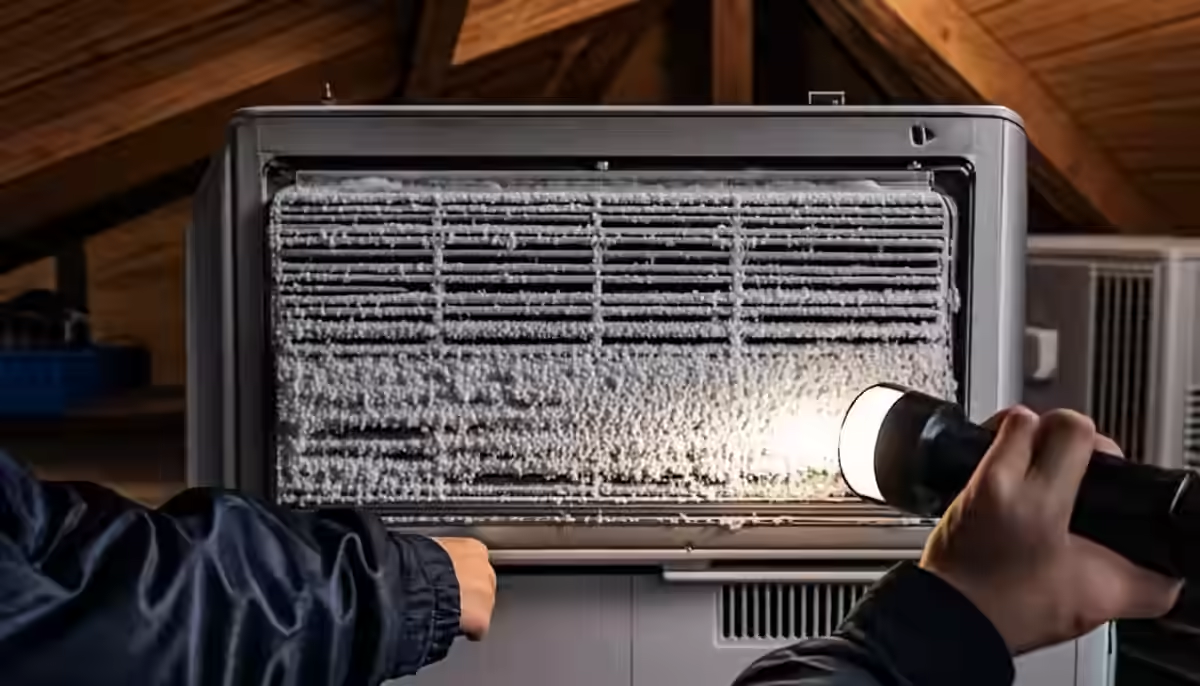
The Honest Answer Up Front
A frozen evaporator coil has two big cause families and a short tail of smaller ones. Roughly 70 percent of the frozen coils we thaw across Metro Vancouver are airflow problems: a filter nobody changed, a blower wheel caked in dust, registers closed to force air upstairs, or ducts too small to feed the coil in the first place. Most of the rest are refrigerant problems, which in practice means a leak, because refrigerant is not consumed, it escapes. The tail covers setpoints pushed too low on mild evenings, oversized units, and coils buried under years of biofilm.
Two instructions before anything else. First, if the coil is frozen right now, switch cooling off at the thermostat and leave the indoor fan running: moving room air is the safe thaw, and Chapter 3 gives you the full protocol, because there is a wrong way to do this that bends fins and floods floors. Second, if this is the second or third freeze, stop treating it as bad luck. A coil that keeps freezing is a system telling you one specific lie, and Chapter 10 decodes the recurrence patterns, because repeat freezing is a leak until proven otherwise.
The encouraging part: the most common cause costs a $20-40 filter to fix, the diagnostic that sorts all of it is $89 and credited to any repair, and the majority of frozen-coil calls we run resolve without anything resembling a replacement quote. The cooling and AC page carries the full service menu; this guide is the deep dive on the symptom we get called about most in July and the muggy weeks of August.
Ice on the coil is never the disease. Ice is the fever. The disease is air that isn't moving or refrigerant that isn't there, and every honest repair starts by figuring out which one you have.
What Freezing Actually Is, in One Chapter
Here is the mechanical picture worth holding onto. In normal operation, the refrigerant inside the indoor coil boils at a temperature just above the freezing point, typically 2 to 5 degrees Celsius, while a few hundred cubic feet per minute of house air washes over the aluminum fins. The air leaves 8 to 11 degrees cooler, and the water vapour it carried condenses on the cold fins and runs down the drain as condensate. That is what a healthy system does thousands of times a summer: cold surface, moving air, water leaving as liquid down a pipe.
Freezing is what happens when the balance between the cold surface and the moving air breaks. Starve the airflow and less heat arrives at the coil, so the refrigerant temperature falls; the surface that should be sitting at 3 degrees sinks past zero, and the condensate that should be draining turns to frost instead. The frost is an insulator, so the coil gets even colder under its own blanket, the ice thickens, and the runaway loop begins. Low refrigerant charge does the same thing from the other direction: not enough refrigerant boiling in the coil means low coil pressure, and low pressure means a coil surface below zero, again with ice as the result.
That loop explains the two symptoms that bring people to this page. The air coming out of the registers goes from cool to barely-cool to warm, because a coil wrapped in ice is a coil that has stopped transferring heat, and the system runs for hours without satisfying, because the thermostat keeps calling and the ice keeps winning. It also explains why the fix is never about the ice. Melt the ice and you have a wet coil and the same broken balance, ready to freeze again tomorrow night.
0 are airflow
Filter, blower, ducts, registers: seven of ten frozen coils we thaw trace back to air that never reached the coil.
0 to thaw
The honest window for a full thaw with the blower running. Faster methods bend fins and flood floors.
$0 diagnostic, credited
Static pressure, delta-T and refrigerant pressures measured on the spot, the fee deducted from any repair.
The Thaw Protocol, Before Anything Else
Every diagnostic in the rest of this guide assumes the coil is ice-free, because pressures and temperatures measured through a block of ice are fiction. The thaw is simple, slow, and free, and doing it correctly protects both the equipment and the floor under it:
Switch cooling off, fan to ON
At the thermostat: system OFF for cooling, indoor fan set to ON. The blower pushing room-temperature air across the coil is the heat source that melts the ice safely.
Plan for 6 to 24 hours
A light frost can clear in an afternoon; a coil frozen into the blower housing takes a full day. Partial melts that refreeze make harder ice. Let it finish.
Protect the floor and the ceiling below
A frozen coil can hold litres of water, and the drain pan was not sized for all of it at once. Towels around an attic or closet unit, and a watchful eye on the ceiling underneath one in the floor above.
Replace or pull the filter now
While it thaws, put a fresh filter in, and check that supply registers around the house are open. Two of the commonest causes take five minutes to address and cost nothing.
Dry, then test once
When the coil is bare and the pan drained, run cooling for twenty minutes and feel the register temperatures. Cool and steady means you may have been one of the lucky filter cases. Warm again within an hour means the diagnostic visit is warranted.
One more practical note from our dispatch desk: call during the thaw, not after the refreeze. If the tech arrives to a solid block, the visit becomes a second visit, and the ice will have had two more days to test your drain pan. The thaw window is dead time that a booked diagnostic fills for free.
Cause Family One: Airflow, the 70 Percent
The filter is the patriarch of this family. A filter past its life chokes the blower by a margin most people would not believe until they see the gauge numbers, and one hot July with a forgotten filter is enough to freeze a coil that ran clean for a decade. The BC-specific wrinkle is the MERV upgrade trap: homeowners install a MERV 13 filter in a one-inch slot sized for MERV 8, and the pressure drop across that dense pleat pack starves the coil in the same way a clogged one does. Your lungs, your dog and your furnace manual all have opinions here, and the manual is the one that matters.
Behind the filter sit the mechanical suspects. A blower wheel caked with six years of dust moves dramatically less air than its nameplate promises, and the dust layer is also where the musty smell comes from. Ductwork contributes on older homes: returns too small for the blower's appetite, a flex duct crushed behind a renovated wall, supply registers closed in unused rooms. Closed registers deserve a special mention because they are so well-intentioned: closing more than about twenty percent of them raises static pressure enough to freeze marginal systems, and the rooms stay cold anyway. If you have been closing registers to push air upstairs, that habit may be the whole story.
We find airflow causes with a static pressure test and a delta-T measurement, both part of the standard visit. Static pressure tells us how hard the blower is fighting the duct system, and delta-T, the temperature drop across the coil, tells us whether the air and refrigerant are meeting each other in the right quantities. A low delta-T with high static points at air; the pressures sort the rest. If the registers blow cool but weak, or the system freezes within hours of a fresh filter, you are in this chapter, and the fixes are the cheap ones in Chapter 9. The broader AC not cooling guide covers the airflow testing in more depth.
Cause Family Two: Refrigerant, the Leak Reality
The sentence every homeowner deserves to hear plainly: refrigerant does not get used up. A system that needs a top-up every year is leaking, and every pound added is a pound purchased twice. Leaks in residential systems concentrate at the joints and connections, the flare fittings on line sets, the brazed unions, the service valves, and the coils themselves, where formicary corrosion eats pinhole paths through the tubing wall over years. The freezing happens because an undercharged coil runs at lower pressure, and lower pressure means a coil surface below zero.
The field signs of a leak are recognizable after you know them. Freezing that starts at one corner or along the first rows of the coil, where the undercharge bites first. An oily residue on a fitting, because compressor oil escapes with the refrigerant and marks the exit point. A system that freezes on mild evenings but limps through hot afternoons, because the charge that remains moves differently as the load changes. And the history that matters most: a service record showing last year's top-up, and the year before's top-up, described to us as maintenance.
The honest repair sequence for a suspected leak is search, then fix, then charge, in that order. A nitrogen pressure test and electronic leak detection run $250-400 and produce an answer with a location attached. The repair cost depends entirely on where the leak lives: an accessible flare fitting is a standard-band repair, a leak inside a coil is a coil replacement conversation, and a leak under a slab or behind finished walls is the honest moment where replacement math starts beating repair math. What we refuse to do, in writing, is the top-up-and-walk-away, because it converts a $300 repair into an annuity paid by the homeowner, and it runs the compressor on a starving diet of oil and refrigerant while it collects.
The Tail: Setpoints, Sizing and Dirty Coils
The remaining causes are fewer but worth knowing, because two of them are decisions rather than defects. First, the setpoint: a thermostat pushed to 16 or 17 degrees overnight on a mild evening asks the coil to run colder than the load justifies, and on a system that is already marginal, that is the last degree. The practical floor in this climate is 20 to 21 for sleeping, which is also cheaper to hold, since every degree of cooling costs roughly three to five percent more runtime.
Second, oversizing. A unit with far more capacity than the house needs satisfies the thermostat in minutes, which is the comfort problem we document elsewhere, but the freeze problem is the mirror image: when the load falls on a mild, damp evening, an oversized unit's coil drops below freezing because there is not enough heat arriving to keep it above zero. We meet this in renovated Vancouver Specials and new laneway homes alike, where the cooling was doubled as cheap insurance against the heat domes. Right-sizing by the room-by-room calculation is the cure, and it is the calculation behind every quote we write.
Third, the dirty coil itself. Years of dust and biofilm on the indoor fins insulate the air from the refrigerant the way ice does, just more slowly, and a coil dirty enough to freeze is a coil overdue for a wash regardless. Blower speed set wrong at installation, usually left low by a tech solving a noise complaint, rounds out the list. The common thread across the whole tail: none of these show up on a refrigerant gauge alone, which is why the diagnostic measures air and refrigerant together instead of opening with a charge hose.
The BC Twist: Freezing on Nights You Least Expect
Inland provinces freeze coils in August at 2 p.m. under a 34-degree sun. Here, the classic freeze arrives at 11 p.m. on a 19-degree evening with the dewpoint sitting at 15. Metro Vancouver's summer is mild on the thermometer and heavy on the moisture, so the air conditioner spends its season doing double duty: cooling a little and drying a lot. Long runtimes at low load are exactly the condition where a marginal coil slips below freezing, and coastal nights supply those runtimes by the dozen. A system that runs flawlessly through a heat dome can freeze solid three days later when the marine air returns and the thermostat keeps calling.
The housing stock amplifies it. Basement suite air handlers in New Westminster and Burnaby sit in cool, damp spaces where the surrounding air adds no free heat to the coil. Condo and townhouse units in Richmond and Coquitlam share undersized returns with renovations the original designer never imagined. And the Fraser Valley's warmer, muggier summer nights, out through Surrey, Langley and Abbotsford, ask systems for exactly the cool-and-dry overnight duty that freezing loves to interrupt. The regional pattern is consistent enough that our techs ask about the overnight behaviour before they ask about anything else: it freezes at night, runs fine at noon, is the single most common sentence in our frozen-coil call logs.
The climate lesson is not to fear your thermostat, it is to notice the pattern early. One overnight freeze with a fresh filter in place is a data point. Two in one season is a diagnostic call. The humidity that makes our summers comfortable to live in makes freezing diagnostic, because the system has to wring that moisture out through a coil that is one marginal condition away from icing, and every cause in this guide shrinks that margin.
What the $89 Visit Actually Measures
A frozen coil is one of the best-value diagnostics we run, because the symptom narrows the testing to four instruments and about sixty minutes. Here is what happens, in order, on a thawed system. Static pressure across the blower: one reading that convicts or clears the filter, the ducts, and the blower wheel in a single number, against the manufacturer's rated maximum, commonly 0.5 inches water column for residential units. Delta-T across the coil: the supply and return temperatures that tell us whether the air and the refrigerant are exchanging heat in the right proportions, with a healthy target of 8 to 11 degrees Celsius of drop.
Then the refrigerant side, gauges on the service ports, pressures read against the outdoor temperature, superheat and subcooling calculated rather than guessed. Superheat tells us what the evaporator is doing with the refrigerant it receives; subcooling tells us what the condenser is sending. Between them, an undercharge, an overcharge, and a metering device fault all separate cleanly, which is why we calculate both instead of reading one pressure and pronouncing. Blower motor amps close the electrical picture, and a visual inspection of the coil and drain pan closes the mechanical one.
The output is a finding, not a feeling: airflow at 320 CFM low, superheat at 24 degrees, cause is air, or pressures low across both sides, superheat high, cause is charge, and here is the leak search option. The $89 fee is credited to any repair we perform, so the visit costs nothing against the fix, and it protects you from the one outcome worse than a frozen coil: paying for refrigerant that leaks out by Labour Day. If you would rather start with the general troubleshooting ladder first, the AC not cooling guide maps the whole symptom tree, and our Richmond AC repair and other city pages book the same diagnostic everywhere we serve.
What the Fixes Cost, Honestly
The spread on frozen-coil repairs is wide because the causes run from a twenty-dollar filter to a twenty-five-hundred-dollar coil, and the honest way to present it is by cause, with the caveat that final pricing is confirmed in writing after on-site assessment:
| Cause and fix | Typical BC price | What decides the number |
|---|---|---|
| Filter replacement | $20-40 | Size and MERV rating; matched to the slot, not upgraded past it |
| Blower wheel cleaning | $180-350 | Access, wheel size, and how many years of dust rode in on it |
| Indoor coil wash | $250-450 | Coil depth, access panel clearance, biofilm versus dust |
| Leak search (nitrogen + detector) | $250-400 | How many joints, how much of the line set is accessible |
| Leak repair at an accessible joint | $350-450 | Flare re-make, valve or fitting replacement, brazed repair |
| Refrigerant recharge | Priced by the pound | R410A at market rates; quoted after the leak is fixed, not before |
| Evaporator coil replacement | $1,200-2,500 installed | Above the standard band; part availability and matching to the condenser |
| Diagnostic | $89, credited | Deducted from any repair, same visit or scheduled |
Two lines on that table are worth sitting with. The filter line, because it is the most common fix on the most dramatic symptom in cooling, and the coil replacement line, because it is the number that changes the conversation from repair to replacement math, especially on units past twelve years. When a coil replacement quote lands, we price the honest alternative in the same document: a matched condenser-and-coil replacement at central AC pricing of $3,800-6,500, or a right-sized ductless zone at $3,800-5,500 for homes where the ductwork is part of the problem. The ductless versus central guide walks that fork properly.
When It Keeps Happening: The Recurrence Decoder
The word keeps in your search is the most diagnostic word in this entire article. A single freeze is an event; a pattern is a message, and the pattern usually names its own cause. This is the table our senior techs compiled from a decade of frozen-coil callouts, and it is the one to read if this is your second visit to this page:
| The pattern you see | What it almost always means |
|---|---|
| Froze once, never again after a filter change | It was the filter. Keep a calendar, buy filters by the four-pack, done. |
| Freezes every mild, damp night; fine in hot weather | Low charge or weak airflow holding on by a thread. The diagnostic decides which. |
| Needs refrigerant every season | A leak you have been renting. Search it once, fix it once, stop paying tribute. |
| Freezes only when set below 18 overnight | Setpoint pushing a marginal system under zero. Raise the floor or fix the margin. |
| Froze for years, worse each summer | Progressive leak or progressive fouling. Either way, the trend line ends in a September phone call. |
| Refreezes within hours of a full thaw and clean filter | Refrigerant until proven otherwise. Book the leak search, not another top-up. |
The economics of recurrence are unforgiving. A top-up that costs a few hundred dollars, repeated twice a season for three seasons, has already paid for the leak search and repair twice, and the compressor has been running lean that whole time. On any unit past ten years with a confirmed coil leak, the honest quote is a system conversation: central replacement at $3,800-6,500 where the ductwork earns it, or ductless zones at $3,800-5,500 where it does not. Financing from 7.99 percent OAC and the CleanBC rebate stack, up to $16,000 on qualifying cold-climate heat pumps, move the math further, and our heat pump page carries that path with the paperwork handled on our side.
Prevention: The Short, Cheap List
Everything in this guide compresses to a short list, and none of it is expensive. Filters on a calendar, every 60 to 90 days in cooling season, sooner with pets and during smoke weeks when the system also scrubs ash. Registers open, at most one or two closed anywhere in the house, and never the ones closest to the return. A setpoint floor of 20 to 21 for overnight sleeping, which your electric bill thanks you for alongside the coil. And the annual maintenance visit at $149-250, which measures the static pressure and delta-T that predict freezing months before the ice arrives.
That spring visit is the one that matters, because it catches the slow drift: the blower wheel two seasons into its dust coat, the coil carrying its first biofilm, the superheat reading three degrees off last year's number. Drift is what recurrence is made of, and the maintenance calendar is how a system runs fifteen summers instead of eight. The full list lives in our spring AC maintenance checklist, and it is the same visit for heat pumps, which freeze coils by identical physics in both cooling and shoulder-season operation.
If the ice is back while you read this: cooling off, fan on, towels down, and then the phone. The $89 diagnostic sorts air from refrigerant in about an hour, the fee is credited toward the fix, and you will leave the conversation knowing whether you own a filter errand or a leak search. That is the whole arrangement, and it is why our cooling crews have held a 5.0-star rating across 26 Google reviews and 12,000-plus jobs since 2010.
Stop the Ice Before It Stops Your Summer
Thaw, then book. The $89 diagnostic measures static pressure, delta-T and refrigerant pressures in one visit, names the cause family, and is credited toward any repair. If the honest answer is a leak search or a replacement conversation, you will get the numbers for both, in writing, with zero obligation.
Frequently Asked Questions
Services From This Guide
Red Seal cooling crews from our Surrey base cover Vancouver, Burnaby, Richmond, Surrey, Langley, Coquitlam, Delta, New Westminster, North Vancouver, Maple Ridge, Port Coquitlam and Abbotsford.
AC repair & diagnostics
Repairs $180-450 with the $89 diagnostic credited, static pressure and delta-T measured every visit.
AC repair in Richmond
Same-day cooling repairs across Richmond, from Steveston to Ironwood.
Heat pump service
Heat pumps freeze coils too. Full service menu, installs $6,500-14,000 with CleanBC paperwork handled.
24/7 emergency service
Live dispatch around the clock, flat $150 after-hours premium disclosed upfront.
Related Guides
AC Not Cooling? 10 Causes and the Fixes
The full symptom ladder, from warm registers to tripped breakers.
CoolingSpring AC Maintenance Checklist for BC Homes
The May visit that catches weak airflow before July does.
CoolingDuctless vs Central AC: What Surrey Homes Should Choose
When freezing-prone ductwork argues for heads instead of a trunk.

We thaw and diagnose more frozen coils in a damp August than in any other month, and the story is nearly always the same: a filter three months past its date, or a slow leak someone topped up last year. Our Red Seal techs measure static pressure and delta-T on every coil call instead of guessing, which is why the $89 diagnostic on this one earns its fee back in avoided refrigerant bills. To book instead of DIY, see AC repair in Vancouver — same-day across the city.
More about our team →Stop the Ice Before It Stops Your Summer
The $89 diagnostic measures airflow, delta-T and refrigerant pressures on the spot, finds which cause family you are in, and is credited toward any repair. One visit, plain-language finding, zero obligation. If you would rather hand this to a pro, our cooling & AC services pages cover Metro Vancouver.
AC frozen solid in a heat wave?
24/7 live dispatch with a flat $150 after-hours premium posted in advance. We will talk you through the thaw protocol on the phone before the truck even leaves.
Call 604-615-2212 WhatsApp Us