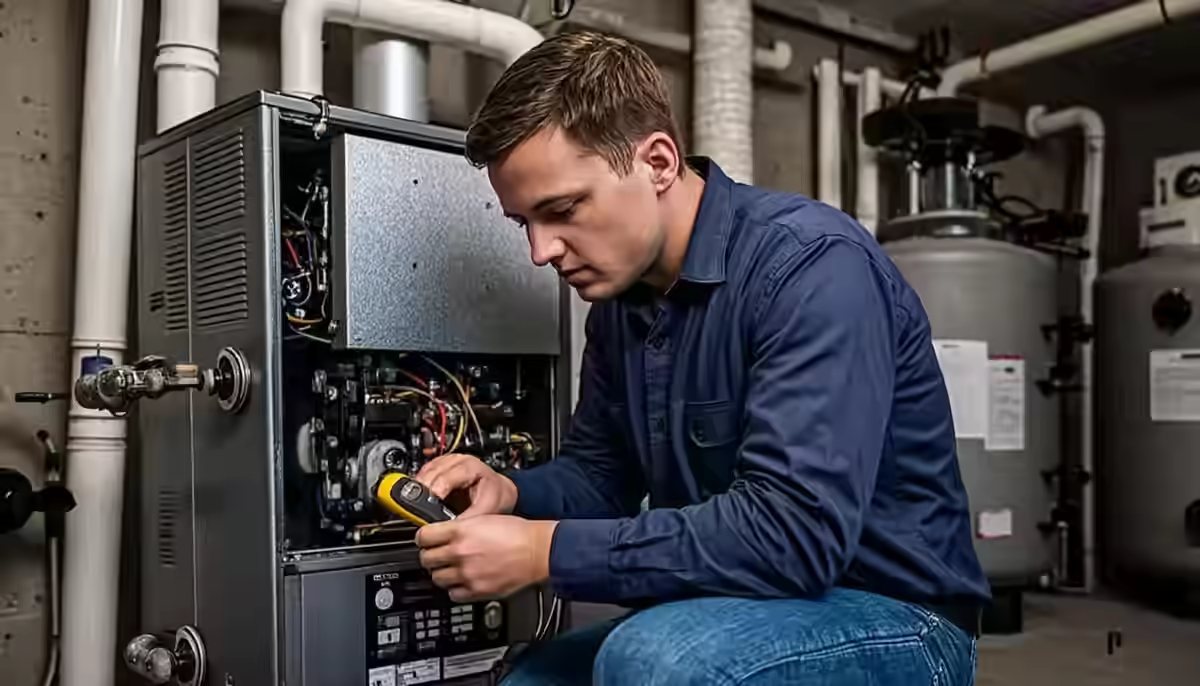
The Honest Answer Up Front
The blinking light on your furnace is not a malfunction. It is the diagnosis — delivered free, in the manufacturer's own language, from a status LED on the control board that reports exactly which circuit failed. Every gas furnace built in the last thirty-plus years has one, every technician who works on your furnace reads it before touching a tool, and most homeowners walk past it for twenty years without knowing it exists. Reading it takes ten minutes and a phone camera, and it converts "my furnace is doing something weird" into "my furnace is showing a pressure switch fault, likely inducer-related, and here is the photo."
What the code gives you is a starting point, not a verdict — that is the honest caveat, and it matters financially. A code names the circuit that complained: the pressure switch that didn't close, the high limit that tripped, the flame that wasn't proven. The root cause sits upstream of that complaint more often than not, which is why our diagnostics pair the code with a manometer, an amp clamp and a combustion analyzer. A homeowner who calls with "two flashes, pause, two flashes, it's a Goodman, it started after the first cold snap" has already done a third of the diagnostic and gets a correspondingly shorter invoice. That is the entire promise of this guide.
The money picture for BC, stated plainly: most code-driven repairs land in our $180 to $450 flat band. Flame sensor cleanings sit inside the $89 diagnostic, which is credited to any repair. Igniters run $180 to $400, pressure and limit switches $180 to $350, control boards $450 to $900, and inducer motors $450 to $1,200 installed. If you are in the Tri-Cities, our furnace repair service for Burnaby and New Westminster books same-day code reads most days, and every one of them ends with the cause in writing.
An error code is an accusation, not a conviction. It tells you which witness filed the complaint. The investigation — manometer, amp clamp, combustion test — is still the job, and skipping it is how a $40 flame sensor becomes a $900 control board.
Finding Your Code: The Sight Glass and the Sticker
Start at the furnace, not the thermostat. On the lower door — the blower compartment door, the one that sits below the burners — find the small round plastic window. That is the sight glass, and through it you will see one or two LEDs on the control board flashing your code. The reason the window exists is that opening the door kills power to the board on most furnaces, which clears the active code you came to read. So: look through the glass first, and photograph the pattern while it is live. A fifteen-second video of the blinking is worth more to a technician than a paragraph of adjectives.
If you must open the door — to reach the chart, or to find the model number — know two things. First, the code chart is almost always located on the inside face of that same blower door or on the wiring diagram envelope nearby; manufacturers print the decode table where the tool that opens the cabinet will find it. Second, the brand and model number live on the rating plate inside the cabinet on an upper corner, and that pairing is what any parts counter or dispatcher needs. "Carrier, three short flashes, one long" is a sentence. "The furnace is blinking at me" is not.
A note on the two-LED boards found on some Carrier and ICP units: one LED reports the fault code and the other reports power status, and you decode the fault one. On Lennox boards the code is sometimes shown as flash pairs — slow blinks for the first digit, fast for the second. On newer communicating systems, the fault appears as an alphanumeric code on the thermostat itself (E-codes), which is honestly the friendliest version of all of this. Whatever your machine speaks, the heating services hub lists every brand we carry charts for, and "read me the code over the phone" is a service we perform for free across all twelve of our cities.
The Grammar of Blinks: What Patterns Mean Before You Count
Codes vary by manufacturer, but the grammar underneath them is surprisingly consistent across the industry, and knowing it lets you classify what you are seeing before you find the chart. The first classification is pace. A slow, steady blink — about once per second — is many boards' way of saying "call for heat in progress, nothing wrong." A fast continuous blink is the alarm state: either a fault code is active and wants counting, or there is a power-level problem such as reversed polarity or a low-voltage issue that needs an electrician's attention, not parts.
The second classification is rhythm. Counted blinks that repeat — two flashes, pause, two flashes, on loop — are the code itself, and the count is the number. Short-then-long flash sequences on two-digit boards read as digits: short flashes are the tens, long flashes the ones, so "short short long" is 21. A steady, unblinking light has its own meanings, and they trend serious: on many boards a solid light means the board is in hard lockout, and on some it means an internal board fault. Off entirely means no control power, and the troubleshooting path for that starts at the switch and the fuse, not the parts list.
| Pattern you see | Typical meaning across brands | Your move |
|---|---|---|
| Slow steady blink, once per second | Normal call for heat on many boards | Relax — no action |
| Counted blinks repeating on a loop | Active fault code — count the flashes | Match against the door chart |
| Short-long mixed sequence | Two-digit code (short = tens, long = units) | Decode via chart or call it in |
| Fast continuous flashing | Fault active or polarity/ground power issue | Diagnostic visit |
| Steady light, no blinking | Hard lockout or board-level fault on many boards | Diagnostic visit |
| LED dark, furnace dead | No control power — switch, fuse, breaker | Check power path first |
Treat the table as a translation aid, not scripture — your specific board's chart is the authority, and it is glued to the inside of your own furnace door. The reason to learn the grammar anyway is triage: a slow blink in October is nothing, a solid light in January is a same-day call, and knowing which is which is the difference between a calm Tuesday and a panicked midnight. For the full no-heat decision tree beyond codes, our furnace not working guide covers the cases where the board has nothing to say.
The Big Five Faults Behind Most Codes
Strip away brand numbering and nearly every furnace fault code in BC resolves into five families. Learn the families and every chart in every basement becomes a dialect you mostly understand.
1. Pressure switch faults. The board expected the pressure switch to close and prove draft before ignition; it didn't. The code names the switch, but the switch is innocent in the majority of cases — the usual culprits are a tired inducer motor, a blocked or ice-capped vent, a cracked or waterlogged sense hose, or genuinely low draft. This is the most common code family we decode between November and February, and the one where parts-cannon misdiagnosis costs the most.
2. High limit faults. The heat exchanger got too hot and the limit switch opened to protect it. Root causes are airflow crimes: loaded filters, blocked returns, felted blower wheels, failing blower capacitors — all covered in depth in our short cycling guide, because limit trips are the number one cause of the start-stop pattern. The fix is almost always airflow, rarely the limit switch itself.
3. Flame sense faults. The burner lit but the board could not prove the flame within its window — typically a film-covered flame sensor rod needing a sixty-second clean with a fine abrasive pad. This family also includes "flame sensed with no call," which is the serious inversion: the board sees fire where none should exist, often pointing at a sticking gas valve. That one means stop resetting and call.
4. Ignition lockouts. The system tried to light several times — most boards allow three or four attempts — failed, and locked out for an hour or until power-cycled. Hot surface igniters that measure out of resistance range are the classic cause, and they run $180 to $400 installed. If the lockout follows a visible pattern (first cold morning, overnight only), note it; intermittent igniter failure tracks temperature.
5. Gas valve and proving faults. The rarest and most serious family: the valve reported wrong state, gas pressure is out of spec, or a rollout or aux limit opened. These involve the gas train, which in BC is licensed gas fitter territory by regulation, and they are never DIY. A gas-valve fault code is the one category where the correct homeowner response is uniform: shut it down and book a licensed diagnostic — emergency service if it's freezing, routine if the house has another heat source.
Brand by Brand: The Codes You'll Actually Meet in BC
Metro Vancouver's installed base has a personality: Carrier and its ICP siblings under KeepRite and Bryant badges are everywhere through the 2000s and 2010s; Goodman surged through the 2010s on price; Trane, Lennox and Rheem fill out the fleet, with a long tail of York. The table below covers the codes you are most likely to meet here, with the mandatory caveat repeated once: manufacturers reuse numbers across board generations, and the sticker inside your door outranks any table on the internet, including this one.
| Brand family | How it shows codes | Commonly seen codes |
|---|---|---|
| Carrier / ICP (KeepRite, Bryant) | Two digits: short flashes = tens, long = units | 31 pressure switch, 32 switch stuck closed, 33 limit open, 13 limit lockout, 14 ignition lockout |
| Goodman / Amana | Single LED, counted flashes | 2 pressure switch open, 3 pressure switch stuck closed, 4 high limit, 5 flame sensed without call |
| Trane / American Standard | Counted flashes on integrated board | 2 pressure switch open is the classic; limit and lockout counts vary by board era |
| Lennox | Flash pairs (slow then fast) on classic boards; E-codes on iComfort | Limit and pressure switch families dominate; E-code numbers printed on the door chart |
| Rheem / Ruud | Counted flashes; older units had no chart at all | 2 pressure switch open is the recurring one across generations |
| York / Luxaire / Coleman | Single red LED, counted flashes | 1 lockout, 2 pressure switch open, 4 limit open — verify per board sticker |
Why the table leans toward pressure switch and limit entries: those two families account for the majority of winter code calls in this region, period. And a BC-specific note — KeepRite is ICP. When a chart lists "ICP family" codes, your KeepRite follows the Carrier numbering above, which surprises people because the badges look unrelated. The brand comparison article in our library covers the parts-cost personalities of these families, and it is a worthwhile read before any brand-loyal repair or replacement decision.
Resetting Without Lying to Yourself
There is a right way to reset, and it is boring. Switch the furnace off at the service switch — the wall switch near the furnace, not the breaker unless there is no switch — wait 30 seconds to 5 minutes, and switch it back on. That clears most soft lockouts (the board's built-in cool-down after failed ignitions) and lets the furnace try again with a clean slate. If it lights and runs for days, you got lucky. If the same code returns within hours, the furnace is telling you the cause is still sitting there, and now it has also told you the failure is persistent rather than transient — which is diagnostic information you just generated for free.
The line you should not cross is repeated resetting. Every reset authorizes another round of purge-ignite attempts, and each round is wear on the igniter and stress on the exchanger. Three resets in an evening is three ignition sequences the machine would not have chosen. Worse, habitual resetting masks trends: the code that only appears on the first cold morning of each month is a pattern your tech would very much like to hear about, and resetting it into oblivion deletes the evidence. Write down the date, the code, the outdoor temperature, and what the furnace had been doing for the previous hour. That log is the cheapest diagnostic instrument in existence.
Never reset, and stop operating the furnace, in three cases: any smell of gas (leave the house first, call FortisBC at 1-800-663-9911 from outside), a bang or boom at ignition, and any flu-like symptoms in the household that ease when you are away from home. Those are safety boundaries, not troubleshooting steps, and the next chapter explains why.
What the Code Won't Tell You
A code tells you which circuit filed a complaint. It does not tell you which part is guilty, and the gap between those two sentences is where heating repair budgets go to die. The pressure switch code is the canonical example — boards blame the switch, the switch is fine in most cases, and the real cause is upstream: a slow inducer, a blocked vent, a cracked hose. A limit code blames the limit switch; the limit is doing exactly its job; the real cause is airflow. An ignition lockout blames the igniter, and usually it is the igniter, but low gas pressure produces the identical code on some machines.
This is why our diagnostic routine for any code pairs the blink count with instruments: a manometer on the pressure switch port to measure actual draft, an amp clamp on the inducer to measure the motor's effort, a microammeter on the flame sensor to measure flame signal strength, and a combustion analysis on the flue to see how the burn itself is going. Those four readings, about fifteen minutes of work with the right tools, convert a code into a cause. It is also why we tell customers on the phone: read me the code, and I'll tell you what it might be — but the invoice will say what it is, because the might-be list is the expensive one.
Half of all code calls end with the cause being something a homeowner could see with a flashlight — a snow-capped vent, a filter fused to its rack, a hose full of water. The other half need instruments. The skill is knowing which half you are in before ordering parts.
The practical takeaway for you: when you call any company about a code, ask one question — "will you measure the draft and amp draw before quoting?" The answer sorts the trade faster than any review site. Our own answer is on the table: every furnace repair visit in Langley or anywhere else in our twelve cities includes those readings in the written diagnosis, and the $89 fee is credited to the repair.
Repair Costs by Code Family
Honest installed ranges for Metro Vancouver, 2026, with the root-cause caveat baked in. The $89 diagnostic at the top of the table is credited to any repair performed, so the cost of finding out is zero if you proceed.
| Code family | Most likely root causes | Typical installed cost |
|---|---|---|
| Flame sense fault | Filmed sensor rod (most), cracked sensor (some) | $0 inside diagnostic; $180-350 replace |
| Ignition lockout | Failed hot surface igniter, low gas pressure | $180-400 |
| Pressure switch fault | Weak inducer, blocked or iced vent, bad hose; switch itself a minority | $0-350 switch; $450-1,200 if inducer |
| High limit fault | Loaded filter, blocked airflow, blower weakness | $20-40 filter to $500-2,200 motor |
| Control board fault | Board relay or circuit failure, sometimes surges | $450-900 |
| Gas valve fault | Valve failure, pressure out of spec — licensed gas fitter only | $450-900 + combustion check |
| Diagnostic visit (any) | Code read, instruments, written cause | $89, credited to repair |
Two honest notes. First, the pressure switch row has the widest spread in the table, from free to four figures, and that spread is precisely why the manometer matters before the wallet opens. Second, control board quotes deserve a second opinion more often than any other line — a surprising share of "bad board" diagnoses turn out to be a $40 flame sensor or a chafed low-voltage wire, and the full decision framework for when a big repair meets an old furnace lives in our repair versus replace guide.
The November Scenario: BC's Cold-Snap Code Surge
Every year, without exception, we get a spike of code calls on the first two genuinely cold nights of the season — and a good share of them are not broken furnaces at all. They are BC weather doing what BC weather does. Frozen condensate is the headliner: condensing furnaces drain a tablespoon or two of water per cycle, and when that drain line or trap freezes — it runs outside or through an unheated crawl space in many Langley, Maple Ridge and North Vancouver homes — water backs up, the pressure switch or float switch trips, and the furnace refuses to run. The code reads like a major failure; the fix is a heat cable or a rerouted drain.
Snow and ice on vent terminals is the second headliner. High-efficiency furnaces vent through PVC at low velocity, precisely because the gases are cool, which means a foot of snow or a shell of ice can cap them. If your furnace throws a pressure switch code the morning after a snowfall with an Arctic outflow behind it, walk outside and look at the wall before you call anyone. Clearing a vent safely from the ground costs nothing; it is the single most common "repair" in the first week of a cold snap, and no part ordered would have fixed it.
The third is cold-stiffened bearings. An inducer motor that was chirping in October seizes on the first minus-five morning because tired bearings and cold lubricant disagree about viscosity. And the fourth is simply capacity strain: furnaces that loafed through a 6°C autumn suddenly run near continuously, and any marginal component — igniter on its last ohms, capacitor at eighty percent — meets the load it has been avoiding. The pattern to remember: if the code appears exactly when the weather turns, suspect the weather's interactions before you suspect the parts list. The winter prep checklist covers all of this in task form.
First 0 cold nights
When the annual code-call surge happens: frozen condensate, capped vents, cold-stiffened bearings meeting real load.
0% of surge calls
The share that resolve without parts — a cleared vent, a thawed drain, a filter. Worth a walk-around before a service call.
$0-250
The October tune-up that clears drains, checks amp draw and inspects vents before the cold snap holds auditions.
What to Say When You Call: The Two-Minute Triage
When you call any heating company about a code, five facts convert the conversation from a description into a triage. One: the brand, from the badge or the rating plate. Two: the model number, same plate. Three: the code itself — count the flashes, or send the video. Four: when it started, and whether it correlates with anything: cold snap, snowfall, first call after sitting overnight, after a power flicker. Five: what you have already done — power cycled once, checked the switch, looked at the vent.
That list sounds trivial, and it is not. It lets the dispatcher route the right truck with the right parts on it, it lets the tech walk in already oriented, and on a busy January evening it is the difference between a one-visit fix and a "we'll have to order that and come back." When you call our line, the person answering will ask for exactly those five things, and the people on the other end are Red Seal, licensed gas fitters BC-PL-2019-4421, 15-plus years in the field, 12,000-plus jobs since 2010.
And if you would rather skip the phone entirely, the quote form below reaches the same dispatch. Paste in the brand, model, code and your city, and you have effectively handed us the first half of the diagnostic. We answer 24/7, after-hours calls carry a flat $150 premium posted in advance, and the $89 diagnostic is credited to any repair we perform.
Codes That Mean Stop: The Red Lines
Most codes are logistics. A small set are safety boundaries, and this chapter exists so the distinction is unmistakable. Treat the following as stop conditions: a gas smell at the furnace or anywhere in the house; a bang, boom or thump at ignition; a code indicating the gas valve stuck open or flame sensed with no call for heat; soot around the burner door or at supply registers; and — above all — people in the house with headaches, nausea or dizziness that ease when they are away from home, which is the textbook carbon monoxide presentation.
The delayed-ignition bang deserves one final word because it sits in a grey zone: it is the single most dangerous noise a furnace makes — unburned gas accumulating in the burner, then lighting all at once — and it is discussed at length in our noise guide, but the code column matters here too. If your board logs ignition retries and you hear percussion with them, the furnace is demonstrating exactly the failure that cracks heat exchangers. Shut it down at the service switch and book emergency service. Between November and March we keep slots open every evening for precisely these calls, because the alternative is a homeowner riding the reset button through a weekend, which no one should do.
For everything else — the counted blinks, the slow flashes, the intermittent ghosts — you are now equipped: read the sight glass, check the door sticker, note the weather, log the pattern, and call with the five facts. Codes are the furnace industry's only honest advertising, and they cost you nothing to read.
Know the Code? Get the Cause.
Send a photo of the blinking light or book the $89 credited diagnostic. A Red Seal tech arrives with the brand charts, a manometer and an amp clamp, and hands you the root cause in writing — with a flat-rate quote before any work starts. Zero obligation.
Frequently Asked Questions
Services From This Guide
Red Seal techs serving Vancouver, Burnaby, Richmond, Surrey, Langley, Coquitlam, Delta, New Westminster, North Vancouver, Maple Ridge, Port Coquitlam and Abbotsford.
Furnace Repair in Burnaby
Same-day code diagnostics across Burnaby and New Westminster, repairs $180-450.
Heating Services
Licensed gas fitting, flat-rate repairs and installs across Metro Vancouver.
24/7 Emergency HVAC
Live dispatch around the clock, $150 flat after-hours premium.
Furnace Repair in Langley
Valley-wide coverage from Walnut Grove to Aldergrove, $89 diagnostic credited.
Related Guides
Furnace Not Working? The Full Diagnostic Guide
The complete no-heat walkthrough, from thermostat to gas valve.
BrandsCarrier vs Lennox vs Trane: Which Furnace?
Brand comparison with the repair-cost realities of each family.
HeatingFurnace Repair vs Replace: The Honest Math
When the repair quote means the furnace is done talking.
Our techs decode control board codes on a dozen brands across twelve Metro Vancouver cities every heating season, and the fastest diagnostics are always the ones where the homeowner shows us a photo of the LED and says 'it started after the cold snap.' This guide teaches that half of the job — where codes live, how to read them, and which ones mean stop. Written from Red Seal field experience, 12,000-plus jobs since 2010. If you want a tech on it today, see furnace repair in Surrey — same-day across the city.
More about our team →Know the Code? Get the Cause.
Send us the code photo or book the $89 credited diagnostic — a Red Seal tech arrives with the brand charts, a manometer and an amp clamp, and hands you the root cause in writing with a flat-rate quote. Zero obligation, same-day slots most days. If you would rather hand this to a pro, our heating & furnace services pages cover Metro Vancouver.
Furnace locked out tonight?
We answer 24/7 with live dispatch across Metro Vancouver. After-hours calls carry a flat $150 premium, posted in advance — and the $89 diagnostic is credited to any repair.
Call 604-615-2212 WhatsApp Us