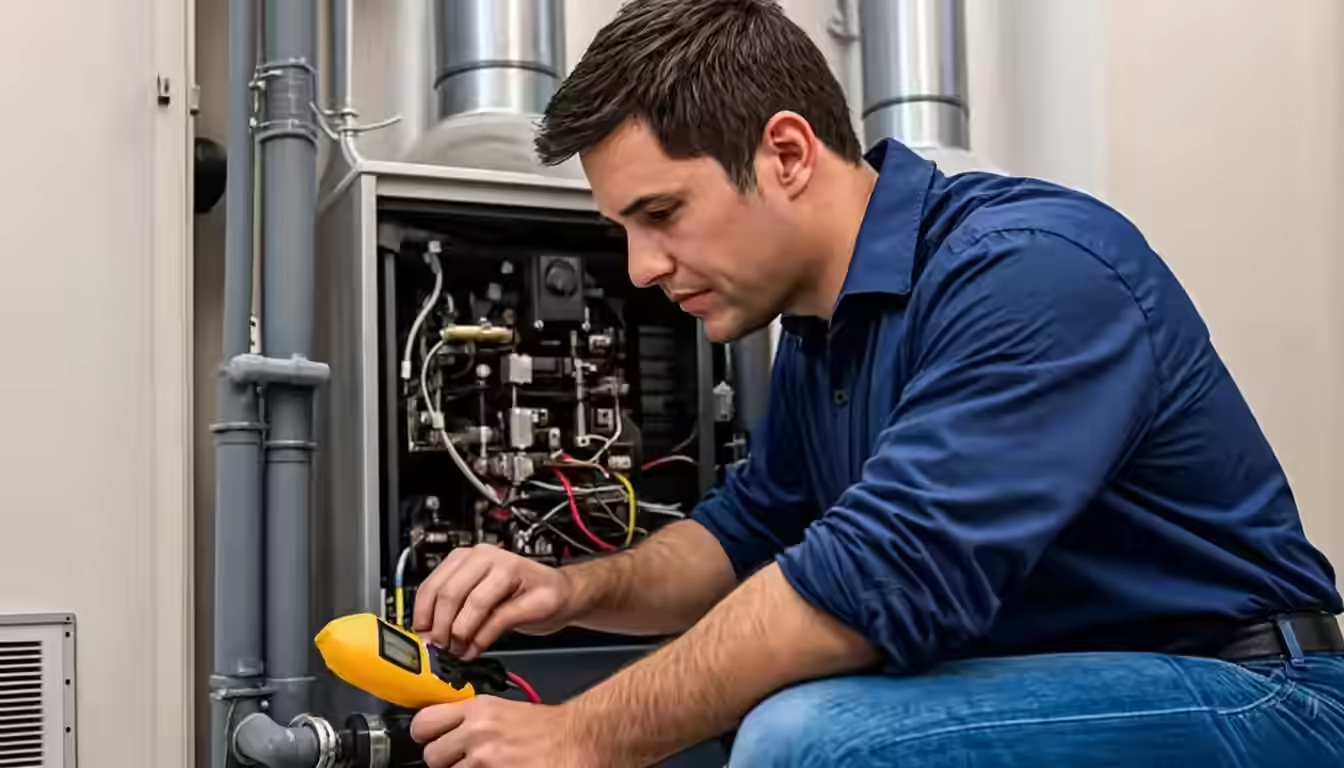
The Honest Answer Up Front
Furnace noise sorts into three bins, and the sorting is mostly good news. The biggest bin is cheap: rattling panels, loose screws, filters whistling, ducts popping — nuisance noises that cost $0 to $450 to fix and threaten nothing but your sleep. The middle bin is maintenance: squealing bearings in the blower or inducer, a wheel out of balance, burners overdue for a clean — noises that are the machine politely scheduling its own repair weeks before it fails. The smallest bin is urgent, and one noise in it matters above all the rest: a boom or bang at ignition, which means gas is accumulating and lighting late, and which should be professionally addressed before the furnace runs another week.
The decoding tool that makes this guide work is timing. A furnace runs a fixed sequence every cycle — inducer start, ignition, burn, blower, shutdown — and each subsystem makes its noises at its own point in that sequence. A screech in the first ten seconds is a different part than a screech that runs all cycle; a boom before the flame is different from a pop a minute after it. Time the noise against the sequence and you have usually halved the diagnosis before you touch anything. The chapters below walk each noise family in plain order of urgency, with honest Metro Vancouver repair costs for every fix from $0 (blower door screws) to $2,200 (an ECM blower motor).
And the money framing: our $89 diagnostic identifies the noise and is credited to any repair we perform, most noise repairs land in the $180 to $450 flat band, and the noise that costs the most ignored is not the loudest one — it is the screech people learn to live with through November, which becomes a no-heat call in January at after-hours rates with a $150 premium. If you're in the Tri-Cities, furnace repair in Coquitlam books same-day diagnostics most of the heating season.
Homeowners ask me if the noise is bad. The honest answer: bearings announce themselves weeks ahead, ducts announce nothing dangerous at all, and delayed ignition announces itself once — loudly — and then it is your job to stop ignoring it. The furnace narrates; the diagnostic just translates.
Decode by Timing: Where in the Cycle the Noise Lands
Every heating cycle runs the same choreography: the small inducer fan spins up first, the igniter fires and gas lights, the burner runs a few minutes, the main blower starts and moves air through the house, the burner shuts at thermostat satisfaction, the blower runs on to purge, and everything stops. Each noise you will ever hear belongs to one of those stages, and knowing the stage is half the diagnosis. Stand at the furnace for one full cycle with a phone recording and you will have more diagnostic information than most phone calls collect.
The logic is mechanical. Noises at start-up, before the flame, come from the inducer, the igniter or the burners. Noises that begin the moment the blower starts are airflow noises — blower wheel, motor, filter, ducts. Noises that arrive a minute or two into the run are thermal noises — duct sheet metal expanding. Noises at the very end, after the burner shuts, are also thermal — metal contracting, sometimes with a tick. And a boom that arrives between the gas valve opening and the flame establishing is combustion, and it is the one you never wait on.
| When you hear it | Subsystem speaking | Typical suspects |
|---|---|---|
| First seconds, before any flame | Inducer motor and ignition | Inducer bearings, draft noise, igniter click |
| Exactly at ignition | Burners and gas | Delayed ignition boom — urgent |
| The moment the blower starts | Airflow path | Blower bearings or wheel, filter whistle, loose panels |
| A minute or two into the run | Ductwork | Oil-canning pops as sheet metal heats |
| Through the whole cycle | Blower motor | Bearings, unbalanced wheel, mounting |
| After the burner shuts down | Ductwork contracting | Ticking and light pops — cosmetic |
Record one full cycle and the table does most of the sorting. What it cannot do is judge severity — a recording of a boom and a recording of a duct pop sound suspiciously alike to anyone who has not stood next to a few thousand furnaces — which is why every chapter below ends with the same advice: when the timing points at combustion, close this article and open a phone line. Our furnace not working guide covers the other end of the spectrum, when the noise stops because the furnace did.
Banging at Start-Up: Delayed Ignition, the One That Matters
Delayed ignition is exactly what it sounds like: the gas valve opens, gas flows into the burner, and the igniter — corroded, weak, or sitting a centimetre from where it should be — takes a beat too long to light it. In that beat, the burner fills with a fuel-air mix, and when ignition finally catches, the accumulated gas burns in one percussive event. From the living room: a boom, a thump you feel in the floor, sometimes a single loud bang that stops the household mid-sentence. It is the single most important noise in this guide, and the BC-specific detail is our humidity: burner ports and igniter surfaces film over faster in coastal air, and furnaces that ran clean for a decade can develop delayed ignition in a single wet season.
Why it cannot wait: each boom is a pressure pulse through the heat exchanger, and heat exchangers fail by fatigue. A season of booms is a season of stress cycles on the one component whose failure ends the furnace — and potentially routes combustion gas into the supply air. The repair itself is usually modest: burner cleaning and adjustment, igniter service or replacement, gas pressure verification, in the $180 to $450 band, and our heating service pages book it as a priority call. If the boom has been happening for months and the furnace is over fifteen, budget honestly for the possibility that the conversation ends at the heat exchanger inspection.
The impostor to rule out: a light metallic tick or pop five to thirty seconds after start-up, spread through the ducts rather than felt at the furnace, is sheet metal expanding — Chapter 7's territory, and entirely cosmetic. The test is location and quality: a boom originates at the furnace and arrives through the floor; duct pops arrive through the vents and sound like the ductwork they are. When in doubt, record it and let the $89 diagnostic settle it — the fee credits to any repair.
Squealing and Screeching: Bearings Asking for Retirement
Two motors in a furnace spin at thousands of RPM, and both announce bearing wear with a high, thin noise that is hard to ignore and easy to procrastinate. The inducer motor — the small exhaust fan from Chapter 2 — typically screeches in the first ten to forty seconds of a cycle and then quiets as its bearings warm and loosen. It is a distinct fingerprint, and it means the motor has entered its final chapters: weeks if the noise is faint, days if it is loud. Replacement runs $450 to $1,200 installed in Metro Vancouver, OEM-dependent, and the full part-by-part story is in our inducer motor guide elsewhere in this library.
The blower motor — the big fan that moves air through the house — squeals or screeches continuously while it runs, sometimes with a rhythmic quality as the wheel turns. Standard PSC blower motors run $500 to $900 installed; ECM motors, with their variable-speed electronics, run $900 to $2,200. The blower has one accomplice worth ruling out first: the capacitor, a $180 to $250 part that, when weak, makes the motor lug and strain audibly. A good tech checks the capacitor's microfarads before condemning the motor, and it is the cheapest sentence in this chapter.
The seasonal pattern we see across Burnaby and New Westminster basements: the first faint squeal arrives in October, the household negotiates with it through December, and the phone call comes on the first minus-five night when the noise becomes silence and the house becomes cold. A bearing that squeals is a bearing that is still turning; a bearing that seizes is a motor replacement at whatever hour it chooses. The squeal is not the problem — it is the appointment card. Book on the noise's schedule, not the failure's.
Every winter, the same story: the squeal started "a few weeks ago." Bearings do not heal, and neither does the calendar — the only variable a homeowner actually controls is which day the repair happens on. Choose a Tuesday. January will not offer you one.
Rattling and Vibrating: The Bin Full of Twenty-Dollar Fixes
The rattle is the most common noise call we attend and the one with the highest proportion of free fixes, because a rattle is anything loose in or near a machine that vibrates for a living. The homeowner checklist, in order of frequency from our call notes: the blower door and burner compartment cover, whose sheet-metal screws back out a quarter-turn at a time over years of filter changes; objects stored on the furnace itself and on the plenum above it — Metro Vancouver utility rooms are storage rooms with an appliance in the corner; the filter sitting crooked in its rack; and screws or brackets on nearby ductwork that have worked loose with the same decades of vibration.
If everything external is snug and the rattle persists, it moves inside the machine, and the two usual residents are the blower wheel and the inducer mounting. A blower wheel collects pet hair and dust in clumps — a genuine BC pattern in homes with dogs and cats, where the summer AC season loads the wheel and the heating season spins it off-balance — and the resulting rattle hums through the whole run cycle. Cleaning and balancing the wheel runs $180 to $350; replacing one that has cracked its hub or shed a fin runs $450 to $900 with the motor labour. A failing inducer mount screw produces a sharper, faster buzz concentrated at start-up, and it shares a repair bill with the inducer chapter: $450 to $1,200 if the assembly is coming out anyway.
One rattle deserves special mention because it is neither cheap nor expensive but structural: vibration transmitted into the floor framing when the furnace's isolation pads have compressed to nothing. That is the rattle the whole house hears, especially in split-entry homes where the mechanical room shares framing with bedrooms. Isolation replacement is modest work, and it converts a house that hums into a house that does not. For strata and townhome owners in Burnaby and the Metrotown corridor, transmission noise is also a bylaw issue worth heading off before the neighbours file the complaint for you.
Metal Scraping: Turn It Off, Then Call
Scraping is the rarest noise in this guide and the easiest to triage: metal on metal means the blower wheel is touching something it should never touch. The causes are few — a set screw that let the wheel shift on its shaft, worn motor bearings that let the shaft droop until the wheel rubs its housing, or a squirrel-cage fin bent inward by debris. The sound is unmistakable, a grinding scrape synced to the blower's rotation, and every minute of operation is machining aluminum off the wheel and housing. This is the one noise where the correct homeowner action is immediate: furnace off at the service switch, diagnostic booked, house kept warm another way if possible.
The economics reward speed. Caught early, scraping is a reseat-and-rebalance at $350 to $450; the wheel is intact and the repair is mostly labour. Left running, the wheel digs a groove, sheds fins, or loads its motor until both need replacing — $500 to $900 for wheel and standard motor, up to $2,200 if the machine has an ECM blower. The repair bill is essentially a countdown timer, and the homeowner controls the clock. There is no scenario where running it "one more day" saves money; there are several where it doubles the invoice.
A close cousin worth distinguishing: a rhythmic tick-scrape-tick at low blower speeds on ECM machines is often the wheel clipping a wire clip or rubbing a foam gasket — less catastrophic, still a same-week service call. And a scrape heard only during AC season that vanishes in heating season is usually the outdoor condenser's fan guard, a cooling-side problem our AC guides cover. But when in doubt, default to the rule above: metal on metal means stop, and the $89 diagnostic — credited to any repair — settles what it is within minutes on site.
Popping and Banging Ducts: The Oil-Can Chorus
If the noise arrives through the vents rather than from the furnace, arrives a minute or two into the run, and sounds like someone flicking the bottom of a cookie sheet — pop, tick, occasionally a proper bang — you own oil-canning. Wide, flat spans of sheet-metal duct flex in and out as they heat and cool, and the pop is the metal snapping between states. It is entirely cosmetic, structurally harmless, and maddening at 6 a.m. The building-stock note: 1960s through 1990s subdivisions across Surrey, Langley, Delta and North Delta were ducted with exactly the wide flat spans that oil-can worst, so the noise has a hometown advantage here.
Modern aggravators are behavioural as much as mechanical. Smart thermostat schedules that swing the setpoint four degrees twice a day drive the ductwork through its biggest thermal excursions twice daily, which is why oil-canning often "suddenly starts" the month after a thermostat upgrade. The free mitigations: gentler setbacks (a degree or two), longer recovery ramps where the thermostat allows them, and supply registers left mostly open so the static pressure stays even. The paid fixes run $150 to $450: screws or cross-breaks at the flexing span to stiffen it, insulation wrap to dampen it, or forming the flat to take the pop out of it entirely. It is an hour of sheet-metal craft, and it works.
The diagnostic line between oil-canning and delayed ignition, since both can be called "banging": ducts pop after the air is already flowing, spread through the house, and repeat with a mechanical rhythm as temperatures change; delayed ignition booms once at the furnace, before the blower, with a thud you feel in your feet. If the household is arguing about which one you have, record a video of a full cycle — the timestamp settles it, and if it is genuinely ambiguous, the $89 diagnostic exists for exactly that Tuesday-morning peace of mind.
Whistling and Rushing Air: The Filter and the Leaks
A whistle at the furnace is the system announcing high static pressure — air being forced through too small an opening. The champion cause is the filter: loaded past its service life, or, just as often, upgraded. The MERV-13-in-a-forty-year-old-return-box problem is a Metro Vancouver classic — a homeowner buys the best filter on the shelf, and the furnace starts whistling within a week because the older blower cannot breathe through it. The fix is a $20 to $40 filter swap back to MERV 8-11, and it is the most satisfying repair in this entire guide: instant, silent, and free of service calls.
The second tier of whistling is duct leakage: joints, seams and cabinet penetrations pulling or blowing air with enough velocity to hiss. Return-side leaks are the noisy ones, because they suck air through gaps at blower speed, and they double as an efficiency problem — every litre of air pulled from the utility room is heated air not pulled from the house. Sealing the accessible joints runs $250 to $800 depending on how much of the system is reachable, and the comfort improvement usually exceeds the noise improvement. The third tier is the return grille itself: undersized or half-blocked by furniture, it whistles at the wall, and the fix is moving the couch. Check that before paying anyone; we attend that call a few times every season and it never stops being a little embarrassing for everyone.
The one whistle-adjacent noise that belongs to professionals: a rushing, roaring burn that gets louder through the cycle can indicate gas pressure running high or a heat exchanger issue, and that diagnosis needs a combustion analyzer in licensed hands — the emergency line if it comes with any burning smell. Ordinary whistling, though, is homeowner territory: filter first, furniture second, and a service call third with the two free checks already crossed off.
Rumbling and Humming: Combustion, Motors and Transformers
A low rumble while the burner runs is the one noise in the airflow-adjacent family that belongs entirely to licensed gas fitters. Candidates include burners needing adjustment, gas pressure out of spec, and — the serious entry — a heat exchanger issue changing the combustion tone. The tell that separates it from motor hum: rumble tracks the flame, not the fan. It starts with ignition, holds while the burner runs, and stops when the gas shuts, regardless of what the blower does. Any rumble paired with a burning smell, soot at the registers, or household symptoms means shut it down and treat it as combustion trouble until tested — this is manometer and combustion-analyzer work, and in BC it is licensed-gas-fitter work by regulation (ours: BC-PL-2019-4421).
Humming without airflow is usually electrical and usually benign-but-doomed: a blower motor trying to start against a dead capacitor hums at mains frequency while going nowhere, and the capacitor — $180 to $250 installed — is among the most common repairs in the trade. A transformer hum is quieter, constant whenever the board has power, and generally lives forever; you are hearing sixty hertz doing what sixty hertz does. A hum you can feel through the floor with no furnace noise at all is sometimes the inducer at standby or a contactor chattering, and it deserves a diagnostic if it persists.
Vibration deserves its own sentence because it travels: a furnace running rough transmits through its pad, its mounts and the house framing until the noise surfaces in a bedroom two floors up, nowhere near the machine. Isolation pads, flex connectors and mounting bolts are cheap, and chasing a "bedroom noise" back to a five-dollar gasket is a genuinely good day of troubleshooting. The October winter prep checklist includes the vibration and mount checks precisely because November is a bad month to discover them.
The Master Noise Table
Nine chapters compressed into one reference. Urgency is graded honestly: "stop now" means the service switch, "this week" means a booked diagnostic, "this season" means mention it at the tune-up, and "optional" means the repair is for your sanity rather than the furnace's health.
| Noise | When it happens | Likely cause | Urgency | Typical BC cost |
|---|---|---|---|---|
| Boom / bang | At ignition, before flame settles | Delayed ignition | Stop now — service before re-running | $180-450 |
| Screech that fades | First 10-40 seconds of cycle | Inducer bearings | This week | $450-1,200 |
| Squeal, continuous | Whenever blower runs | Blower bearings or capacitor | This week | $180-250 cap; $500-2,200 motor |
| Metal scraping | With blower, synced to rotation | Blower wheel rubbing housing | Stop now | $350-450 reseat; $500-900 wheel/motor |
| Rattle | Whole cycle | Panels, screws, objects, wheel balance | DIY first, then this season | $0 DIY; $180-350 wheel clean |
| Pops and ticks | A minute into run, after shutdown | Duct oil-canning | Optional | $0-450 |
| Whistle at furnace | Whenever blower runs | Loaded or over-MERV filter | DIY today | $20-40 |
| Whistle at wall / hiss | With blower | Blocked return, duct leaks | This season | $0 furniture; $250-800 sealing |
| Rumble with flame | Burner running | Burners, gas pressure, exchanger | Stop now if smell or symptoms | $180-450 + combustion test |
| Hum, no airflow | Call for heat, fan never starts | Blower capacitor | This week | $180-250 |
The full decision tree for noises that become no-heat calls — capacitor, igniter, flame sensor, the whole ignition family — lives in our repair versus replace guide, because noise repairs on a 20-year-old furnace deserve the same honest math as any other repair.
Record It First: The Fifteen-Minute Noise Diary
Before you call anyone — us included — spend one heating cycle at the furnace with your phone. Record video of the full sequence, start to shutdown, with the microphone close enough to catch the noise's character. Note three things on the recording or on paper: when the noise arrives in the cycle (before flame, at flame, with blower, after shutdown), what it sounds like at the furnace versus at a distant register, and whether anything changes it (thermostat setback size, time of day, weather). That is the whole diary, and it is worth more than any description over the phone.
The payoff is concrete. A homeowner who says "screech for the first twenty seconds, then fine, started three weeks ago, it's a 2011 KeepRite" has told a Red Seal tech nearly everything — the timing points at the inducer, the age points at the era of assemblies we stock, and the three-week history points at a bearing that still turns. The diagnostic shortens, the right part is more likely to be on the truck, and in a region where November evenings book solid, that is the difference between a one-visit fix and a two-visit one. Send the video with the quote form below and dispatch reads it before anyone rings your doorbell.
0 seconds of video
One recorded cycle that tells a tech the timing, the location and the character of the noise before arrival.
0 weeks of warning
The typical window a squealing bearing gives you. Spend it booking a Tuesday, not betting against January.
0-second triage
The $89 credited diagnostic that names the noise in writing — and costs nothing if you have the repair done.
Get the Noise Diagnosed Before It Becomes a Repair
Book the $89 credited diagnostic and a Red Seal tech will reproduce the noise, trace it to its part, and hand you a flat-rate quote in writing — loose panel or dying bearing, boom or pop. Attach a video of the cycle with your request and we arrive already oriented. Zero obligation.
Frequently Asked Questions
Services From This Guide
Red Seal crews serving Vancouver, Burnaby, Richmond, Surrey, Langley, Coquitlam, Delta, New Westminster, North Vancouver, Maple Ridge, Port Coquitlam and Abbotsford.
Furnace Repair in Coquitlam
Same-day noise and no-heat diagnostics across the Tri-Cities, repairs $180-450.
Heating Services
Licensed gas fitting, flat-rate repairs and installs across Metro Vancouver.
24/7 Emergency HVAC
Live dispatch around the clock, $150 flat after-hours premium.
HVAC in Burnaby
Heating and cooling service for Burnaby homes and stratas.
Related Guides
Furnace Not Working? The Full Diagnostic Guide
When the noise graduates to silence — the complete no-heat walkthrough.
AdviceHow to Choose an HVAC Contractor in Vancouver
The questions that separate diagnosticians from parts-swappers.
SeasonalWinter Prep for Your Vancouver Home
The October checklist that keeps November quiet and warm.

Noise calls are our favourite diagnostics because the furnace announces its own problem — the job is knowing which sound is a $30 fix and which is a safety stop. This guide is built from our techs' call notes across twelve Metro Vancouver cities: the timing rules, the brand quirks, the ductwork era that pops, and the one noise we drop everything for. Red Seal certified, 12,000-plus jobs since 2010. If you want a tech on it today, see furnace repair in Langley — same-day across the city.
More about our team →Get the Noise Diagnosed Before It Becomes a Repair
Book the $89 credited diagnostic and a Red Seal tech will reproduce the noise, identify the cause and hand you a flat-rate quote in writing — whether it's a loose panel, a dying bearing or a burner needing attention. Zero obligation. If you would rather hand this to a pro, our heating & furnace services pages cover Metro Vancouver.
Furnace banging or gone quiet?
24/7 live dispatch across Metro Vancouver. After-hours calls carry a flat $150 premium posted in advance, and the $89 diagnostic is credited to any repair we perform.
Call 604-615-2212 WhatsApp Us