The Honest Answer Up Front
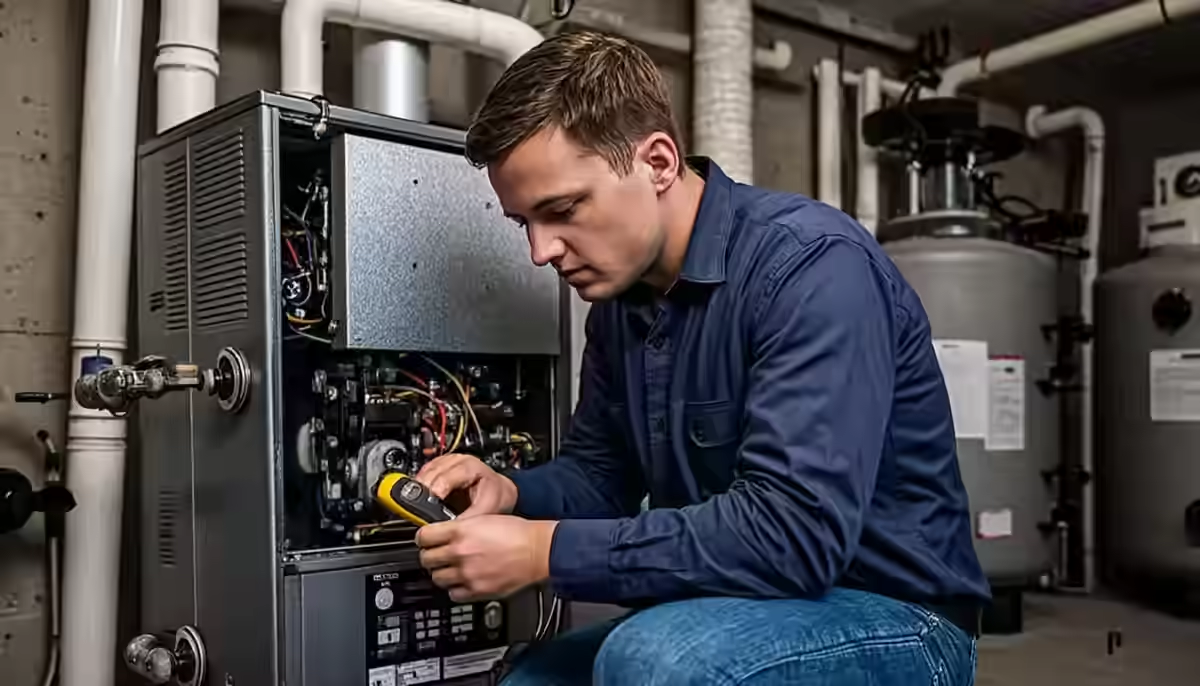
The pressure switch is your furnace's ignition bouncer: before the gas valve is allowed to open, the switch must feel proof, in negative pressure, that the vent is actually carrying combustion gases outside. Stuck open means the inducer fan runs, you hear it, the burners never light, and the control board eventually flashes a fault code and locks out. The furnace is not broken so much as refusing to light a fire it cannot prove it can vent, which is the safety system working exactly as designed, at the worst possible hour.
The honest diagnosis: the switch itself is the culprit only sometimes. In Metro Vancouver the cause ranking from our service calls runs, first, the vent, an iced or snow-buried sidewall termination, a bird nest, a blocked flue; second, the sensing hose, cracked, kinked or waterlogged with condensate; third, a weakening inducer motor; and only then the switch's own fatigued diaphragm. That ranking is why the repair bill for a pressure switch code lands anywhere from nearly $0, you clear the ice off your own vent, to $280-650 for the switch and its immediate plumbing, to $450-1,200 if the inducer is dying. Our $89 diagnostic, credited to any repair, is how you find out which before spending.
One rule outranks everything else in this guide, so it gets stated in the first chapter and repeated in its own: never jumper a pressure switch to force ignition. Every winter the internet teaches some brave homeowner that trick, and every winter furnace repair crews explain to the next one why bypassing the draft proof is how carbon monoxide enters a house. Chapter 9 covers it properly.
A pressure switch stuck open is annoying. A pressure switch jumped shut is dangerous. The furnace that refuses to start in November is making the safer mistake.
$0-$0 repair
The honest band for a pressure switch repair visit in Metro Vancouver: diagnosis, correct-rated part, labour, commissioning.
4 causes, ranked
Vent blockage first, sensing hose second, inducer third, the switch's own diaphragm fourth. The part everyone blames is the part least often guilty.
Never jumper
The switch is the last thing standing between a bad flue and carbon monoxide in your hallway. There is no version of this repair that starts with bypassing it.
What the Switch Actually Proves
Modern gas furnaces light in a strict sequence, and every step is a permission slip for the next. The thermostat calls for heat. The induced-draft blower, a small fan that pushes combustion gases through the heat exchanger and out the flue, spins up first and must reach speed. Its spinning creates a slight vacuum inside the exchanger, and the pressure switch, a palm-sized disc with a rubber diaphragm and two wires, sits on that vacuum through a small sensing hose. When the draft is real, the diaphragm sucks in, the electrical contact closes, and the signal tells the control board: venting proven, you may open the gas valve. Ignition follows, and the house warms.
The vacuum is tiny and precisely specified. Technicians measure it in inches of water column, and a typical high-efficiency furnace wants to see something in the range of minus half an inch to minus two inches WC at the switch, with the exact setpoint printed on the switch's own label. Too little vacuum, a blocked flue, a slow inducer, a leaking hose, and the contact never closes. The board waits a few seconds, reads an open circuit, and shuts the sequence down before a single cubic foot of gas is released. That is the entire drama of a stuck-open code: a furnace that will not gamble.
Two details complete the picture. High-efficiency condensing furnaces, the two-pipe sidewall-vented units common across BC since the 1990s, prove draft on both pipes, and their combustion produces acidic condensate that must drain freely, which is why a frozen condensate line can imitate a pressure switch fault even though the switch and flue are both fine. And the switch comes in a family of setpoints, which matters at repair time: the replacement must match the rating printed on the original, because a switch with the wrong water-column setting either never closes or closes when it should not, and both are wrong answers.
Reading the Blink Before the Truck Arrives
When the sequence aborts, the control board reports itself in flashes: a LED on the board itself blinks a pattern, and the legend translating it lives on a sticker inside the blower compartment door. Take the door off, count the blinks, match the pattern, and you have transformed a mystery into a sentence. On many common board families, three flashes is the pressure switch stuck open code; others use two flashes for an open switch and three for a switch that closed when it should not have; some blink long-short patterns that read like Morse. The chart on your door is the truth for your furnace, and a photo of it, pattern and legend together, is the single most useful thing you can text your technician.
| What you observe | What it usually means | Your move |
|---|---|---|
| Inducer runs, no ignition, three flashes (many boards) | Pressure switch open: draft not proven | Check the vent outside and the hose, Chapter 5-6; then book the diagnostic |
| Inducer runs, switch code, furnace lights on second try | Marginal draft: weakening inducer or partial flue restriction | Book it before the cold snap finishes the job |
| Nothing runs at all, no codes | Power, thermostat, board or fuse, a different conversation | The full no-heat triage in our furnace-not-working guide |
| Code clears after clearing ice or snow, returns next cold night | Vent termination or slope problem, not the switch | Vent correction work; the switch is the messenger |
A note on lockouts: after a failed sequence, most boards try a set number of times and then sit in hard lockout until power is cycled. Resetting once to observe the sequence is reasonable. Resetting all night is not, because each cycle is a real ignition attempt on a vent somebody has not yet inspected, and the pattern, works-every-second-try, is diagnostic gold you are erasing. Two resets, then leave it off and call, is the professional's habit and a good one to copy. The furnace troubleshooting guide covers the other eleven checks this symptom is not.
The Safe Homeowner Checklist
There is a short list of checks a homeowner can run without tools, and it finds the cause often enough to be worth the ten minutes. The sequence, in the order that pays off most often in November:
Walk outside to the vent terminations
Two pipes on the wall for high-efficiency furnaces, one exhaust, one intake. Snow drifted over them, an icicle growing off the exhaust, frost plugging the intake screen: each is a five-minute fix with a broom and a few minutes of patience. Do it gently, the pipes are plastic.
Listen to the startup
Thermostat up two degrees, stand at the furnace. Inducer running with no ignition and a fault light is the classic stuck-open signature. Inducer not running at all is a different fault with a different chapter.
Eyes on the hose, power off
Switch the furnace power off, find the small rubber hose from the switch to the inducer housing, and look: cracked ends, a kink, or water sitting in the loop. Reseating a loose end or draining the water costs nothing and fixes a remarkable share of these calls.
Confirm the condensate drains
A frozen or clogged condensate line backs the furnace's own wastewater up, and several boards report it as a pressure fault. If the condensate line is iced where it exits the house, warm it gently, never with an open flame, and see if the fault clears.
That is the entire safe list. What is not on it: opening the burner compartment, testing wires with anything conductive, and every version of the jumper trick. The line between homeowner checks and licensed work is not turf protection, it is the line between the venting-adjacent parts you can see and the combustion-sequence parts that can hurt you, and the heating crews who take these calls every cold snap would rather explain a house call than a hospital visit.
Cause One: The Wet-Coast Flue
The number one pressure switch culprit in Metro Vancouver is the vent termination, and the region's climate works at it from three directions at once. The outflow cold snap, the December-to-February pattern where Arctic air funnels down the Fraser Valley and out the Strait, drives wind chills through the valleys and freezes the moisture in exhaust gases right at the termination: a high-efficiency furnace breathes out a plume of warm, wet air, and in outflow wind that plume condenses and rims the pipe with ice until the draft the switch is measuring disappears. Snow adds the second front, a drift against the wall or a plow ridge burying both pipes, and the third front is biological: bird nests in spring, wasp nests in summer, and the occasional dead bird delivered by autumn, each a draft blocker that reports itself as a switch fault in the first cold week.
The permanent fixes are unglamorous and effective. Termination clearances brought to code, pipes high enough off grade and clear of drift zones, a correctly sized vent cap or elbow kit that keeps the plume off the intake, sections re-sloped so condensate runs back toward the drain instead of pooling and freezing in a low spot, and, for the chronic offenders, insulated vent sections on exposed walls. In older neighbourhoods from New Westminster to North Vancouver, we also find legacy flues, metal B-vent chimneys shared or abandoned, partially capped, or home to decades of debris, and those need a licensed inspection rather than a broom.
The homeowner habit that prevents most of this chapter costs one minute per storm: after every big snowfall and every outflow night, walk around the house and eyeball the vent pipes. Ice at the exhaust, frost on the intake, snow against the wall, clear it gently. The families who do this almost never meet us for a pressure switch call in January; the ones who do not, we know by name by Christmas.
Cause Two: The Ten-Dollar Hose
Between the switch and the inducer housing runs a rubber hose the diameter of a pencil, and it fails in three ways that each imitate a $400 problem. It cracks at the ends, where years of heat cycling harden the rubber until the seal against the fittings leaks just enough that the vacuum never reaches the setpoint. It kinks, usually after somebody rerouted it slightly during an earlier repair and left it one bend too far. And it fills with water, condensate running backward down the line when the drainage path is lazy, so the liquid column sits in the hose and the switch reads a pressure that is half draft and half water. A hose with water in it can also freeze in a cold garage or mechanical room corner, which turns an intermittent November fault into a hard no-heat on the coldest night.
The repair is exactly as small as it sounds: a fresh section of the correct pressure-rated hose, routed with a downhill loop so condensate cannot pool, ends seated firmly, and the sensing port on the inducer housing cleared of any debris or corrosion that was capping it. In our flat-rate world this is a short-labour job, and it is why a pressure switch code sometimes resolves for a fraction of the price of the switch itself. When the diagnostic finds the hose, the honest technician replaces it on principle even when it looks survivable, because a ten-year-old hose that failed once has told you its plans.
One cousin of the hose deserves its own sentence: the sensing port on the inducer housing can corrode or clog on older units, so the hose is fine, the switch is fine, and the port itself is not passing vacuum. Clearing or re-tapping that port is part of the same short visit, and it is the classic example of why this fault family rewards diagnosis over parts-swapping, which is what the $89 credited diagnostic exists to prevent.
Cause Three: The Tired Inducer
When the vent is clear and the hose is new and the switch still refuses to close, the question moves to the induced-draft blower: is it actually producing the vacuum it was born with? Inducers weaken with age in ways the ear can sometimes catch. A screech or grind at startup is bearings, and bearings never improve. A slower ramp than spec, the motor taking an extra second or two to wind up, drops the vacuum below setpoint exactly on the coldest starts, when the flue is longest and the air densest, which is why the marginal inducer announces itself in January and behaves all April. And a housing that has taken condensate through a failed drain path rusts internally until the wheel's balance and clearance are gone.
The tell a technician measures, and the number that settles the argument, is the vacuum at the switch port against the setpoint on the label: a healthy system reads comfortably past the rating, a marginal one skims it, and a failing one misses it on cold starts. Inducer replacement in Metro Vancouver runs $450 to $1,200 installed, the wide band reflecting the range of motor assemblies across brands and eras, and the repair-versus-replace math depends on the furnace around it: on a 12-year-old unit, replace the inducer and carry on; on a 20-year-old unit, the inducer is often the last major component before the repair versus replacement conversation, and it deserves that context in writing before anyone orders the part.
A footnote worth remembering: repeated pressure switch codes on the same furnace across two or three winters, with the switch replaced each time, is the classic misdiagnosed inducer. The switch was never lying; it was accurately reporting a draft that was slowly getting harder to produce. Pattern, not parts, is what diagnosis is for.
Cause Four: The Switch Itself, and Why the Part Number Matters
Finally, sometimes it is the switch. The rubber diaphragm inside ages, stiffens, and stops making the tiny travel the vacuum asks of it; the contact pits; the disc cracks at a fitting. A genuine switch failure is real and common enough, it is simply fourth in line behind three things that imitate it, which is the whole reason this article exists. The repair visit for a confirmed failed switch, correct part, labour, verification of the draft before and after, runs $280 to $650, with the part itself typically $180 to $350 across the common brands.
The detail that separates a proper repair from a callback is the rating. Pressure switches are calibrated to specific water-column setpoints, and the setpoint is printed on the switch label along with the part number. There is no universal substitute, and there is no upgrading to a more sensitive or less sensitive unit to make a marginal draft look fine: a switch with the wrong rating either refuses to close on a healthy system, the same no-heat you started with, or closes on a system whose draft is not actually proven, which is the failure mode Chapter 9 exists to prevent. The correct part, matched by number and rating, verified with a manometer before and after, is the entire professional standard, and it is the standard on every furnace repair we run in Surrey and everywhere else we serve.
Warranty note while we are here: a pressure switch replaced under a parts warranty still carries diagnostic and labour costs unless your plan covers them, and a switch failing repeatedly on the same furnace is telling you to look upstream, at the vent or the inducer, not at the warranty desk.
The Bypass Taboo, and What a Red Tag Means
Somewhere on every DIY forum there is a confident post explaining how to jumper the pressure switch wires to get the furnace running tonight. The physics of why that post is dangerous is one sentence long: the switch is the only component proving that combustion gases are leaving the building, and a jumper tells the board that proof exists when it does not. A furnace tricked into igniting against a blocked or failing vent delivers its exhaust somewhere, and inside a sealed winter house, that somewhere is your air. Carbon monoxide is odourless, it accumulates, and it kills British Columbians most winters, usually in exactly this kind of improvised-circumstances scenario. No licensed technician will jumper a pressure switch in your home, and the ones who see it done disable the furnace on the spot.
That disabling has a name: a red tag, and understanding it removes the fear from the term. Red tags are the mechanism licensed contractors use under Technical Safety BC rules to take unsafe gas equipment out of service: a red tag means a hazard was found, a warning tag means a deficiency with a correction deadline, and in both cases the paperwork goes to the safety authority. A red-tagged furnace can be repaired and re-inspected, often the same week, and the tag itself is not a fine or a black mark on the house, it is a safety system catching a problem before it catches a family. If your furnace ever gets tagged, the path is straightforward: documented repair, re-inspection, tag cleared.
The overnight bridge when the furnace is down and the repair is booked: electric space heaters on their own circuits, sealed-door safety first, taps trickling if the deep freeze is in town, and everyone sleeping with working CO alarms. It is a colder night than the jumper promise, and it is the version everyone wakes up from. Gas odour at any point means outside first, FortisBC at 1-800-663-9911 second, and everything else third.
The Costs, Laid Out Flat
The full price ladder for a pressure switch fault, from the DIY fix to the worst case, using our Metro Vancouver flat-rate sheet:
| Outcome of the diagnostic | Typical cost | Notes |
|---|---|---|
| Vent blocked by snow or ice, homeowner clears it | $0 | The one-minute-per-storm habit prevents this chapter |
| Diagnostic visit, any cause | $89 | Credited in full to any repair it leads to |
| Hose replacement, port clearing | $150-$280 | Short-labour job; often bundled with the diagnostic credit |
| Pressure switch replacement, correct-rated part | $280-$650 | Part $180-$350, plus labour and before/after draft verification |
| Vent termination correction, cap, slope, clearances | $250-$800 | The permanent fix for repeat winter codes |
| Inducer motor replacement | $450-$1,200 | Triggers the repair-versus-replace math on older furnaces |
| After-hours emergency visit | +$150 flat | Posted in advance, no multipliers by the hour |
The pattern to notice: the ladder's cheap rungs are the common causes, and the expensive rungs are the rare ones. That is the statistical argument for diagnosis-first, and the argument against the parts-cannon approach, replacing the switch on speculation and discovering the vent was the problem on the second no-heat call. Financing from 7.99% OAC exists when the answer lands on the inducer-plus-old-furnace rung and the honest conversation becomes replacement instead, with new furnaces running $4,800 to $9,500 installed.
Prevention: The Boring Stuff That Works
Every cause in this guide has a prevention, and none of it is exotic. The annual maintenance visit, $149 to $250, includes the pressure switch's whole world: the vent terminations inspected, the hose examined and re-seated or replaced, the draft measured against the switch rating with a manometer, the condensate path flushed, the inducer listened to by someone who knows what its last five winters sounded like. Done in October, before the first outflow night, it converts most January pressure switch calls into a line item on a report you read in the spring.
The homeowner's list is shorter and just as real: the one-minute vent walk after every snowfall and cold-snap night, ice and frost cleared gently; the condensate exit kept clear and never allowed to freeze against the foundation; nothing stored against the vent pipes, inside or out; and the CO alarms, one per floor and outside the bedrooms, tested on the same schedule as the smoke alarms. The full seasonal version of this list lives in our winter prep guide, written for exactly the November-to-February window this fault loves.
And the last habit is the one this whole guide has been building: when the switch code appears, read it as a message rather than a malfunction. Something in the venting chain is not measuring up, and the diagnostic that identifies it, $89, credited, is cheaper than one parts-cannon weekend and safer than one jumper. Book it before the next cold snap books it for you.
Book the Diagnostic Before the Next Cold Snap
The $89 diagnostic, credited to any repair, covers the full sequence: draft measured against the switch rating, hose and ports inspected, vent terminations and condensate path checked, inducer assessed. You get the cause, the photo, and a written price before we touch anything. Emergency crews answer 24/7 all winter with a flat $150 after-hours premium posted in advance.
Frequently Asked Questions
Services From This Guide
Red Seal crews, licensed gas fitters and flat-rate pricing across the twelve Metro Vancouver cities we serve, from Vancouver, Burnaby and the North Shore through Surrey, Delta and Coquitlam out to Langley, Abbotsford and Maple Ridge.
Furnace Repair Vancouver
No-heat diagnostics 24/7, $89 credited, repairs $180-450.
Heating Services
Furnaces $4,800-9,500, maintenance $149-250, gas fitters on every crew.
Furnace Repair Surrey
Fraser Valley no-heat response, cold-snap ready.
24/7 Emergency Repair
$150 flat after-hours premium, live dispatch all winter.
Pressure switch calls spike with the first outflow wind of every November, and our Red Seal crews have pulled birds, wasp nests, icicles and one memorable hockey card out of Metro Vancouver flues. This guide is the diagnostic sequence our technicians actually run, written for homeowners who want to understand the blinking light before the truck arrives, and it names the one shortcut, jumping the switch, that we will never stop warning about. To book instead of DIY, see furnace repair in Vancouver — same-day across the city.
More about our team →Get the No-Ignition Call Booked Before the Cold Snap
A diagnostic visit runs $89, credited to any repair, and covers the full sequence: inducer, hose, switch pressure against rating, flue and termination. You get the measurement, the cause and a written price before we touch anything. Zero obligation beyond the diagnosis you already needed. If you would rather hand this to a pro, our heating & furnace services pages cover Metro Vancouver.
No heat tonight?
Emergency calls are answered 24/7 with live dispatch and a flat $150 after-hours premium posted in advance. The $89 diagnostic is credited to any repair, and most furnace repairs run $180 to $450, pressure switch repairs $280 to $650.
Call 604-615-2212 WhatsApp Us