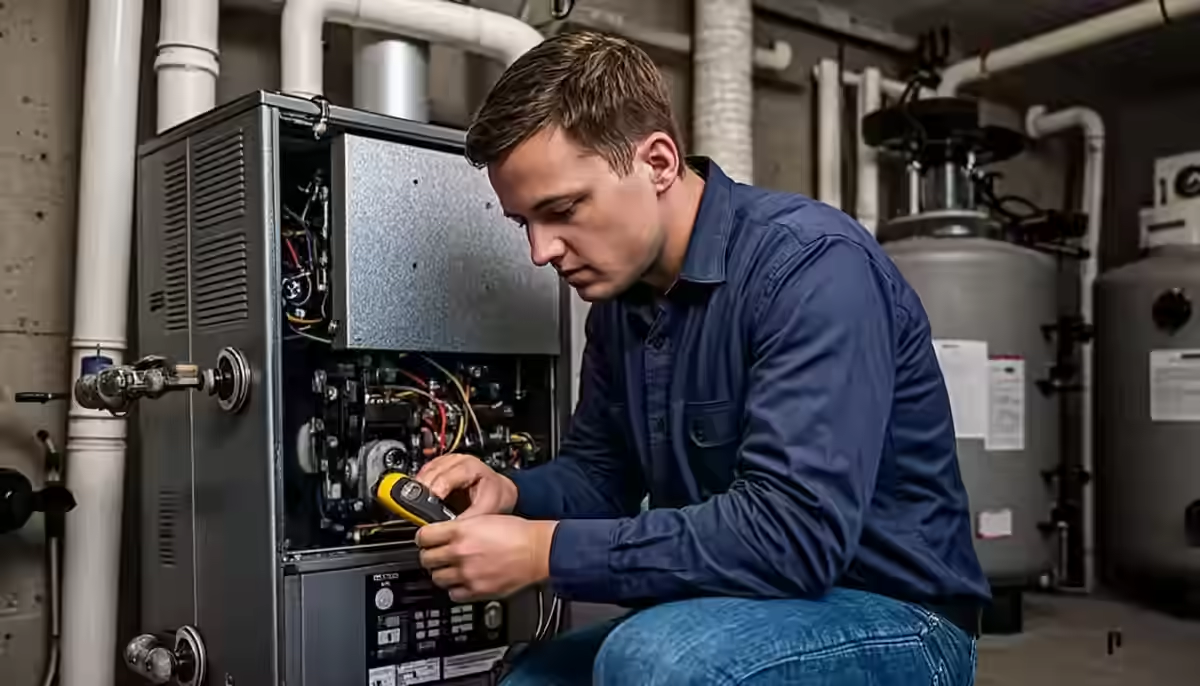
The Honest Answer Up Front
Short cycling means your furnace starts, runs a few minutes, shuts down, and does it all again before the house is properly warm — usually under ten minutes of run time per cycle, sometimes as often as every five minutes, hour after hour. It is not a fault in its own right. It is a symptom with seven common root causes, and in Metro Vancouver the top two are a loaded air filter and a film-covered flame sensor. Both are cheap. Five of the seven causes can be checked by a homeowner with a phone flashlight and ten minutes, which is exactly what this guide walks you through.
The money picture, stated plainly: a filter swap is $20 to $40 in parts from any hardware store. A flame sensor cleaning typically lands inside our $89 diagnostic, and that fee is credited to any repair we perform. A limit switch or pressure switch replacement runs $180 to $350 installed. A blower motor runs $500 to $2,200 depending on whether your furnace uses a basic PSC motor or an ECM. And the one cause that cannot be repaired at any price — a furnace that was simply installed too big for the house in the first place — ends in a right-sized replacement at $4,800 to $9,500 installed. Most short cycling calls we run through the fall resolve between $0 and $450, and if you are in the Fraser Valley's furnace heartland, our furnace repair page for Surrey covers same-day diagnostic availability.
What you should not do is ignore it and hope. A furnace that short cycles through a BC heating season logs two to three times the ignitions of a healthy one, and every ignition is a thermal shock to the heat exchanger, a spin-up for two motors, and a spark event for the igniter. It is the mechanical equivalent of stop-and-go city driving: the odometer looks fine and the engine wears out anyway. The house also pays in comfort — short blasts of hot air leave cold floors and hot ceilings, which in older Vancouver housing stock is the difference between a house that feels warm and a house that reads warm on the thermostat.
A furnace earns its lifespan in steady run time. When a customer tells me it runs "two minutes, off, two minutes, off," I already know one of three things before I open the door: airflow, flame sense, or sizing. The diagnostic just tells me which.
What a Healthy Cycle Actually Looks Like
Before you diagnose anything, you need a baseline, because "on and off a lot" means different things on different days. A properly sized furnace in a Metro Vancouver home runs 10 to 20 minutes per cycle on a cold January evening, fires 3 to 6 times an hour at most, and holds the thermostat within half a degree. On a mild October afternoon at 9°C, that same furnace might run only 6 to 8 minutes and that is correct behaviour — the house barely needs heat, so the burner barely runs. Homeowners notice the short mild-weather cycles in fall, panic, and call about a problem that does not exist yet.
The distinction that matters is load. Short cycling is only a fault when it happens against a real heating load — cold nights, thermostat set several degrees below room temperature, and the furnace still quits in under five minutes. That is the machine telling you it is being prevented from doing its job, either because it cannot breathe (airflow), cannot confirm its own flame (flame sense), is being told to quit early (thermostat or limit), or physically cannot shed its heat fast enough because it is oversized for the ducts it feeds.
| What you are seeing | What it usually means | Concern level |
|---|---|---|
| Runs 10-20 min, 3-6 starts/hour on a cold evening | Healthy, correctly sized furnace | None |
| Runs 6-8 min on a mild 8°C afternoon | Normal for low-load days | None |
| Under 5 minutes per cycle in any weather, hourly restarts | Short cycling — airflow, flame sense, control or limit fault | Book a diagnostic |
| Burner lights for 3-10 seconds, dies, retries, then nothing | Flame sense failure or ignition lockout — a cousin of short cycling | Book now, stop resetting |
| Burner shuts early, blower keeps running hard, restarts later | High limit tripping on restricted airflow | Check filter, then book |
| Runs long but the house never warms properly | Envelope, duct or sizing problem — a different failure entirely | Assessment visit |
That last row matters because homeowners often bundle every furnace misbehaviour into "short cycling." A furnace that runs constantly without warming the house is the opposite problem, and we cover the full no-heat and not-warming walkthrough in our furnace not working guide. This article is strictly about the start-stop pattern — the furnace that quits before the work is done and comes back too soon.
Start With the Twenty-Dollar Answer: the Filter
The most common short cycling cause we find between October and February is also the most boring: a filter that has quietly turned into a wall. BC homes are sealed tight from October to April, which means every gram of dust, pet dander and renovation debris in the house passes through that filter repeatedly. Homes near arterial routes like Knight Street, Kingsway or the Mary Hill Bypass load filters with road dust noticeably faster than quiet-street homes. And in a city that renovates as constantly as Vancouver, one weekend of drywall sanding can finish a filter that had two months of life left.
The mechanism matters because it explains the symptom. A loaded filter starves the blower of return air. Less air across the heat exchanger means the exchanger runs hotter than its design temperature, the high limit switch reads that temperature and opens as a safety, and the burner shuts down mid-cycle while the blower keeps running to purge the heat. Ten minutes later the exchanger has cooled, the limit closes, and the cycle starts again. From the living room it looks like a furnace with a gremlin. From inside the cabinet it is a furnace protecting itself, exactly as designed.
The check takes thirty seconds and no skill. Pull the filter and hold it up to a light — if you cannot see the bulb clearly through the media, it is done, and it was likely done weeks ago. While you are there, sanity-check the rating: a MERV 8 to 11 one-inch filter is right for most older blowers. We regularly find MERV 13 filters jammed into forty-year-old Vancouver Special return boxes, which restricts airflow so badly that a clean filter still trips limits. Swap in a fresh one, run the furnace through a cold evening, and if the cycling stretches out, you have solved a $400 service call for under $20.
The Flame Sensor: A Forty-Dollar Part That Behaves Like a Ghost
The flame sensor is a thin metal rod sitting in the burner flame, and its job is philosophical: it proves to the control board that the gas it opened the valve for actually caught fire. Flame conducts a tiny rectified current — the board reads it in microamps, and most boards want to see well above half a microamp to stay satisfied. When the rod gets coated in a film of combustion byproducts and airborne silica, the current drops below threshold, the board decides the flame is out, and it closes the gas valve three to ten seconds after lighting. The burner retries a few times, then the board locks out for an hour or three.
BC's climate makes this worse than the national average. Coastal humidity keeps household dust slightly sticky, condensing furnaces produce a slightly acidic condensate environment, and our long September-to-May heating season puts more ignition events on each sensor than a Prairie furnace sees in two years. The classic presentation is a furnace that works all afternoon, then fails at 2 a.m. on the coldest night of November, then works again when the tech arrives — because the failure is marginal and temperature-dependent, and by morning the sensor passes again. We call those ghosts, and they are why we clean and microamp-test the sensor rather than just eyeballing it.
The fix is a clean with a fine abrasive pad — our techs use Scotch-Brite, never coarse sandpaper, because grit embedded in the rod becomes a seed for the next film. Cleaning happens within the $89 diagnostic, which credits toward any repair. If the rod is cracked or the porcelain insulator is compromised, a new sensor installed runs $180 to $350. Two warnings from the field: do not "test" a suspect sensor by bypassing anything, and do not let anyone sell you a full control board before the sensor has been cleaned and measured. A surprising share of "bad board" diagnoses in this province are a $40 sensor wearing a costume.
Thermostat and Wiring: The Brain That Can Lie
The thermostat decides when a cycle starts and when it ends, so every short cycling investigation has to clear it. The classic in older homes is placement: a thermostat mounted in a hallway directly fed by a supply register, or in a drafty front entry where the door swings open every twenty minutes, reads temperatures that have nothing to do with the living room it is supposed to represent. It calls for heat, gets blasted by its own register, satisfies in four minutes, and shuts the furnace down. Vancouver Specials with their single main-floor thermostat and closed-off bedrooms are prime territory.
Smart thermostats bring a second set of failure modes. A Nest or ecobee configured for the wrong equipment — heat pump settings on a gas furnace, or aggressive smart-recovery algorithms — can produce cycling patterns that look exactly like a mechanical fault. Dying batteries cause brownout resets mid-call. And in homes that have been renovated, the low-voltage wire between thermostat and furnace is a common casualty: a staple nicked by a drywaller five years ago finally corrodes through, and the signal drops in and out with the humidity. Meanwhile, the old mercury thermostats still soldiering on in many 1960s and 70s Metro Vancouver homes have adjustable heat anticipators that, set wrong, cycle a furnace like a washing machine.
Your diagnostic lever is observation: when the furnace quits, check whether the thermostat still shows "heating." If the display stopped calling the instant the furnace stopped, the thermostat ended the cycle — location, configuration or wiring. If the thermostat is still calling for heat while the furnace sits silent, the thermostat is innocent and the fault is inside the cabinet. Thermostat replacement runs $250 to $550 installed, with smart units at the upper end, and it comes with proper placement advice instead of the wall where the old one happened to be.
Overheating: When the High Limit Is Doing Its Job
The high limit switch is a temperature-triggered circuit breaker for the heat exchanger, and on most residential furnaces it trips somewhere in the 170 to 200°F range depending on brand. When it trips, the burner dies and the blower keeps running — hard — to pull the excess heat off the exchanger. The signature from the living room is a furnace that quits mid-cycle with the fan still roaring, sits quiet for several minutes, then fires again on its own. Homeowners often describe it as "overheating and shutting off," and they are exactly right; the question is why the exchanger got hot enough to need protection.
Beyond the filter, the usual suspects are all airflow crimes: a return grille buried behind a couch or a new storage wall; too many supply registers closed because a bedroom got converted into an office; a blower wheel felted with pet hair, which loads up over the summer AC season and then starves heating airflow in October; a failing blower capacitor that lets the motor lug; and the granddaddy of them all in this region — undersized or badly laid out return ducting in 1960s and 70s ranchers, where the furnace was upgraded over the years but the ductwork never was. In two-storey homes with basement suites, closed suite doors plus a single shared return can push a furnace into limit trips every single cycle.
Repair costs follow the cause: blower capacitors are $180 to $250 installed, a blower wheel cleaning runs $180 to $350, PSC blower motors run $500 to $900, ECM motors $900 to $2,200, and limit switches themselves — when they simply fatigue after a decade of trips — are $180 to $350. Duct modifications are quoted after assessment, and honestly, they are sometimes the repair that finally stops a lifetime of short cycling in an older home. Every heating service visit we run includes a static pressure reading for exactly this reason: it is the one number that says whether the ductwork can feed the furnace above it.
The Furnace That Was Always Too Big
Every few weeks we meet a furnace that has short cycled since the day it was installed, and no filter, sensor or switch will ever fix it. Metro Vancouver's design temperatures are mild — roughly -7°C for Vancouver, Richmond and North Vancouver, sliding toward -10 to -12°C for the Fraser Valley communities like Langley, Maple Ridge and Abbotsford — and a typical 2,000 to 2,800 square foot detached home here needs roughly 45,000 to 70,000 BTU per hour at design. Through the 1980s and 1990s, a lot of furnaces were sized by the square-foot-per-BTU folk wisdom of the era, and 100,000 to 125,000 BTU input units went into houses that needed two-thirds of that. Oversizing was free insurance in the sales pitch and a hidden defect on the install date.
An oversized furnace satisfies the thermostat fast, and fast satisfaction is the entire problem. The burner dumps heat quicker than the ducts and rooms can absorb it, supply air temperatures spike, the house gets pockets of hot and cold air because the blower never runs long enough to mix the air properly, and the furnace racks up ignitions. There is a fuel penalty too — the first ninety seconds of any cycle are purge, ignition and heat-up, the least efficient burn of the whole sequence, and a furnace that runs five cycles where one would do pays that toll five times. It also dehumidifies and filters less in summer if the same blower serves an AC coil, because runtime is where both of those jobs happen.
The honest options are three. One: keep the furnace, fix everything around it — perfect filter discipline, clean blower, sealed ducts — and accept that it will still cycle short, just less dramatically. Two: replace it, at today's installed pricing of $4,800 to $9,500 for a properly sized gas furnace, or pivot to a heat pump if the electrification math appeals. Three: if a replacement conversation is already on the table for other reasons, this is the moment to right-size, because it is the only fix that actually addresses the disease rather than the symptom. Our repair versus replace guide runs the full decision math, and a Manual J load calculation — not a rule of thumb — is the only honest way to confirm the diagnosis.
What the Fixes Cost, Honestly
This is the table our customers ask for at the door, so here it is in full. Prices are installed, honest ranges for Metro Vancouver in 2026, and final pricing is always confirmed in writing after we have actually diagnosed your furnace — anyone quoting a repair price before seeing the unit is quoting a guess. The diagnostic itself is $89 and is credited to any repair we perform, so the true cost of finding out is zero if you fix it with us.
| Root cause | The fix | Typical installed cost (BC) |
|---|---|---|
| Loaded filter restricting airflow | Filter swap, correct MERV | $20-40 DIY |
| Flame sensor film | Clean and microamp-test | Within $89 diagnostic (credited) |
| Failed flame sensor | Replace sensor rod | $180-350 |
| Thermostat fault or bad placement | Replace and relocate | $250-550 |
| High limit switch fatigue | Replace limit, verify airflow | $180-350 |
| Blower capacitor | Replace capacitor | $180-250 |
| Dirty blower wheel | Pull, wash and rebalance wheel | $180-350 |
| PSC blower motor failure | Motor replacement | $500-900 |
| ECM blower motor failure | Motor or module replacement | $900-2,200 |
| Oversized furnace | Right-sized replacement | $4,800-9,500 |
A few notes from the field. Repairs generally land inside our $180 to $450 flat-rate band, with motors and boards the common exceptions. After-hours emergency calls carry a flat $150 premium — posted in advance, never a percentage — and if you are facing the replacement end of this table, financing starts from 7.99% OAC and our 24/7 emergency service page explains exactly how dispatch works at 2 a.m. in January.
What a Season of Short Cycling Actually Costs You
Here is the arithmetic that turns "it's annoying" into "it's expensive." A healthy furnace in a Metro Vancouver home averages roughly four starts per hour across a ten-hour heating day and a 230-day heating season — call it 9,000 to 10,000 ignitions a year. A furnace cycling every five minutes logs double that, and a severe case cycling every three to four minutes clears 20,000. Igniters are rated in cycles, gas valves and board relays age in cycles, inducer and blower bearings take a spin-up hammering with every cycle, and the heat exchanger endures a full thermal shock from cold to 300-something°F and back, every time.
Fuel is the quieter penalty. The purge, ignition and warm-up phase of every cycle burns gas at the lowest efficiency of the entire run, and a furnace that runs five short cycles instead of one long one pays that toll five times over. Industry testing puts cycling losses in the 5 to 10 percent range, which on a typical Metro Vancouver gas bill is real money by March. Comfort is the third cost, and anyone who has lived above a short cycling furnace knows it: the room overshoots, cools, overshoots again, and the thermostat becomes a suggestion box.
Run the math forward and the conclusion writes itself: short cycling is a problem worth a few hundred dollars of diagnosis and repair this month, because the alternative is replacing a heat exchanger or a whole furnace years early. The winter prep checklist we publish every fall exists precisely because a thirty-minute October once-over catches most of these causes before the season does.
0,000+ ignitions
What a severe short cycling season logs, versus roughly 9,500 for a healthy furnace — double the wear on every moving and sparking part.
0-10% fuel penalty
Cycling losses from purge-and-restart burns, paid on every gas bill from November to April until the cause is fixed.
$0 to find out
The credited diagnostic that identifies which of the seven causes you own — and costs nothing if you have the repair done.
Five Checks to Make Before You Call Anyone
These five checks take twenty minutes total and eliminate the majority of our short cycling call-outs before they become call-outs. Do them in order, because they run cheapest to most informative.
One — the filter pull-and-light test. Slide the filter out and hold it up to a ceiling light. No clear view of the bulb, no further questions: replace it with a MERV 8 to 11 and re-run the furnace through an evening. This single step resolves a remarkable share of October cycling complaints.
Two — the register and return audit. Walk the house and count supply registers that are closed or blocked by furniture, then find every return grille and confirm it breathes freely. More than a third of registers closed, a return hidden behind a couch, or a suite bedroom door kept shut against a single shared return — each of these can push a healthy furnace into limit trips in an older Metro Vancouver floor plan.
Three — the thermostat sanity pass. Fresh batteries, fan set to AUTO (not ON, which masks cycling patterns), and a location check: is it in the blast path of a register or a drafty entry? Then, the next time the furnace quits mid-cycle, look at whether the display is still calling for heat. That single observation splits the problem in half.
Four — watch one full cycle at the furnace. Through the sight glass or with the blower door removed carefully (power comes off with the door on most furnaces — that is normal), watch the sequence: does the burner light, run a few minutes and die with the blower still running? That is the limit. Does the burner die within seconds of lighting, retry, then quit? That is flame sense. Does everything stop the moment the thermostat is satisfied? That is the thermostat, or a furnace that is simply too big.
Five — count starts per hour on a cold evening. Between 8 and 10 p.m. on a night below 5°C, count ignitions for one hour and note the pattern with a timestamp video. Anything over eight starts an hour against a real heating load is short cycling, and your fifteen-second video is worth more to a technician than a paragraph of description — it tells us which chapter of this article to start from.
What not to do, equally clearly: do not bypass or tape any switch to keep heat running, do not power-cycle a lockout more than once or twice, and do not sand a flame sensor with coarse grit. The first is dangerous, the second masks the evidence, and the third quietly guarantees you will need the sensor replaced anyway.
Fix or Replace: The Honest Line
Once the cause is known, the decision usually makes itself. The table below is the same logic our techs apply at the kitchen table, with the one rule of thumb worth memorizing: repair costs that climb past 30 to 40 percent of replacement value, on a furnace past its mid-teens, stop being repairs and start being instalments.
| Your situation | The honest call |
|---|---|
| Furnace under 10 years, one failed part (sensor, limit, capacitor) | Repair at $180-450 and keep up the maintenance — you have years of runway |
| Ages 12-18, first motor or control board failure | Repair if the quote sits under about a third of replacement value; start the replacement planning conversation |
| Over 15 years with a cracked heat exchanger or second major component | Replacement math almost always wins — heat exchanger cracks end the conversation on safety grounds |
| Any age, confirmed oversized, renovation or sale planned | Right-size at replacement, $4,800-9,500, and price the heat pump alternative while the walls are open |
| Short cycling for years, every cheap cause already eliminated | Pay for a Manual J load calculation before paying for anything else |
I tell customers the same thing every November: pay once for the diagnosis, not all winter for the symptom. A $250 flame sensor repair beats a $2,500 winter of stop-start gas bills and a furnace that ages two seasons in one.
If the table points you toward replacement, the sizing conversation is the one to have before the brand conversation — and our furnace installation page for Vancouver walks through what a proper load-calc-based quote includes, from Manual J to permit to combustion testing at start-up. Wherever you land, land there on purpose.
Stop the Start-Stop Pattern Before January
Book the $89 credited diagnostic and a Red Seal tech will time your cycles, read the control board, check static pressure and hand you the cause in writing — filter, flame sensor, limit, thermostat or sizing — with a flat-rate quote before any work begins. If it's a $30 filter, you'll hear that too.
Frequently Asked Questions
Services From This Guide
Licensed Red Seal crews serving Vancouver, Burnaby, Richmond, Surrey, Langley, Coquitlam, Delta, New Westminster, North Vancouver, Maple Ridge, Port Coquitlam and Abbotsford.
Heating Services
Repairs, installs and tune-ups, flat-rate, $89 diagnostic credited.
Furnace Repair in Surrey
Same-day diagnostics across Surrey and Cloverdale, repairs $180-450.
24/7 Emergency HVAC
Live dispatch around the clock, $150 flat after-hours premium.
HVAC in Vancouver
Heating and cooling service for Vancouver homes and suites.
Related Guides
Furnace Not Working? The Full Diagnostic Guide
No heat at all? Start with the complete no-heat walkthrough.
HeatingFurnace Repair vs Replace: The Honest Math
When a $300 fix makes sense and when you are polishing a tombstone.
SeasonalWinter Prep for Your Vancouver Home
The October checklist that prevents most November emergency calls.

We start chasing short cycling calls every October across twelve Metro Vancouver cities, and the same seven causes show up every season. This piece is the triage conversation our techs have at the door — what a healthy cycle looks like, which causes are cheap, which one means the furnace was doomed from install day, and what we check first. Written from 15-plus years of Red Seal field work and 12,000-plus jobs since 2010. To book instead of DIY, see furnace repair in Vancouver — same-day across the city. The symptom-by-symptom walkthrough is Furnace Short Cycling: 8 Causes & Fixes.
More about our team →Stop the Start-Stop Pattern Before January
Book the $89 diagnostic and a Red Seal tech will time your cycles, read the control board, and hand you the cause in writing — the fee is credited to any repair we do. Zero obligation, flat-rate quote before any work starts. If you would rather hand this to a pro, our heating & furnace services pages cover Metro Vancouver. The causes and fixes are laid out step by step in Furnace Short Cycling: 9 Causes and Real Fixes.
Furnace quitting at 2 a.m.?
We answer 24/7 with live dispatch. After-hours calls carry a flat $150 premium, posted in advance — no meter running, no surprises. The $89 diagnostic is credited to any repair.
Call 604-615-2212 WhatsApp Us