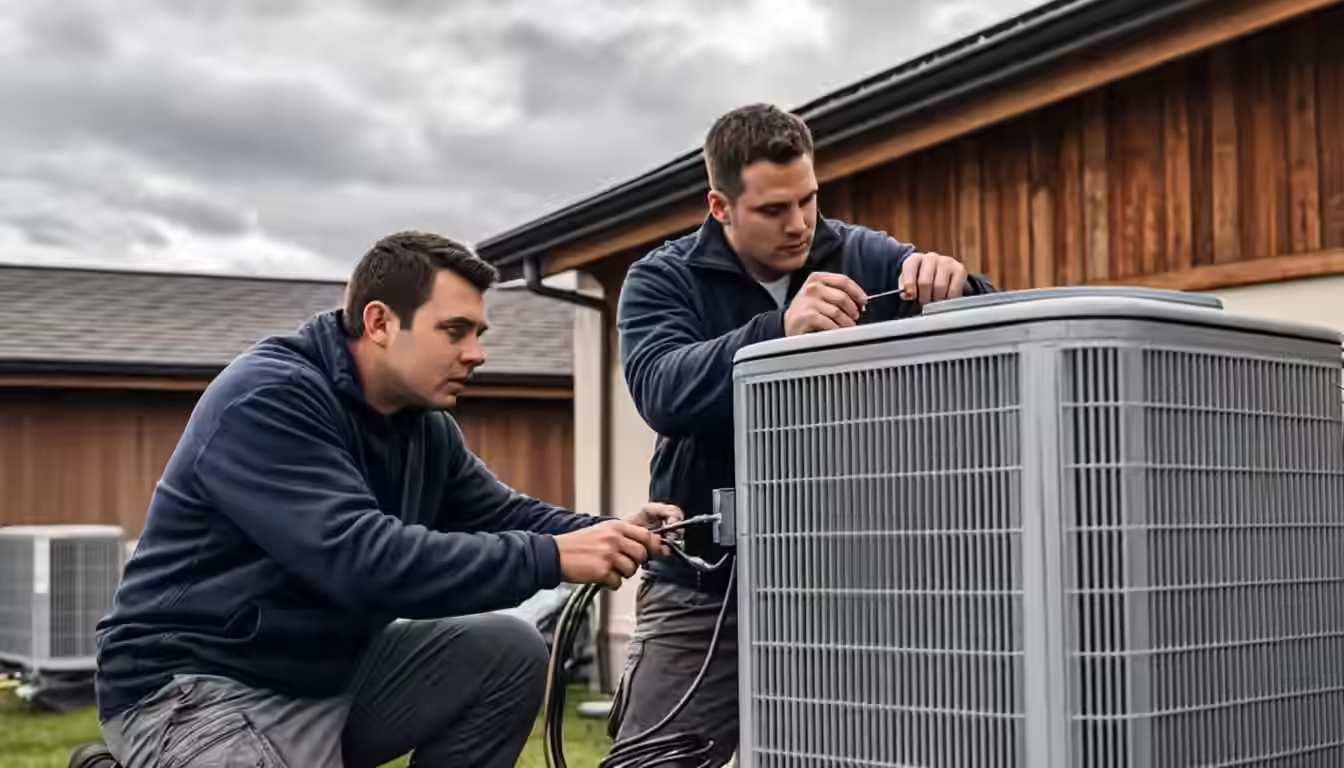
The Honest Answer Up Front
Most heat pump repairs in BC land between $180 and $450, all-in, parts and labour. That is the band we publish for cooling repairs, and it applies because a heat pump's cooling-side parts, capacitors, contactors, fan motors, defrost components, control boards, are the ones that fail most, in heating season just as much as July. The diagnostic that settles what your job actually is runs $89 to $129, credited in full to any repair you approve. After hours, the premium is a flat $150, disclosed before we roll. Maintenance visits are quoted per system, because a ductless head and a ducted air handler are different jobs, and we refuse to pretend one number covers both.
When a repair estimate pushes past the top of the band, the honest question becomes replacement arithmetic, and in 2026 BC that arithmetic includes the rebate stack. A ductless single-zone replacement runs $3,800 to $5,500. A cold-climate ducted heat pump runs $6,500 to $14,000, before combined CleanBC, BC Hydro, FortisBC and municipal support that can reach $16,000, with limited-time bonus top-ups of up to $1,000 in some seasons. Which means a $600 repair on a 14-year-old system and a $14,000 heat pump netting under $4,000 after incentives can be in the same conversation, and a good technician will put both on one page instead of steering you to one of them.
What this guide will not do is hand you a national average and call it local, because BC's climate genuinely changes both the failure profile and the service math: wet-coast coil fouling, winter defrost cycles, and the R-410A to R-454B refrigerant transition all move the numbers here in ways a Toronto blog post cannot. What it will do is give you every range, every factor and every question you need to judge the next quote in about a minute. Our heat pump teams have serviced these systems across Metro Vancouver since the technology was a curiosity here, and every number below is one we actually charge.
0 jobs since 2010
Heating, cooling and plumbing calls across 17 Metro Vancouver cities, heat pumps included since the early days.
0 typical repair band
Where most heat pump repairs land, parts and labour, after a diagnostic credited back in full.
0 star verified rating
From customers whose heat pump verdicts came with gauges attached and invoices that matched.
0 rebate stack potential
Combined CleanBC, BC Hydro, FortisBC and municipal support on qualifying conversions, paperwork handled.
Service vs Repair: Two Different Visits
The words get used interchangeably and the prices get confused, so the honest guide starts by separating them. A service visit, also called maintenance or a tune-up, is planned: the system is working, and the visit exists to keep it that way and to document its condition. A repair visit is unplanned: something has stopped working, or is about to, and the visit exists to find it and fix it. The first is quoted per system, the second starts with the $89 to $129 diagnostic that is credited to the repair.
What a proper service visit covers on a heat pump: coil cleaning on the outdoor unit, filter check and replacement guidance on the indoor side, electrical readings on the capacitors and contactors that fail in this climate, refrigerant and performance readings against the manufacturer's specification, a defrost-cycle verification coming out of winter, condensate drain treatment, and a written report on the whole system's condition. That report is the quiet half of the value: it is the paper trail that makes any future repair-versus-replace conversation honest, because it documents the system's condition over years rather than anyone's memory of it.
What a repair visit covers: everything the symptom demands. A heat pump that will not start gets the electrical side metered before anyone names a part. A heat pump that heats poorly but runs gets performance readings and a defrost check. A heat pump that ices up in winter gets the defrost system, the airflow and the refrigerant charge examined together, because ice has several fathers and replacing the wrong one is how a $250 repair becomes a $900 one. The heat pump guide for Vancouver homes covers the equipment side of all of this if you are new to the technology.
The Common Failures in a BC Climate
A heat pump in Metro Vancouver lives a different life than the same machine in Calgary or Toronto. In cooling season it fights the coastal classics: moss and algae growth on outdoor coils, cottonwood fluff in June, and general debris from the region's enthusiasm for trees. In heating season it runs the defrost cycle, sometimes for hours a day in our wet two-to-eight-degree stretch from November through February, because above the coast mountains the air is not cold so much as it is saturated, and saturated air ices a coil faster than dry cold ever does. Defrost boards, defrost sensors and the reversing valves that drive the cycle are, alongside capacitors, our most-replaced BC heat pump parts.
The rest of the failure list is shared with air conditioners everywhere: run and start capacitors that weaken with age and heat, contactors that pit and stick, condenser and blower fan motors that seize or wander, control boards that fail with the season's first power event, refrigerant leaks at corroded line-set fittings, and condensate drain clogs that back up into pan overflows. Nearly all of it falls inside the $180-$450 band, and most of it is preventable or at least postponable, which is the honest argument for the maintenance visit in Chapter 6. Our cooling teams keep the failure statistics, and the pattern has not changed in years: the maintained systems break half as often, and their repairs land lower in the band.
One failure category deserves its own sentence: ice. A light frost on the outdoor coil in damp cold is normal and the defrost cycle handles it. A block of ice that persists through a defrost cycle is not normal, and it is not a refrigerant problem until someone has checked the defrost system, the airflow and the filter first. Homeowners who diagnose ice as low refrigerant and refill are buying a repair of a symptom, and the honest diagnostic checks the cheap causes before pricing the expensive one.
The Cold-Climate Reality Check
The honest performance picture for BC: Metro Vancouver is close to ideal heat pump territory, because our winters are mild and damp rather than severe, and a cold-climate unit runs at high efficiency through almost every hour of a normal year. The Fraser Valley and the valley's cold pockets, Abbotsford, Mission, Maple Ridge on a clear January night, get the genuine cold snaps, and there the cold-climate designation matters: a proper cold-climate heat pump carries rated performance down to roughly minus fifteen and beyond, where standard units surrender capacity just as the house needs it most. Sizing for that night, with a proper load calculation, is what separates an install that heats confidently from one that leans on backup heat all February.
Backup heat is the topic nobody prices until January. Most ducted heat pump installs in BC keep electric auxiliary heat in the air handler for the coldest hours, and the honest conversation is about how rarely it should run: a right-sized cold-climate system in Metro Vancouver should carry the house through all but a handful of nights, and if the auxiliary strips are running in November, the system was sized wrong or something is failing. That is a service symptom, not a preference, and it is on the diagnostic checklist whenever a customer reports high winter bills. On the equipment landscape, the heating side of our site covers the full picture, and the 2021 heat dome's legacy hangs over all of it: the same machine that heats in February now carries a health mandate in July, as our heat dome preparedness guide explains.
The refrigerant transition is the last piece of the 2026 picture. R-410A is being phased down across new equipment in favour of lower-global-warming-potential refrigerants such as R-454B, which means two things for owners: repairs on existing R-410A systems remain completely serviceable today, and a major repair on an older R-410A system deserves a side-by-side with a current-generation replacement, because the refrigerant generation is part of the long-game math. That is not a reason to panic-replace anything; it is a reason to expect the honest conversation from whoever quotes the repair.
Maintenance: What It Costs and What It Saves
Heat pump maintenance is quoted per system, and the honest reason is that the work differs by configuration: a ductless head service is a ladder-and-coil-clean job with its own filter story, a ducted system's visit includes the air handler, the filter rack and the duct-side checks, and a multi-head ductless system prices by the head because each indoor unit is its own coil, fan and filter. A number quoted before anyone knows what is on your wall or in your closet is a marketing number, not a service price, and we do not publish one.
What the visit buys, itemized: coil cleaning on the outdoor unit where BC's moss and fluff do their damage; electrical checkout of the capacitors and contactors before they fail in the season that matters; refrigerant and performance readings against specification, which is how a slow decline gets caught while it is still cheap; defrost verification coming out of winter; condensate drain treatment before the overflow finds the ceiling; and the written condition report that becomes the paper trail for every future decision. Twice a year suits the systems that work hardest, single-wall ductless units heating additions and basements, valley homes running longer cold seasons, and any unit past year ten; once a year is the honest baseline for everything else, ideally in spring so the cooling side is verified before July.
The payback, stated without sales gloss: maintenance does not make equipment immortal, it changes the odds and the costs. A capacitor caught in April costs the low end of the repair band in July. A coil kept clean does not push the compressor against high head pressure through every season. And the systems whose condition is documented annually are the ones where the repair-versus-replace conversation happens on facts instead of vibes, which over a system's life is worth more than any single repair. The homeowner half of maintenance is in Chapter 9's checklist, and it is free.

Repair or Replace: The Rebate-Aware Arithmetic
The age checkpoints for a heat pump: under 10 years, repair is usually the right buy, and check the parts warranty before anything else because much may be covered. Ten to fifteen, repair unless the finding is the compressor or the reversing valve, the two parts whose price changes the conversation. Over fifteen, replacement usually wins on arithmetic alone, before the rebates even enter. What makes BC different in 2026 is that the rebate stack enters almost immediately: combined CleanBC, BC Hydro, FortisBC and municipal support on a qualifying conversion can reach $16,000, which pulls the net cost of a $6,500-to-$14,000 cold-climate ducted system down by thousands, and turns a $700 repair-versus-replacement decision into a genuinely close call.
| Situation | Honest answer | The numbers behind it |
|---|---|---|
| Under 10 years, parts failure | Repair | $180-$450 against years of life; check warranty first |
| 10-15 years, standard part | Repair, then plan | Repair now, price the replacement for next season |
| Any age, compressor or reversing valve | Side-by-side mandatory | Quoted per system against $3,800-$5,500 ductless or $6,500-$14,000 ducted |
| Over 15 years | Replace | Arithmetic wins before rebates; the stack widens the gap |
| Older R-410A system, major repair | Ask the generation question | R-454B-era replacement may be the better long game |
What we refuse to do is let a rebate make the decision by itself. Incentives have windows, quotas and pre-approval requirements, and a rebate assumed but not verified is a promise someone else has to keep. What we insist on is both numbers on one page: the repair, quoted flat-rate from the diagnostic findings, and the replacement, quoted with the rebate stack applied only to the programs you actually qualify for, with the paperwork handled by us on qualifying jobs. Financing from 7.99% with approved credit exists for the replacement side of that page, in plain terms on our financing page.
Bottom line
Under 10 years, repair. Over 15, replace. In between, and any time the compressor is the finding, demand the side-by-side: the repair quote against $3,800-$5,500 ductless or $6,500-$14,000 ducted, net of verified rebates that can reach $16,000.
The Rebate Stack Explained
The one-sentence version: repairs never qualify, qualifying heat pump conversions can stack support from CleanBC, BC Hydro, FortisBC and municipal programs up to a combined $16,000, and some seasons carry limited-time bonus top-ups of up to $1,000. The stack exists because the province wants fossil-fuel heating converted to electric, and the money is real; so are the eligibility rules, the pre-approval steps and the windows, which is why the honest version of this chapter is about process, not promises.
What we do on qualifying jobs: complete the paperwork. Every program has its forms, its documentation requirements and its submission order, and the paperwork is genuinely the annoying half of a rebate, so we handle it as part of the work rather than handing you a link and a shrug. What we will not do is quote a rebate as if it were guaranteed before eligibility is checked, because a customer who plans around a rebate that gets declined was sold, not served. The CleanBC rebates guide carries the current program details, and the energy efficient upgrades guide covers the wider landscape beyond heat pumps.
For the service-and-repair reader, the rebate chapter matters at exactly two moments: when a repair quote approaches replacement territory, and when an aging system has one or two seasons left and the household wants the conversion timed to maximize the stack. Both are planning conversations, and both are better had in autumn than in a January emergency, which is the standing theme of every cost guide we write.

Where You Live Changes the Job
BC is not one climate, and the service math knows it. Coastal Vancouver, Richmond, and the North Shore run the defrost-heavy damp-winter profile, with salt air near the water adding corrosion pressure on outdoor units and line sets. The Fraser Valley, Abbotsford, Mission, Langley's eastern edge, gets colder snaps and longer heating runs, so sizing, backup heat and defrost performance matter more there than anywhere in the region. And everywhere shares the rain, which means coil fouling is a provincial constant, not a neighborhood quirk. Our Vancouver heat pump crews and Surrey teams see both profiles in a single week.
Response times differ by distance, and we publish them rather than implying one number: emergency dispatch reaches Vancouver, Burnaby, Richmond, New Westminster, North Vancouver and Port Coquitlam in 30 to 45 minutes, Surrey, Coquitlam, Langley and Delta in 45 to 60 minutes, Maple Ridge in 50 to 70 minutes, and Abbotsford in 60 to 80 minutes. No-heat calls in freezing weather get priority for households with infants, seniors or anyone medically vulnerable, and the 24/7 line at 604-615-2212 is answered around the clock, with the after-hours premium a flat $150 stated before the van rolls.
And the free part, the homeowner checklist that works in every zone: hose the outdoor coil gently from the inside out with the disconnect pulled, twice a year in our climate; keep a hand-width of clearance around the unit and defend it from the hedge; change or clean the filters on schedule, because a starved heat pump in February looks exactly like a failing one; keep the condensate drain clear; and listen, because new sounds, grinds, buzzes or a defrost cycle that never seems to end, are the machine reporting a problem before it becomes a repair. None of that replaces the annual service visit; all of it makes the service visit cheaper and the repairs rarer.
How to Get a Fair Service Quote
A fair heat pump service or repair quote has four features, checkable in under a minute. It is flat-rate: one written number for the complete job, approved before work starts, that does not move if the visit runs long. It itemizes the finding in plain language, the failed part named, the readings that proved it, the fix and the part on the same line. It states the warranty in writing: our repairs carry a 2-year written workmanship warranty, and parts carry manufacturer warranties registered on your behalf. And the company is verifiable: our licence is BC-PL-2019-4421, Red Seal certified, $2M liability insured, WorkSafeBC covered, and any legitimate company in this province produces the equivalents in one email.
The red flags, heat pump edition: a compressor or refrigerant verdict with no gauges attached; a maintenance quote with no system questions asked, because a price that ignores whether you have a ductless head or a ducted handler is a marketing number; refrigerant top-ups offered as a standing service, because refrigerant is not a consumable, it is a sealed charge, and adding it repeatedly without finding the leak is selling buckets for a leaking boat; and any rebate quoted as guaranteed before eligibility is checked. The deeper checklist is in our guide on choosing an HVAC contractor, and every line applies to heat pump service exactly as written.

Bottom line
Flat-rate in writing, gauges on the verdict, a 2-year workmanship warranty, and a licence you can verify. Four checks, one minute, and on a heat pump the second check is the one that saves the most money.
The One-Page Cheat Sheet
If you remember nothing else from this guide, remember this page. Print it, screenshot it, or read it to the next company you call and see how they do against it.
- Diagnostic: $89-$129, instruments on both sides, credited in full to any approved repair.
- Typical repair band: $180-$450, parts and labour, flat-rate, approved before work starts.
- Maintenance: quoted per system, once a year minimum in BC, spring-timed.
- After-hours: flat $150 premium, disclosed before dispatch. No multipliers.
- Replacement: ductless single-zone $3,800-$5,500; cold-climate ducted $6,500-$14,000.
- Rebates: repairs never qualify; qualifying conversions can stack up to $16,000, with bonus top-ups up to $1,000 some seasons. Paperwork handled by us.
- Decision rule: under 10, repair; over 15, replace; compressor findings and the years between, side-by-side on paper.
- BC reality: wet-coast coil fouling and winter defrost cycles are the two things that age these systems. Hose the coil, keep the filters clean, book the annual visit.
- The number: 604-615-2212, 24/7, live dispatch, real technicians.
Behind the numbers: a real diagnostic with instruments, flat-rate quotes approved before work starts, honest rebate-aware repair-or-replace math with both numbers on one page, and maintenance that makes the whole story cheaper. That is the whole job, in a climate that gives heat pumps everything they want except a dry Tuesday.
Frequently Asked Questions
Services That Solve This Faster
Heat pump service and repair
Diagnostics with instruments, flat-rate repairs, per-system maintenance and written condition reports.
Heat pump service in Vancouver
City crews for defrost-heavy damp-winter systems, 30-45 minute emergency response.
Heat pump service in Surrey
45-60 minute response across Surrey, between the coastal and valley climate profiles.
Cooling and AC service
The cooling-side repairs that dominate heat pump service, for AC-only systems too.
24/7 emergency service
No-heat calls answered around the clock, flat $150 after-hours premium stated upfront.
Related Guides From Our Team
Heat Pump Guide for Vancouver Homes — the equipment background behind every service decision, sizing and brands included.
CleanBC Rebates 2026 Guide — the current program details behind the up-to-$16,000 stack, in plain language.
Heat Dome Preparedness — why the same machine now carries a July health mandate, and what to do before the next one.
Energy Efficient Upgrades in BC — the wider landscape beyond heat pumps, from windows to water heating.
How to Choose an HVAC Contractor — the checklist that makes quote comparison honest, whoever you call.

Red Seal certified, licensed gas fitters (BC-PL-2019-4421), $2M insured, 15-plus years on the tools, 12,000-plus jobs across Metro Vancouver since 2010, 4.9 stars from verified reviews. We wrote this guide because Metro Vancouver homeowners deserve the numbers, the code references and the honest trade-offs before anyone touches a wrench or a wallet.
More about our team →Talk to a Real Technician About This Today
Book a visit with a Red Seal technician: a real diagnostic, a written flat-rate quote before any work starts, honest repair-versus-replace math, CleanBC rebate paperwork handled and financing from 7.99 percent with approved credit. Emergencies answered 24/7 at 604-615-2212.
AC humming instead of cooling?
Diagnostics across Metro Vancouver, usually same-day in cooling season, credited to any repair, with the verdict delivered with gauges attached. Heat-wave emergency? The 24/7 line is answered around the clock, priority for maintenance-plan customers, flat $150 after-hours premium.
Call 604-615-2212 WhatsApp Us