The Honest Answer Up Front
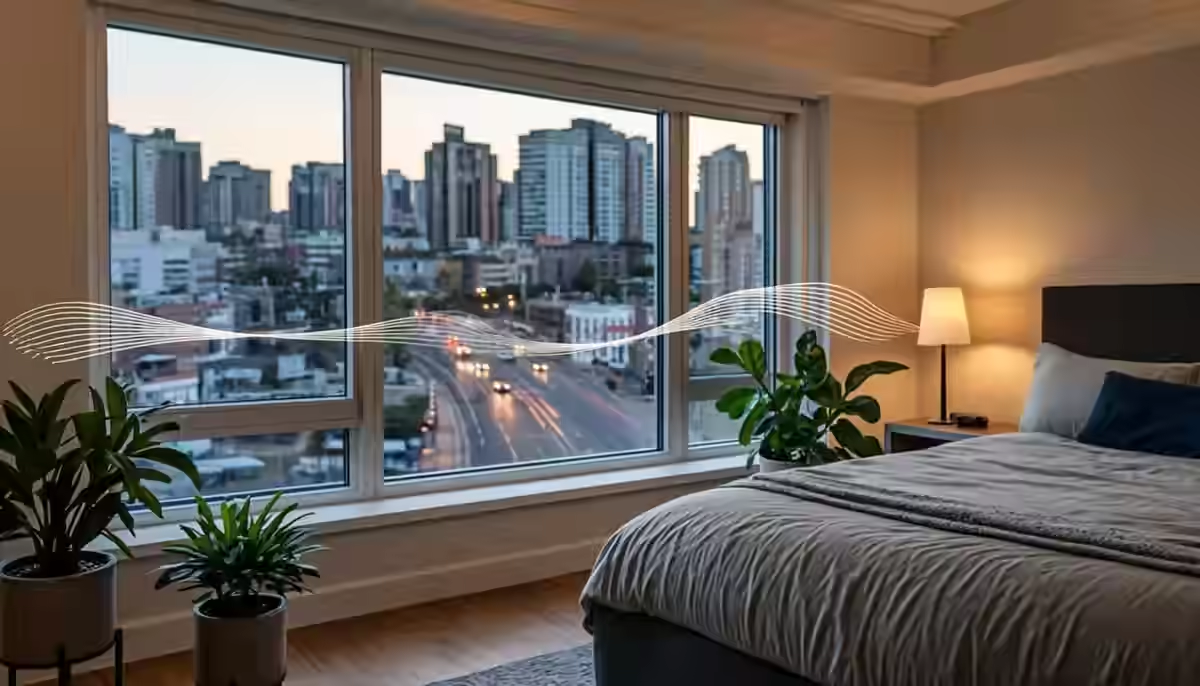
You cannot soundproof a Metro Vancouver home with any single product. What you can do is cut perceived noise by a third to a half, which feels like a different house, by matching the glazing to your noise source. Aircraft and train rumble need mass and a deep air cavity: laminated glass and, ideally, secondary interior glazing. Traffic noise needs airtightness and a decent double with laminated panes. SkyTrain screech is high-frequency and falls to almost any competent sealed unit. And every source responds to the free fix first: air-sealing the gaps, because a window that leaks air leaks sound straight past the best glass money buys.
In numbers: an old single-pane window tests around 26-28 STC. A standard modern double hits 28-31. An acoustic package, laminated panes, asymmetric glass thicknesses, gets you to 35-40, and secondary interior glazing with a wide air gap reaches 40-48, which is library quiet against most street noise. Each 10 dB of improvement registers as roughly half as loud. Costs run from $0 for caulking and weatherstripping, through $400-$900 per window for interior inserts, to $800-$1,700 per window for acoustic replacement glass, and the full context on windows as a project, ratings, permits, rebates, lives in our Vancouver window replacement guide. This article stays on the noise problem alone, because noise is its own discipline with its own honest answers.
Sound moves through air and it moves through mass, and a window is mostly the first and very little of the second. Every real noise fix is either more mass, a bigger air gap, or a sealed edge. Anyone selling you something else is selling weatherstripping with better branding.
0
How much reduction reads as "half as loud" to the ear. Three dB is barely perceptible; ten is a room transformed.
0
What secondary interior glazing with a 50-100 mm air gap achieves against street noise, while leaving the original window untouched.
0
YVR operates around the clock with overnight noise-abatement procedures. Traffic and SkyTrain have schedules; airplanes don't.
Your Noise Source Decides Your Fix
Acoustics is frequency physics, and the four noises that plague Metro Vancouver homes live in different frequency bands. Low frequencies, the aircraft rumble and the train bass, are the hardest to block: they bend around obstacles and travel through structures. High frequencies, the SkyTrain squeal at a tight curve, are the easiest. Buying windows without knowing which problem you have is how people spend $15,000 and still hear the 11 p.m. freight.
| Source | Frequency character | Schedule | What actually works |
|---|---|---|---|
| Aircraft (YVR) | Low-frequency rumble, 50-500 Hz | 24/7 with overnight abatement | Mass + deep cavity: laminated glass plus secondary glazing; sealing alone disappoints |
| Trains (freight, WCE) | Low rumble plus horn blasts | All hours for freight; WCE weekday peaks | Same as aircraft; horns benefit more from sealing |
| Traffic and trucks | Broadband with bass content | Peaks 6-9 am, 3-7 pm; truck routes all day | Airtightness plus acoustic double (laminated) does most of the job |
| SkyTrain | Rumble plus high-frequency squeal | Roughly 5 am-1 am, every 2-6 minutes at peak | Squeal falls to any good sealed unit; rumble needs the low-frequency toolkit |
A note on ratings before the table misleads anyone: STC is measured from 125 Hz up, so it barely credits low-frequency performance, and manufacturers know it. For aircraft and rail, ask for OITC, the Outdoor-Indoor Transmission Class, which weights the low bands honestly. A window can carry a proud STC number and still pass the airplane bass line. If a quote for a flight-path house shows no OITC figure, ask for it.
Metro Vancouver's Noise Map
The aircraft problem has an address pattern. YVR sits on Sea Island, and its arrival and departure paths sweep over Richmond's city centre, Burkeville, Marpole and parts of south Vancouver, with departure climbs reaching Burnaby and New Westminster depending on runway direction and weather. The Vancouver Airport Authority publishes noise exposure forecast contours and a flight-tracking tool called WebTrak, and if you're house-hunting under the paths, twenty minutes with those maps is worth more than any realtor's assurance about "quieter hours." The honest rule: inside the NEF 25 contour, noise is a daily fact of the house, not a defect you can negotiate away.
Rail and SkyTrain have their own map. The New Westminster rail bridge carries freight across the Fraser with a swing span that opens for river traffic, and the surrounding blocks hear it. The BNSF line hugs Burrard Inlet through North Vancouver, Burnaby and Port Moody, CN and CP run through Pitt Meadows, Port Coquitlam and Surrey, and the West Coast Express adds five round trips each weekday along the valley. The Expo Line's elevated guideway runs through Burnaby, New Westminster and Surrey, the Millennium Line through Burnaby, and the Canada Line is elevated down Richmond's No. 3 Road and across the Fraser, close enough to some Richmond condos that the bedroom wall hums with every pass. Our Richmond windows and doors page and its New Westminster counterpart exist partly because those two cities bookend the region's noise geography.
Traffic noise clusters on the arterials and the truck routes: Kingsway, Knight and Oak through Vancouver, Hastings through the East Side, Highway 1 from the Ironworkers Memorial through the North Shore and Burnaby, and the container corridors feeding Deltaport and the port terminals through Delta, Surrey and along the Fraser. A bedroom facing an arterial 30 metres away is a different acoustic project than the same bedroom facing a side street. Walk the block at 5 p.m. before you buy, and open the window in the room you'd sleep in.
The Physics in Four Hundred Words
Three laws govern everything in this article. First, mass: heavier barriers stop more sound, and each doubling of mass buys roughly 5 to 6 dB. That's why laminated glass, two panes bonded to a soft interlayer that also damps vibration, outperforms its weight, and why a second full window inside your window works better than any single unit can.
Second, airtightness: sound is air pressure, and any path air takes, sound takes. A coin-sized gap at a window edge can cost a wall nearly half of its rating, which is why weatherstripping and acoustic caulking are the highest-decibel-per-dollar purchases in the entire field. A leaky window frame with superb glass is a noise hole with a view.
Third, the cavity: two barriers separated by dead air outperform one heavy barrier, and the wider the gap the better, especially at low frequencies. This is the entire secret of secondary glazing: a 50-100 mm air gap between the original window and an interior panel decouples the two mass layers, and low-frequency sound that shrugs at triple-pane glass loses its footing in that gap. It's also why the "triple-pane stops airplane noise" claim is only partly true: three panes in one sealed unit sit millimetres apart, coupled by the same frame. Great for mids and highs, modest for the rumble that keeps flight-path bedrooms awake.
Perception is the fourth thing worth knowing. Decibels are logarithmic: a 3 dB change barely registers, 5 dB is clearly audible, 10 dB reads as half as loud, and 20 dB as a quarter. So when an acoustic package cuts an interior from 65 dB to 55 dB during a flyover, the spec sheet calls it 10 dB and your nervous system calls it a different room. That gap between numbers and feeling is where most noise-product marketing lives, and knowing it keeps you immune.
What Your Old Windows Are Delivering Right Now
A single-pane wood window, 3 mm of glass in a frame that has been painted shut and reopened four times, tests around 26-28 STC, and the operative word is "around," because a single-pane window's real-world performance is set by its gaps more than its glass. A 1970s-80s aluminum slider, the default window of the Vancouver Special era, tests 26-30 on paper and worse in practice once its pile weatherstripping has flattened, which by now all of it has. Aluminum is also a stiff, light frame that transmits vibration happily, a thermal and acoustic double loser.
The gap between those baselines and a modern sealed unit is why so many Metro Vancouver homeowners report that window replacement "fixed" the noise: going from a leaky aluminum slider to a tight vinyl or fiberglass double is a 5-10 dB improvement in real rooms, mostly from airtightness and the second pane of mass. It's a genuine fix for traffic and SkyTrain squeal. Where it disappoints is the flight-path bedroom and the rail corridor, where the first $10,000 buys the easy mid-frequency decade and the low-frequency decade barely moves without the cavity trick. That's not a sales failure, it's physics, and Chapter 7 is the honest answer to it.
The Glazing Ladder, Rung by Rung
Every factory option in the noise conversation, in ascending order of quiet. Ratings are honest laboratory ranges; rooms vary with frame tightness, room size and flanking, which is Chapter 8's subject.
| Upgrade | Typical rating | Installed cost per window | Honest note |
|---|---|---|---|
| Air-sealing and weatherstripping existing windows | +2-4 dB | $0-$250 | First money spent, any source; the cheapest dB in the industry |
| Standard double-pane replacement, tight frame | 28-31 STC | $650-$950 | Fixes traffic and squeal; low-frequency gains modest |
| Double with one laminated pane, asymmetric thickness | 32-35 STC | $800-$1,300 | The sweet spot for arterial traffic and mid-frequency noise |
| Acoustic triple with laminated panes | 35-40 STC | $1,000-$1,700 | Also the CleanBC-eligible configuration; ask for OITC too |
| Secondary interior glazing, 50-100 mm gap | 40-48 STC | $400-$900 | Best low-frequency performance per dollar; original window stays |
Read the last row twice, because it's the one the window industry undersells. A $600 interior panel behind your existing window outperforms a $1,500 acoustic triple on aircraft rumble, because the cavity does what coupled panes cannot. The replacement industry sells units; the cavity is only for sale from crews who fit secondary glazing, like ours through the windows and doors service, or from insert suppliers. Match the rung to the source, and stop climbing when the room is quiet.
Secondary Glazing: The Heritage-Friendly Answer
Secondary glazing is a second pane, glass or quality acrylic, mounted inside the room on its own frame or magnetic mounts, 50 to 100 mm behind the existing window. The original stays exactly as it is, which matters enormously in a city where the original window is part of the house's character and, in conservation areas, part of its legal protection. Mount Pleasant Craftsman sash, Queens Park stained glass, Strathcona cottage casings: all of it stays, and the room still drops 10-15 dB against street noise and 8-12 dB against aircraft.
Practicalities, honestly. Openability: panels can slide or lift out for cleaning and summer ventilation, and magnetic acrylic panels pop off entirely, so you lose nothing that matters. Condensation: the cavity between old and new panes must be sealed against room air, or the space fogs in January; proper installs use compression seals and a small desiccant strategy, ask the installer directly how they handle cavity air. Cost: $400-$900 per window installed for standard sizes, with glass panels above acrylic, and large or specialty shapes above that. And the gap is the performance: a 20 mm gap is a decent extra pane; a 100 mm gap is the difference between muffling traffic and genuinely quieting a flight path. If a quote leads with the pane and never mentions the gap, that's a weatherstripping salesman in acoustician's clothing.
For strata and renters, secondary glazing is usually the only route that doesn't need permission, it's interior work, reversible, no envelope change, though written permission is still polite and, in strata, often required for anything mounted to common property. We'll come back to the rules in Chapter 10.
The Weak-Sibling Rule: Flanking Paths
A room is only as quiet as its leakiest surface, and the window is rarely the only hole. Sound flanks: it comes through the vented crawlspace grille under the wall, the HRV fresh-air intake, the dryer vent's flapper, the old chimney, the wall outlets on exterior walls, the mail slot, the bathroom exhaust damper, and every other window in the room including the little one over the sink nobody thinks about. Spend $5,000 on the bedroom window while the sleeping ear sits two metres from a leaky wall vent, and the money buys a quieter window, not a quieter sleep.
The fix order is cheap-first and always the same: seal the room's edges, acoustic caulking at trim and baseboards where they meet the floor, $10 a tube; backdraft dampers on exhaust terminations; a proper damper or cover on the fireplace; and weatherstrip every operable window in the room, not just the loud wall's. Only then buy glazing, and size it against the room's actual weakest paths. This is also why honest noise contractors, including ours, will spend ten minutes with a hand at the baseboards before quoting glass. A crew that quotes acoustic triples without touching the room is selling products, not quiet.
Bedrooms, Shift Work and the Night Test
The World Health Organization's night-noise guideline sits around 40 dB averaged outside the bedroom window, and the health literature behind it links chronic night noise to fragmented sleep and cardiovascular stress, which is the careful way of saying that the 5:40 a.m. departure over Marpole is not just an annoyance, it's a health input. We're window people, not physicians, so we'll stay in our lane: the nights that matter most are the ones with a nurse home from a shift, a baby on a schedule, or a light sleeper wired to the sound of the guideway, and for those households the bedroom is the project, not the house.
Do the night test before spending anything. Sleep with the current windows as they are and note the times noise wakes you, then correlate with WebTrak or the TransLink schedule. If the answer is two events a night, you need 10-15 dB and every rung of the ladder matters. If it's a constant arterial drone, you need 8-10 dB and airtightness is most of it. And skip the folklore on the way: heavy acoustic curtains deliver 1-3 dB in mid frequencies and effectively nothing at aircraft and train frequencies, "soundproof" window film delivers about nothing at any frequency, and egg cartons deliver a conversation piece. Mass, cavity, seal. Everything else is décor.
Strata, Heritage and What You're Allowed to Change
Three jurisdictions, three answers. Aircraft and rail noise are federal matters, NAV CANADA, the airport authority, the railways, and no municipal noise bylaw touches them; the City of Vancouver's bylaw is loud about karaoke and quiet about airplanes. SkyTrain noise runs through TransLink's corridors and its complaints process, which is real but slow. The practical translation: nobody is coming to quiet your street, and the building envelope you own or co-own is the fix that actually ships this year.
In strata, windows are usually common property, so replacement glazing needs the corporation's approval and often a three-quarter vote if the bylaws treat it as altering common property, and a flight-path building facing a collective noise problem can amortize a whole-envelope project the same way it amortizes a roof. Interior secondary glazing is typically an owner-side modification, reversible, but written approval is still the polite and usually required route. In Vancouver's heritage conservation areas and character-merit zones, and New Westminster's heritage districts, the retention-first conversation is mandatory: repair the original, add the interior panel, keep the street face the street's. Done well, nobody outside can tell you did anything at all, which is exactly the point.
Costs, Payback and Honest Priorities
Here is the worked example we actually quote from: a Marpole bedroom with two windows facing the flight path, currently single-pane wood sash, night interior around 60 dB during overflights. The honest packages:
| Package | Room result | Cost, two windows | Honest verdict |
|---|---|---|---|
| Seal, caulk, weatherstrip, dampers | -3 to -5 dB, flyovers still audible | $150-$500 | Do it regardless; it's the first rung of every other package |
| Secondary glazing on both windows | -10 to -15 dB, sleep-through most overflights | $800-$1,800 | Best dB per dollar for aircraft; original windows stay |
| Acoustic triple replacement (OITC-rated) | -8 to -12 dB, plus comfort and energy value | $2,000-$3,400 | Right if windows are due anyway; CleanBC-eligible when triple |
| Replacement + secondary behind it | -15 to -20 dB, near-library on the flight path | $2,800-$4,600 | The flight-path special; overkill for traffic noise |
Payback framing, honestly: noise work almost never pays back in energy dollars alone, though acoustic replacement glass carries the same winter comfort and heating-value math as any triple, 15-25 percent of an older home's heat loss sits at its windows, and the CleanBC rebate, roughly $500 to $2,000 on qualifying triple-pane projects with the pre- and post-upgrade evaluations, applies, current rules in our CleanBC rebates guide. The rest of the return is sleep, focus and resale on a noisy street, which appraisers discount quietly and buyers discount loudly. Final pricing is confirmed in writing after we measure, and the measurement visit includes a decibel reading, because quiet should be quoted in its own units.
The Quiet-House Cheat Sheet
The whole article in one table, matched to your noise source. Screenshot it, bring it to the quote, and ask for OITC numbers if your row is the first two.
| Question | The honest answer |
|---|---|
| Under the YVR flight path? | Mass plus cavity: laminated glass and secondary glazing, $800-$1,800 for a two-window bedroom |
| On a rail corridor? | Same toolkit as aircraft; horns benefit most from airtight sealing |
| Facing an arterial? | Seal first, then a laminated acoustic double, $800-$1,300 per window |
| Beside the SkyTrain guideway? | Squeal falls to any sealed unit; rumble needs the low-frequency toolkit |
| First purchase, any source? | Air-sealing, $0-$250: caulking, weatherstripping, dampers; cheapest dB anywhere |
| Do curtains or film work? | Curtains 1-3 dB mid-frequency, film effectively zero; mass, cavity, seal is the whole game |
| Heritage or strata? | Secondary interior glazing: reversible, permission-friendly, original stays |
| What does quiet cost? | Bedroom-scale: $150-$500 sealing, $800-$1,800 secondary, $2,000-$3,400 acoustic replacement |
One closing thought from the field: the quietest houses we work in aren't the ones with the most glass technology. They're the ones where somebody matched the fix to the source, sealed the room's edges, and stopped at quiet enough. Every dB past "sleeps through the 5:40 departure" is a luxury purchase, and we'd rather tell you that at the measure than sell it to you at the showroom.
Get a Noise Quote in Decibels, Not Adjectives
Book a free noise measure: we walk your room, read the dB, name your source, check the flanking paths, and leave a written quote matched to the rung of the ladder your noise actually needs, sealing, secondary glazing or acoustic replacement. Zero obligation, and the quote is yours whoever you hire.
Frequently Asked Questions
Services From This Guide
Licensed crews, flat-rate pricing and 24/7 emergency response across Vancouver, Burnaby, Richmond, Surrey, Langley, Coquitlam, Delta, New Westminster, North Vancouver, Maple Ridge, Port Coquitlam and Abbotsford.
Window & Door Replacement
Acoustic glazing packages quoted with OITC numbers, $650-$1,700 per window installed.
Windows & Doors in Richmond
Flight-path glazing work for Richmond and Sea Island approaches, measured in dB.
Windows & Doors in New Westminster
Rail-corridor and guideway noise work for New Westminster's older stock.
Windows & Doors in North Vancouver
BNSF corridor and traffic noise packages for the North Shore, heritage-friendly.
Related Guides
Window Replacement in Vancouver
The replacement side: costs, glass ratings, permits, strata and the CleanBC claim order.
EnergyEnergy-Efficient Upgrades for BC Homes
Where window work sits in the envelope priority list, and what to do first.
RebatesCleanBC Rebates in 2026
The current rebate stack, eligibility rules and the pre-upgrade evaluation order.

We measure noise the way we measure heating loads: with instruments, at the room, matched to the source. Our crews have quieted bedrooms under the YVR paths in Marpole and Richmond, beside the New Westminster rail bridge and along the SkyTrain guideway through Burnaby, and this guide is the decibel-first conversation we have at every free measure, including the honest part about curtains and film. To book instead of DIY, see window & door service in Vancouver — same-day across the city.
More about our team →Get a Noise Quote in Decibels
A free noise measure walks your room, reads the dB, names your source, checks flanking paths, and returns a written quote matched to the ladder rung you actually need, sealing, secondary glazing or acoustic replacement. Zero obligation, quote is yours to keep. If you would rather hand this to a pro, our window & door services pages cover Metro Vancouver.
Broken window on a noisy street?
Smashed or fogged units are 24/7 calls with flat after-hours pricing posted in advance. Board-ups and same-day sealed-unit orders are routine, and the $89 diagnostic is credited to any repair.
Call 604-615-2212 WhatsApp Us