The Honest Answer Up Front
An air conditioner is a dehumidifier that happens to cool. The indoor coil runs colder than the dew point of the air passing over it, so moisture condenses on the fins the way it does on a cold glass — and in a Metro Vancouver August, with outdoor dew points that would embarrass Toronto, a properly running central system can wring fifteen to twenty litres of water out of a house in a day. All of that water has a single job: run down the fins, drip into a pan, travel one small pipe to a termination outside. Every "AC leaking water" call we attend is a failure somewhere on that one-way trip, and the location of the water tells you where the failure is before anyone opens a panel.
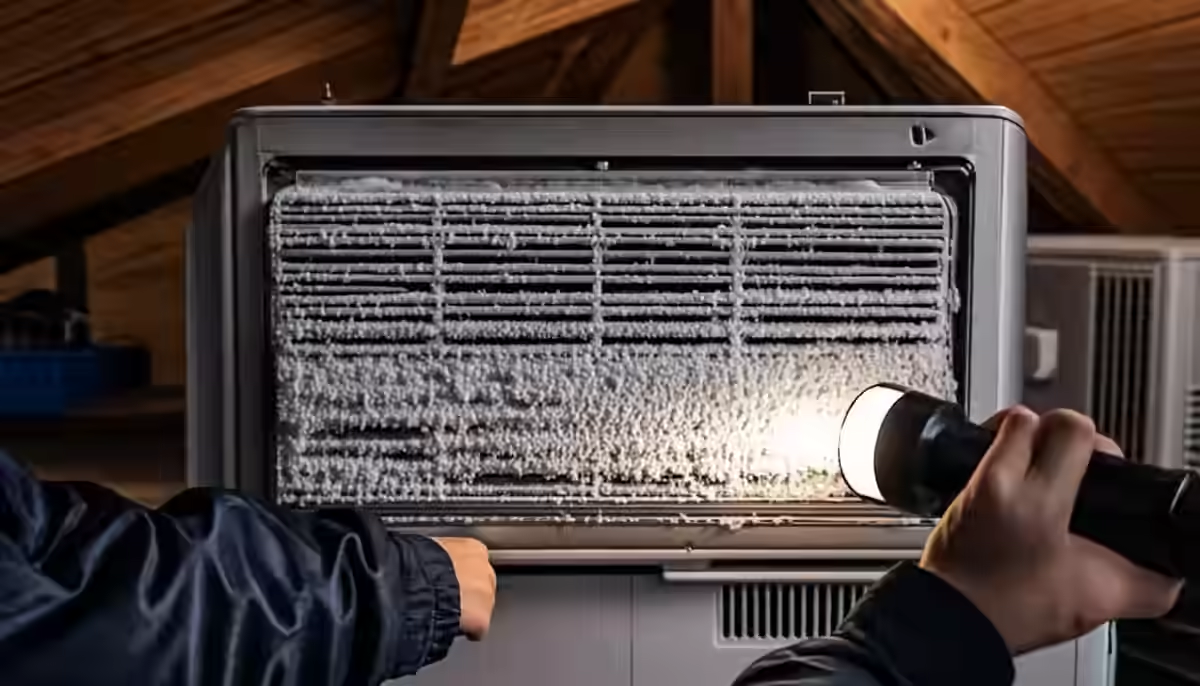
The three causes, in the order our dispatch board sees them: a clogged condensate drain (the algae-and-slime story that owns our humid summers), a failed drain pan or float switch (the rusted-pan and attic-flood story), and a frozen evaporator coil that melted (the dramatic one — a sheet of ice turns to litres of water in an hour, usually because of low refrigerant or a starved blower, and it comes with a no-cooling complaint attached). Each has a distinct fingerprint, a distinct fix and a distinct urgency, and the first job of this guide is to help you tell them apart before water does more talking than it should.
The urgency sort, stated plainly: water dripping near the air handler in a basement or closet is a same-day call and usually a same-visit fix. Water staining a ceiling below an attic unit is a stop-the-system-now situation — attic units are the one configuration where a small drain problem becomes a soaked ceiling, and the float switch that should have caught it gets its own chapter. And water plus a warm house means the frozen-coil chapter is yours: turn the cooling off at the thermostat, switch the fan to ON, put towels down, and read chapter six before you restart anything.
0 are drain clogs
Of the interior-water calls we attend, the overwhelming majority are a blocked condensate line — algae and slime in a hot summer pipe. Ten minutes of vacuum often clears it.
0 a system can make
A central AC pulling moisture from a humid Vancouver August can condense twenty litres a day. Every drop of it must travel one small pipe to the outside.
0 typical repair band
Drain clearing, pan repairs, float switches and line re-routes mostly land here. Diagnostics run $89, credited in full to the completed repair.
0 first-hour damage cap
The window in which a ceiling stain, a soaked floor and a mould start are all still cheap. Water damage triage is a clock, not a project.
Where the Water Comes From (and Why Our Summers Make So Much of It)
The condensate physics deserve two paragraphs, because homeowners who understand them diagnose half of this guide over the phone. Air holds water vapour in proportion to its temperature — warm air carries more, and cooling air below its dew point forces the excess out as liquid. Your evaporator coil is deliberately the coldest surface in the house in summer: return air at 25 degrees and 60 percent relative humidity hits a coil running at 5 to 10 degrees, and roughly a gram of water condenses out of every cubic metre of air that crosses it. Multiply that by four hundred cubic feet per minute through a typical blower and you get the astonishing arithmetic: a central system in a humid week produces water at the rate of a dripping faucet, continuously, all day.
Metro Vancouver makes this worse in a way that surprises homeowners from drier climates. Our summers are cool on the thermometer but soggy on the dew point — a 24-degree afternoon at 70 percent humidity is more condensate per hour than a 30-degree interior afternoon at 25 percent. Add the July-August pattern where a marine layer keeps overnight humidity high and houses never dry out between cooling cycles, and the condensate system that ran dry and happy for eleven months suddenly moves its full rated capacity. That is why AC water problems in this region are seasonal events with a calendar: they begin the first humid week of July and end when the rain returns in September.
The whole path, one more time, because every cause in this guide is one link in it: vapour condenses on the coil fins, runs down to a sloped pan under the coil, exits through a trap (the same P-trap physics as under your sink, holding sewer gas and keeping the drain primed), travels the condensate line to a floor drain, sump, laundry sink or exterior termination, and in attic installations passes through a secondary safety pan with its own overflow line and float switch. A failure at any link produces water — the only question is where it shows up and how fast.
Read the Location: What the Water Is Telling You
Diagnosis starts with where the water is, not what the system is doing. Water pooling directly under or around the indoor unit — the furnace-closet floor, the basement slab beside the air handler, the carpet in the utility room — points at the primary drain path: a clogged line, a dry or blocked trap, or a cracked primary pan. The system cools fine; it just leaks. This is the relaxed version, the same-day-service version, and usually the $180-to-$450 version.
Water staining a ceiling or running a light fixture below the unit points upward in every sense: an attic installation whose primary drain has failed and whose secondary safety system either does not exist or failed with it. This is the urgent version — every hour of runtime adds litres to drywall and insulation — and it comes with two hard questions we cover in the attic chapter: is there a float switch (and did it trip), and is the secondary pan drain line actually sloped and terminated somewhere visible. Ceiling water from an attic unit is the single most expensive small repair in residential cooling, because the repair is small and the ceiling is not.
Water plus a warm house plus, often, a hissing or silent air handler points at the frozen coil: the ice story. Homeowners usually find it after the fact — the system iced up overnight with the symptom masked (weak airflow, mild cooling), then the ice melted and released its entire load at once, overwhelming pans and drains alike. If you catch the ice while it is still ice, you have found a different problem early: low refrigerant, a clogged filter, or a failing blower, and the water is the secondary symptom of a primary cause that needs a licensed technician with gauges. The melt protocol is chapter six; the causes are chapter seven.
| Where the water is | Most likely cause | Your first move | Urgency |
|---|---|---|---|
| Under the air handler or furnace closet | Clogged condensate drain or dry trap | Wet/dry vac on the drain termination | Same day |
| Around a mini-split head, at the wall | Head drain clog or kinked line | Shut the head off; towels; chapter twelve | Same day |
| Ceiling stain below an attic unit | Primary drain failed, secondary pan overwhelmed | Stop cooling now; kill the breaker | Now |
| Water and ice on the coil or fins | Frozen coil — low refrigerant or airflow | Cooling OFF, fan ON, melt, then service | Before restart |
| Water at the exterior termination only | Normal condensate — possibly misdirected | Re-aim or extend the drip point | None |
| Water and rust streaks on an old pan | Corroded primary drain pan | Pan repair or replacement visit | This week |
| Water only when very humid outside | Marginal drain flow, partial clog | Vacuum clear, then book a flush | This week |
Water location to cause to first move — the triage table our phone team runs.
Cause 1: The Clogged Condensate Drain (Start Here)
The drain clog is the champion of this category, and it is a biology problem wearing plumbing clothes. The inside of a condensate line is warm, dark, wet and fed a constant trickle of organic dust washed off the coil — which is to say it is a perfectly engineered algae and slime farm. A biofilm establishes on the pipe walls, thickens over seasons, and one humid week it lets go and mats across the first fitting or trap bend it reaches. The pan fills, the water has nowhere to go, and the overflow path becomes your floor. The fingerprint: the system cools normally, the water appears gradually, and the drain termination outside has gone suspiciously dry.
The homeowner fix that genuinely works, when the clog is in the line and the system is off: a shop wet/dry vac on the drain termination outside, pulling backwards through the whole run. Ten minutes of suction moves most soft clogs — the step-by-step is written out in the how-to at the bottom of this guide, and it is the single highest-value DIY in cooling maintenance. What does not work, and actively harms: blowing compressed air from the inside (it packs the biofilm tighter), pouring bleach down the line on modern systems (it degrades rubber and plastic components over the years — see the algae-tab chapter for the honest chemistry), and ignoring it because the water "mostly stopped" (a partially clogged line is a fully clogged line on a Saturday).
When the vacuum does not clear it, the clog is either hardened scale at a fitting, a trap that has grown shut, or a belly in the line where the pipe has sagged and holds standing sludge — all professional territory, all quick work with the right gear. Our techs clear lines with nitrogen or CO2 propulsion (a controlled burst that scrubs the wall clean rather than punching a hole through the biofilm), cut out and replace matted sections, re-pitch bellies, and finish with a full flush and flow test so the fix is proven with water, not hope. That visit lands in the $180 to $450 band for the overwhelming majority of cases, and it includes the flow-rate check that tells you whether your line is a re-offender in the making.
Cause 2: The Drain Pan and the Float Switch That Saves Ceilings
Under every evaporator coil sits a pan, and in homes with air handlers in attics or above finished ceilings there should be a second one. The primary pan collects coil condensate and feeds the drain line; the secondary pan sits under the entire unit and catches what the primary fails to hold, draining through its own separate line to a highly visible spot — usually over a window or door — so that a primary failure announces itself in a place nobody can ignore. That deliberate drips-on-your-head design is the oldest and best safety engineering in this trade, and it is why a secondary line dripping over the front door is a feature, not a defect.
The float switch is the electronic half of the protection: a small sensor in the primary pan (or an inline float on the drain) that cuts power to the cooling system when water rises, shutting the machine down before the pan overflows. On a properly protected attic system, a clogged drain means the AC simply stops cooling on the hottest day of the year — which is how we meet many of these homeowners: annoyed, but with a dry ceiling. If your attic unit has no float switch, or has one that is bypassed or failed (they stick, they crust with algae, their wires get knocked loose during other service), the installation is a same-visit add in the lower repair band and it is honestly the cheapest ceiling insurance sold in this province.
The pans themselves fail on a schedule set by material and water chemistry. A galvanized primary pan in a twenty-year-old system rusts through at the seam exactly where it always does — the low corner nearest the drain fitting — and the fingerprint is a weep rather than a flood: rust-stained water, chronic humidity in the closet, a smell. Plastic pans crack instead of rusting, usually at a fitting stressed by a re-piped drain line or a heavy tech leaning on them. Pan replacement is straightforward work on most systems and lands mid-band; the honest conversation is when the pan is part of a coil that is also corroded, at which point the AC repair visit becomes a repair-versus-replace conversation, and the numbers in our guides are built to make that call honest.
Cause 3: The Frozen Coil and the Melt Flood
The ice story starts days before the water arrives. Something restricts the heat the coil can absorb or the refrigerant flowing through it — a filter so loaded the airflow starves the coil, a blower running half speed on a dying capacitor, or a refrigerant charge that has leaked low — and the coil temperature drops below freezing. Condensate on the fins freezes; the ice insulates the coil further; the freeze accelerates; and within a night or two there is a block of frost an inch thick swallowing the coil and the first foot of the suction line. The house warms slowly, the airflow feels weak, and then the system cycles off and the melt begins: litres of water, all at once, into a pan designed for a trickle.
The melt protocol, in order, and it matters: thermostat to OFF for cooling (stop making ice), fan switch to ON (air across the coil is the fastest safe melt and it also tells you the blower works), towels and a wet vac at the pan, and resist every instinct to chip or scrape the ice — a screwdriver through an evaporator fin pack is a coil replacement, and a coil replacement is a quote, not a repair. A full melt takes two to six hours depending on how much ice you grew; running the blower through it keeps the water going down the drain in a manageable stream instead of dropping off the ice in sheets. If the drain is also clogged — and in the ice story it often is, because the freeze locked condensate in the line — vacuum the termination clear mid-melt.
Then the part homeowners do not want to hear but this guide exists to say: after the melt, the cause still needs a licensed technician. Ice is a symptom of one of three things — restricted airflow (filter, blower, ducts), low refrigerant (a leak, and leaks need finding, not just recharging), or a metering device fault — and two of the three will simply regrow the ice the next humid night. Restarting a thawed system without diagnosis is how a filter story becomes a compressor story; the $89 diagnostic with gauges and a meter settles which of the three you own, and it is credited to whatever the fix turns out to be. Our AC not cooling guide covers the full weak-airflow decision tree if the system limps rather than dies.
The First Hour: Ceiling-Stain Triage That Actually Limits Damage
When water is coming through a ceiling, the order of operations is short and unforgiving. First, stop the source at the system: cooling OFF at the thermostat, and if water is still moving, the breaker for the air handler — a float-switched unit may already have done this for you. Second, protect what is under the stain: move what moves, tarp what does not, and put a bucket inside the overflow path. Third — and this is the step people skip — puncture the bulge if the drywall is ballooning. A water-loaded ceiling holds litres in a dome that eventually lets go all at once over everything you just moved; a small deliberate hole in the low point drains it into a bucket on your terms. It feels destructive. It is damage control, and every restoration contractor in this city will back the call.
The fourth step is documentation, and it is worth real money: photos of the stain, the unit, the pan, the stain again an hour later, and the system settings as you found them — the sequence is the story your insurance adjuster will want and the one your technician will want more. Attic-unit water claims are where coverage language gets tested (gradual-leak clauses versus sudden-and-accidental), and the difference between a documented sudden event and a mystery stain from "sometime this summer" can be the difference between a covered ceiling and a sad cheque. We write findings and photographs into every water-call report partly for the medicine of it and partly because our customers file with them.
The fifth step is the mould clock, and it starts the moment the drywall soaks. Surface drying within 24 to 48 hours — fans, a dehumidifier, the September rain doing you a favour with cool dry air — and a ceiling typically survives with a stain repair. Soaked insulation above it stays wet far longer than the drywall shows, and a sagging, waterlogged batt is both a mould incubator and a permanent drip reservoir feeding the stain back. If the ceiling material has been wet through, the honest move is an inspection opening: cut the inquiry hole, look at what is above it, and dry what needs drying before the patch-and-paint hides a slow problem for a year.
Attic Units, Crawlspace Heads and the Geography of Risk
Where the equipment lives sets the stakes, and Metro Vancouver has a specific geography of it. Attic air handlers — common in 1990s-and-newer two-storeys across Surrey, Langley and Coquitlam where ducting the upstairs from below was awkward — carry the highest water stakes in residential cooling, because every drain failure has a finished ceiling beneath it. For those homes the checklist is unforgiving: a working float switch on the primary, a secondary pan that is actually level and actually drains, and an annual inspection of both, because the March check that finds a cracked secondary pan costs nothing compared to the August that finds it for you. Our AC maintenance visits treat attic units as their own category for exactly this reason.
Crawlspace and garage equipment flips the risk profile: water on a slab or a crawlspace floor is a nuisance rather than a catastrophe, but the drain lines run through cooler spaces where our October-to-March shoulder lets algae die back and sediment settle, and where an exterior termination that ends near a walkway grows its winter algae-slick on the concrete. The termination itself deserves attention in this climate: a drain that dumps against the foundation wall keeps a damp stripe on the crawl side of the footing, and a termination that freezes in an arctic outflow — the valley version — can back an ice plug up the line. Extended, angled away from the foundation, and clear of walkways is the standard we install to.
The microclimates layer on top. Units serving homes a block from the water — Steveston, White Rock, Deep Cove — see longer condensate seasons and more corrosive pan life from salt-adjacent air, which is why a galvanized pan on a coastal home gets inspected rather than trusted at fifteen years. Valley homes see the freeze end of the risk, and upper-elevation North Shore and British Properties homes see the humidity extreme: the fog belt above the marine layer can keep dew points high on days the rest of the region is dry, and those homes make condensate in May when Vancouver is still heating. If your water problems have a weird calendar, the microclimate is usually the reason, and it is worth saying on the phone when you book — it changes what the tech brings.
Algae Tabs, Vinegar and the Chemistry We Actually Recommend
Because the clog is biological, the maintenance conversation is chemical, and the honest version has three tiers. Tier one, the one we install and recommend: slow-release algae tabs in the pan or an inline tablet feeder, dosed once or twice a season. They are formulated for condensate systems — mildly antiseptic, compatible with pans, pumps and lines — and they keep the biofilm from establishing in the first place, which is the entire game. Tier two, the acceptable home version: a cup of white vinegar through the line each shoulder season, which is gentle, harmless to the hardware, and enough to slow (not stop) an established film. Tier three, the one we talk people out of: household bleach, which works on the biology and works equally on the rubber grommets, pump impellers and plastic fittings it touches, and whose fumes ride the drain right back into the air stream in tightly built homes.
The frequency question has a real answer for this region: treat the line in spring when the season starts, check flow mid-July when the humidity peaks, and treat again in September if your system runs deep into the shoulder. Homes with known re-offender history — big trees shading a north-side termination, a line with a long horizontal run, a system that had a biofilm event — go on the twice-a-spring schedule and usually stop re-offending. The tab costs less than a coffee and the clogged-line service call does not; the arithmetic is boring and total.
One more piece of chemistry honesty, because it saves compressors: the "condensate pan tablets" sold beside pool chemicals and drain cleaners are not the same product, and the aggressive ones will eat a plastic pan in a season or two. Buy tabs labelled for air conditioning condensate, in the small quantities the HVAC counter sells, and if you are unsure, ask at the visit — our trucks carry the correct ones and a season of them costs a fraction of the visit. Maintenance chemistry is a place where the wrong product is worse than no product, and we would rather hand you the right tab than sell you the repair the wrong one schedules.
The Mini-Split Version: Water at the Wall
Ductless heads have their own water story, and it starts with the same biology: the head condenses, the pan in the chassis collects, the line carries — but the line is a thin flexible hose running inside the wall or along the exterior, and the stakes are a stained wallboard instead of a ceiling. The classic ductless leak is a drain clog inside the head (the pan biofilm story in miniature, and the fix is the professional deep clean with the pan scrubbed and the line flushed), followed closely by a kinked or detached drain hose where the line exits the wall — usually the residue of a past landscaping, painting or siding project that nudged the exterior run.
The installation angle matters more with ductless: a head mounted even a few millimetres out of level pools condensate at the wrong end of the pan, and a long line-set run that sags on its way to the termination holds water until the sag lets go or grows its own clog. The freeze story exists here too — a head starved by a filthy filter can ice its coil in cooling mode, and the melt finds the same pan. But the majority of ductless water calls we attend resolve into the cleaning schedule the head never got: the pan, the wheel and the drain all load together in our climate, and the annual $149-to-$229 per-head service exists precisely because the alternative is the wall-repair version of this guide.
If water is dripping from the bottom of a head right now: shut that head off at the remote (leave others running if they are dry), towels under it, and do not run it in cooling again until it has been looked at — a leaking head that keeps condensing is feeding the wall cavity it is mounted on, and wall cavities forgive slowly. The drain flush and hose re-secure are quick visits inside the standard band; the wall repair is not, and the order of those two sentences is the whole prevention pitch.
Prevention: The Spring Visit That Deletes This Guide
Every cause in this guide has a springtime antidote, and together they are the condensate half of the $129 tune-up. The visit clears and flow-tests the drain line before the season loads it, checks the trap and the termination, inspects the primary pan (and the secondary pan and float switch on attic units), verifies filter and airflow so the freeze story never starts, and measures blower and capacitor health so the coil never starves. It is a sixty-to-ninety-minute appointment in April or May that costs less than any single repair in this guide and is designed to prevent all of them; the $199-a-year maintenance plan wraps it with priority booking and 10 to 15 percent off any repair it finds, which is the honest structure of how maintenance plans pay.
The homeowner share between visits is a short list. Watch the exterior termination on humid afternoons in July and August — a steady drip is the system breathing normally, and a dry termination on a running system is the early warning this guide keeps repeating. Keep the filter honest, because the frozen-coil chapter begins with a loaded filter more often than any other single cause. Drop the algae tab on schedule. And once a season, look at the pan if your unit has a visible one: a clean pan is beige or white, a pan with grey fur or black spotting is booking the deep clean before it books the leak. Our spring AC checklist runs the full list with the reasoning behind each item.
The timing note that matters in this climate: the tune-up window is April to June, before the first humid week, because the failure season here is short and intense — the same ten weeks every year, July through early September, when dew points peak and every marginal drain in the region gets its test at once. Book the visit in the spring and the calendar works for you; book it in the middle of the event and you are in the queue with everyone else's wet floor. The plan customers who book every April know this; the July callers learn it annually.
- April-May: book the $129 tune-up — drain cleared and flow-tested before the season.
- May: algae tab in the pan or feeder; check the exterior termination is clear and angled away.
- July-August: weekly glance at the termination on humid afternoons — a steady drip is healthy.
- All season: filter honest, and any weak-airflow symptom investigated before it becomes ice.
- September: if the system runs deep into the shoulder, a second tab and one more termination check.
- Anytime: water anywhere it should not be — system off, towels down, diagnose by location.
What It Costs: The Honest Ladder
The price ladder for AC water problems, in the order you meet them. Tonight, free: system off, towels, wet/dry vac on the drain termination — the DIY in the how-to below clears a meaningful share of soft clogs and costs nothing but ten minutes. The professional visit: $89 diagnostic, credited in full to any completed repair, with the drain clear, flush and flow-test, trap service, pan repairs and float-switch installs mostly landing between $180 and $450 — the lower half of the general $180-to-$650 repair band that the wider refrigerant-side work climbs into. The freeze diagnosis: same $89 start, and the fix depends on the cause — a filter and airflow story can be a tune-up line item, a blower or capacitor story sits mid-band, and a refrigerant leak is a find-and-repair conversation with its own honest numbers.
The two premium items in this category are the attic ones: full secondary-pan replacement on a unit that has to come apart, and the ceiling restoration that follows a failed safety net. The pan work is repair-band-plus territory quoted flat in writing; the ceiling is a restoration contractor's invoice, and the entire float-switch chapter exists because that invoice starts at four figures and goes where insurance and coverage language take it. The $129 tune-up and a working float switch are, dollar for dollar, the cheapest ceiling protection available to an attic-system homeowner in this province — we state it that bluntly in person too.
And the honest insurance note from the field: document everything, the hour you find water. Photos of the unit, the pan, the stain, the settings; the sequence our reports include; the date and time. Sudden-and-accidental coverage language is friendlier to a documented event than to a mystery stain, and the same photographs that help the claim also cut the diagnostic time in half, because the tech who can see where the water was does not have to find out where it went. The form below and the 24/7 line at 604-615-2212 both reach people who will ask for exactly those pictures — bring them to either.
Water Found, Named, Fixed
The whole guide on one line of logic: an AC makes water on purpose, moves it on purpose, and every leak is a specific broken link in that one-way trip — so read the location, shut the system, vacuum the line if the story fits, and bring the diagnosis to someone with gauges if it does not. The clogged drain is the overwhelming odds and the cheapest fix; the pan and float switch are the ceiling insurance; the frozen coil is the only cause where the water is the smaller problem. Most of you reading this in July have the first one, and the wet/dry vac chapter may end your evening productively.
When it is more than that: the AC repair team answers at 604-615-2212, 24/7 through the season, with typical response of 30 to 45 minutes in Vancouver, Burnaby, Richmond, New Westminster, North Vancouver and Port Coquitlam; 45 to 60 minutes in Surrey, Coquitlam, Langley and Delta; and 50 to 85 minutes through the valley. The after-hours premium is a flat $150, disclosed before the truck rolls — because a ceiling at 11 p.m. should not also come with a surprise on the invoice. The $89 diagnostic is credited to the repair, most water fixes land in the $180-to-$450 band, and the flat-rate pricing page publishes all of it so you can check our math before we arrive.
Next spring, do the version of this that is boring: the tune-up in April, the tab in May, the termination check in July, and the whole category stays theoretical. That is the goal of every chapter above — not the clever repair, but the one you never needed. Until then, the towels are yours, the gauges are ours, and the water always tells the truth about where the problem is. You just have to read it where it lands.
Frequently Asked Questions
Services That Solve This Faster
AC Repair and Water Diagnostics
Condensate clogs, failed pans, frozen coils: metered diagnosis at $89 credited to the repair, most fixes $180-$450.
AC Tune-Ups
The $129 spring visit: drain cleared and flow-tested, pans and float switches inspected, airflow verified before the humid season.
24/7 Emergency Cooling
Ceiling stains and no-cooling in a heat event: live dispatch at 604-615-2212, flat $150 after-hours premium, 30-45 minute core response.
Maintenance Plans
$199 a year: seasonal tune-ups with priority booking, 10-15% off repairs found, stored records that keep warranties honest.
Related Guides From Our Team
AC Not Cooling? The Honest Fix Guide — the weak-airflow decision tree that usually stands behind a frozen coil.
AC Maintenance Spring Checklist — the April-May visit that clears the drain before July tests it.
How to Clean a Mini Split (and When Not To) — the ductless version of the pan-and-drain story, and the deep clean that prevents it.
AC and Furnace Capacitor Replacement — the weak-blower failure that starves coils into freezing, explained with the meter readings.
What Size AC Do I Need in BC? — why oversizing causes short cycles and poor dehumidification — the water-adjacent sins.

Red Seal certified, licensed gas fitters (BC-PL-2019-4421), $2M insured, 15-plus years on the tools, 12,000-plus jobs across Metro Vancouver since 2010, 4.9 stars from verified reviews. We wrote this guide because Metro Vancouver homeowners deserve the numbers, the code references and the honest trade-offs before anyone touches a wrench or a wallet.
More about our team →Get the Water Stopped and Named Today
Metered diagnosis of any leak in this guide at $89 credited to the repair, most condensate fixes between $180 and $450, flat-rate quotes before work starts, and Red Seal technicians under licence BC-PL-2019-4421. Water through a ceiling jumps the queue — 604-615-2212, 24/7.
Water where it should not be?
Tell us where the water is showing up, how long it has been running, and whether the system still cools — those three answers usually name the cause before the truck leaves. Attic units and ceiling stains get priority dispatch, and the $89 diagnostic is credited to any repair. Emergency? The 24/7 line at 604-615-2212 answers around the clock with a flat $150 after-hours premium, disclosed up front.
Call 604-615-2212 WhatsApp Us