
The Honest Answer Up Front
If you own an existing home in Vancouver, Surrey, Burnaby or anywhere else in Metro Vancouver, here is the most important sentence in this guide: the BC Step Code does not force you to change anything in the house you already live in. Replacing your furnace like for like next winter does not trigger it. Renovating your kitchen does not trigger it. The Step Code governs new construction, and through municipal by-laws, some major renovations that add or significantly alter building area.
Why should you care anyway? Because the Step Code is the clearest map of where home heating and cooling in this province is going. It sets airtightness targets, roughly 3.0 air changes per hour at 50 pascals at Step 3, and tighter at Steps 4 and 5. Tight homes have small heating loads, and small loads are exactly where gas furnaces fit worst and inverter-driven heat pumps fit best. Add the fact that the BC Building Code now requires cooling capability in new homes, and heat pumps become the path of least resistance for new construction, which is why so many laneway houses and multiplexes are being built with them.
For existing homes, the relevance is money. When your furnace or AC eventually needs replacing, the equipment mix that the Step Code has pushed into the market, modulating heat pumps, HRVs, better controls, is what will be quoted to you, often with CleanBC, BC Hydro, FortisBC and municipal rebates stacked on top, which can reach $16,000 combined on eligible installs. Knowing the code math before that day arrives puts you ahead of the sales pitch.
0 jobs since 2010
Everything we know about BC homes, learned one crawlspace and blower door at a time.
~3.0 ACH50
The Step 3 airtightness zone for a typical Lower Mainland home, about a third of an older house's leakage.
1 system, 2 seasons
Heat pumps deliver the heating and the cooling that new codes demand, in one piece of equipment.
Up to $16,000
Combined CleanBC, BC Hydro, FortisBC and municipal rebates on eligible heat pump retrofits. Amounts change; we verify at booking.
Bottom line
The Step Code will never knock on your door and demand a new furnace. It is shaping the market around you: tighter new homes, heat pumps as the default, cooling as a code requirement. Read it as a preview of your own replacement options in five years, not as an order today.
What the Step Code Actually Is
The BC Energy Step Code came into the BC Building Code in 2017 as a voluntary, performance-based path. Instead of prescribing specific insulation values and window specs, it says: here is the energy outcome, prove you hit it. Compliance is demonstrated with two things, a modelled energy budget for the building, and a measured airtightness result from a blower door test. The code climbs in five steps; Step 1 is essentially the old baseline, and each step up demands a better envelope and a lower energy budget. Step 3 has become the practical requirement for much new residential construction across Metro Vancouver, and the City of Vancouver's building by-law has been an early and aggressive adopter.
Two features matter to homeowners. First, it is measured, not assumed. The airtightness number on the compliance certificate was produced by a fan depressurizing your actual house, not by a spreadsheet. Second, it is a moving target set by municipalities. Vancouver, Burnaby, New Westminster, North Vancouver and others have adopted different steps for different building types at different times, so the answer to what applies to your project genuinely depends on your city and your permit date. That is a question for the permit counter, and it takes ten minutes to ask.
For Part 9 homes, houses, duplexes, townhouses and small multiplexes, the practical picture in 2026 is: Step 3 is the table stakes for most new urban infill in this region, and anything pushing Step 4 or 5 is being built for a future of EnerGuide labels and rising energy prices. If you want the retrofit version of this conversation for the home you already own, our energy-efficient upgrades guide covers the existing-home side.
Airtightness in Plain Language
A blower door test locks a framed fan into your front doorway and depressurizes the house to 50 pascals, roughly the pressure of a stiff winter wind. The instrument measures how much air rushes in through every gap in the envelope, and converts it to air changes per hour, ACH50. A leaky house might exchange its entire indoor air volume with the outdoors eight or more times per hour under that pressure. A Step 3 house holds to roughly 3.0, and a Step 5 house gets close to 1.0.
| Building | Typical ACH50 | What it means in real life |
|---|---|---|
| 1970s Vancouver Special, unrenovated | 8-12 | Drafty, dry winter air, cold floors near exterior walls, thermostat set higher than the room feels |
| Average older home after some air sealing | 5-7 | Better, but still losing heat through top plates, rim joists and old window rough openings |
| Step 3 new home | ~3.0 | Quiet, even temperatures, needs mechanical ventilation because leaks no longer supply fresh air |
| Step 5 new home | ~1.0 or lower | Passive-house territory; heating load so small the equipment almost disappears |
What it takes to get to 3.0: taped sheathing membranes done carefully at every penetration, sealed top plates and rim joists, quality windows installed with proper air sealing at the rough opening, and a mechanical ventilation strategy, because once you seal a house properly, you are obliged to ventilate it on purpose. That last item is where a lot of budgets get surprised, and it is the subject of chapter 6. Windows carry a big share of the envelope story; our Vancouver window replacement guide covers the other half of that math.
Why Tight Homes Change the HVAC Math
This is the chapter that explains why builders of Step 3 homes keep landing on heat pumps, and it is pure physics. A leaky 2,400 square foot Vancouver Special from 1978 might need 50,000 to 60,000 BTU per hour on a cold January night. A tight 1,200 square foot Step 3 unit might need 12,000 to 15,000 BTU per hour at the same outdoor temperature. The equipment market was built around the first number. It has a problem with the second.
Here is the specific issue. The smallest widely available two-stage gas furnaces have a rated input around 40,000 BTU per hour, and even on low fire they deliver roughly 60 to 70 percent of capacity, call it 20,000 to 24,000 BTU per hour. If the house only needs 12,000, the furnace is permanently oversized. It fires, hits the setpoint fast, shuts down, waits, fires again. That is short cycling, and it is bad in three ways: comfort suffers because temperatures overshoot and swing, efficiency suffers because every start cycle wastes fuel, and wear accelerates on the heat exchanger, inducer and igniter. Modulating gas furnaces can turn down further, but they cost more, still cannot usually go low enough for the smallest loads, and they add venting and gas piping per unit.
| Situation | Approximate numbers | The honest verdict |
|---|---|---|
| Leaky 2,400 sq ft 1970s house, design night load | 50,000-60,000 BTU/hr | Standard furnace territory; a mid-size two-stage unit fits like a glove |
| Tight Step 3 1,200 sq ft unit, design night load | 12,000-15,000 BTU/hr | Below the comfortable minimum output of most gas furnaces |
| Smallest two-stage furnace on low fire | ~20,000-24,000 BTU/hr | Oversized for the load; expect short cycling and comfort swings |
| Inverter heat pump at low modulation | ~25-40% of rated capacity | Tracks the load down; long steady runs, quiet, efficient |
The pattern we see on service calls backs this up. Oversized furnaces in small tight spaces, laneway houses done wrong, suites, micro-condos, show up in our queue with igniter failures and comfort complaints far out of proportion to their numbers. The equipment is not defective; it never belonged in that building. If you want the full replacement-decision framework for an existing home with an aging furnace, our furnace repair versus replace guide is the honest version of that conversation.
Heat Pumps and the Step Code
The Step Code never says the word heat pump. It sets energy and airtightness targets and lets the design team figure out the equipment. But at Step 3 and above, the engineering keeps arriving at the same place, because an inverter-driven heat pump is the only common residential technology that modulates down to a quarter or a third of its rated capacity and tracks a small heating load all winter. It runs long, quiet, steady cycles instead of blasting and shutting off.
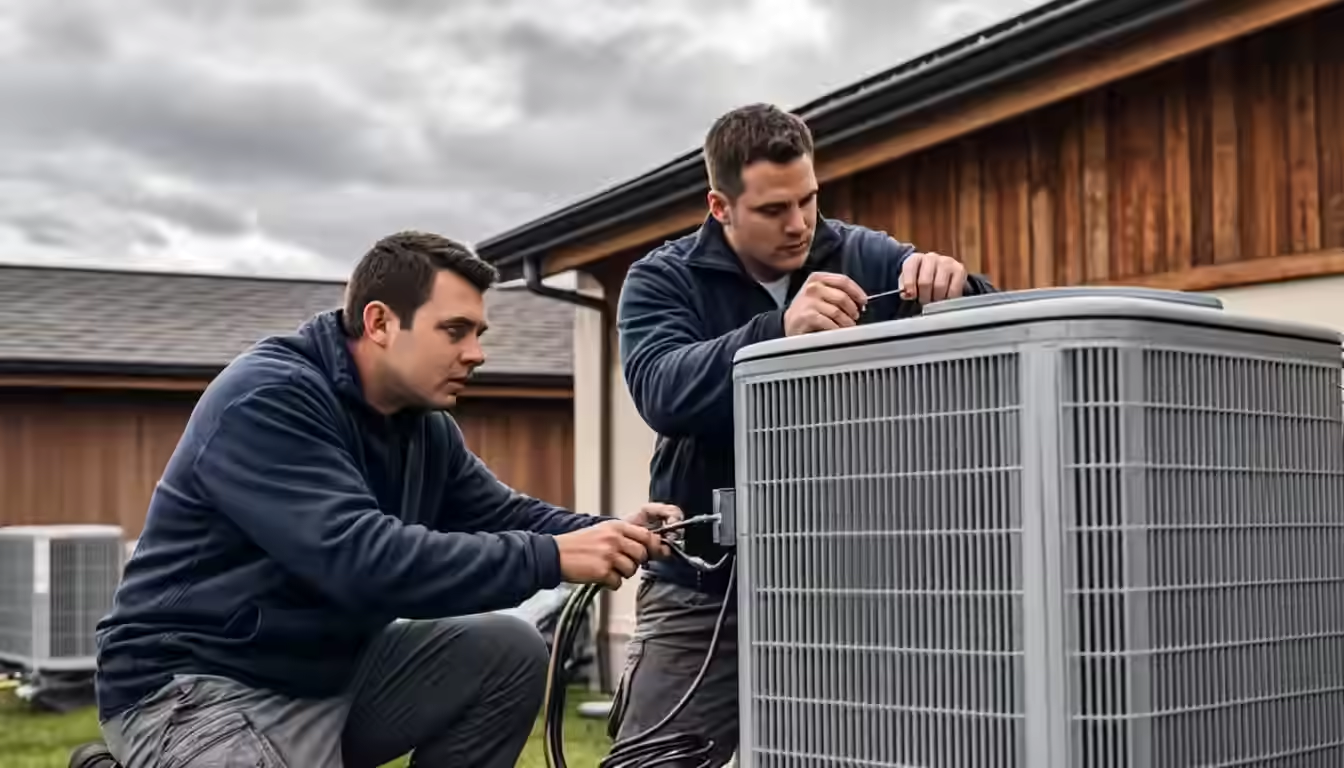
The second reason is the cooling requirement. The BC Building Code now requires cooling capability in new homes, a direct legacy of the 2021 heat dome. A heat pump satisfies that requirement natively, in the same cabinet, on the same refrigerant circuit, with the same electrical service. A gas furnace answers the heating side and then leaves you buying a separate condenser, a second pad, a second set of refrigerant lines and a bigger electrical load to cover cooling. On paper, for a new building, the heat pump is one purchase doing two code-mandated jobs.
The economics on our price list look like this: a single-zone ductless heat pump installs for $3,800 to $5,500, and a ducted cold-climate system runs $6,500 to $14,000 depending on capacity, ductwork and electrical work. For context, a high-efficiency two-stage gas furnace is $5,500 to $9,000, before anyone has spent a dollar on cooling. In a new building the comparison usually ends there. In an existing home it is more interesting, and we will do that math honestly in chapter 8. The full equipment walkthrough lives in our Vancouver heat pump guide.
Ventilation: The Part People Forget
Every dollar spent making a house tighter is partly wasted if nobody plans how the occupants will breathe. A Step 3 home cannot rely on accidental leakage for fresh air, so the code requires mechanical ventilation, and in practice that means an HRV or ERV. A heat recovery ventilator pulls stale indoor air out and fresh outdoor air in through a heat exchanger that recovers most of the warmth from the exhaust stream, so you get fresh air in January without dumping heat into the backyard.
On new construction, the cost is a line item in the mechanical budget, and it is cheaper than most people expect when it is planned into the design instead of retrofitted. In existing homes, adding an HRV is real work, duct runs, ceiling penetrations, a boost switch in the bathroom, and it is worth doing when a house has been tightened substantially through air sealing and window upgrades. The signal that you need one is simple: if your house gets stuffy overnight, if cooking smells linger for hours, or if windows sweat in winter, your envelope is either too leaky or too tight without ventilation, and both problems have the same fix.

Maintenance is the unglamorous part: HRV filters want checking every couple of months, and the core gets vacuumed seasonally. We build filter checks into our maintenance visits, and the same discipline applies to heat pump filter care across our cooling service and heating service programs. If you are weighing which efficiency upgrades are actually worth it in an older home, the BC energy upgrades guide ranks them honestly, ventilation included.
What the Step Code Means for Renovations
This is the chapter most readers actually need. The boundary is this: a like-for-like replacement, a furnace for a furnace, an AC condenser for an AC condenser, is a permit-and-safety matter governed by the gas code and electrical code, not an energy-code matter. Nobody at the permit counter will ask you to upgrade your walls. If your 1994 furnace dies in December, you can replace it with a modern high-efficiency furnace and be warm by the weekend.
The line gets crossed when construction creates or significantly alters building area. A new laneway house, a new multiplex, a large addition, and in many municipalities a gut renovation down to the structure, will pull the project into the energy compliance path, and the city will tell you which step applies. Vancouver's building by-law, Burnaby's and Surrey's adoptions differ in the details, but the pattern is identical: new floor area equals new performance expectations. Renovating a kitchen or a bathroom does not trigger it. Adding a floor does.
The practical advice we give anyone planning a major renovation in 2026 or 2027: ask the permit counter the energy question before you finalize the mechanical budget, because if the project lands in the compliance path, the envelope work you were maybe going to skip, air sealing, window quality, insulation detailing, stops being optional. And if a heat pump is on your horizon either way, our crews cover heat pump installs in Vancouver and every surrounding city, with the same flat-rate quote discipline on all of them.
Your Replacement Decision in 2026
If you are replacing equipment in an existing home this year or next, the Step Code does not apply to you, but it has built the menu you will order from. Here is that menu, with our real install ranges and where each option sits relative to the direction the code is pushing.
| System | Installed range (CAD) | Code direction fit |
|---|---|---|
| High-efficiency two-stage gas furnace | $5,500-$9,000 | Legal and fine in existing homes; a mismatch for small tight new builds |
| Central AC added to a furnace | $3,800-$6,500 | Cooling-only purchase; does nothing for the heating bill |
| Ductless single-zone heat pump | $3,800-$5,500 | Heats and cools one zone; the laneway and suite workhorse |
| Cold-climate ducted heat pump | $6,500-$14,000 | The closest thing to a code-proof choice; both seasons, one system |

The honest comparison for an existing home is a two-part question. Part one: does your house have usable ductwork? If yes, a ducted heat pump against a furnace-plus-AC combination is a genuine contest, and the rebate stack can decide it, because combined CleanBC, BC Hydro, FortisBC and municipal support on an eligible heat pump can reach $16,000, and limited-time bonuses of up to $1,000 appear in some seasons. If no ductwork exists, multi-zone ductless avoids running ducts through a finished house entirely. Part two: what does your gas situation look like? If you would keep a gas line alive solely for a furnace, the arithmetic of the heat pump improves again. Rebate amounts change frequently, so we verify every program at booking rather than quoting from last year's flyer.
Bottom line
If you have ducts and a working gas setup, compare a ducted heat pump against furnace-plus-AC with real quotes. If you have no ducts, the heat pump wins by default. Either way, the rebate stack belongs in the comparison, not after it.
Step Code and Your Home Value
Buyers are starting to ask the questions the Step Code institutionalized. New homes come with EnerGuide labels and compliance documentation that older stock simply does not have, and after the 2021 heat dome, the question is this house comfortable in July is now asked in February, at the inspection, in writing. A home with a documented envelope, an HRV and a heat pump answers it before it is asked.
Operating cost is the other half of value. A tight envelope with a right-sized heat pump running at low modulation uses dramatically less energy over a winter than a leaky envelope with an aging furnace, and Metro Vancouver's rate structure, BC Hydro electricity on one side, FortisBC gas on the other, means the balance shifts with every rate change. Our honest position: do not buy any HVAC equipment as an investment, buy it for the years you will live with it. But when the day comes to sell, a documented, permitted, well-maintained mechanical system with our 2-year workmanship warranty behind the most recent work is a genuine negotiating asset, and a 20-year-old mystery furnace is the opposite.
If replacing a hot water tank is on your horizon at the same time, the same market forces apply; our water heater service covers tank and tankless options, and heat pump water heaters pair naturally with the electrical work a heat pump already brings into the house.
What Compliance Day Looks Like
For a new home, the airtightness test is the moment of truth, and good builders schedule it twice. The mid-construction test happens after the air barrier and windows are in but before drywall, so every leak is still reachable: electrical boxes, top plates, rim joists, exhaust penetrations. A technician from an energy advisory firm sets up the blower door, takes the reading, then walks the house with a smoke pencil or infrared camera while the fan holds the pressure. It takes under two hours and it saves weeks.
The final test happens at occupancy stage, and the number goes on the compliance documentation. If a house misses, the fix is unglamorous: sealing, taping, gaskets, retest. What does not work is arguing with the fan. On the mechanical side, the commissioning process matters just as much: a heat pump that has been started up properly, airflow verified, refrigerant charge checked against the manufacturer's subcooling and superheat targets, controls configured, will deliver the performance the energy model promised. One that has been turned on and handed over will not, and that gap is where most disappointed new homeowners come from. We commission everything we install, and we document it.
The Cheat Sheet
The whole guide, compressed into the table we would give a neighbour over the fence.
| If this is you | What actually matters |
|---|---|
| Building new, laneway or multiplex | Design heat pump plus HRV in from day one; ask the permit counter which step applies |
| Replacing a furnace in an existing home | No code trigger; price a heat pump in the same quote and compare with rebates included |
| Major gut renovation with permits | Ask the energy question first; envelope work may stop being optional |
| Buying a newly built home | Ask for the EnerGuide label and the airtightness number, and ask who commissioned the equipment |
| Tightened your older house with sealing and windows | Watch for stuffiness and winter condensation; an HRV may be the missing piece |
We have been installing and commissioning heating and cooling across Metro Vancouver since 2010, 12,000-plus jobs, Red Seal certified, licence BC-PL-2019-4421, and we handle the CleanBC, BC Hydro, FortisBC and municipal paperwork on eligible retrofits at no extra charge. If you are planning a build or a replacement and want the numbers run honestly for your specific house, that is what the quote visit is for.
Frequently Asked Questions
Services That Solve This Faster
Heat pump installation
The system that fits Step 3 homes best, from single-zone ductless to cold-climate ducted systems.
Heating and furnace service
Honest repair-vs-replace math for existing homes, with flat-rate quotes and same-day diagnostics.
Cooling and AC service
Cooling is now a code requirement in new homes; we install, service and right-size AC across the region.
Heat pumps in Vancouver
Local crews who know Vancouver Building By-law requirements, strata rules and permit counters.
Related Guides From Our Team
The Vancouver heat pump guide — the full equipment walkthrough if the Step Code has you leaning toward a heat pump.
Energy-efficient upgrades for BC homes — the retrofit side of the same story: what is worth doing to the house you already own.
CleanBC rebates in 2026 — how the retrofit rebate stack works and what paperwork we handle for you.
Furnace repair vs replace — the honest decision framework if your existing furnace is the reason you are reading this.
Window replacement in Vancouver — windows are half the airtightness story; here is the other half of the envelope.

Red Seal certified, licensed gas fitters (BC-PL-2019-4421), $2M insured, 15-plus years on the tools, 12,000-plus jobs across Metro Vancouver since 2010, 4.9 stars from verified reviews. We wrote this guide because Metro Vancouver homeowners deserve the numbers, the code references and the honest trade-offs before anyone touches a wrench or a wallet.
More about our team →Talk to a Real Technician About This Today
Book a visit with a Red Seal technician: a real diagnostic, a written flat-rate quote before any work starts, honest repair-versus-replace math, CleanBC rebate paperwork handled and financing from 7.99 percent with approved credit. Emergencies answered 24/7 at 604-615-2212.
Building or renovating in 2026?
Our Red Seal technicians design and install heating and cooling for new homes, laneway houses and multiplexes across Metro Vancouver, and we handle the CleanBC paperwork on eligible retrofits. Quotes are flat-rate and written before work starts, with financing from 7.99 percent on approved credit.
Call 604-615-2212 WhatsApp Us