
The Honest Answer Up Front
Here is the short version we give at the kitchen table after 12,000-plus jobs across Metro Vancouver since 2010: if your home has functioning forced-air ducts, central air conditioning installed at $3,800 to $6,500 is almost always the better long-term buy, and the gap between it and the window-unit route widens every summer this region has. If you have no ducts, a strata that forbids exterior changes, or one west-facing bedroom that ruins two weeks of the year, window and portable units are a legitimate answer, not a compromise we grudgingly allow.
What changed the calculus is the summers themselves. The 2021 heat dome, the string of Julys since where overnight lows stay in the twenties, and the smoke events that make open windows a health decision rather than a comfort one, have turned cooling from a luxury into infrastructure in this province. Central AC cools every room at once, filters the air the furnace already moves, adds quiet to bedrooms that window units turn into airfield hangars, and shows up in purchase decisions now that buyers ask about cooling the way they used to ask about gas fireplaces. Our central AC installation guide for Vancouver homes walks the install itself in detail if that is the stage you are at.
This guide compares the three routes honestly, in BC dollars, with the running-cost math most comparisons skip and the physical limits of window and portable units explained without marketing. It ends with a decision tree by home type, because the right answer for a 1912 Vancouver special is not the right answer for a 1998 Surrey family home, and the right answer for a strata condo is a conversation with your property manager before it is a conversation with us.
Any contractor who quotes central air over the phone, without seeing your ducts, your panel and your floor plan, is guessing. Every honest cooling quote in this province starts with a load calculation and a site visit, and ours does too.
0 jobs since 2010
Heating, cooling and plumbing jobs completed by our Red Seal team across Metro Vancouver and the Fraser Valley.
0 diagnostic, credited
The flat diagnostic fee on struggling AC systems, credited in full toward any repair that follows it.
0 star rated
From 26 verified Google reviews, earned one honest quote and one flat-rate invoice at a time.
0 on workmanship
Every install carries a 2-year workmanship warranty, under BC licence BC-PL-2019-4421 with $2M liability coverage.
What BC Summers Now Demand From Cooling
Metro Vancouver was historically a "open the window at 9 p.m." climate, and a lot of advice you will read online still assumes it. The record says otherwise now. The June 2021 heat dome pushed Lytton past 49°C and killed 619 people in this province, most of them in homes that had no cooling. Since then, Environment Canada heat warnings for the South Coast have become a routine feature of July, and the pattern that matters is not just the daytime peak but the overnight minimum: when lows stay above 20°C for three nights, homes with no mechanical cooling never recover, and indoor temperatures ratchet upward all week.
The regional spread matters too. Vancouver proper, shaded by mountains and water, runs a few degrees cooler than the Fraser Valley floor: Abbotsford, Langley and Cloverdale routinely see mid-thirties afternoons that Kitsilano escapes, and the east-west gradient repeats inside cities, with east Burnaby and north Surrey warmer than the shading streets of Shaughnessy. If your neighbours one neighbourhood over swear they do not need AC, check which side of the ridge they live on before you take the bet.
Then there is the smoke. Wildfire smoke events now arrive most summers, and during those weeks the advice flips from "open everything at night" to "close everything and filter." That is a job for a system that moves air through a filter, which a furnace blower with a central coil does on fan-only mode and which a window shaker cannot do at all. The heat dome preparedness guide we publish covers the whole-home checklist; the cooling comparison here is the equipment half of that plan.
The last factor is who is in the home. Infants, seniors, people on certain medications and pets all tolerate heat waves measurably worse, and the last three summers of emergency calls have taught us which houses those are. A cooling plan in this region is no longer a comfort upgrade; for a lot of households it is a health decision with a price tag, and the honest comparison is the one that weighs it that way.
The Three Options at a Glance
There is a fourth option, ductless mini-splits, which deserve their own ductless versus central comparison and a heat-pump rebate conversation, so we keep it in the cost chapters and focus this table on the three most homeowners actually weigh: central AC on existing ducts, window units, and portable units.
| Factor | Central AC | Window units | Portable units |
|---|---|---|---|
| Installed cost with our team | $3,800 - $6,500 flat-rate, permitted | Hardware-store purchase, self-installed | Hardware-store purchase, self-installed |
| Rooms cooled per system | Whole home through existing ducts | The room it sits in | Effectively the room it sits in |
| Typical service life | 15 - 20 years, serviceable | 5 - 10 years, disposable | 5 - 10 years, disposable |
| Noise in the bedroom | Outdoor condenser; indoor side is silent | Compressor sits in the window you sleep beside | Compressor sits on your floor |
| Air filtration and smoke weeks | Furnace fan moves air through a real filter | Minimal, washable mesh at best | Minimal |
| Effect on resale | Positive; buyers ask for it now | Neutral at best | Neutral at best |
| Strata permission needed | Often, for exterior condenser | Sometimes, for window appearance | Rarely |
| Winter | Sits idle beside the furnace, no handling | Remove, store, re-install annually | Store somewhere |
Read the table once vertically, the way each column lives in your house, and once horizontally, the way each row hits your actual summer. The two rows that decide most arguments are noise and coverage: a bedroom window unit is louder than the central system cooling the entire house, and two portables fighting a two-storey home still lose the upstairs, which is the floor that needed help.
Central wins on the whole-house job
Every room at once, silent indoors, filtered air on smoke days, one thermostat, and equipment that outlives three generations of window units.
Window units win the two-week problem
For one room, a rental suite, or a strata that forbids everything else, they are the fastest, cheapest, most reversible answer in the building.
Portables win nothing outright
They exist for casement windows, strata rules and heat-dome triage. Buy one knowingly, not as a house-wide plan.
Upfront Costs in BC Dollars
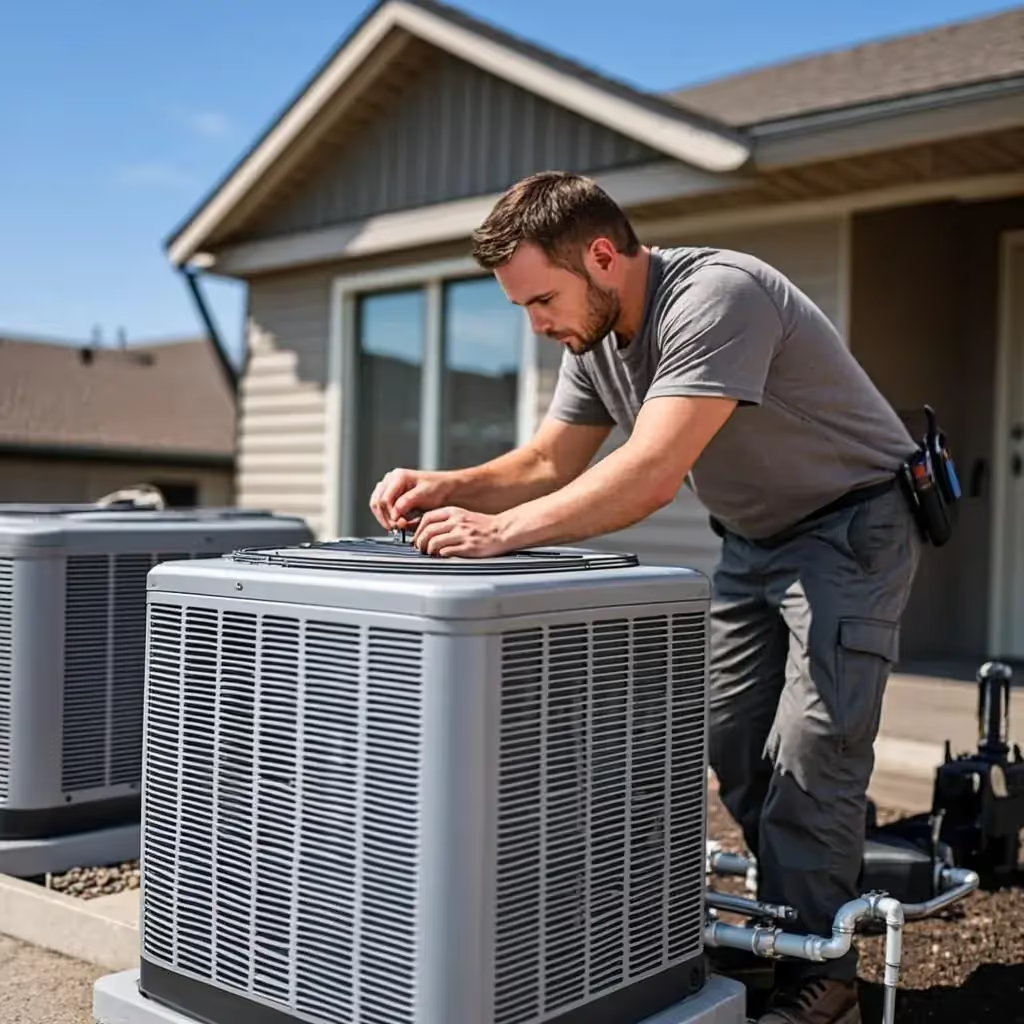
Central AC installed by our team runs $3,800 to $6,500, flat-rate and in writing before we start. The spread inside that range is real, not negotiating theatre: it moves with the condenser tonnage your load calculation calls for, whether the evaporator coil matches your furnace blower or needs a transition, line-set length and routing, the electrical circuit from your panel, and the permit. A small bungalow with a healthy duct system sits near the bottom; a larger home with a long refrigerant run and panel work sits near the top, and both numbers include commissioning and the 2-year workmanship warranty.
The ductless alternative changes the conversation. A single-zone ductless heat pump runs $3,800 to $5,500, a multi-zone system covering upstairs and main floors runs $9,500 to $16,000, and a cold-climate ducted heat pump replacing the whole HVAC approach runs $6,500 to $14,000. Combined CleanBC Better Homes, BC Hydro, FortisBC and municipal top-ups can reach $16,000 for cold-climate heat pumps in 2026, and we complete the paperwork. That rebate stack is why many homeowners weighing central AC against window units end up weighing central against a heat pump instead, and the year-round heating side of that decision deserves its own conversation.
Window and portable units live outside our invoice book, by design. They are retail purchases: cheapest in the spring before the first heat warning empties the shelves, mounting hardware extra, installation your own Saturday project. We will not pretend a number for them; we will only note the pattern we see in service calls, which is families replacing and adding units every few years for a decade before finally calling us, having spent enough total to have covered a meaningful share of a central system that would still be running.
0 - $6,500 central
The whole flat-rate installed range, permitted and commissioned, with the 2-year workmanship warranty attached.
0 - $5,500 ductless
Single-zone ductless heat pump, the no-ducts alternative that also heats in winter.
0 heat pump rebates
Combined CleanBC Better Homes, BC Hydro, FortisBC and municipal top-ups for cold-climate heat pumps in 2026; we handle the paperwork.
0 diagnostic, credited
Already have AC that disappoints? The flat diagnostic is credited in full toward the repair when one follows.
Beware the quote that arrives before anyone measured anything. Condenser size, blower match, duct capacity and your electrical panel are the four numbers that make an honest price, and all four require eyes on your house.
The Running-Cost Math Nobody Shows You
The honest way to compare electrical cost is not brand slogans, it is the nameplate. Every unit sold in Canada carries its rated wattage or amperage, and your real summer cost is the sum of every unit you actually run, multiplied by the hours you run it, at whatever BC Hydro tier you are in by August. A single central condenser has one nameplate. The window-unit plan for a three-bedroom house has three or four, each running harder and longer because they only fight the room they sit in while the hallway stays hot.
Efficiency standards tell the same story. Central systems sold today meet the SEER2 testing regime, which rates the system as a whole, and the file cabinet-sized condenser in your side yard gets efficiencies the toaster-sized compressor in a window opening physically cannot match at its scale. Portables are worse again, because the single-hose majority of them spend a third or more of their output re-cooling the hot outside air they just pulled in through your wall gaps. When a portable "feels" weaker than its box number, that is not perception, it is the physics doing exactly what the box number ignored.
There are two running-cost credits central owners forget to count. First, fan-only mode: running the furnace blower during smoke weeks or warm evenings pushes the whole house through the filter for pennies of fan power, a service no window unit can perform. Second, right-sizing: a central system chosen from a proper load calculation runs long, steady cycles that dehumidify properly, while an oversized system, the classic window-unit temptation of "bigger box, colder room," short-cycles, which wastes power and leaves the air clammy. Our cooling and AC service pages cover the sizing conversation in detail.
One cost nobody prices until August of a bad year: the repair call. Central AC repairs through our flat-rate book run $180 to $450, with the $89 diagnostic credited toward any repair, and after-hours calls carry the $150 flat premium posted in advance. Window and portable units do not get repaired at those prices; they get carried to the recycling depot and replaced. Which of those two calendars you prefer is a legitimate personal choice, and we would rather you make it knowing both exist.
Window and Portable Units: The Honest Limits
We install central systems for a living and we still own a window unit for the cabin, so this chapter is not a sales pitch wearing physics gloves. It is the five limits we explain to every homeowner who asks whether the hardware-store route will carry their house, because every one of them shows up as a July service call or a 1 a.m. search result.
One unit, one room, no negotiation
A window unit cools the room it sits in and a few feet of hallway beyond. Two-storey homes discover that the downstairs unit does nothing measurable upstairs, and the upstairs bedrooms, the hottest rooms in every BC house of this shape, need their own units each. Coverage is bought one window at a time.
The compressor sleeps where you sleep
The compressor of a window unit is inside the window opening, a metre from your pillow. Central AC puts the compressor outdoors and the indoor side is silent ductwork. Families routinely spend the money after their second sweaty, noisy summer, not their first.
Single-hose portables fight your own house
A single-hose portable blows conditioned air out the window to carry heat away, dropping the room pressure so hot outside air leaks in through every gap to replace it. Effective capacity lands well below the box number. Dual-hose units fix the pressure problem but remain one-room machines with a floor-level compressor.
Windows and strata have opinions
Sash windows, casement (crank) windows and sliding windows each accept only certain form factors, often badly sealed. Stratas increasingly restrict visible window units in common-view facades. Mounting hardware, security bars and the fall hazard of a badly supported unit are real checklist items, not fine print.
The seasonal drag
Every autumn the units come out, get carried to storage, and go back in every spring, re-sealed and re-supported, or they sit in the windows all winter as a cold, drafty, condensation-generating hole in your building envelope. Central equipment does none of that; it waits beside the furnace.
The honest summary: for a single problem room, a rental, or a strata-locked condo, a window unit is a tool doing exactly the job it was designed for. As a whole-home strategy in the summers this region now has, it is a treadmill of purchases, noise and lugging that most families eventually step off, and the step-off point is usually the third heat warning in two years.
What Central AC Actually Involves
A central install on a ducted home is a one-day project inside a one-week permit window: the evaporator coil goes above the furnace, the condenser sits on a pad outside, a refrigerant line set connects them, an electrical circuit feeds the condenser, and the thermostat learns a cooling mode. Done by Red Seal certified technicians under BC licence BC-PL-2019-4421, it carries $2M liability coverage and our 2-year workmanship warranty. What separates a good install from a regrettable one is the work that happens before any of that hardware shows up.
A load calculation, not a guess
Room-by-room heat gain, orientation, insulation, windows and duct capacity decide condenser size. Oversizing is the quiet killer of comfort and humidity control; undersizing leaves July on the table.
A matched system
The evaporator coil must be paired to your furnace blower and the condenser, or airflow and efficiency both suffer. Mixing brands or generations to save a few dollars costs it back across 15 years.
The electrical check
The condenser needs its own circuit, and older panels sometimes need work first. Discovering that at install day is a schedule slip; discovering it at quote stage is a line item.
Permits and the refrigerant transition
Electrical permits and a commissioned, documented start-up are included in our flat price. New equipment arrives on the low-GWP refrigerants now phasing in across Canada, one more reason installers quoting leftover R-410A stock deserve a second question.
If you already own central AC and it is the one disappointing you this spring, that is a different, cheaper conversation: most cooling let-downs are repair-scale, $180 to $450 through our flat-rate book with the $89 diagnostic credited toward the fix. The troubleshooting walkthrough for warm air, short cycling and icy coils starts with our AC repair service in Vancouver, and the same crew and flat-rate book cover the valley side of the region from Surrey to Langley.
The Decision Tree by Home Type
Cooling decisions in this region are housing-stock decisions. Here is the table we work from, home type by home type, with the honest first recommendation for each.
| Your home | The realistic options | Our honest first call |
|---|---|---|
| Pre-1940 character home, radiator or baseboard heat, no ducts | Ductless single or multi-zone; window units for problem rooms | Ductless if you own; window units if budget is now |
| 1970s-1990s house with furnace ducts (Surrey, Langley, Coquitlam stock) | Central AC on existing ducts; multi-zone ductless | Central, $3,800 - $6,500, after a duct and load check |
| 2000s+ house with a modern furnace and healthy ducts | Central AC; heat pump replacement of the whole system | Central now, or price the heat pump with 2026 rebates first |
| Condo or strata apartment | Portable; window unit if the strata allows; in-suite ductless with permission | Check the bylaws before buying anything |
| Two-storey with one hot upstairs | Ductless for the upstairs; central with zoning; window unit per bedroom | Ductless upstairs or properly zoned central, not five window units |
| Rental property or suite | Window units you control; ductless head in the suite | Ductless for tenant retention; window units for cap-ex control |
Two footnotes to the table. Strata condos are a bylaw question before they are an equipment question: window restrictions, exterior condensers and in-suite ductless each get decided in different paragraphs of different strata documents across Metro Vancouver. And the heat pump column keeps growing for a reason: the heat pump option for Vancouver homes covers both directions of the year, and with combined rebates reaching $16,000 for cold-climate units in 2026, the honest comparison for a ducted home is often central-AC-now versus heat-pump-instead, not window-versus-central, and the payment side, including financing from 7.99 percent with approved credit, is laid out on our financing page.

The Cheat Sheet and Next Steps
If you remember nothing else from two thousand words of comparison, keep these four rules. They carry most of the honest weight, and every one of them was earned across more than 12,000 jobs in this region since 2010.
Ducts plus ownership equals central
A ducted home you plan to keep is the clearest case for central AC: whole-home coverage, quiet bedrooms, filtered air and resale value, $3,800 - $6,500 installed.
One room, two weeks: window unit
Single problem room, rental or strata-locked condo? The hardware-store answer is legitimate. Buy in spring, mount it safely, own its limits.
Never plan on portables
A portable is heat-dome triage for casement windows and bylaw corners, not a household cooling strategy. If you own, plan ductless or central instead.
Get the load calculation first
Whatever you buy, buy the right size. Every honest quote in this province starts with someone measuring your house, your ducts and your panel.
The next step is the free estimate. Book a Red Seal estimator, get the load calculation and a flat, written price for the system your house actually wants, and if central is not the right answer for your home, hear that from someone with no stake in the window-unit sale either. We answer cooling emergencies 24/7 at 604-615-2212, and the same number reaches the estimators who will happily tell you a single window unit is all your spare bedroom needs, if that turns out to be the truth.
Frequently Asked Questions
Services From This Guide
Central installs, ductless quotes, flat-rate repairs and honest advice across Metro Vancouver, seventeen cities, seven days a week.
Central AC installation
Flat-rate $3,800 - $6,500 installs on ducted Metro Vancouver homes, load-calculated, permitted and commissioned.
AC repair Vancouver
Warm air, short cycling, icy coils? $89 diagnostic credited to the repair, flat-rate fixes from $180 - $450.
AC repair Surrey
The same flat-rate book across the Fraser Valley, Surrey to Langley and Cloverdale, 2-year workmanship warranty.
Financing and rebates
Financing from 7.99 percent with approved credit, and heat pump rebates that can reach $16,000 combined in 2026.
Related Guides
Central AC Installation: The Vancouver Guide
What install day looks like, what the permit covers and the five decisions that set the final price.
ComparisonDuctless vs Central AC in Surrey
The no-ducts alternative compared honestly, including zoning, costs and which homes each one suits.
SeasonalHeat Dome Preparedness for BC Homes
The whole-home heat plan: cooling, night flushing, smoke-week filtration and who is most at risk.

Red Seal certified, licensed gas fitters (BC-PL-2019-4421), $2M insured and 15-plus years in the field, with more than 12,000 jobs completed across Metro Vancouver since 2010 and a 5.0-star rating across 26 Google reviews. We wrote this guide because the window-versus-central answer is only honest when the company giving it installs one route and still recommends the other two when they fit. To turn these numbers into a flat-rate quote, see AC repair in Burnaby — same-day across the city.
More about our team →Get Your Honest Cooling Quote
Book a free cooling estimate with a Red Seal estimator. You get the load calculation, a flat written price for central or ductless, the heat pump rebate picture for 2026, and a straight answer if the honest recommendation is a single window unit. Financing from 7.99 percent with approved credit, zero obligation, same-day quotes on most calls. If you would rather hand this to a pro, our cooling & AC services pages cover Metro Vancouver.
AC down right now?
Cooling no-heat calls are answered 24/7 with live dispatch and flat after-hours pricing posted in advance. Daytime? The $89 diagnostic is usually same-day in Vancouver, Burnaby and Surrey.
Call 604-615-2212 WhatsApp Us