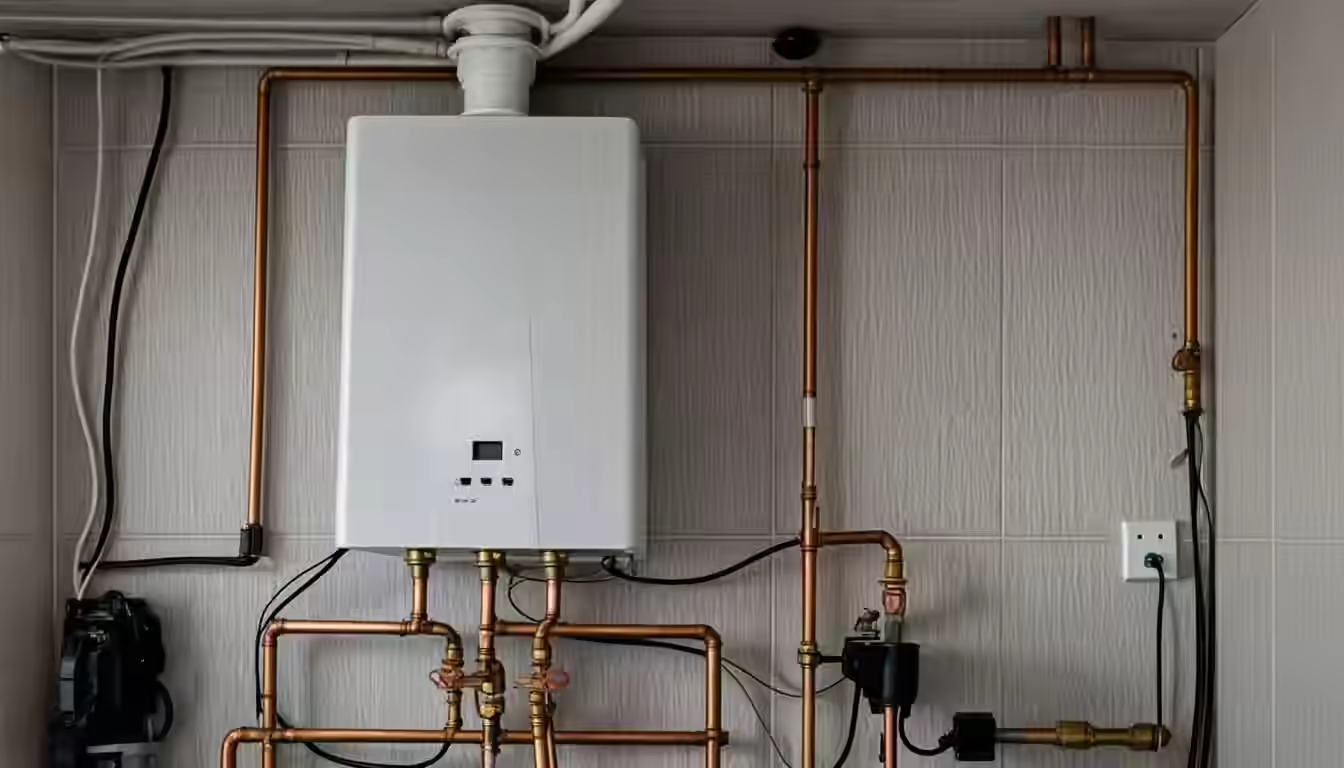
The Ten-Year Answer Up Front
Here is the honest verdict for Metro Vancouver: for a family of four, a gas tank costs roughly $300 to $350 a year in fuel while an electric tank costs roughly $510 to $630 in electricity, so gas wins the operating ledger by $150 to $300 a year, less than almost anywhere else on the continent. Installation runs the other way, $2,200 to $3,200 for a standard gas tank against $1,800 to $2,600 for an electric, because gas carries what we call the venting tax. Add repairs, lifespan and the fixed charges hiding on your FortisBC bill, and over ten years the two fuels land closer than most homeowners expect, close enough that the right answer usually comes down to your house, not the fuel.
And then there is the wildcard that changed this whole comparison. A heat pump water heater uses roughly a third of the electricity of a resistance tank, roughly $150 to $190 a year for that same family of four, and CleanBC pays $1,000 on eligible models. In 2026, the real comparison in BC is not gas versus electric. It is two old technologies fighting for second place while a third quietly wins on the ten-year ledger, which is why we run all three side by side in every water heater estimate we write.
Anywhere else in North America, gas wins this fight in one sentence. In BC, our electricity is too cheap and our gas delivery charges too high for the easy answer, which is exactly why you should see the math before you buy.
0 gas advantage
The typical operating-cost gap between a gas tank and an electric resistance tank for a BC family of four.
0 CleanBC rebate
Paid on eligible heat pump water heaters, the machine that runs both fuel ledgers off the table.
0 either way
Expected tank life in our climate with maintenance, because the tank, not the fuel, is what eventually leaks.
The Four Machines You're Actually Comparing
"Gas versus electric" sounds like two options. In 2026 Metro Vancouver showrooms and supply houses there are really four machines, and misnaming them is where most comparisons go wrong before the first dollar gets counted. The atmospheric gas tank is the classic: a standing pilot or intermittent spark, a burner under a steel tank, a metal vent through the roof or chimney. It's the machine most pre-2005 homes in Burnaby, New Westminster and East Vancouver have sitting in the basement right now, and it keeps working through a power outage, a fact that matters more than people think in January.
The power-vented gas tank adds a fan that pushes flue gas out a sidewall, which frees it from chimneys and suits cramped townhouse mechanical closets, at the price of needing an electrical outlet and losing your outage immunity. The electric resistance tank is two heating elements immersed in a steel tank, dead simple, 94 to 96 percent efficient at converting electricity into hot water, and installable anywhere you have 240 volts, which is why condos and laneway houses are full of them. The fourth machine is the heat pump water heater, an electric tank with a small air-source heat pump bolted on top that moves three to four units of heat per unit of electricity. Tankless units sit adjacent to this conversation, and our tankless versus tank comparison covers that decision on its own terms.
| Machine | Efficiency (UEF) | Needs | Best fit |
|---|---|---|---|
| Atmospheric gas tank | 0.58-0.64 | Gas line + chimney/B-vent + combustion air | Houses with existing chimney, outage resilience valued |
| Power-vented gas tank | 0.64-0.70 | Gas line + 120V outlet + sidewall vent | Townhouses, no-chimney homes, cramped rooms |
| Electric resistance tank | 0.92-0.96 | 240V / 30A dedicated circuit | Condos, laneways, homes without gas service |
| Heat pump water heater | 3.0-4.0 | 240V circuit + ~1 m clearance + air volume or ducting | Basements, utility rooms, rebate-minded homeowners |
One note on that efficiency column: UEF, the uniform energy factor, is the number on the black-and-yellow EnerGuide label, and it measures energy in versus energy delivered under standardized testing. A gas tank at 0.62 loses a third of its fuel up the flue and through the tank walls. An electric tank converts nearly everything it draws. A heat pump water heater at 3.5 delivers three and a half times what it draws because it isn't converting at all, it's moving heat from your utility room into your water. Keep the label numbers in mind; the next chapters turn them into dollars.
Ledger One: What Installation Actually Costs
The tank is the cheap part; the day of labour and the code requirements around it are where the money goes. A same-brand electric tank swap in an accessible Surrey garage runs $1,800 to $2,600 installed, including haul-away, a new T&P relief valve, flex connectors, dielectric fittings, seismic strapping and the permit. A straight atmospheric gas tank swap where the chimney and gas line already exist runs $2,200 to $3,200, with the premium buying the venting check, gas fitting by a licensed gas fitter, combustion testing and the gas permit. That $400-to-$600 spread is the venting tax in its mildest form.
The tax compounds when the old vent can't be reused. A chimney that's cracked, shared improperly with a fireplace, or lined for a removed furnace forces either a liner ($800 to $1,500) or a jump to power-venting ($3,200 to $3,800 installed). On the electric side the mirror-image cost is the panel: if there's no spare 240-volt, 30-amp circuit, running one from a panel with space costs $300 to $600, and a full panel upgrade before any water heater work starts is a different conversation. This is why we quote water heaters on-site and in writing, and why any phone number quoted without seeing the vent and panel is fiction.
| Installation scenario | Typical range (installed) | What moves the price |
|---|---|---|
| Electric tank swap, existing circuit | $1,800 - $2,600 | Tank size, pan and drain routing, stair carries |
| Electric tank + new 240V/30A circuit | $2,100 - $3,200 | Panel capacity, run length, finished-ceiling access |
| Gas tank swap, existing vent + gas line | $2,200 - $3,200 | Vent condition, combustion air openings, permit |
| Power-vented gas tank | $3,200 - $3,800 | Sidewall penetration, outlet, condensate routing |
| Heat pump water heater | $3,400 - $4,800 before $1,000 rebate | Air volume or ducting, condensate pump, height clearance |
| Tankless (for reference) | $3,800 - $6,500 | Gas line upsizing, PVC venting, recirc option |
Two BC-specific lines in that table deserve emphasis. Every tank we install, gas or electric, gets strapped top and bottom, because a water heater is a 180-kilogram pendulum in an earthquake and the BC Building Code treats it that way. And every gas install includes combustion testing, because a tank that looks fine can still spill carbon monoxide through a compromised vent. Those items are not upsells; they are the job. Our Vancouver water heater crews run the same scope from the city core to Abbotsford, same-day swaps and full conversions included.
Ledger Two: The Operating Math, BC Hydro vs FortisBC
Start with the household, not the fuel. A family of four in Metro Vancouver draws roughly 200 litres of hot water a day, showers, laundry, dishes and the rest. Raising water from our 10-degree winter inlet to a 60-degree storage temperature takes about 42 megajoules a day, roughly 15 gigajoules a year of delivered heat. That is the honest baseline every operating-cost estimate should start from, and you can scale it: about 4 gigajoules a year per person, so a couple uses 8, a family of five uses 20.
Now the rates, stated honestly because they move every year. BC Hydro's residential rates sit at roughly 11 to 12 cents per kilowatt-hour on the Step 1 tier and roughly 14 cents on Step 2 as of the 2025 rate year, among the lowest electricity prices in North America. FortisBC residential gas, once the commodity, delivery charges and riders are stacked, lands in the low-to-mid teens per gigajoule for most Lower Mainland homes, and the consumer carbon tax that once added several dollars per gigajoule came off residential bills on April 1, 2025. The consequence is the strange BC reality this article exists to explain: gas is still cheaper per unit of heat, but not by the continent-wide landslide your relatives in Alberta assume.
| Family of four, ~15 GJ/yr delivered hot water | Annual input | Rate assumption | Annual cost |
|---|---|---|---|
| Gas tank (UEF 0.62) | ~24-25 GJ of gas | $12-$14 per GJ all-in | $300 - $350 |
| Electric tank (UEF 0.94) | ~4,400-4,600 kWh | 11.3-14¢ per kWh | $510 - $630 |
| Heat pump water heater (UEF 3.2) | ~1,300-1,400 kWh | 11.3-14¢ per kWh | $150 - $190 |
Run your own version of this table off your actual bills: FortisBC prints your gigajoules and your all-in cost per GJ on the back page, and BC Hydro's usage tool shows your kWh against the Step 1 threshold. The trap to avoid is comparing BC Hydro's per-kWh price directly to FortisBC's per-GJ commodity price, a mistake that appears in half the online forum arguments about this topic. A gigajoule is 278 kilowatt-hours; the only fair comparison is dollars per year for the same hot water, which is exactly what this table shows. Smaller households narrow every gap, and a single person in a condo is arguing over $50 a year, which is why we always say the operating ledger matters most to big families.
Ledger Three: The Fixed-Charge Trap
Here is the line item that decides more Metro Vancouver fuel choices than any efficiency rating. FortisBC's residential rate includes a basic monthly charge, roughly $12 to $13, that you pay whether you burn one gigajoule or fifty. If your house heats with gas, the furnace already pays that charge, and the water heater's marginal cost is purely the per-gigajoule rate, which is the cheap scenario in Chapter 4. But if the water heater is your only gas appliance, the full fixed charge belongs to it: add roughly $150 a year to the gas tank's operating cost, and the $300-to-$350 fuel bill quietly becomes $450 to $500.
Run that against the electric tank at $510 to $630 and the gas advantage shrinks to roughly the price of a nice dinner per year, before counting the venting tax on installation. This is the scenario our estimators see constantly in East Vancouver character homes and 1970s Burnaby ranchers where the furnace went electric or heat pump years ago but the old gas tank soldiered on: a water heater paying a private utility subscription for the privilege of existing. Removing the gas meter entirely also removes the account, and that arithmetic increasingly ends with a heat pump water heater or a resistance tank and one less bill in the drawer.
The mirror-image trap is electrical capacity. A laneway house or condo suite with a small panel may have no room for a 30-amp, 240-volt circuit, making "just go electric" a panel-upgrade project rather than a tank swap. Neither utility charges you for a path that doesn't exist, but the infrastructure to reach one fuel or the other is a real cost, and it belongs in the ten-year math. When we quote a fuel switch, the estimate shows the circuit or gas-line work as its own line, so you can see which utility's fixed costs you're actually marrying.
Before you compare fuels, count your meters. A water heater that keeps a gas meter alive for itself is paying rent on a house with one tenant.
Ledger Four: Recovery, First Hour and Family Reality
Tank capacity is the number on the box; first-hour rating is the number that decides whether your family fights over showers. The first-hour rating (FHR) counts how much hot water the machine can deliver in the first hour of use, starting from a full tank, and the difference between fuels is dramatic. A gas burner puts roughly 35,000 to 40,000 BTU per hour into the water, reheating about 40 gallons an hour. An electric tank's elements are limited, usually 4,500 watts with one element energized at a time, which recovers roughly 20 to 25 gallons an hour. Same nameplate capacity, half the recovery rate.
In practice: a family of four with a 40-gallon gas tank can shower, run the dishwasher and still have a buffer, because the tank refills its usable heat almost as fast as it drains. The identical family with a 40-gallon electric tank will run out at the third shower, not because the tank is smaller but because it can't catch up between draws. This is why honest electric sizing often steps up one tank size, a 50 or 60-gallon electric tank delivering what a 40-gallon gas tank delivers in first-hour terms. If you've been blaming your family's habits, our hot-water-runs-out-fast coverage of the sizing math is worth ten minutes before you buy anything.
| Household | Peak-hour draw | Gas tank that fits | Electric tank that fits |
|---|---|---|---|
| 1-2 people, condo life | ~45-55 gal | 30-40 gal (FHR 60+) | 40 gal (FHR 50+) |
| 3-4 people | ~70-85 gal | 40-50 gal (FHR 70+) | 50-60 gal (FHR 75+) |
| 5+ people, teens, laundry | ~90-110 gal | 50-65 gal (FHR 85+) | 65-80 gal (FHR 90+) or dual tanks |
| Bath-and-shower heavy (soaker tub) | Tub fill + 2 showers | 50 gal minimum | 60-80 gal, schedule the tub |
The 60-percent rule of thumb keeps sizing honest: you only get to use about 60 to 70 percent of a tank's nameplate in one sitting before the water runs lukewarm, because cold water enters the bottom as hot leaves the top. A 40-gallon tank delivers roughly 26 usable gallons on demand, plus whatever recovery adds during the draw. Gas adds double the recovery, which is the real reason gas tanks feel bigger than their label, and the reason a fuel switch down in tank size usually disappoints the second shower in line.
Ledger Five: Space, Venting and the Safety Ledger
Fuel choice quietly decides where a water heater is allowed to live. A gas tank needs combustion air, an opening or louvered path supplying the burner's air, plus code-required clearance to combustibles, which is why gas tanks sit in furnace rooms with louvered doors rather than bedroom closets. An electric tank needs no air and no vent, so it can legally occupy a hallway closet, a condo utility nook or a laneway-house corner, which in space-constrained Vancouver real estate is worth real money per square foot. A heat pump water heater needs the most thoughtful placement of the three, roughly a metre of headroom and enough room air volume, or ducting to an adjacent space, because it harvests heat from the air around it.
Safety is where the fuels genuinely differ, and the differences are not symmetric. Gas appliances introduce combustion: carbon monoxide risk if a vent fails, a flame in your house, and a legal requirement in BC that any gas work be done by a licensed gas fitter. The T&P relief valve, the brass safety on every tank top that dumps water if temperature or pressure exceeds safe limits, is universal to both fuels and must discharge to within six inches of the floor, never into a crawlspace and never capped. And in this province, every tank gets seismic strapping, upper and lower, because the same code that braces your furnace expects your 180-kilogram water heater to survive a magnitude-7 shaking without snapping its gas connector.
One more space consideration worth naming in strata-heavy cities: anything beyond your own strata lot, including exterior walls for sidewall venting and common gas risers, needs strata approval before work starts. Condo and townhouse fuel decisions are therefore partly governance decisions, and our experience across Burnaby, Coquitlam and New Westminster strata buildings is that electric conversions clear this bar far more often than new penetrations for gas venting. If you're weighing a switch, the answer to "can I?" sometimes lives in your strata bylaws before it lives in the mechanical code.
Repairs and Lifespan Over Ten Years
Both fuels deliver tanks built from similar steel, similar anode rods and similar glass linings, so both are 8-to-13-year machines in our soft-water climate, with the tank's own leak being the usual cause of death. The repair profiles on the way there differ. Gas tanks kill controls: thermocouples and thermopiles ($150 to $250), gas control valves ($450 to $850 installed by a licensed gas fitter), and the occasional draft-spillage investigation. Electric tanks kill elements and thermostats, which are among the cheapest repairs in the plumbing world at $180 to $350, and an electric tank that has eaten one element often just needs the other one watched.
For the ten-year ledger, a fair planning number is $300 to $500 of repairs on the gas side and $150 to $300 on the electric side, assuming reasonable luck. The strategy that actually moves these numbers is maintenance: an annual flush, which runs $149 to $250, and anode inspection every three to four years, which can stretch a marginal tank to a good one. Metro Vancouver's surface water is genuinely soft, so our scale problems are milder than the Okanagan's, but well-served properties in Langley, Abbotsford and parts of Maple Ridge draw harder groundwater that accelerates both sediment and anode consumption. The full symptom guide lives in our water heater failure signs article, including how to read a serial number for age.
| Repair | Fuel | Typical cost | Worth it before year 10? |
|---|---|---|---|
| Thermocouple / thermopile | Gas | $150 - $250 | Yes, cheap insurance |
| Gas control valve | Gas | $450 - $850 | Before year 8 usually yes, after year 10 rarely |
| Heating element | Electric | $180 - $350 | Yes, almost always |
| Thermostat | Electric | $180 - $300 | Yes |
| Anode rod replacement | Both | $200 - $350 | Yes, the single best life-extender |
| Tank flush | Both | $149 - $250 | Annually in hard-water areas, every 2-3 years here |
A note for former Ontarians: the rental habit is strong back there, where more than half of homes lease their tank from Enercare or Reliance and a failed valve is a phone call to a landlord of sorts. BC is an ownership province, and that difference is worth real money over a decade, the full rental-versus-buy math lives in our rental vs buy breakdown, but the short version is that BC-style ownership with maintenance beats rental payments in nearly every scenario we've modelled.
The Ten-Year Totals, Three Homes
Here are the five ledgers added up for the family of four, using mid-range numbers from the chapters above. Three homes, because the totals change with the house. The gas-heated house keeps its water heater on a gas account the furnace already pays for. The all-electric house has no gas meter, so a gas tank would have to open one and pay the fixed charges alone. The condo has no gas service at all and a panel with space, which is the laneway-and-apartment reality across Vancouver, Burnaby and New Westminster.
| Ten-year total (family of four) | Install | Energy (10 yrs) | Repairs | Total |
|---|---|---|---|---|
| Gas-heated house: gas tank | ~$2,700 | ~$3,250 | ~$400 | ~$6,350 |
| Gas-heated house: electric tank | ~$2,200 | ~$5,700 | ~$250 | ~$8,150 |
| All-electric house: electric tank | ~$2,200 | ~$5,700 | ~$250 | ~$8,150 |
| All-electric house: gas tank + new account | ~$2,700 | ~$4,700 (incl. fixed charges) | ~$400 | ~$7,800 |
| Any house: heat pump water heater | ~$4,100 - $1,000 rebate | ~$1,700 | ~$500 | ~$5,300 |
Read the pattern rather than the decimals. In a house that already heats with gas, staying with gas is the cheap default and switching to electric resistance costs about $1,800 extra over the decade. In a house without gas, opening a gas account for the water heater's benefit alone saves almost nothing over electric resistance, roughly $350 over ten years, while costing a chimney or sidewall vent and a combustion appliance you didn't need. And in every scenario the heat pump water heater wins the decade by $800 to $2,800, its only entry fee being the higher up-front price and the space requirements from Chapter 7. These are estimates with honest ranges, not invoices; your house's numbers come from an on-site assessment, in writing, before anyone orders a tank.
The Wildcard: Heat Pump Water Heaters and the $1,000 Rebate
A heat pump water heater is an electric tank with a small air conditioner on top, running in reverse: it pulls heat out of the room air and deposits it in the water. The consequence for the ledger is a UEF of 3.0 to 4.0, meaning one kilowatt-hour of electricity delivers three to four kilowatt-hours of hot water. That turns the family-of-four operating cost into the $150-to-$190 line from Chapter 4, cheaper than gas even in the gas-heated house, and cheaper than half a gas bill's fixed charges in the all-electric one.
The paperwork stacks in your favour in 2026. CleanBC Better Homes pays up to $1,000 on eligible models from the qualifying products list, the same program family that pays up to $16,000 on cold-climate heat pumps, and we file the applications for our customers because the sequencing matters, model eligibility and pre-approval rules trip up otherwise perfect installs. The full program map, including the federal 0% Greener Homes Loan that can finance the whole upgrade, lives in our CleanBC rebates guide. The honest catches: the unit needs roughly a metre of top clearance and enough room volume, or ducting to an adjacent space, because it processes the air around it. It cools that space by a degree or two, which in a heated basement is mostly a shrug and in a tiny unheated utility room can matter. It's taller than a standard tank, so some closets and under-stair nooks are out. And in a power outage it's as dead as any electric tank.
Where it doesn't win is the tightest budgets and the shortest horizons: if the purchase price is the constraint, a $1,800 electric tank against a $3,400-plus heat pump unit is a $1,600 gap, and even with the rebate the payback runs roughly 6 to 10 years at BC Hydro rates. If you're selling the house in two years, buy for the buyer's plumber, not the decade. But if you're staying, and your mechanical room has the space, the wildcard is the best bet on this whole page, and the home energy upgrade math only improves when the water heater is combined with the rest of the stack.
The Decision Table, City by City
Housing stock does a lot of the deciding around Metro Vancouver. East Vancouver and New Westminster character homes usually have the chimney and the basement that make an atmospheric gas tank the path of least resistance, and the 100-year-old vent deserves an inspection either way. The 1970s-80s ranchers of Burnaby, Surrey and Coquitlam are the swiss-army cases: chimney sometimes shared, gas sometimes already in the walls, heat pump water heaters fitting beautifully in the big utility rooms. Richmond and Delta homes often sit slab-on-grade with tanks in garages, where flood pans, drain routing and the cold garage's effect on a heat pump unit all matter. Langley, Maple Ridge and Abbotsford add acreage wells with harder water that argues for maintenance-heavy simplicity. And strata-titled homes across the region live under bylaws that tilt toward electric. Here is the summary as a decision table:
| Your situation | Lean toward | Why |
|---|---|---|
| House heats with gas, sound chimney, family of 4+ | Gas tank or HPWH | Marginal gas cost is cheap; HPWH still wins the decade if the room fits |
| Water heater is the only gas appliance | Electric tank or HPWH | Fixed charges erase most of gas's edge; consider closing the account |
| Condo, laneway, no gas service | Electric tank | No venting, no strata approvals, small loads make gaps small |
| Big unfinished basement, staying 7+ years | HPWH | Lowest 10-year total, $1,000 rebate, free cooling bonus in summer |
| Outage resilience is the priority | Atmospheric gas tank | Standing pilot works through black holes in the grid |
| Tank already failed, budget is tight | Same-fuel same-day swap | Fastest and cheapest path back to hot showers; upgrade later with a plan |
Whatever the table says, the sequence is the same: confirm what you have, vent or circuit, gas account or none, tank age and size, then price the two or three paths that fit your house. That's a free estimate in our world, and it ends with numbers on paper you can hold. Twelve thousand jobs since 2010 across twelve cities have taught us that homeowners make good decisions when the ledgers are laid out honestly, and the plumbing team behind every one of those water heaters is the same licensed crew, gas fitting and electrical coordination included, start to finish.
Get the Ledger Run on Your House
A free estimate prices your gas, electric and heat pump options against your actual vent, panel and gas account, with the ten-year math and the CleanBC rebate attached. Tank already dead? Emergency crews run 24/7, and the $89 diagnostic is credited to any repair.
Frequently Asked Questions
Services From This Guide
Licensed crews, flat-rate pricing and 24/7 emergency response across Vancouver, Burnaby, Richmond, Surrey, Langley, Coquitlam, Delta, New Westminster, North Vancouver, Maple Ridge, Port Coquitlam and Abbotsford.
Water Heater Installation
Tank, tankless and heat pump water heaters installed by licensed gas fitters, $1,800-$3,800 for tank swaps.
Water Heaters in Vancouver
Same-day tank swaps and conversions for Vancouver's older housing stock, venting included. The brand-by-brand breakdown lives in Water Heater Venting Types Compared: Natural, Power, Direct.
Water Heaters in Surrey
Gas and electric replacements across Surrey with flat-rate quotes and seismic strapping done to code. Related reading: Water Heater Sizing Guide for BC Households.
Plumbing Services
Repairs, repipes and fixture work from Red Seal plumbers across all twelve cities we serve. If you are troubleshooting this right now, Water Heater Leaking: 6 Causes and the 10-Year Rule maps the causes and fixes.
Related Guides
Tankless vs Tank Water Heaters
The endless-hot-water pitch vs the storage-tank reality for BC homes.
Water HeatersHot Water Tank Rental vs Buy
Ontario's rental culture vs BC ownership, and the 10-year math of each.
RebatesCleanBC Rebates in 2026
Every rebate that stacks on heat pump water heaters and heating upgrades.

We swap gas and electric tanks across Metro Vancouver every week, and the fuel question comes up on almost every estimate. This comparison is the ledger math our estimators walk homeowners through, written down: real install ranges from our own quotes, BC Hydro and FortisBC rate logic, and the venting and fixed-charge traps that surprise people who priced a water heater in another province. Real BC numbers for this live in Gas vs Electric Heating in BC: The 2026 Cost Comparison. To turn these numbers into a flat-rate quote, see water heater repair in Burnaby — same-day across the city.
More about our team →Get Real Numbers for Your House
A free estimate puts your gas and electric options side by side with venting, electrical and operating costs priced for your actual home, not a national average. Zero obligation, and the CleanBC paperwork is ours to file. Related reading: Flushing Your Water Heater: Step-by-Step and When to Skip It. If you would rather hand this to a pro, our water heater services pages cover Metro Vancouver.
Tank leaking or cold today?
Water heater emergencies are answered 24/7 with live dispatch and flat after-hours pricing posted in advance. Vans carry common tanks and parts, and the $89 diagnostic is credited to any repair.
Call 604-615-2212 WhatsApp Us