The Honest Answer Up Front
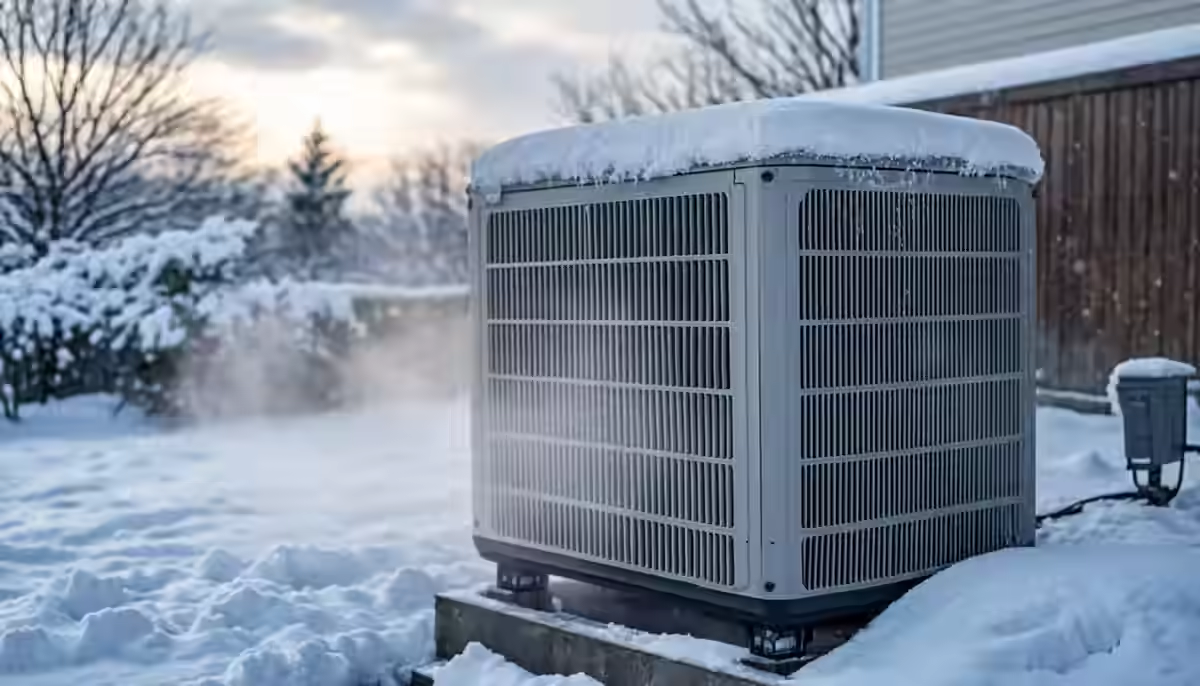
That steam, the roar, the pause in heating, is the defrost cycle, and in winter it is the most normal thing your heat pump does. A heat pump heats your house by absorbing outdoor heat through a coil that runs colder than the air around it, and whenever that coil sits below 0°C in damp air, frost forms on it the same way it forms on a cold window. Left alone, the frost builds into a fur coat that chokes airflow and collapses heating capacity, so the system periodically flips itself into reverse for 2 to 10 minutes, cooks the ice off the outdoor coil, and returns to heating. The steam you see is that ice becoming water vapour. The hum or whoosh you hear is the reversing valve and the compressor working the problem. It is not smoke, it is not a fault, and roughly nine out of ten winter service calls that start with "my heat pump is on fire" end with a technician watching one healthy defrost cycle and going home.
Here are the numbers that matter. In coastal BC conditions, between 0 and 6°C with rain, drizzle or fog, a heat pump in heating mode may initiate defrost every 30 to 90 minutes, and each cycle lasts 2 to 10 minutes. During that window your indoor air goes lukewarm because the system is deliberately air-conditioning your house, and the electric auxiliary heat, typically 5 to 10 kW, stages up to cover the gap. A unit that defrosts, clears fully, and returns to blowing warm air is doing its job, even if it does it eighteen times through a wet Tuesday in Burnaby. The failure pattern is different and specific: ice that survives the cycle, frost that thickens day over day, grinding noises, or heat that never quite arrives. Those are the $180-to-$450 repairs, and the rest of this guide teaches you to tell the difference before anyone bills you for it. The full heat pump services page covers the install-and-rebate side of this equipment; this guide is about the three months of the year when it earns its keep.
The Cycle, Step by Step
Defrost is not a mode someone forgot to turn off. It is a choreographed sequence the control board runs whenever frost conditions are detected, and knowing the choreography is what lets you watch your own unit and read its health in thirty seconds.
Frost forms on the coil
In heating mode the outdoor coil runs 5 to 10°C colder than the outdoor air so it can absorb heat. Below freezing, that cold surface pulls moisture out of BC's wet air and deposits it as frost, starting at the bottom of the coil where the refrigerant is coldest.
The board detects the problem
Modern demand-defrost systems compare a coil sensor against the outdoor temperature and the runtime clock. When the coil reads several degrees colder than it should for the conditions, the board concludes ice is insulating the coil and calls for defrost.
The system reverses
The reversing valve flips and the system runs in cooling mode, which makes the outdoor coil the hot condenser. The outdoor fan stops so the heat concentrates in the coil instead of blowing away, and hot refrigerant, often 50°C or more, melts the frost from the inside out.
Auxiliary heat covers the house
With the indoor coil now cold, the electric heat strips, typically 5 to 10 kW, stage on to keep the airstream from blowing cold. This is the window where you may hear a different hum and feel cooler air at the registers. It should last minutes, not hours.
Steam, drain, restart
The melting ice becomes the steam you see, drains out the bottom of the unit, and when the coil sensor confirms it is clear, the valve flips back, the outdoor fan restarts, and heating resumes. Total elapsed time, 2 to 10 minutes in a healthy system.
One detail worth filing away: the defrost water has to go somewhere, and in January it drains onto a pad that is itself near freezing. A unit sitting level on a pad with working drainage sheds that water cleanly; a unit settling into a low spot or sitting in its own ice bowl refreezes the meltwater, and the defrost cycle starts fighting a rink instead of a frost coat. Our winter prep guide covers the October drainage check that prevents exactly this.
Why the Wet Coast Defrosts More Than Anywhere Else
Frost needs two ingredients: a surface below freezing and moisture in the air. The BC coast supplies both at once for weeks on end. Vancouver's January mean temperature sits around 5°C, which sounds mild, but the region spends an enormous share of winter in the 0 to 6°C band, hovering between rain and snow, with relative humidity parked at 85 to 95 percent. That band is the sweet spot for coil frost: cold enough for the coil to sit below 0°C, wet enough to feed it. Our coastal heating design temperature is about -7°C, while out in the Fraser Valley, Abbotsford, Chilliwack, eastern Maple Ridge, it is closer to -10°C, and the Valley adds its own quirk: cold clear outflow nights that produce less frost, punctuated by wet near-freezing days that produce a lot of it.
Compare that with the Prairies. At -25°C, prairie air holds almost no moisture, so a heat pump coil frost up slowly and defrosts rarely, maybe a few times a day. In a North Vancouver drizzle at 2°C, the same unit can defrost every 30 to 45 minutes for days. Neither pattern is a defect; they are the same machine responding to different weather. What changes is the cost of the auxiliary heat that fills each defrost gap, which is why the coastal conversation is always about kWh and the prairie conversation is always about capacity.
| Condition | Coil behaviour | Typical defrost rhythm |
|---|---|---|
| 2 to 6°C, rain or drizzle | Heavy frost, fastest buildup of the year | Every 30-60 minutes, the BC winter default |
| 0 to 2°C, wet snow | Frost plus snow loading on the top of the unit | Every 30-90 minutes, snow drift adds to the load |
| -5 to -10°C, outflow wind | Slower frost, drier air, but coil runs very cold | Every 60-120 minutes, longer cycles |
| Below -15°C, clear | Minimal frost, air is nearly dry | Rare, a few times a day on older units |
| Below -25°C, sustained | Defrost largely irrelevant, capacity is the story | Sporadic; backup heat carries more of the load |
If your mental picture of heat pumps came from a relative in Calgary, this table is the correction. The same equipment leads a completely different life here, and a contractor who sizes and configures for prairie winters will misjudge a coastal one. We set defrost boards and size auxiliary heat for the weather this coast actually gets, and our Vancouver heat pump guide covers the rest of the coastal operating picture.
What Is Normal Versus What Is a Service Call
Here is the chapter to keep open on your phone in the yard. Most winter heat pump behaviour that alarms homeowners is benign, and most of the behaviour that genuinely matters gets ignored because it arrives quietly. The table sorts the two columns.
| What you see or hear | Verdict | What it means |
|---|---|---|
| Steam off the top for 1-3 minutes, then normal heating | Normal | Textbook defrost, watch it fondly and go back inside |
| A whoosh or click, then the outdoor fan stops | Normal | Reversing valve flipping, fan paused to hold heat in the coil |
| Lukewarm air at the registers for a few minutes | Normal | Auxiliary heat covering the defrost window, minutes only |
| Water pooling under the unit then drying up | Normal | Defrost meltwater draining, check it drains away and does not pool |
| Frost visible on the coil, gone within minutes | Normal | The cycle is winning, which is the whole point |
| Ice still on the coil after the fan restarts | Service call | Defrost terminating early or never starting, sensor or board territory |
| Ice only on the bottom third of the coil | Service call | The classic low-charge signature, refrigerant work is licensed trade work |
| Grinding, scraping or loud banging from the unit | Service call | Fan blade on ice, failing motor bearing or debris, stop the unit |
| Running continuously with the house cooling down | Service call | Stuck in defrost or capacity loss, the aux heat is carrying the house |
| Burning smell with visible smoke | Shut down, then call | Not defrost, open the breaker before you dial 604-615-2212 |
A pattern is worth more than a snapshot. One defrost that ends with leftover frost on a savage morning is noise; three days of thickening ice while the house gets steadily harder to heat is a signal. Watch the unit through two or three full cycles before calling, and note what the fan does, where the ice sits, and how long each pause lasts. That observation, thirty seconds of it, is genuinely useful to the tech who arrives, and it is the difference between a $180 sensor and a shotgun diagnosis.
Steam Is Not Smoke
Every winter we take the call: "my heat pump is on fire." It has never once been on fire in that specific call pattern, and the reason is physics. Defrost dumps 50°C-plus refrigerant through a coil that was coated in ice at -2°C, and the meltwater leaves the coil as a white plume that, backlit against a dark garage in February, looks exactly like the opening scene of a very bad day. Real differences: defrost steam is white, odourless, rises and dissipates within one to three minutes, and ends with the fan restarting and warm air returning. Electrical smoke is grey to black, carries an acrid smell, and keeps coming. A burning smell from the indoor unit with no steam outside is its own problem, usually a dusty strip heater on first use or, worse, a failing blower motor.
The honest instruction is short. Acrid smell, visible smoke, or a unit that will not restart: open the breaker that serves the outdoor unit and the air handler, then call us at 604-615-2212, any hour, with the $150 after-hours premium flat and disclosed before we roll. Steam that behaves like the table above: finish your coffee. And if you ever smell gas at the meter, the furnace, or anywhere near the mechanical room, that is a different call entirely, FortisBC at 1-800-663-9911, from outside the house, before anything else.
One more steam impostor: a dripping gutter above the unit can throw water vapour off a cold coil that has nothing to do with defrost, and a unit sitting in its own meltwater bowl can refreeze a crust overnight. Neither is a defrost fault, both get fixed with a pad and a downspout, and both show up on the placement checklist in Chapter 8.
When Defrost Fails: The Real Causes
Defrost failures have a short suspect list, and it is the same five culprits almost every time. The diagnosis, and therefore the bill, depends on which one your unit is hosting, and the ice pattern is the fingerprint.
| Cause | The tell | Typical fix and cost |
|---|---|---|
| Failed defrost sensor or thermistor | No defrost at all, ice builds steadily while the weather is clearly frosty | Replace sensor, $180-280, the most common winter heat pump repair we do |
| Defrost control board or timer | Defrosts on a rigid clock regardless of frost, or never terminates | Board replacement, $280-450 depending on the platform |
| Low refrigerant charge | Ice on the bottom third of the coil only, capacity sagging house-wide | Leak search and repair first, $180-450, recharge priced after the leak is found |
| Stuck reversing valve | Unit will not switch modes, stuck heating weakly or in permanent defrost | Sometimes freed electrically, otherwise valve replacement, often a repair-versus-replace talk |
| Outdoor fan motor or blade problem | Fan will not run after defrost, or blade rings against an ice ring | Motor or blade, $250-450, and a lesson in why the pad drainage chapter exists |
| Snow or debris burial | Drift up to the fans, coil matted with cottonwood debris from last June | Dig out and coil wash, often bundled into a $149-250 maintenance visit |
Fifteen years of these calls, and the bottom-third ice pattern is the one I will drive across town for on a Sunday. It is almost never "just ice." It is a slow leak announcing itself, and the homeowners who catch it in January buy a $300 repair instead of a compressor the following November.
Refrigerant work deserves its own sentence: it is licensed trade work under BC regulation, full stop. A homeowner cannot legally recharge a system, and on 2025-and-newer equipment running R-454B, the refrigerant is mildly flammable, A2L class, which adds handling rules that make the YouTube version of this repair a genuinely bad idea. If a tech quotes you "a top-up" without leak-searching first, that is your cue to get a second opinion, and our Surrey heat pump crews give those for free.
The Honest Bill for a Winter Heat Pump Call
Prices first, so nobody has to wonder. The diagnostic is $89 and it is credited to any repair we do on the spot. The repairs that come out of defrost calls, sensors, boards, fan motors, small leak repairs, run $180 to $450. A maintenance visit that includes defrost testing, coil washing and drainage checks runs $149 to $250, and doing it in October is cheaper than doing any of the above in January. After-hours emergency calls carry a $150 flat premium, posted in advance, never a surprise multiplier. Repairs $180-450, maintenance $149-250, diagnostic $89 credited: those are the numbers, and the table shows what buys what.
| Service | What it includes | Price |
|---|---|---|
| Diagnostic visit | Full defrost-cycle observation, sensor readings, aux heat test, honest verdict | $89, credited to any repair |
| Sensor or thermistor replacement | The most common defrost fix, parts and labour | $180-280 |
| Defrost board replacement | Board, programming, full cycle verification after | $280-450 |
| Leak search and repair | Nitrogen or electronic search, braze repair, recharge priced after | $180-450 plus refrigerant |
| Winter maintenance visit | Defrost test, coil wash, drainage check, control tightening | $149-250 |
| After-hours emergency call | 24/7 dispatch, same diagnostic and repair pricing | Plus $150 flat premium |
2-10 minutes
Duration of a healthy defrost cycle, steam and all.
0 to 6°C and raining
The coastal band where frost forms fastest and defrost runs most.
5-10 kW of aux heat
What covers your house during each defrost window, and why minutes matter.
One cost nobody prices honestly until it lands: the auxiliary heat that fills every defrost gap is electric resistance heat, the most expensive heat a BC Hydro meter can buy, and a unit stuck defrosting half the night can quietly burn through the energy a healthy week would have used. That is why a defrost fault shows up on your bill weeks before it shows up as ice you can see, and why a $180 sensor is sometimes the cheapest line item in the entire month.
Keeping Defrost Healthy: The Prevention List
Defrost problems are mostly drainage problems and elevation problems wearing a refrigeration costume, which is excellent news, because both are cheap to fix in October and miserable to fix in January. The list, in the order it pays off:
Elevate the unit above the snow line
A unit sitting on a flush concrete slab in the Fraser Valley spends February with its lower coil in a snowbank. We mount units 30 to 45 cm off grade on stands or a raised pad, higher in valley snow zones like Abbotsford and Maple Ridge, lower but never flush at the coast.
Fix the pad and the drainage
Level pad, gravel bed beneath, meltwater routed away from the base. Defrost dumps litres of water per day in frost season; if it pools and refreezes, the unit sits in an ice bowl of its own making.
Manage what falls from above
Roofline drip, an unguttered eave, or a downspout discharge above the unit will glaze the coil in freeze-thaw cycles no defrost board can outrun. Divert, gutter, or add a manufactured hood with the manufacturer's required clearance.
Wash the coil once a year
Cottonwood seed in June and general grit halve the airflow through the outdoor coil, and low airflow is slow frost and long defrosts by November. Gentle garden-hose washing, never a pressure washer, or it comes with the maintenance visit.
Never tarp it shut
A heat pump is not a swamp cooler; it needs full airflow all winter. Wrapped units trap moisture, corrode terminals and void warranties. If snow shedding is the worry, a hood above, never a bag around.
Do those five and the defrost system has an easy life: short cycles, clean coil, free drainage, and aux heat that barely clocks in. Skip them and no sensor replacement will save you, because the machine is fighting its installation, not its components. Placement and drainage get a full chapter of their own in our winter home prep guide, because the two lists are the same list.
Cold-Climate Units, Rebates and the 2026 Context
If your defrost complaints are really capacity complaints, the replacement conversation has changed a lot in five years. Cold-climate heat pumps now hold rated heating capacity to -15°C and 70 to 80 percent of it at -25°C, which covers every winter night the coast and the Valley can produce. More relevant to this guide, inverter-driven units modulate their speed instead of cycling hard, which keeps the outdoor coil warmer, frost lighter and defrost cycles fewer and shorter. Where a 2012 single-speed unit might defrost every 40 minutes through a January drizzle, its modern replacement can stretch that to a couple of hours or run long enough to dry the coil clear without a full reversal.
The money side moved further than the hardware. In 2026 the combined CleanBC Better Homes, BC Hydro and FortisBC rebates stack as high as $16,000 for qualifying cold-climate heat pumps, with municipal top-ups in several cities on top, and we complete and file the paperwork as part of the install. Replacements start from $6,500 for straightforward swaps and run to $14,000 for whole-home systems, with ductless single zones at $3,800 to $5,500 and multi-zone at $9,500 to $16,000, and the CleanBC rebates guide maps exactly what stacks with what. Two caveats from the field: the R-410A to R-454B refrigerant transition means most 2025-and-later equipment runs the new A2L refrigerant, which changes some servicing rules and prices, and a rebate-eligible install still has to be a correctly placed, correctly drained install, or you will be reading this guide again about the new unit.
When replacement is the honest answer rather than the profitable one: compressors past 12 to 15 years with a leak history, boards obsolete for a unit that has needed three defrost repairs in two winters, and any repair quote that crosses half the replacement math. Our repair versus replace guide walks the arithmetic, and it applies to heat pumps line for line.
The Yard-Side Cheat Sheet
Print this, or keep it open while you watch the unit through one full cycle. The defrost question, compressed to what actually decides whether you call anyone:
| Question at the unit | The honest answer |
|---|---|
| Is the steam normal? | Yes, if it is white, odourless, lasts 1-3 minutes and the fan restarts after |
| Is defrosting several times a day a fault? | No, 30-90 minute spacing is normal coastal winter behaviour in the 0-6°C wet band |
| When is ice a problem? | When it survives the cycle, sits on the bottom third only, or thickens day over day |
| Should I chip it off? | Never with a tool; brush snow, pour warm water in a pinch, fix the cause |
| What will the repair cost? | $180-450 for sensors, boards, fans and small leak fixes, $89 diagnostic credited |
| What prevents it all? | Elevation above snow, pad drainage, eaves managed, annual coil wash, $149-250 |
| Is it time to replace instead? | 12-15 year old unit with a leak history, or a repair over half the replacement math, with rebates to $16,000 |
The pattern to take away: defrost is your heat pump cleaning its own windshield, and a healthy one does it fast, quietly and without drama. When the pattern changes, ice that lingers, heat that sags, bills that climb, that is the machine asking for a technician, and the earlier the ask, the smaller the bill. That is the entire winter operating manual, and it fits on one page.
Watch One Cycle With a Red Seal Tech
A free estimate puts a technician in your yard to observe a full defrost cycle, test sensors and auxiliary heat, and check the pad, drainage and snow clearance that decide whether this winter is quiet. Ice that will not clear is a 24/7 emergency call, $150 flat after-hours premium, and the $89 diagnostic is credited to any repair.
Frequently Asked Questions
Services From This Guide
Red Seal crews, flat-rate pricing and 24/7 emergency response across all twelve Metro Vancouver cities, from Vancouver and Burnaby out to Abbotsford and Maple Ridge.
Heat Pump Services
Installs $6,500-14,000, repairs $180-450, rebates to $16,000.
Heat Pumps in Surrey
Fraser Valley winters, honest sizing, local crews.
24/7 Emergency Heat Pump Repair
$150 flat after-hours premium, $89 diagnostic credited.
Heat Pump Financing
From 7.99% OAC, because winter does not wait for spring.
Related Guides

We wrote this one after a January week in Surrey where three separate households called 911 about a smoking heat pump that was simply defrosting. Fifteen winters of heat pump service across Metro Vancouver has taught us exactly which steam is boring and which ice is expensive, and this guide puts that pattern recognition in your hands. To book instead of DIY, see heat pump repair in Vancouver — same-day across the city.
More about our team →Get Your Heat Pump Winter-Ready
A free estimate covers defrost performance testing, snow and drainage checks at the outdoor unit, and honest repair-versus-replace math. Zero obligation, and the $89 diagnostic is credited to any repair we do. If you would rather hand this to a pro, our heat pump services pages cover Metro Vancouver. For a side-by-side comparison, see Heat Pump vs Air Conditioner: The BC Answer.
Ice that will not clear?
Emergency calls are answered 24/7 with live dispatch and a flat $150 after-hours premium posted in advance. If the unit is smoking or smells of burning, shut it off at the breaker first, then call 604-615-2212.
Call 604-615-2212 WhatsApp Us