
The Honest Answer Up Front
Refrigerant does not get used up. Your air conditioner circulates the same charge through a sealed copper circuit for its entire life, and if a technician tells you it is low, the only honest sentence that follows is: it leaked. Not it burned off, not it needs a refresh, not that is normal every few years. A low charge on a residential system is a hole somewhere, full stop.
That single fact reframes everything about cooling repairs. The top-up, add some refrigerant, take the payment, see you next summer, is the most profitable recurring service in the industry precisely because it treats the symptom on a subscription basis. The honest path costs more once and less forever: find the leak, fix the leak, weigh in the correct charge, verify it holds. Straightforward leak repairs land inside our $180 to $450 AC repair band, and the $89 diagnostic is credited to the repair on the same visit.
This guide gives you the homeowner side of that conversation: how to recognize a leak from your living room, how professionals actually locate them, what repairs honestly cost, and the decision math for when a leaking older unit should be replaced instead of patched, with real Metro Vancouver numbers throughout. Our cooling and AC services team wrote it from the service calls, and we include the failure points we find most often in this region, because they are specific to it.
A sealed system is sealed. Every kilogram of refrigerant that ever left it went through a hole someone could have found, and usually one that someone should have found the first time the system was low.
0 jobs since 2010
Cooling, heating and plumbing jobs completed by our Red Seal team across Metro Vancouver and the Fraser Valley.
0 star rated, 26 reviews
Homeowners rating the work flat-rate, on time and explained honestly before the wrench turns.
0 average response
Live 24/7 dispatch across 17 Metro Vancouver cities, with the $150 flat after-hours premium posted in advance.
$0 diagnostic, credited
The full system read on your first visit, deducted from any repair that follows the same day.
The Sealed Circuit, in One Page
The system is a loop: refrigerant absorbs heat inside your home, dumps it outside, and repeats. Every joint in that loop is a potential leak point, and knowing where they are is half of the diagnosis.
The evaporator coil absorbs the heat
Inside the furnace or air handler, refrigerant enters the coil as a cold, low-pressure mist. The blower pushes house air across the fins, and the refrigerant boils into vapour as it carries the heat away. Frost on this coil during cooling season means something is wrong, and low charge is on the shortlist.
The compressor pressurizes the vapour
The heart of the system squeezes the vapour hot and dense so it can dump heat outdoors. The compressor is the part that dies expensively when a leak goes unrepaired, because a starved compressor runs hot and can take liquid where only vapour belongs.
The condenser coil releases the heat
In the outdoor unit, the hot refrigerant flows through the condenser coil while the fan pulls air across it. It sheds your home heat to the outdoors and condenses back to liquid. This coil lives in rain, salt air and cottonwood season, which is why it and its joints appear on every leak-hunting list.
The metering device starts the cycle over
A tiny expansion valve or orifice drops the liquid pressure back down so it can flash cold again in the evaporator. The circuit is brazed and flared copper from end to end, with a handful of threaded joints, and it holds the same charge for decades when the workmanship is right.
The engineering point that matters to you: nothing in this loop consumes refrigerant. There is no filter to change and no reservoir that depletes. The charge is weighed in at installation to match the line length and coil, and the correct amount is printed on the nameplate. When a system is low, it is because the loop opened somewhere, and every honest repair starts by finding where.
Signs You Actually Have a Leak
Leaks announce themselves gradually, because the charge usually leaves over weeks and months rather than all at once. Homeowners describe the same progression to us so often it has a rhythm: the system still cools, then it cools on cooler days but struggles in a heat wave, then the run times get long and the registers feel mild, then ice appears. Here is the full map.
| What you notice | What it usually means | Urgency |
|---|---|---|
| Ice on the larger copper line or the indoor coil | Low charge starving the evaporator, letting it drop below freezing | Turn the system off to thaw it, then book a diagnostic; running it iced damages the coil |
| Cool but weak air from the registers | Reduced refrigerant mass means less heat moved per cycle | Days to weeks; book within the week |
| Run cycles that never seem to end | System compensating for lost capacity by running longer | Same; also watch the BC Hydro bill for the clue |
| Hissing near the unit or lines | Gas escaping through a fitting or pinhole | Same day if audible; that is a fast leak |
| Oily residue at fittings or on the coil | Refrigerant carries oil with it, and oil weeping marks the hole | Book; the stain is a gift, it says where to look |
| Summer electricity bills climbing | Longer run times quietly doubling cooling cost while capacity fades | Worth a charge verification at the next visit |
| System worked fine for years, suddenly weak | A braze or flare finally opened, or coil corrosion pinholed | Diagnostic, not a guess |
| Topped up last summer, weak again this summer | The leak was never found | Change the approach: leak search first, refrigerant second |
One false friend to rule out before you suspect refrigerant: a clogged filter or a badly blocked coil also freezes the evaporator and mimics half this table. That is why the diagnostic measures pressures and superheat rather than assuming, and it is also why replacing a filter before the visit is a fair ask: it removes the cheapest explanation honestly.
How Leaks Are Really Found
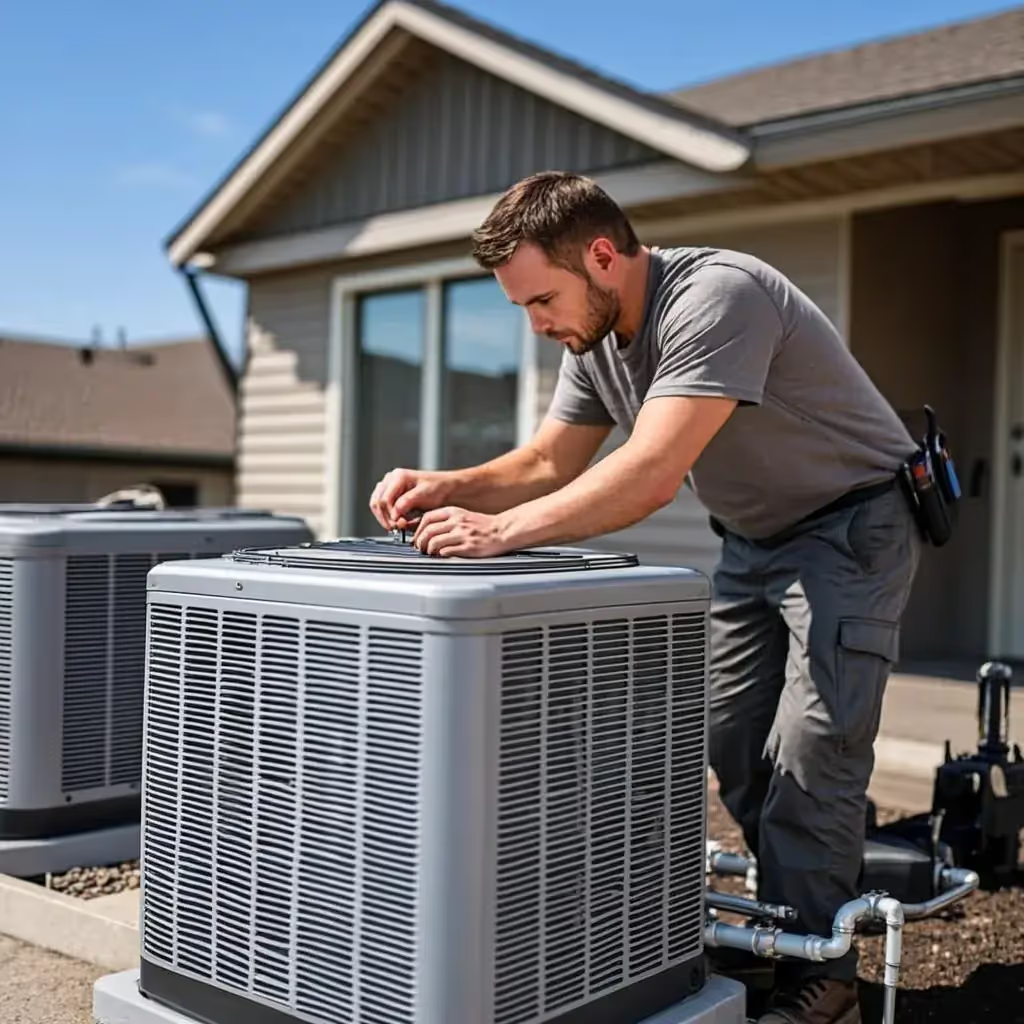
Leak detection is a craft, and the tools each earn their place on a different kind of hole. When our AC repair crews in Surrey and across the region run a leak search, this is the toolkit and the order it gets used in.
| Method | How it works | What it is best at |
|---|---|---|
| Electronic leak detector | A heated sensor sniffs refrigerant molecules in air, alarming as concentration rises | Surveying the whole circuit fast; pinpointing the room, then the joint |
| Bubble solution | Soap solution brushed on suspect fittings; escaping gas forms visible bubbles | Confirming a specific fitting in seconds; the honest final proof |
| UV fluorescent dye | Dye added to the oil circulates and exits at the leak, glowing under UV light | Slow leaks that defeat sniffers; runs hiding behind coils or in line sets |
| Nitrogen pressure isolation | Circuit emptied and pressurized with dry nitrogen, then watched section by section | Proving which component leaks when the system is empty; also finds leaks too small to alarm |
| Visual inspection | Oil stains, corrosion bloom and green oxide at copper joints | The fastest wins; leaks leave residue a trained eye reads like a map |
Two honesty notes. First, a proper search takes time on small leaks, and a company that finds nothing in fifteen minutes and recommends a top-up has not finished looking. Second, some leaks are genuinely worth more to repair than to hunt: on a system near end of life, the correct recommendation after a failed detection pass is often replacement math, not another charge. A contractor who presents that choice is doing the job right.
The legal backdrop also shapes diagnosis. Handling refrigerant requires certification, recovery equipment and a licence for a reason: these gases are regulated, venting them is prohibited, and a proper repair finishes with the system weighed to the nameplate charge, not eyeballed. If a service visit ends with refrigerant added from an unlabelled tank with no gauge work and no leak search, you have not received a diagnosis, you have received a subscription.
Been Topped Up More Than Once?
Stop renting the problem. The $89 diagnostic includes a real leak search, and the fee is credited to any repair completed the same visit. Call 604-615-2212 or request a free quote.
The Honesty Test for Top-Ups
Because refrigerant leaving is a leak by definition, the industry has a repeatable revenue pattern: charge the system, charge the customer, book the same call next July. You can test any contractor, including us, with three questions before a single hose goes on.
- Question one: "Where is it leaking?" If the plan is refrigerant first and looking maybe later, the order is inverted. A legitimate visit puts gauges on, confirms low charge, and moves immediately to finding the hole, because the fix without the find is temporary by arithmetic.
- Question two: "How much did you add, and what did you find?" Refrigerant is weighed, and the number matters: a system two hundred grams low has a small slow leak; a system half empty has a big one, and someone should be hunting harder. Ask for the leak search result in writing, whether the answer is found, not found yet, or not accessible.
- Question three: "What happens if we do nothing?" The honest answer includes the compressor. A low charge runs the compressor hot and can slug it with liquid, and a compressor failure on an older system is usually a replacement trigger. A contractor who says just top it up every summer without mentioning that is not sharing the whole board.
Here is the invoice pattern of a company that never finds leaks: refrigerant, refrigerant, refrigerant, then a compressor. The honest pattern reads: diagnostic, leak found, repair, done. One of those lists is a customer for life, and the other is a customer until the compressor quits.
To be fair to the trade, there are legitimate one-time charge corrections: a system disturbed by a renovation, a line set re-run or a repair that required opening the circuit, all end with a weigh-in and are not leaks. The pattern to refuse is the undiagnosed repeat, the top-up with no search, the third summer of the same visit.
Where Metro Vancouver Systems Leak
After enough service calls, a region writes its own leak map. Ours has five hot spots, and the climate and the housing stock put them in this order.
- Ductless flare fittings. Every mini-split head connects through flare nuts, and a flare made slightly off-angle weeps for years before it becomes audible. With the region now dense with ductless installs, many of them rapid retrofits during the heat-dome years, flare joints are our single most common find. The good news: re-making a flare is honest, affordable repair work.
- Evaporator coils on older central systems. Indoor coils in humid environments develop pinhole corrosion, and a coastal climate with long shoulder seasons keeps condensate on those fins far more hours than an inland city. A coil past its teens with a verified leak is a repair-versus-replace decision.
- Schrader service valves. The charging ports on the outdoor unit use the same valve principle as a tire, and their cores wear or loosen with age. They leak small, they are cheap to replace, and they are the happiest finding on any leak search.
- Condenser coils in coastal yards. Salt air in Richmond, Tsawwassen and along the North Shore attacks coil fins and joints, and lawn-mower and trimmer damage adds physical holes inland. Condenser coil leaks on aging outdoor units usually end in replacement math.
- Vibration rub-throughs. Copper lines crossing framing, straps or masonry without protection wear slowly every hour the compressor runs. We find these on both furnace-attached systems and ductless line sets, and they are entirely preventable at install time, which is why our crews sleeve and separate every crossing.
The regional pattern matters because it changes where a search begins. A ductless call starts at the flares; a fifteen-year-old central system starts at the indoor coil; a coastal yard, the kind our AC repair crews in Richmond see daily, earns a harder look at the condenser. That experience gap is the difference between a leak found in one visit and a system topped up on faith.
Repair Paths and Honest Prices
Once a leak is located, the repair paths sort into an honest ladder, from the jobs that land inside the standard repair band to the ones that start a replacement conversation. Our pricing is flat-rate and written before work begins, and the $89 diagnostic is credited to whichever repair follows.
| Leak location | The repair | Where it lands |
|---|---|---|
| Schrader valve core | Core replaced under pressure, port resealed | Low end of the $180 to $450 AC repair band |
| Flare fitting on a ductless line | Flare re-made to gauge, nut reseated, vacuum drawn, charge weighed | Middle of the band |
| Accessible braze joint on a line set | Joint rebrazed, system evacuated and recharged | Middle to upper band |
| Rub-through on an accessible line | Section replaced or sleeved, evacuated, recharged | Upper band |
| Pinholed evaporator coil | Coil replacement with new refrigerant charge | Beyond the band; on units past 12 years, replacement math usually wins |
| Leaking condenser coil | Coil or outdoor unit replacement | Beyond the band; outdoor-unit replacement on an older system becomes a matched-system question |
Two rules hold the ladder together. Any repair that opens the circuit ends with a proper vacuum pull-down and a weighed charge to the nameplate, because leaving air and moisture in the loop quietly destroys the compressor years early. And any quote that charges by the kilogram for refrigerant without a leak search attached deserves the Chapter 5 questions.
The economics of leak repair reward the same thing every honest trade rewards: the smallest correct fix, done once, sealed properly, and verified to hold. The ladder exists so you can see where your find sits before you authorize anything.
When to Stop Repairing
Not every leak deserves a repair. A Schrader core on a seven-year-old system: always. A pinholed evaporator coil on a fourteen-year-old system with a previous top-up history: the honest math usually points elsewhere, because coil labour plus a fresh charge buys most of the way toward a new system with a warranty measured in decades.
The numbers we use on those calls: a new central air system installed runs $3,800 to $6,500, and ductless heat pump options start at $3,800 to $5,500, with combined CleanBC Better Homes, BC Hydro, FortisBC and municipal top-ups that can reach $16,000 for qualifying cold-climate heat pumps in 2026, paperwork we complete for you. If the choice between patching and replacing is live, our ductless versus central AC comparison for Surrey homes walks the equipment decision, and the AC installation guide covers what a proper replacement day looks like, from sizing to commissioning.
| Your situation | The honest direction |
|---|---|
| System under 8 years, small accessible leak | Repair it; the remaining life justifies the spend |
| System 8 to 12 years, straightforward leak | Repair if the find sits low on the ladder; price both paths if it is a coil |
| System over 12 years, evaporator or condenser coil leak | Replacement math first; coil repairs at this age rarely pay back |
| Any age, second confirmed leak in three seasons | The system is telling you something; get both numbers in writing |
| R-22 era equipment with a leak | Replace; that refrigerant has not been manufactured or imported for new use in years, and repair economics ended with it |
| Repair quoted above replacement cost | A quote that high is a recommendation you did not ask for, delivered sideways |

Preventing the Next Leak
Leaks are not all bad luck, and the preventable share is larger than most homeowners expect. The list is short and none of it is exotic.
- Install quality is destiny. Flares cut to gauge, line sets sleeved at every framing crossing, joints brazed with nitrogen flowing, and a proper vacuum before charging: the majority of leaks we repair trace to a shortcut in that list, sometimes a decade earlier. It is the strongest argument for hiring on workmanship, not price.
- Keep coils clean. Organic debris holds moisture against coil fins and fittings, and damp copper in a coastal climate corrodes. Seasonal coil cleaning is maintenance, not luxury.
- Protect the outdoor lines. A line set strapped tight and shielded from trimmers, foot traffic and UV does not develop rub-throughs. A loose line whipping against masonry does.
- Catch it small. A system that gets a gauge check every spring reveals a slow leak as a small repair instead of a July compressor. The maintenance visit is the cheapest leak detection that exists.
- Do not ignore the weak-summer signs. The Chapter 3 table is the early-warning system you already own. Response speed is the difference between a fitting re-made and a system mourned.
Safety, Plainly
Modern residential refrigerants are not the dangerous-to-breathe class of old industrial gases, and the quantity in a home system is small. The realistic safety picture is three lines long. First, do not run a system you suspect is low: the compressor damage risk is real, and the repair bill for a slugged compressor dwarfs the leak repair. Second, if you hear a strong hiss or smell a sharp chemical odour near equipment, shut the system off and ventilate the space, and if anyone feels dizzy or unwell, step outside and call from there; caution is free. Third, never attempt to open the sealed circuit yourself: beyond certification law, the pressures and stored charge in that loop injure people who know less than they think, and our licensed crews exist precisely so you never have to.
The environmental line is worth one sentence more: refrigerants are potent greenhouse gases, and Canada regulates their handling for exactly that reason. Certified recovery instead of venting is not paperwork theatre, it is the whole point of the licence our Red Seal technicians carry.
City Notes Across Metro Vancouver
Where your home sits in the region changes which leak pattern leads, from coastal corrosion to ductless flare density. These are the patterns our city crews see.
Vancouver
Dense ductless retrofits from the heat-dome years: flare joint checks are the first move on most leak calls.
Surrey
New-build central systems and big lots: vibration rub-throughs and trimmer damage lead the find list.
Burnaby
Aging infill-system evaporator coils in humid shoulder seasons; gauge checks separate leaks from filter stories.
Richmond
Salt-air condenser corrosion tops the list; annual coil inspection is standing advice for island-flat yards.
Coquitlam
Forest-lot debris and moisture hold corrosion on coils; prevention starts with seasonal cleaning.
Langley
Long rural line sets crossing outbuildings and framing: sleeved crossings and protection pay off here.
The Decision Cheat Sheet
The whole guide in one table. If your situation is not on it, that is what the diagnostic exists for.
| Situation | The honest call |
|---|---|
| Ice on lines or coil, system still cooling a bit | Shut it off, let it thaw, book the diagnostic this week |
| Told it is low on refrigerant, no leak search offered | Ask the three Chapter 5 questions; the order is search first, charge second |
| Topped up last year, low again this year | Full leak search now; the hole has had a year head start |
| Straightforward find: valve core, flare, accessible joint | Repair in the $180 to $450 band, diagnostic credited, vacuum and weigh-in included |
| Coil leak on a system past 12 years | Replacement math first: $3,800 to $6,500 central, $3,800 to $5,500 ductless to start |
| Strong hiss, chemical odour, anyone feeling unwell | System off, ventilate, step outside, call; then repair before restart |
The one-sentence version: refrigerant never runs out, so every low charge is a leak, every leak has an address, and every honest repair finds the address before it bills the gas.
Frequently Asked Questions
Services From This Guide
Certified leak search, flat-rate repairs and replacement estimates across 17 Metro Vancouver cities, Red Seal certified with the $89 diagnostic credited to repair.
AC repair and leak search
Certified leak detection with repairs in the $180 to $450 band, and the $89 diagnostic credited to same-visit work.
Heat pump installs and rebates
Cold-climate heat pumps with CleanBC, BC Hydro and FortisBC top-ups that can reach $16,000 in 2026. We handle the paperwork.
AC repair in Coquitlam
Crews who know the regional leak map, from forest-lot coil corrosion to ductless flare checks, stocked for same-visit repairs.
24/7 emergency cooling
No-cooling calls answered around the clock, $150 flat after-hours premium posted in advance.
Related Guides
Ductless vs Central AC
The equipment decision that follows a coil leak verdict, compared honestly for Surrey homes.
CoolingAC Installation in Vancouver
Sizing, staging and commissioning standards that decide whether the new system ever leaks at all.
SeasonalHeat Dome Preparedness
The May checklist that catches weak systems before the first heat wave makes them emergencies.

Red Seal certified, licensed gas fitters (BC-PL-2019-4421), $2M insured and 15-plus years in the field, with more than 12,000 jobs completed across Metro Vancouver since 2010 and a 5.0-star rating across 26 Google reviews. We wrote this guide because the top-up-without-a-search pattern is the most expensive honest mistake in cooling: it converts a findable, fixable leak into a compressor and a replacement, and the difference is one company willing to look first. To turn these numbers into a flat-rate quote, see AC repair in Vancouver — same-day across the city.
More about our team →Get Your Honest Leak Diagnosis
Book the $89 diagnostic or a free replacement estimate with a Red Seal tech. You get a real leak search instead of a reflex top-up, a flat written price for every repair path on the ladder, and financing from 7.99 percent if replacement wins the math. Zero obligation, same-day quotes on most calls. If you would rather hand this to a pro, our cooling & AC services pages cover Metro Vancouver.
AC failing in the heat right now?
No-cooling calls are answered 24/7 with live dispatch and the $150 flat after-hours premium posted in advance. Daytime? The $89 diagnostic is usually same-day in Vancouver, Burnaby and Surrey.
Call 604-615-2212 WhatsApp Us