
The Honest Answer Up Front
Here is the short version we give customers on the phone. FortisBC, the regulated natural gas utility covering most of Metro Vancouver, runs seasonal incentive programs for high-efficiency gas furnaces and boilers. The dollar amounts change with each program cycle, which is why we verify the live numbers at booking instead of quoting from a page that might be six months stale. Two figures are worth remembering: combined heat-pump support can reach $16,000 across CleanBC, BC Hydro, FortisBC and municipal programs, and limited-time bonuses of up to $1,000 appear in some seasons.
For a straight gas furnace or boiler replacement, expect the rebate to land somewhere between a few hundred dollars and the low thousands, depending on the program cycle and your equipment choice. That is real money, but it is not a reason to rip out a working appliance. What the rebate actually does is close part of the gap between minimum code-legal equipment and the condensing gear the programs want you to buy: a two-stage furnace at $5,500 to $9,000 installed instead of an 80 percent single-stage unit from $3,800, or a combi boiler at $7,000 to $11,000 instead of a basic boiler plus a separate hot water tank.
The honest part most guides skip: more rebate applications die on paperwork than on eligibility. A wrong model number on an invoice, a missing permit, no pre-approval, equipment never registered, a DIY installation. Every one of those is a denied claim. That is why we register eligible equipment, list model and serial numbers on every invoice, pull gas permits, and file the CleanBC, BC Hydro, FortisBC and municipal paperwork as part of the job, and why this guide spends as much time on the fine print as on the numbers.
0 combined stack
CleanBC, BC Hydro, FortisBC and municipal support combined, on qualifying heat-pump conversions.
0 seasonal bonus
Limited-time top-ups that appear in some program cycles. We confirm live amounts at booking.
Installs from 0
80 percent single-stage furnaces installed; high-efficiency two-stage runs $5,500 to $9,000.
0 jobs since 2010
Rebate paperwork handled on qualifying installs across 17 Metro Vancouver cities.
How FortisBC Rebate Programs Actually Work
FortisBC is the regulated utility that supplies natural gas to most homes we serve, from Vancouver and Burnaby out through Surrey, Langley, Maple Ridge and Abbotsford. When people say FortisBC rebates, they usually mean the conservation incentive programs the utility administers, sometimes under its own banner and sometimes jointly with CleanBC Better Homes, the provincial umbrella program that channels money toward heat pumps, high-efficiency gas equipment and building-envelope upgrades. Our companion walkthrough of the broader CleanBC rebates landscape covers the provincial side; this guide stays on the gas-equipment track.
The mechanics are consistent even when the amounts are not. The equipment has to be on the eligible models list for the current cycle. The installation has to be done by a licensed contractor, with a gas permit and a licence number on the paperwork. Many streams want registration or pre-approval before the installation, not after. The invoice needs model numbers, serial numbers, dates and the installing licence number. Some programs also care about home type and whether the home is your primary residence, which matters a lot in Vancouver, where half the basement furnaces we service are also heating a mortgage-helper suite.
Why do the amounts keep changing? Because these programs are funded in cycles tied to conservation budgets and regulatory filings. A rebate that existed in spring can be exhausted by fall, or boosted mid-season by a limited-time bonus of up to $1,000. That is our caveat on every number in this guide: the combined heat-pump stack can reach $16,000, bonuses come and go, and the exact live figures for your address are something we confirm at booking, from the program sources, before you sign anything.
What we check at booking costs you nothing: your utility and fuel type, whether your address is in an eligible service territory, whether the equipment you want is on the current eligible list, and which programs stack for your situation. Ten minutes of verification beats a denied application eight weeks later. If you want the wider view of incentive programs first, our FortisBC HVAC rebates walkthrough maps which programs sit under which banner.
Gas Furnace Upgrades: What Qualifies
For gas furnaces, the programs target condensing equipment. In practice that means 96 percent AFUE or better, which today means a two-stage or modulating furnace with a secondary heat exchanger and PVC or polypropylene side-wall venting. An 80 percent single-stage furnace, still perfectly legal and something we install from $3,800 where budget rules the decision, does not qualify. The high-efficiency two-stage range runs $5,500 to $9,000 installed, permitted and commissioned.
What moves the number inside that range: venting rework, because older homes with masonry chimneys usually need new side-wall venting for a condensing unit; condensate drainage to a floor drain or pump; duct condition; and access. A 1960s Burnaby ranch with the furnace sitting in an open basement is a different afternoon than a Vancouver Special with the furnace wedged under a stairwell beside a finished laundry room. The full breakdown lives in our Vancouver furnace cost guide, and the repair-versus-replace decision gets its own treatment in this repair-or-replace breakdown.
The efficiency math, honestly stated: stepping from 80 to 96 percent AFUE means roughly 17 percent less gas burned per unit of heat delivered. If you spend $1,600 a year on gas for space heating, that is in the $250 to $280 per year range, before the domestic hot water share, which stays the same. A rebate that takes $1,000 or $2,000 off the upgrade price moves the payback on that difference from a decade to roughly half that. We show this arithmetic in writing on every quote; if the numbers do not work for your house, we say so. Furnace service across the region is covered on our heating services page.
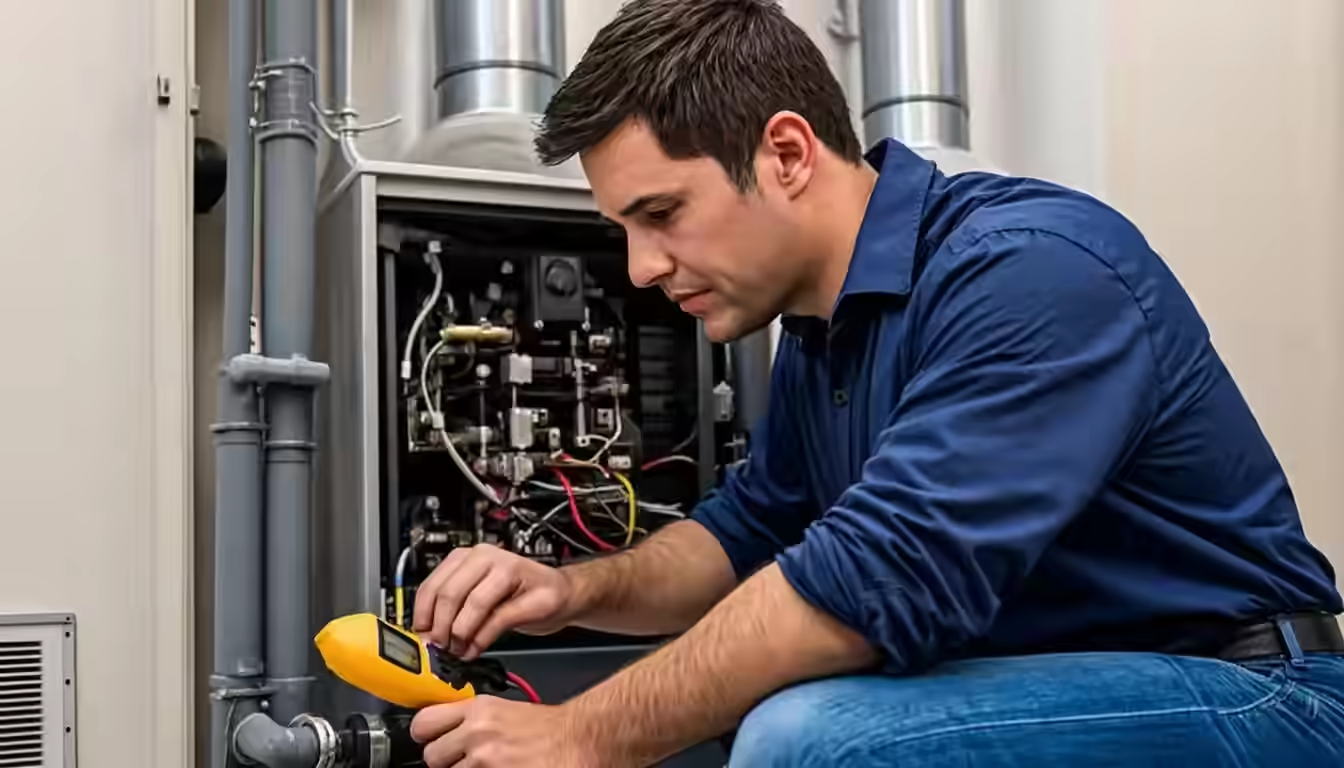
Boiler and Combi Boiler Upgrades
Boilers are the other half of the gas-equipment track, and in older Metro Vancouver housing stock they are everywhere: hydronic radiant in Vancouver character homes and North Vancouver splits, cast-iron radiators in New Westminster and Burnaby, in-slab radiant in 1970s Surrey and Langley ranchers. If your heat comes through pipes instead of ducts, this is your section, and the boiler services page covers the full service lineup.
The price reality: a straightforward cast-iron boiler replacement runs $5,500 to $12,000, and a combi boiler, which does space heating and domestic hot water with no separate tank, runs $7,000 to $11,000 installed. Combi conversions pair well with rebate logic because you are consolidating two appliances into one high-efficiency unit, but only when the hot water load and the radiation design support it. We measure the connected load before recommending a combi; oversizing a combi to cover a big soaker tub is how you get short cycling and cold showers, and no rebate fixes that.
Repairs run $180 to $550: failed circulators, leaking isolation valves, aquastats, pressure relief valves, the annual pressure top-up that turns into a leak investigation. The repair-versus-replace line for boilers is age plus block condition. A 25-year-old cast-iron block that has been serviced is often worth repairing; a leaking heat exchanger or a cracked section is a replacement conversation, and that is the moment a rebate file matters. If you are weighing the fuel paths themselves, our boiler versus furnace comparison for Vancouver goes deeper on that decision.
The rebate angle mirrors furnaces: condensing equipment at roughly 95 percent AFUE or better, on the eligible list, installed by a licensed contractor under permit, with the paperwork filed correctly and on time. The same seasonal caveat applies, and we verify the live amounts at booking.
Eligibility: The Fine Print That Disqualifies People
Most eligibility failures are boring and preventable. Here is the checklist we run before anyone orders equipment, and who is responsible for each line.
| Requirement | Why it exists | Who provides it |
|---|---|---|
| Active FortisBC gas account | Programs fund efficiency for gas customers in their territory | You, from your gas bill |
| Pre-approval or registration | Programs fund forward-looking upgrades, not retrofits | Us, at booking, before install day |
| Equipment on the eligible list | Not every 96 percent unit qualifies; lists change per cycle | Us, at equipment selection |
| Licensed contractor install | BC Gas Code and program rules | Us, licence BC-PL-2019-4421 |
| Gas permit | Legal requirement for gas appliance work | Us, pulled before work starts |
| Invoice with model and serial | Proof of exactly what was installed | Us, automatically on every invoice |
| Photos and commissioning data | Verification the install was completed as filed | Us, at handover |
The disqualifier that surprises people most: fuel type. Homes heated with oil, propane or electric baseboards are not in the gas-equipment programs at all. For those homes the money lives in the heat-pump stack through BC Hydro and CleanBC, up to $16,000 combined, and honestly that is usually the better conversation anyway; our heat pump services page is the starting point. Strata-titled homes and homes with secondary suites sometimes qualify differently, and primary-residence rules can matter, so we flag those cases at booking rather than discovering them at filing time.

Stacking FortisBC, CleanBC, BC Hydro and Municipal Money
Stacking means one upgrade, several programs, each with its own form and its own rules. The four players in Metro Vancouver: CleanBC Better Homes as the provincial umbrella, BC Hydro on the electric and heat-pump side, FortisBC on gas equipment and gas-served homes, and a rotating cast of municipal top-ups. Municipal programs change with council budgets, so we check them by address; our overview of CleanBC, utility and municipal rebate stacking explains how the layers combine.
The headline stack belongs to heat pumps: up to $16,000 combined across CleanBC, BC Hydro, FortisBC and municipal programs, with limited-time bonuses of up to $1,000 appearing in some seasons. Gas furnace and boiler swaps stack smaller: FortisBC plus, in some cycles, CleanBC or municipal support. The exact combination for your home depends on your fuel, your address and the season, which is a five-minute check for us and an evening of tab-juggling for everyone else.
One path people under-use: hybrid dual-fuel systems, a heat pump paired with a high-efficiency gas furnace. The heat pump carries spring and fall and most of a Metro Vancouver winter, the furnace takes the cold snaps, and both rebate tracks can come into play depending on the program cycle. It is not the cheapest system to buy, but for homes with good ductwork and a mid-life furnace it is often the smartest single renovation an HVAC budget can buy. Financing from 7.99 percent with approved credit and full rebate paperwork handling are both standard on our installs; details are on our financing and rebates page.
Bottom line
The biggest number in BC home heating support is $16,000 combined for heat pumps through CleanBC, BC Hydro, FortisBC and municipal programs. For gas furnace and boiler upgrades the stack is smaller, and every figure in it moves with the season. We verify the live stack at booking and print it on your quote, so the number you approve is the number that gets filed.
What You Actually Pay: Installed Costs in 2026
Rebates only matter relative to what the job costs in the first place. These are our flat-rate installed ranges, approved in writing before work starts.
| Job | Typical range (CAD) | What moves the number |
|---|---|---|
| 80 percent single-stage furnace install | from $3,800 | Access, existing venting still suitable, no rebate eligibility |
| High-efficiency two-stage furnace | $5,500-$9,000 | Venting rework, condensate drainage, duct condition, tier |
| Cast-iron boiler replacement | $5,500-$12,000 | Radiation type, piping condition, circulation rework |
| Combi boiler install | $7,000-$11,000 | Hot water load, piping reconfiguration, gas line size |
| Furnace repair | $180-$650 | Parts, age, access, diagnostic $89-$129 credited |
| Boiler repair | $180-$550 | Circulators, controls, exchanger condition |
| Annual tune-up | $129 | Fixed price, includes combustion analysis |
And here is how those numbers line up against the situations we actually see on calls, which is usually the more useful table.
| Situation | What we usually recommend | Why |
|---|---|---|
| Working 80 percent furnace, 12 years old | Run it, tune it yearly at $129, plan the swap for a failure year | A few hundred dollars of rebate does not justify early replacement |
| Cracked heat exchanger, 20-year-old furnace | High-efficiency replacement with a rebate file opened before install | Repair cost approaches replacement value; rebate closes the gap |
| Oil or propane heated home | Heat-pump conversion path, stack up to $16,000 | Fuel switching is where the serious money is in 2026 |
| 30-year-old boiler, radiant floors | Condensing boiler or combi, quoted both ways with rebate math shown | Low-temperature radiant loads suit condensing equipment best |
The Paperwork and the Timeline
A rebate file is a sequence, and the order matters. First, booking verification: fuel, address, program status, eligible equipment. Second, pre-approval or registration where the stream requires it, before anything is ordered. Third, the install itself, under a gas permit. Fourth, the invoice package: itemized, with model numbers, serial numbers, licence number and permit number. Fifth, the application or applications, one per program, each with its own attachments. Sixth, payment, by cheque or deposit, weeks later.
Your part in that sequence is small: your FortisBC account number, access to the mechanical room, and the decisions. Our part is everything else. We register eligible equipment, pull permits, produce the invoice package automatically, take the photos programs ask for, record commissioning data from combustion analysis, file each application, and follow up on it. If a program comes back with a question, we answer it; you should never be googling form fields at 11pm because a rebate file stalled.
Timeline honesty: complete files are typically processed in a number of weeks, and stacks involving multiple programs can run a few months. The cheque is a rebate, not a point-of-sale discount, and it is not deducted from our invoice; it comes to you from the program. Where that timing gap matters, financing from 7.99 percent with approved credit bridges it: you finance the installed price, then apply the rebate against the balance when it lands.
Bottom line
A rebate application is a file, not a form. Complete files with registered equipment, permits, model and serial numbers, and commissioning data get paid; incomplete files get denied. We build the file as part of the job, which is the only way we would want it done on our own houses.
Six Rebate Mistakes We See Every Month
1. Installing before pre-approval. The single most common killer. Some streams accept late applications, but many do not, and no contractor charm reverses a denied file. The fix costs one phone call before the work, which is why our booking step exists.
2. Picking equipment off the wrong list. A 96 percent furnace is not automatically an eligible 96 percent furnace. Eligible model lists change per program cycle, and a model that qualified last year may have been replaced by its successor this year. We check the current list at selection, not from memory.
3. Invoices without model, serial and licence numbers. Programs verify what was installed and by whom. An invoice that says furnace replacement, paid in full proves nothing. Ours carry the model, the serial, the permit and our licence number, because we have seen what generic paperwork does to a claim.
4. Skipping the permit to save the fee. No permit, no rebate, and worse: an unpermitted gas appliance install is a code problem that surfaces during resale or an insurance claim. The permit is not optional paperwork; it is the legal spine of the job.
5. Chasing the biggest rebate into the wrong fuel. The $16,000 stack belongs to heat-pump conversions, and it is genuinely transformative money. But if your home has a three-year-old high-efficiency furnace and good ductwork, ripping it out for the stack is not a deal; it is a donation to the equipment landfill. The rebate follows the right plan for the house, not the other way around.
6. Letting the rebate choose the equipment. The right furnace or boiler for your home is chosen by load calculation, radiation or ductwork condition, and serviceability, in that order. The rebate then discounts the right answer. When the tail wags the dog, you end up with equipment that qualifies for a program and fights your house for the next 15 years.
What Install Day Looks Like
The permit gets posted, the gas gets shut off at the appliance, and the old equipment comes out and goes to proper disposal, not the lane. The new unit gets set and levelled, vented to code with PVC or polypropylene, drained to a floor drain or condensate pump, and connected to gas piping by a licensed fitter. Then comes the part that separates a commissioned install from a parts swap: purge and leak test, ignition timing, and combustion analysis with calibrated instruments, with the numbers recorded because the rebate file wants them.
Most single-family furnace swaps are one day. Boiler and combi work can run two days where piping gets reconfigured, and in older homes with galvanized or poly-B near the mechanical room we sometimes recommend addressing that piping while the system is open; our PEX repipe guide for Vancouver homes explains why we bring it up. Before we leave: thermostat setup, a working CO alarm check, a walkthrough of the new equipment, and the paperwork package in your hands.
One safety note that has nothing to do with rebates and everything to do with your family: if you ever smell gas, leave the house first and call FortisBC at 1-800-663-9911 or 911. Never call a trades company for a gas smell, including us. Emergency work otherwise, burst lines, no heat in a cold snap, is a different story: our emergency line runs 24/7 at 604-615-2212, with a flat $150 after-hours premium disclosed upfront, never a surprise on the invoice.
Protecting the Investment
Rebate-eligible equipment is built to run 15 to 20 years, and the maintenance that gets it there is unglamorous. An annual tune-up at $129 covers the items that actually matter: combustion analysis, heat exchanger inspection, burners, flame sensor, condensate trap, pressures and safeties. For boilers, add water quality and pressure checks; the water inside a hydronic loop is the difference between a 25-year system and a 12-year one.
Filters are the other half. Check monthly during heating season; coastal homes pull more dust than people expect, and a clogged filter is the number one cause of avoidable service calls on furnaces we service across the region. A filter change costs a few dollars. A blower motor fighting a blocked filter does not.
Warranties, honestly stated: manufacturer parts warranties on registered equipment typically run 10 years, with longer coverage on heat exchangers, and the registration has to happen at install, which we do for you. On top of that, every job we do carries our 2-year written workmanship warranty. Keep the paperwork package from install day; it is your warranty trail, your rebate trail and your resale file in one folder. If you are prepping the whole house for winter rather than one appliance, our winter prep guide for Vancouver homes is the checklist we hand customers in October.
Frequently Asked Questions
Services That Solve This Faster
Furnace and Heating Services
Repair, tune-up and high-efficiency replacement with rebate-eligible equipment and flat-rate quotes.
Boiler Service and Installs
Cast-iron and combi boiler replacements for radiant homes across Metro Vancouver, permits included.
Heat Pumps
The $16,000 rebate stack lives here. Cold-climate ducted and ductless installs with the paperwork handled.
Financing and Rebates
Financing from 7.99 percent with approved credit, plus CleanBC, BC Hydro, FortisBC and municipal paperwork.
Furnace Installation in Vancouver
Local furnace replacement with rebate verification at booking and same-week install windows.
Related Guides From Our Team
CleanBC Rebates 2026: The Full Guide — the provincial umbrella side of the stack, including the heat-pump money.
Furnace Cost in Vancouver 2026 — every line item inside the $3,800 to $9,000 installed range.
Boiler vs Furnace in Vancouver — which fuel path suits your home before any rebate math starts.
FortisBC HVAC Rebates — the utility-side companion to this guide, program by program.
Furnace Repair vs Replace — the decision arithmetic that comes before the rebate conversation.

Red Seal certified, licensed gas fitters (BC-PL-2019-4421), $2M insured, 15-plus years on the tools, 12,000-plus jobs across Metro Vancouver since 2010, 4.9 stars from verified reviews. We wrote this guide because Metro Vancouver homeowners deserve the numbers, the code references and the honest trade-offs before anyone touches a wrench or a wallet.
More about our team →Talk to a Real Technician About This Today
Book a visit with a Red Seal technician: a real diagnostic, a written flat-rate quote before any work starts, honest repair-versus-replace math, CleanBC rebate paperwork handled and financing from 7.99 percent with approved credit. Emergencies answered 24/7 at 604-615-2212.
AC humming instead of cooling?
Diagnostics across Metro Vancouver, usually same-day in cooling season, credited to any repair, with the verdict delivered with gauges attached. Heat-wave emergency? The 24/7 line is answered around the clock, priority for maintenance-plan customers, flat $150 after-hours premium.
Call 604-615-2212 WhatsApp Us