The Honest Answer Up Front
In Metro Vancouver, the honest answer is that air-source wins the payback fight for most homes, and geothermal wins a short list of specific situations. Air-source heat pumps install in a day or two at $6,500 to $14,000 for whole-home systems, $3,800 to $5,500 for single-zone ductless, and the 2026 CleanBC, BC Hydro and FortisBC stack can reach $16,000 on qualifying cold-climate units, meaning many households pay a low four-figure net for equipment that covers heating and cooling. Geothermal, ground-source, systems install at $28,000 to $55,000 in the Lower Mainland because the loop is a construction project, and in our mild coastal climate it saves only about $150 to $300 a year in energy over a right-sized air-source system. Run that arithmetic and the loop pays for itself in decades, not years. That is not an argument against geothermal, it is an argument for knowing which game you are playing, because in the right situation, propane-heated acreages, new builds with room to trench, forever homes, geothermal is a genuinely excellent machine that will outlive the mortgage.
We install both, and we quote both, which is the only honest position for this comparison. Roughly ten air-source systems go in for every ground-source one in our book of work, and the reasons are structural: the coast's -7°C design temperature is trivial duty for modern cold-climate air-source equipment, the rebate stack favours it heavily, and lots here are small and drilling is not cheap. This guide runs the full comparison, loop types, lot rules, costs, efficiency, payback, so that whichever way you decide, you decide on numbers. The heat pump services page carries the air-source catalog; this guide is the fork in the road.
Same Physics, Different Heat Source
Both machines are heat pumps in the strict sense: vapour-compression cycles that move heat rather than make it. An air-source unit pulls heat from outdoor air, even at -15°C, because there is always heat to be found in air above absolute zero, and it gets less efficient as that air gets colder. A ground-source unit pulls heat from a loop of fluid buried in the earth, and here is the geotechnical gift of the Lower Mainland: below about three metres, soil temperature holds nearly steady year-round at roughly 10 to 13°C in this region, close to the mean annual air temperature. So while your air-source unit is working against a -7°C coastal or -10°C Fraser Valley design night, a ground-source unit is working against a constant, mild, 10-ish degree earth. That is the entire engineering case for geothermal in one sentence, and also, as you will see in Chapter 5, the entire reason its payback is awkward here: our air is not cold enough to make the earth's stability worth $30,000.
The efficiency numbers frame it. Air-source seasonal COP in a Metro Vancouver winter lands at 2.5 to 3.5, meaning each kWh of electricity moves 2.5 to 3.5 kWh of heat into the house, dipping toward 2 in the coldest weeks and climbing past 4 in spring and fall. Ground-source units hold COP 3.5 to 4.5 essentially all season, because the loop never sees the cold snap. The delta between those two columns, after the pump and fan electricity is counted, is the $150 to $300 a year from Chapter 1. Everything else in this comparison, cost, construction, rebates, maintenance, landscape, flows from how you value that delta.
One more shared trait that matters to BC buyers: both systems reverse for cooling, both eliminate combustion from the mechanical room, and both qualify as the primary system in new Step Code construction. Neither produces carbon monoxide; neither needs a gas line; both pair with the envelope work in our energy-efficient upgrades guide, which is worth doing before you size either machine, because the cheapest system is always the smaller one a tighter house lets you buy.
The Three Loops, and What Each One Wants From Your Lot
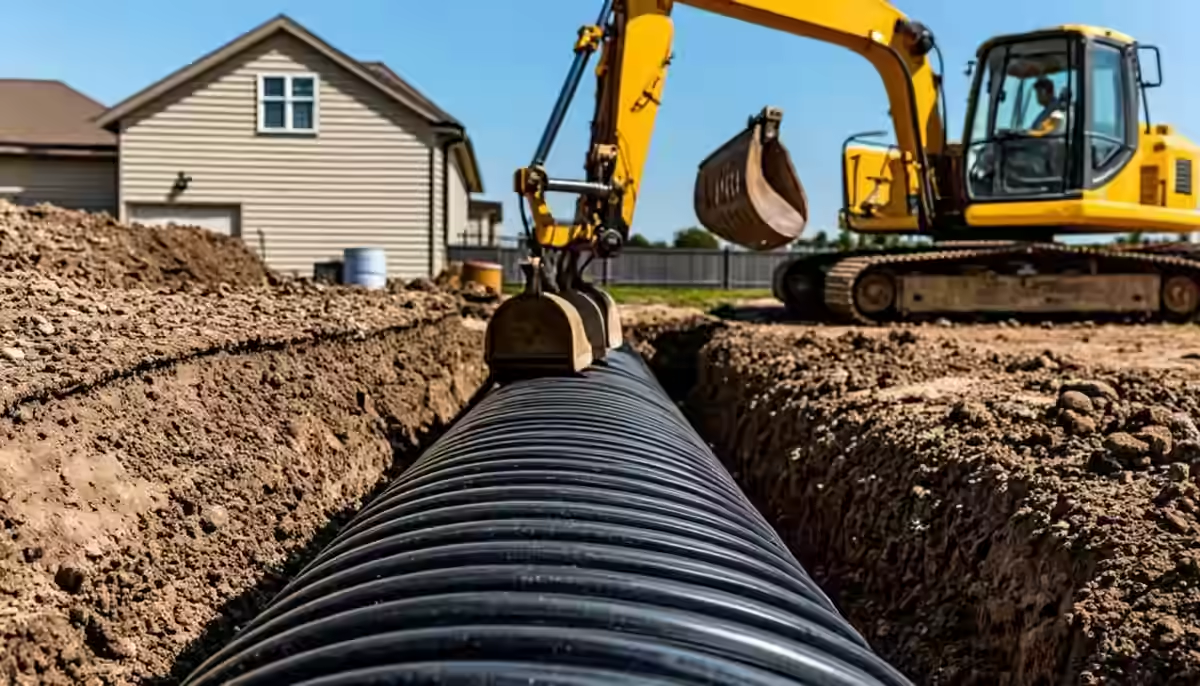
Geothermal is not one product, it is three construction projects with the same heat pump attached, and the loop your lot allows largely sets your price. This is where the geology of the Lower Mainland starts making decisions for you.
Horizontal closed loop
Trenches 1.5 to 2 metres deep with HDPE pipe laid in slinky or straight runs, needing roughly a quarter acre or more of open yard. Cheapest loop where the room exists, $28,000 to $42,000 installed, and the natural fit for Langley, Maple Ridge and Abbotsford acreage. Rich Delta and Langley loam trenches beautifully; rocky North Shore slopes do not.
Vertical closed loop
Boreholes 60 to 90 metres deep, typically three or four for a detached home, grouted HDPE U-tubes, sited under a driveway or in a side yard. Drilling runs roughly $60 to $100 per metre in the Lower Mainland, so systems land at $38,000 to $55,000-plus. Vertical is how small-lot Vancouver and North Vancouver homes get geothermal at all, and why most of them decide not to.
Open loop, well to disposal
Well water pumped through the heat pump and discharged to a drain field, ditch or second well. Least equipment cost, $18,000 to $30,000 where a productive well exists, and the Abbotsford-Sumas aquifer makes parts of the Valley natural territory. The trade-offs are water quality, iron bacteria and sediment foul heat exchangers, registration under the Water Sustainability Act, and a discharge the municipality will actually approve.
A fourth configuration, lake loop, exists where a property fronts deep water, and a handful of North Shore and Indian Arm properties could theoretically use it, but shoreline approvals in BC make it rare enough that we will leave it at a mention. If a quote lands on your table, the first question is which loop it assumes, because that single line explains most of the spread between a $20,000 geothermal quote and a $55,000 one. Final loop pricing is confirmed in writing after a site assessment, full stop; anyone quoting a loop blind over the phone is guessing at your geology.
The Full Cost Table, Installed
Numbers first, Lower Mainland, 2026, installed by us, including the mechanical work inside the house. Every geothermal line moves with geology and access; every air-source line moves with equipment tier and ductwork condition. These are honest planning ranges, and the written quote after a site visit is the only number that binds.
| System | Installed cost | 2026 rebate reality | Site notes |
|---|---|---|---|
| Ductless air-source, single zone | $3,800-5,500 | Rebate-eligible where program rules allow | One-day install, no ducts needed |
| Multi-zone ductless, 2-5 heads | $9,500-16,000 | Cold-climate tiers stack highest | Baseboard-heated homes, laneway homes |
| Central air-source heat pump | $6,500-14,000 | Up to $16,000 combined stack on qualifying cold-climate units | Needs sound ductwork; replaces furnace+AC |
| Geothermal, horizontal loop | $28,000-42,000 | Own CleanBC tier, smaller than the air-source stack | Quarter acre of yard to trench, access for an excavator |
| Geothermal, vertical boreholes | $38,000-55,000+ | Same ground-source tier | Small lots, rock, tight access; drilling at $60-100/m |
| Geothermal, open loop | $18,000-30,000 | Same ground-source tier | Needs a productive well, clean water and an approved discharge |
Two lines hide inside that table. First, the geothermal spread, $18,000 to $55,000, is not equipment variance, it is geology and lot size, which is why a proper geothermal quote starts with a site assessment and, on vertical projects, sometimes a thermal conductivity test rather than a brochure. Second, the air-source rebate line is doing heavy lifting: a qualifying cold-climate unit can net out at a fraction of list once the CleanBC, BC Hydro, FortisBC and municipal stack is applied, and we file all of it. The CleanBC rebates guide maps the stack; the payback table below shows what it does to this comparison.
The Payback Math, Shown, Not Claimed
Take the same 2,000-square-foot Surrey detached house from our other guides, roughly 60 gigajoules of heat per winter plus a modest cooling season, and run four systems through ten years. Assumptions, stated so you can check the work: BC Hydro at 11 to 14 cents per kWh across the steps, FortisBC gas at $13 to $16 per GJ all-in, propane at $0.90 to $1.20 per litre delivered, air-source seasonal COP 3.0, geothermal COP 4.0, and mid-range rebate outcomes where programs apply. Financing, maintenance and rate escalation are left out on purpose; they move the columns, not the conclusion.
| Ten-year picture | Gas furnace + AC | Air-source heat pump | Geothermal (vertical) |
|---|---|---|---|
| Installed cost, mid-range | $10,000-13,000 | $9,000-11,000 | $45,000 |
| Rebate applied (mid-case) | $0 | -$6,000 | -$3,000 |
| Energy per year, heating | $840-960 gas + fixed charges | $600-780 electric | $470-560 electric |
| Energy per year, cooling | $100-140 | $60-90 | $50-70 |
| Ten-year energy total | $9,400-11,000 | $6,600-8,700 | $5,200-6,300 |
| Ten-year total | $19,400-24,000 | $9,600-13,700 | $47,200-48,300 |
Read the bottom row twice, because it is the whole article: over a decade, air-source costs roughly half what the furnace-and-AC path costs, and geothermal costs roughly four times the air-source path, while saving the air-source system only about $1,400 to $2,400 in energy over the same ten years. The loop premium is $25,000 to $35,000, the annual return on that premium is $150 to $300, and no interest rate in BC turns that into a ten-year win. Geothermal's payback case in Metro Vancouver is a decades-and-lifestyle case, not an arithmetic one.
Now the scenario where the math flips, and it is a real one in our service area: the Langley or Maple Ridge acreage home heating with propane. At $0.90 to $1.20 per litre delivered, propane heat runs roughly $38 to $50 per useful GJ, so the same 60 GJ winter costs $2,300 to $3,000 in fuel. Against that number, geothermal saves $1,800 to $2,500 a year and the loop pays back in ten to fifteen years, with air-source still usually ahead on pure arithmetic but by a much slimmer margin, and both are transformative. Electric baseboard homes, COP 1.0, see the same flip. The lesson: geothermal payback is decided by what you are leaving, not by the loop in the ground, which is exactly why the free estimate starts with your current fuel bill and not with a trencher.
What BC Geography Does to Each Option
The Lower Mainland is a quilt of soils and lot shapes, and it prices the two technologies differently street by street. Vancouver and Burnaby: 33-foot lots mean vertical loops or no geothermal, drilling access is tight, and the mild -7°C coastal design temperature makes air-source the obvious fit; this is our highest air-source-density territory. North Vancouver and West Vancouver: slope, rock and tree cover make drilling expensive and air-source siting genuinely tricky, and both systems want a careful yard reading. Richmond and Delta: deep loam and clay trench easily when a lot has room, but high water tables and peat in places complicate both loops and outdoor-unit pads, and drainage rules apply to everything.
Surrey, Langley, Maple Ridge and Abbotsford are where the comparison gets interesting, because lot sizes finally give geothermal room to breathe. Half-acre and larger parcels allow horizontal loops, which are the cheapest ground loop per capacity, and the Fraser Valley's colder -10°C design temperature and outflow winds push air-source efficiency down a notch while leaving the ground untouched at 10 degrees. Add propane tanks and older baseboard-heated ranchers to the mix and you have the region's genuine geothermal market. The Abbotsford-Sumas aquifer adds the open-loop option across much of Abbotsford and parts of Langley, with the caveat that well yield, water quality and discharge approval decide feasibility before any equipment does. Our Langley heat pump crews see the acreage version of this conversation weekly, and the answer is property-specific every single time.
The point of the geography tour: a comparison article written for Toronto or Calgary prices does not survive contact with a 33-foot Vancouver lot or a Maple Ridge rock shelf. Loop cost is local, air-source duty is local, and rebates are provincial, so the honest version of this guide has to be regional all the way down, which is why every number in it is a Lower Mainland number.
The Decision, Honestly
Strip away the brochures and the decision has four honest questions in it. How long are you staying? Geothermal's loop is a 50-year asset attached to a specific property, and paying $45,000 for a loop you will use for six years is wealth destruction no efficiency number rescues. What are you heating with now? Leaving propane or baseboards makes geothermal arithmetic work; leaving a young gas furnace rarely does. Does your lot allow a cheap loop? A quarter acre of open Langley yard is a different project than a rock shelf in North Van. And do you want the outdoor equipment gone? Some homeowners, and every strata council ever, value the silence and the absence of an outdoor unit, and that preference is legitimate even when the payback table shrugs.
Our own decision rule, the one we apply at estimates because it keeps us honest: if the ten-year table in Chapter 5 does not clearly favour geothermal for your house, we recommend air-source and say so in writing, and if you choose geothermal anyway for the 50-year view, we build it properly and cheerfully. Ten to one, that is the ratio the region actually chooses, and the one case in ten is usually an acreage, a new build, or a family planting flags for decades. There is no wrong answer on this fork. There is only the answer your lot, your horizon and your fuel bill point at.
Lifespan and Maintenance, Compared
Geothermal's quiet advantages live in this chapter. Nothing sits outside: no coil to frost, no fan to ice, no salt air or cottonwood seed, which is why ground-source indoor units run 20 to 25 years while the loop under the lawn is rated for 50-plus, and why the 1980s loops still in service across North America are a running industry joke about outliving their warranties. Air-source outdoor units in our climate run 15 to 20 years with maintenance, and the wet coast works them harder than any dry-climate spec sheet assumes; the defrost cycles alone add thousands of operating hours a coastal winter. On maintenance, the annual visit is similar in price, $149 to $250, but the content differs: geothermal gets loop-flow verification, water-side chemistry checks on open loops, and the standard filters and controls; air-source adds the outdoor coil wash and defrost performance test.
| Factor | Air-source | Geothermal |
|---|---|---|
| Expected unit life | 15-20 years with maintenance | 20-25 years indoors, loop 50+ |
| Winter wear | Defrost cycles, rain, coastal salt near the water | Essentially none, the loop never sees weather |
| Annual maintenance | $149-250, coil wash and defrost test included | $149-250, loop flow and water chemistry included |
| Typical repairs | $180-450, sensors, boards, fans, capacitors | $180-450, similar indoors; loop repairs are rare and priced per event |
| Noise and yard presence | 55-65 dB(A) at 1 m, unit occupies a pad | No outdoor unit at all, loop invisible underground |
| Winter efficiency floor | COP near 2 on the coldest Valley nights | COP 3.5-4.5 regardless of the weather above |
The repair footnote is the honest one: air-source repairs are common and cheap, sensor, board, fan, capacitor, in the $180-to-$450 band, while geothermal's indoor repairs are similar but the failure modes that would touch the loop are rare enough that a properly grouted and pressure-tested loop is essentially a fit-and-forget asset. The trade is frequency against catastrophe: air-source fails small more often, geothermal almost never fails big. Both beat a furnace on the combustion-safety front, no heat exchanger cracks, no CO risk, no red tags, which is its own quiet line in the comparison.
Rebates, Rules and Paperwork
The 2026 incentive landscape leans air-source, and it is not subtle. Qualifying cold-climate air-source heat pumps stack CleanBC Better Homes, BC Hydro, FortisBC and municipal top-ups to as much as $16,000, with the highest tiers requiring the cold-climate designation and, in some programs, a pre-installation energy assessment. Ground-source heat pumps carry their own CleanBC tier, several thousand dollars, materially smaller than the air-source stack, and program terms shift through the year, so we confirm the current schedule in writing with every quote and file the paperwork either way. The net effect is arithmetic: the rebate system in this province is deliberately pushing the technology that installs cheaply at scale, which is the same technology our climate barely stresses. Our CleanBC rebates guide tracks the stack, and it is the first thing we check before any quote, because quoting a rebate that expired last month is how trust dies.
Geothermal adds a paperwork layer air-source never sees. Vertical drilling wants municipal drilling permits and, in some jurisdictions, development approvals for the rig access; wells for open loops fall under the Ground Water Protection Act and the Water Sustainability Act, with registration and, above certain withdrawal thresholds, licensing; trenching across a serviced lot wants locate scans and, in flood-plain Richmond and Delta, drainage-district awareness; and discharge for open loops needs somewhere legal for the water to go. None of this is exotic, we handle it, but it adds weeks and it explains why a geothermal timeline is measured in months while an air-source install is measured in days. Air-source has its own list, mostly placement, noise bylaws and strata approvals, and it fits on one page.
Five Questions Before Anyone Drills
If a geothermal quote lands on your table, these five questions separate the designers from the trench-renters, and they apply to air-source quotes with minor edits. One: was the loop sized from a room-by-room heat loss calculation at the design temperature, -7°C coastal, -10°C Valley, or from a per-square-foot guess? Two: on vertical projects, was a thermal conductivity test run, or is the driller assuming your soil is someone else's soil? Three: who pulls the permits, the drilling, the wells, the discharge, and whose name is on them? Four: what is the grouting and pressure-testing protocol, because a badly grouted borehole is a lifelong efficiency leak no one can see? Five: what does the commissioning report include, loop flow rates, entering and leaving water temperatures, COP verification, and will you get a copy? A contractor who answers those five in numbers before you sign is rare and worth the wait. The broader vetting list lives in our Vancouver heat pump guide, and every question in it works on us too.
The best geothermal customer I ever had asked me to justify the loop against a second air-source quote, line by line, in front of both documents. We spent ninety minutes on it. He chose geothermal for the right reason, a forever home on Langley acreage leaving propane, and he shook my hand on the way in and the way out. That is what this decision is supposed to look like: slower, and in writing.
10-13°C, forever
Lower Mainland ground temperature below 3 metres, summer and winter alike.
50+ years
Rated life of a buried HDPE loop, reused when the indoor unit is eventually replaced.
10 to 1
Air-source versus geothermal installs in our own book of work across Metro Vancouver.
Run Both Systems Against Your Actual House
A free estimate prices your home for both paths, air-source and geothermal if the lot allows it, with the 2026 rebate stack applied and the ten-year table in writing. Zero obligation, and we will tell you plainly when the cheaper system is the right one. Repairs run $180-450 with the $89 diagnostic credited, 24/7. What you actually pay is broken down in Why Your Heat Pump Costs More to Run Than It Should.
Frequently Asked Questions
Services From This Guide
Red Seal crews, licensed gas fitters and flat-rate pricing across all twelve Metro Vancouver cities, from Vancouver and the North Shore through Surrey and Delta out to Langley, Abbotsford and Maple Ridge. Homeowners ask about this often — the full answer is in Heat Pump Ice in Winter: Defrost, Explained.
Heat Pump Services
Air-source installs $6,500-14,000, ductless from $3,800, rebates to $16,000.
Heat Pumps in Langley
Acreage loads, propane replacements, room to trench.
Financing from 7.99%
OAC monthly plans for either system, rebate math preserved.
24/7 Emergency Repair
$150 flat after-hours premium, $89 diagnostic credited.
Related Guides

We wrote this because geothermal is the quote we are most often asked to double-check, usually after a homeowner finds the first number staggering. Having installed air-source systems across all twelve of our cities and designed ground loops for Fraser Valley properties, we would rather show you the payback math that says no than sell you the prestige option that never pays back. If you are weighing this decision, read Heat Pump Warranties: What Is Covered and What Voids Them first. To turn these numbers into a flat-rate quote, see heat pump repair in Burnaby — same-day across the city. The brand-by-brand breakdown lives in Mini-Split vs Central Heat Pump for BC Homes.
More about our team →Get Both Numbers, Then Decide
A free estimate runs your actual heat load, lot and utility rates through both the air-source and geothermal options, with the 2026 rebate stack and a written payback comparison. Zero obligation, and we will tell you plainly when the cheaper system is the right one. If you are weighing this decision, read Heat Pump Sizing: Why Oversizing Ruins Comfort and first. If you would rather hand this to a pro, our heat pump services pages cover Metro Vancouver. If you are weighing this decision, read Heat Pumps in a BC Winter: Real Performance Data first.
System down right now?
Emergency calls are answered 24/7 with live dispatch and a flat $150 after-hours premium posted in advance. The $89 diagnostic is credited to any repair, and heat pump repairs run $180 to $450.
Call 604-615-2212 WhatsApp Us